You have seen the pitch a hundred times. A channel that uploads on its own, a book catalogue published over a weekend, an account that fills up while you sleep. Searching for passive income with AI mostly returns videos selling a method, and rarely methods that hold up. Sorting them is hard because both look the same at a glance: same vocabulary, same screenshots, same confident tone.
This article does the sorting, in both directions. It first names five systems that do not exist, with the exact rule that stops each one. It then details seven systems that genuinely work, stating for each the work required before the first payout. You will find no amounts here, no time to profit, and no dashboard screenshots: those numbers depend on your market, your niche and your consistency, and anyone promising them in advance is inventing. For a wider map of the monetisation routes, our survey of the serious ways to earn money with AI is the place to start.
The short answer
Passive income with AI exists, with one correction of vocabulary: it is semi passive. AI lowers the cost of building a catalogue. It removes neither the build time, nor the upkeep, nor the conditions set by the platforms that distribute and pay. Seven systems hold up today: the search driven video library, the repeatable format channel, the ebook catalogue, the audiobook, the music catalogue, the image and clip library, and the referral programme. All share the same mechanic: an asset exists first, and pays second. None of them pays while it is being built.
What passive means, and what it never means
Passive income is not income without work. It is income decoupled from time: you produce once, and the piece keeps paying without daily attention. A video answering a question people ask all year keeps working long after upload. A news reaction video dies within two days. Both cost the same to make, they have completely different lifespans, and lifespan is what decides whether income is passive.
The second distinction matters even more. What becomes passive is the catalogue, never the single piece. One track, one book, one video produce almost nothing stable. A coherent set of pieces, published under one format and shelved together, ends up producing a steady flow because entries offset one another. Every system below is therefore measured in catalogues, and the honest question is not how much it pays, but how many pieces you can produce, and for how long.
Five passive income promises that do not exist
Start with the negative sort, because it saves the most time. The five systems below circulate everywhere, in the same words. Each runs into a condition the platform itself published, and that condition is public: it takes a few minutes to read, before you invest weeks of production.
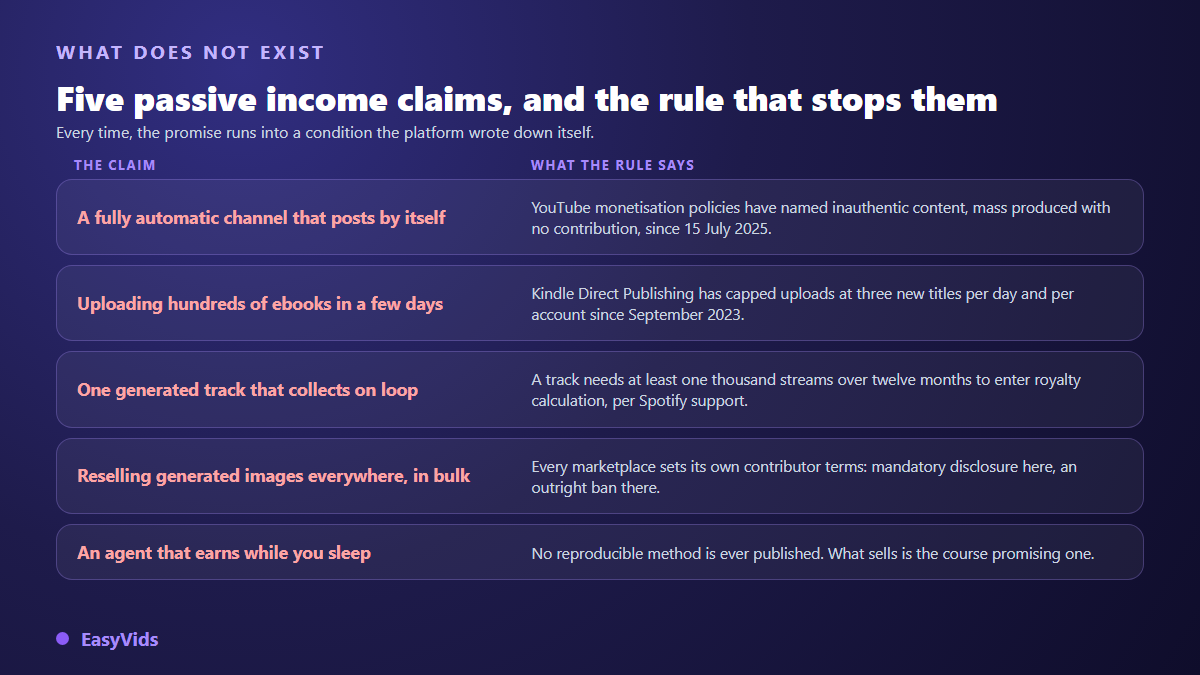
- The fully automatic channel that uploads by itself. YouTube monetisation policies renamed their repetitious content section as inauthentic content on 15 July 2025. According to the YouTube Help Centre, it targets mass produced content with no contribution of your own, which describes an autopilot exactly.
- Uploading hundreds of ebooks in a few days. Since September 2023, Kindle Direct Publishing has limited uploads to three new titles per day and per account, a measure Amazon announced publicly to slow down mass publishing.
- The generated track that collects on loop. According to the Spotify support page on track monetisation eligibility, a track must have reached one thousand streams over the past twelve months to enter recording royalty calculation. A catalogue uploaded with no audience triggers nothing.
- Bulk reselling of generated images on every stock library. There is no shared rule: each marketplace sets its own contributor terms, some require an explicit disclosure, others refuse generated content outright. A batch prepared before reading the terms is a wasted batch.
- The agent that earns while you sleep. No reproducible, verifiable method has been published in this category. What sells here is the course describing the method, not the method itself.
One thing links these five promises: they all assume a platform will pay for volume without looking at what is inside it. The opposite happens, and the entry bars are public. The entry conditions of the YouTube Partner Programme give a fair idea of how high the bar sits before any advertising revenue starts to exist.
The seven systems that hold up, and the work they demand first
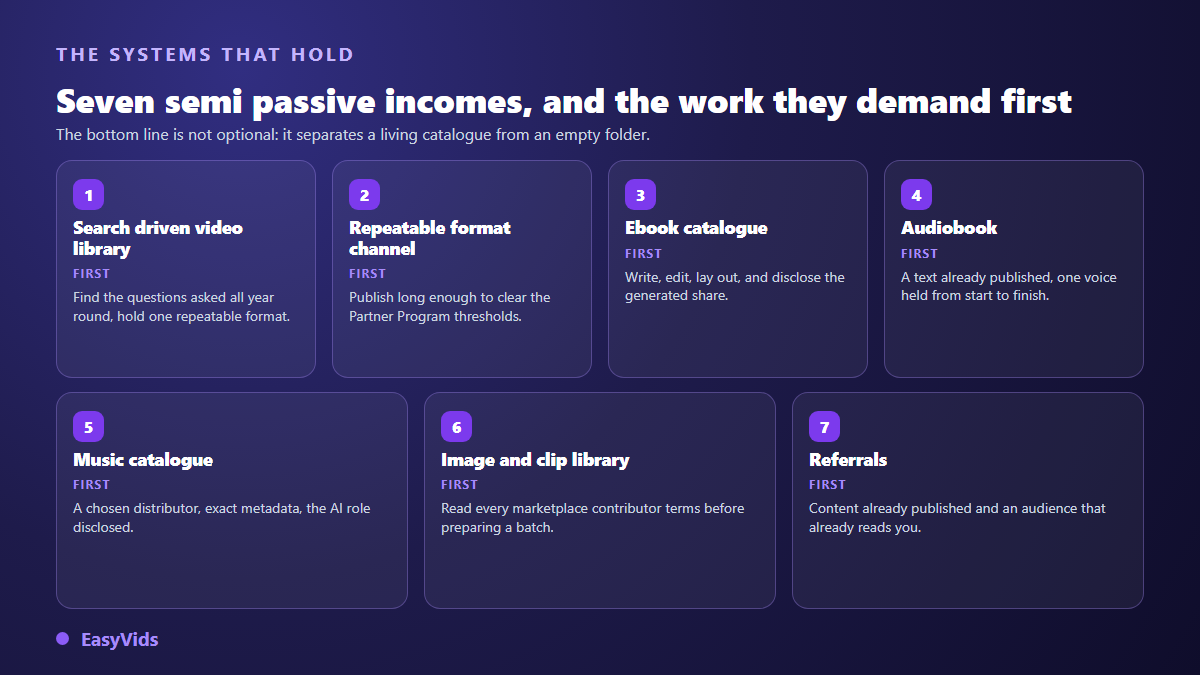
The seven systems below share three properties: they rest on a catalogue, they use AI to build that catalogue faster, and they leave you owning what you produce. For each one, the line that matters is not the revenue, it is the before box: what has to exist for the mechanic to even start turning.
1. The search driven video library
Think library, not news feed. You collect the questions asked all year in your field, then produce one video per question, in one identical format. Each video keeps being found by search months after upload, and revenue follows accumulated traffic rather than a spike. Work required first: build the question list, hold a stable format, and accept that the earliest pieces mostly serve to establish that format. The EasyVids Director writes the script, splits it into scenes, generates the visuals, lays the voice over and edits, which keeps a consistent series manageable for one person.
2. The repeatable format channel, without showing your face
A narrative variant of the first: one theme, one tone, one appointment. The faceless format suits AI well, since voice and visuals are generated, but it never removes the writing. Work required first: publish long enough to clear the Partner Programme thresholds, which are measured over twelve months of watch time according to the YouTube Help Centre, and give the channel an identity no other channel could copy. Our guide to running a YouTube channel without showing your face covers the formats that survive that pace.
3. The ebook catalogue treated as a collection
One book is not an income. A coherent collection on one subject, with covers from the same family and titles that answer each other, is one, because a satisfied reader moves to the next title. Work required first: write, edit, lay out, produce the covers, and disclose the generated share at upload. AI shortens the writing and the illustration. It does not shorten the editing pass, which is the only defence against a book nobody finishes. Our complete method for creating an ebook with AI walks the whole chain, from subject to layout.
4. The audiobook made from a text you already published
This is the best effort to lifespan ratio on the list, with one condition: the text has to exist already. You create nothing new, you open a second distribution channel for an asset you own. Work required first: a published book, one voice held from beginning to end, and a full listen before upload, because a mispronounced name repeated for hours is impossible to miss. The steps are laid out in our guide to turning a book into an AI narrated audiobook.
5. The music catalogue released through a distributor
Generated music can be released and paid, through a distributor: streaming platforms take no direct uploads from an artist account. On 25 September 2025, Spotify published a set of measures on music made with artificial intelligence, and the text does not treat AI use as a fault in itself: it targets impersonation of identifiable artists, mass uploaded duplicates and misleading metadata. Work required first: pick a distributor whose terms accept your production method, prepare exact metadata, disclose the role of AI, and build a catalogue somebody has a reason to play. Thresholds and steps are detailed in our article on AI music and getting paid for streams.
6. The image and clip library on stock marketplaces
Uploading visuals to marketplaces remains a classic catalogue income, except that the rules move often. Some platforms accept generated content with a mandatory disclosure, others refuse it, others rule out any realistic face. Work required first: read the contributor page of every target platform before preparing a batch, then produce useful series rather than pretty images. Our article on the platforms that accept generated images maps that ground, and stresses that it needs rechecking before each upload run.
7. The referral programme attached to content you already publish
This is the only system on the list that needs no new catalogue: it leans on the one you already have. If your audience reads or watches you to learn how to produce, a tool recommendation fits naturally inside existing content. Work required first: a real audience and content already published, without which there is nothing to attach the recommendation to. Our partner programme works on that principle. One honest note, since this system is usually presented backwards: with no prior audience it produces nothing, and it only compounds usefully alongside one of the six systems above.
Passive income is never maintenance free income
This is the part the pitches always leave out. A catalogue ages. Platform rules change, formats date, and the questions your videos answered find other answers elsewhere. Upkeep is light compared with the build, but it is never nothing: a library left for years without updates eventually stops producing altogether.
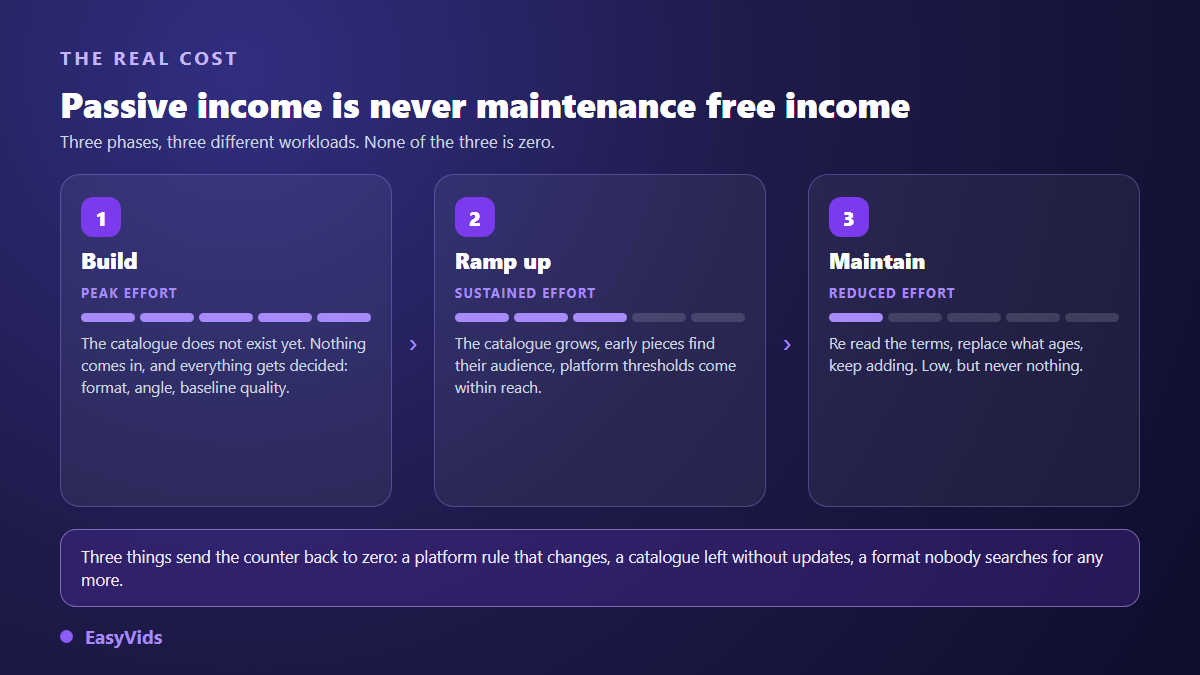
Think in three phases. The build, where effort peaks and revenue is nil. The ramp up, where the catalogue grows and early pieces find their audience. The upkeep, where effort falls sharply without disappearing: re read the platform terms, replace what has aged, keep adding. A system presented without that third phase is a badly described system, and that omission is the most reliable way to spot a sales pitch.
Platform rules to read before you build
On this ground an outdated claim is expensive, so here are the dated points. According to the YouTube Help Centre, the Partner Programme opens advertising revenue at 1,000 subscribers with 4,000 valid public watch hours over twelve months, or 1,000 subscribers with 10 million valid Shorts views over ninety days. On 15 July 2025, the monetisation policies replaced the heading repetitious content with inauthentic content; the platform creator liaison presented that change publicly as a clarification rather than a new ban. These rules decide your revenue, not whether your videos stay online: they belong to the Partner Programme terms, not to the Community Guidelines.
Three more points are worth knowing before you pick a system. Since March 2024, YouTube Studio asks you to disclose realistic altered or synthetic content at upload, and the platform documentation attaches no penalty to that disclosure. Since September 2023, Amazon asks at upload whether the content of a book is AI generated, covering text, images and translation, and the Kindle Direct Publishing disclosure rules set out the line between generated and assisted content. Finally, the European Union artificial intelligence regulation provides in its article 50 an obligation to inform the public when image, audio or video content has been generated or manipulated by a machine and could pass for authentic; the timetable set by the text places that part in application on 2 August 2026.
How to choose the system that fits you
The best system is not the most profitable on paper, it is the one you will keep going long enough for it to exist. One route at a time, chosen on what you already do well, beats three routes started and dropped. Six criteria are enough to decide.
- What you already produce effortlessly: a text, a voice, an image, a story. It is the only durable advantage you start with.
- The lifespan of the format: one piece answering a question asked all year beats ten pieces chasing the news.
- The rules of the destination platform, read before producing rather than after the first rejection.
- The volume you can sustain for a year, not for one enthusiastic week.
- Ownership of what you make: check that the tool allows commercial use and watermark free export.
- Your ability to maintain: a catalogue you will never be able to update is a catalogue that will fade out.
One last habit prevents a lot of disappointment: check what your format actually earns before betting on it. On video, reading RPM by niche gives far more reliable orders of magnitude than screenshots posted on social feeds. On the production side, our pricing page sets out the plans, with a free trial so you can test the full chain before committing to a whole catalogue.
Frequently asked questions
Is passive income with AI really passive?
Not in the strict sense. It is semi passive: the work concentrates at the start, then drops sharply without ever vanishing. What becomes passive is the catalogue once built, never the build period nor the upkeep that follows. A method promising otherwise is describing a product that does not exist.
Can a channel made entirely of generated content be monetised?
Yes. According to the YouTube Help Centre, no rule targets the production tool. What gets penalised is content mass produced with no contribution of your own, along with content simply borrowed from others. A format written, illustrated and narrated from your own angle sits inside the rules, whatever software made it.
Should I pick one system or launch several?
One, held long enough to know whether it takes. Two systems only compound when they feed each other, for instance a video audience that makes an ebook catalogue on the same subject possible. Two unrelated routes simply split your attention, and neither reaches critical size.
How many pieces does a catalogue need before it produces anything?
There is no universal number, and nobody can give you one without knowing your niche. The useful marker lies elsewhere: a catalogue starts producing when it covers enough different demands for entries to offset each other. Below that point you depend on a single piece, which means you depend on luck.
Do I have to disclose that content was generated by AI?
It depends on the platform, and the answer is read before producing. YouTube has asked since March 2024 for realistic altered or synthetic content to be disclosed, Amazon has asked since September 2023 whether the content of a book is generated, and several image marketplaces require the same note. The principle is stable everywhere: disclosing does not penalise you, failing to disclose exposes you.
The sorting is simpler than it looks. Discard anything promising revenue without a build, choose one system out of the seven, and judge it on the work it demands first rather than on the earnings someone shows you. To build that first catalogue without stacking up subscriptions, create a free account: the EasyVids studio brings video, voice, music, images and ebooks together in one place.