You launch an ad, you put budget behind it, and viewers leave after two seconds. The product is good, the targeting is right, and still nothing happens. Nine times out of ten the problem is neither the audience nor the edit: it is the ad script, which opens by introducing a brand instead of speaking to a person.
The fix is not better writing. It is writing to a structure. Every ad that sells follows the same sequence, and its opening line obeys rules of its own, the ones gathered in our collection of hooks that stop the scroll. Here is that structure, followed by fifteen ad templates you can adapt to your product in minutes.
The short answer
A working ad script holds five beats inside roughly thirty seconds: a hook that names the person concerned within three seconds, the tension of the problem, a demonstration of the product in action, one proof point, then a single call to action. The fifteen templates below never change that structure. They change the angle, the story that brings the product in. Pick the angle from what your audience already knows about you, and keep the structure.
An ad script is not a video script
A content video speaks to someone who clicked. It may set up its subject and breathe. An ad lands on people who asked for nothing, in a feed where the exit is one thumb movement away. Every sentence has to earn the right to be followed by the next one. No warm up, no company introduction, no polite opening.
Length changes everything too. A long form sales video walks through a full argument and handles objections one by one, which is a different craft, covered in the seven step VSL structure. A feed ad lives on fifteen to thirty seconds. You do not have room to convince. You have room to create a want and point it at a click.
Anatomy of a thirty second ad
The five beats work together. Each one sets up the next, and viewers drop exactly where one is missing. A demonstration without tension feels irrelevant. Proof without demonstration proves nothing. A call to action without proof sounds like begging.
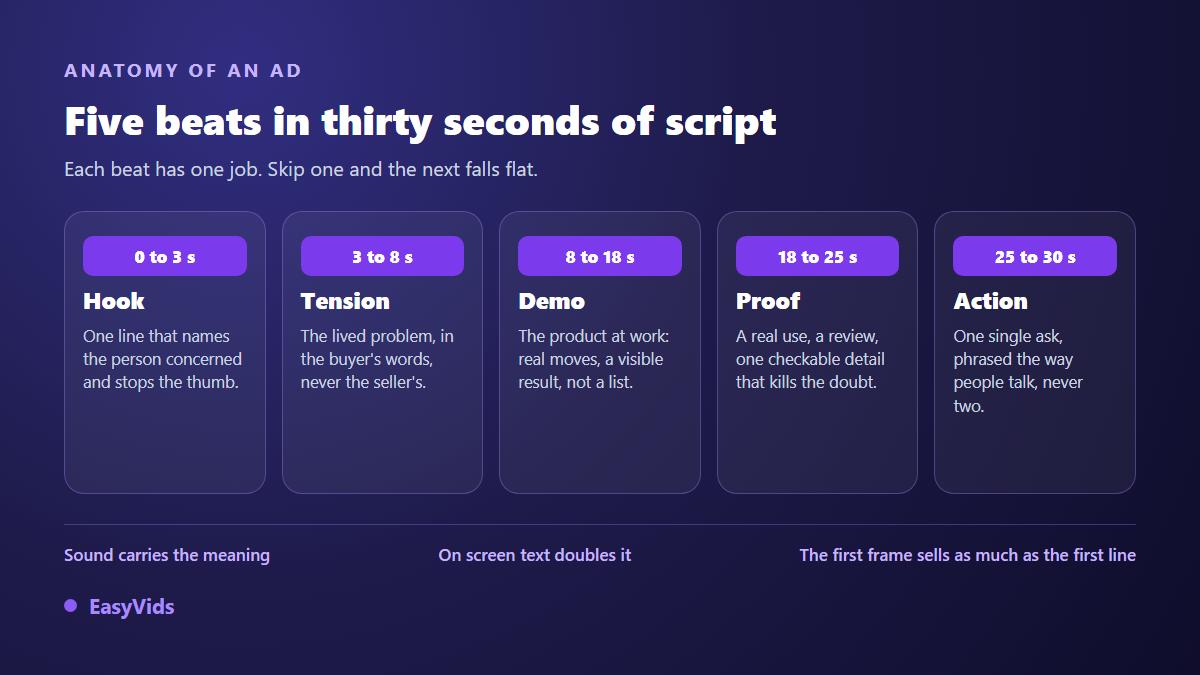
To calibrate the text, count characters rather than words. Across our own productions, six seconds of narration fit into about 110 characters, roughly a sentence and a half. A thirty second ad is therefore a short text, five or six sentences. If your draft runs to fifteen, the issue is not the pace of the voice, it is the number of ideas.
The 15 ad templates, sorted by audience temperature
The same product is not told the same way to someone discovering your brand and to someone who has seen the offer three times. Ad platforms call this audience temperature. The templates below are sorted into three families: discover, remove doubt, trigger. Each one gives its intent and a sample opening line to rewrite in your words and your customers' words.
Five templates for a cold audience
- Problem then solution. The most universal one. Open on a lived, specific, recognisable situation, and let the product arrive as the way out. Sample line: « Three hours packing an order, and it still ships without a label. »
- Demonstration in three moves. No story, only gestures. The product does what it promises in three filmed actions. Sample line: « Watch what happens the second it touches the fabric. »
- Honest before and after. The contrast carries the ad, as long as it stays verifiable and shows the path, not just the two ends. Sample line: « This is my desk on Monday. Same desk on Friday. »
- The objection turned around. Say out loud what the buyer is thinking, then answer it. Sample line: « Yes, cheaper versions exist. Here is why I did not keep mine. »
- The narrated unboxing. Opening the parcel, with commentary that explains each item instead of gushing. Sample line: « First time opening it, and there is one thing I did not expect. »
These five share one property: they assume no prior knowledge of your brand. The product name can even wait until the end. On a cold audience, recognising the situation matters far more than recognising the logo.
Five templates for an audience that hesitates
- The customer testimonial. One person, one benefit, told with the original hesitation included. Sample line: « I waited two months before ordering, and I regret waiting. »
- The method comparison. Set your solution against the usual way of doing things, never against a named competitor. Sample line: « The classic method takes a whole evening. This one fits a lunch break. »
- The three mistakes. A teaching format that builds authority before anything is offered. Sample line: « Three mistakes that ruin your knives, and the second one is in every kitchen. »
- Use cases in rapid fire. Four or five different situations in a few seconds, so everyone finds theirs. Sample line: « Travelling, at the desk, in the car, and somewhere you would not expect. »
- The founder story. Why the product exists, told by the person who made it. Sample line: « I built this because I never found what I was looking for. »
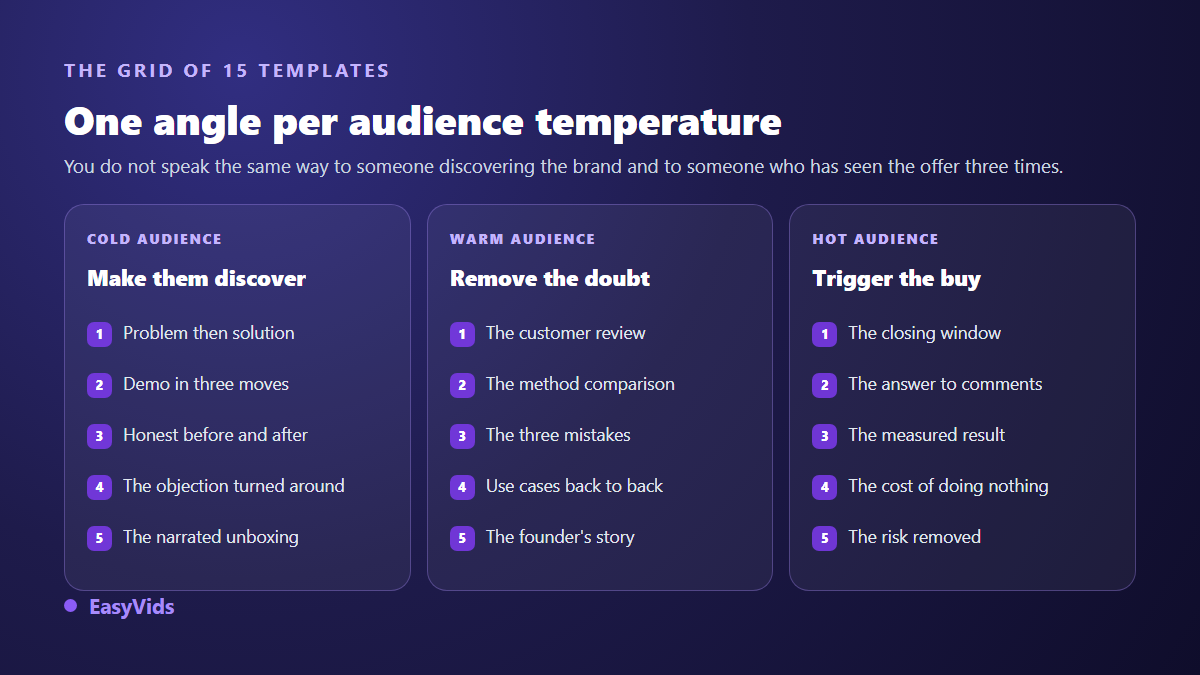
Five templates that trigger the order
- The closing window. A real deadline, never an invented one: a limited run ending, a last day, an announced restock gap. Sample line: « Four days left, then this version leaves the catalogue. »
- Answering the comments. Take a question asked under a previous ad and answer it on camera. Sample line: « People keep asking whether it survives the wash. Answer in fifteen seconds. »
- The measured result. A number you can back, presented with how it was measured. Sample line: « Thirty days of use, and here is exactly what changed. »
- The cost of doing nothing. Put a figure on the time or effort lost by carrying on as before. Sample line: « Every week without it, you spend two hours on the same task. »
- Risk removed. Guarantee, returns, free trial: anything that makes the decision reversible. Sample line: « Try it for a month. If nothing changes, it goes back on us. »
Whatever template you pick, end on one single request. Two calls to action in one ad cancel one of them, often both. If the wording is the sticking point, our call to action formulas that convert without begging offer lines that sit inside spoken speech rather than being bolted on at the end.
TikTok and Facebook do not want the same ad
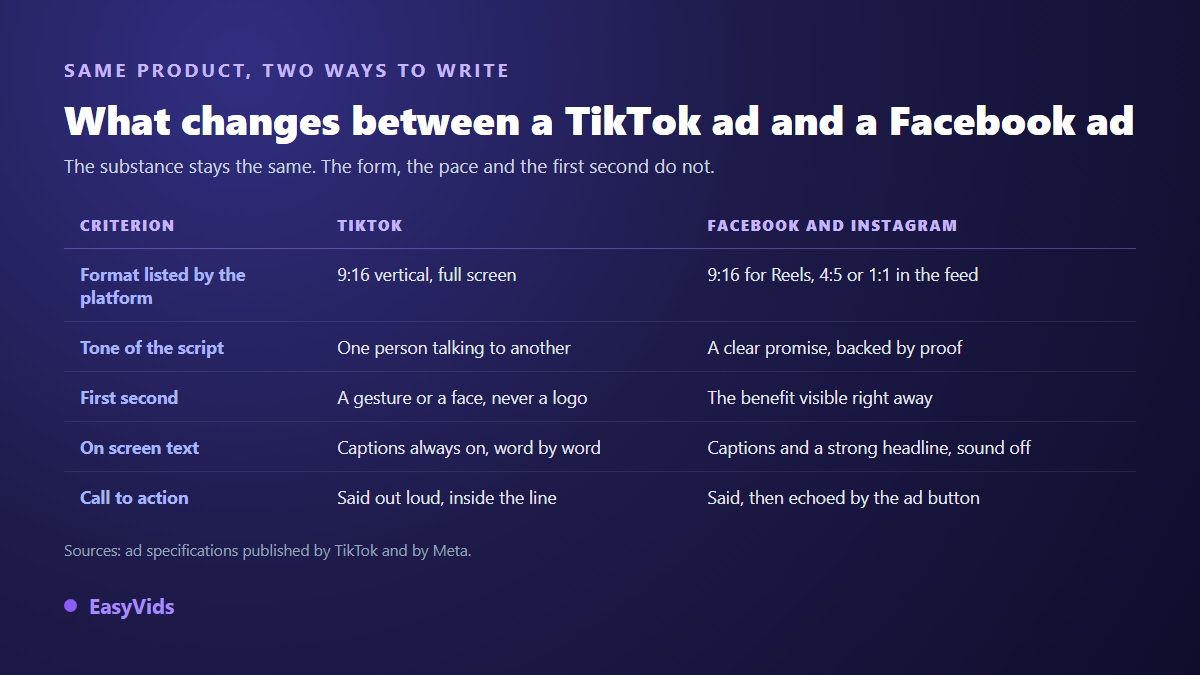
The first difference is technical and documented. According to the advertising specifications published by TikTok, an In-Feed ad fills the screen in vertical 9:16. On Meta's side, the placement specifications separate Reels, also 9:16, from the news feed, where 4:5 and square are recommended. Writing a script without knowing where it will run means letting the platform crop your frames, and it rarely crops where you would.
The second difference is tone, and it shows in the first second. A TikTok feed rewards what looks like one person talking to another: a face, a gesture, an ordinary room. A Meta feed takes a clear promise stated upfront and backed by proof. Same product, same template, two different opening lines. Both platforms' creative guidance agrees on one point: the script has to make sense with the sound off, so caption it.
What ad policies stop you writing
A script can be excellent and still be rejected. Meta's advertising standards prohibit asserting or implying that you know a personal attribute of the viewer: health, weight, religion, orientation, financial difficulty. In practice, « Tired of your acne? » falls under that rule, while « A simple routine for acne prone skin » does not. One word decides whether your campaign runs.
The same standards restrict before and after imagery suggesting unlikely results, especially around health and weight loss: the contrast template stays usable as long as the result is credible and the path is shown. On AI, Meta's advertising policy requires disclosure of digitally created or altered content in ads about politics, elections and social issues. TikTok's community guidelines ask creators to label realistic AI generated content, and the platform relies on C2PA Content Credentials to attach that label automatically when the file carries them. These pages change: read them before each campaign, not once a year.
Generating fifteen scripts without writing them fifteen times
Writing fifteen variants by hand takes a day. In the studio, the marketing script window starts from your product: its name, its description, and for a digital product the PDF itself, whose text feeds the argument. You set the length in words and the language, then pick the selling angle among problem and solution, demonstration, before and after, storytelling and testimonial, or let the model choose. The result fills the script field of the page, where you read it back and fix it before anything is launched. Plan details sit on the pricing page.
A web research option completes the writing when you sell a technical product whose buyers' vocabulary you do not yet own: the model checks real usage before writing. The habit that matters most stays the same either way. Generate the angle, then rewrite the opening line by hand. That is the line viewers hear, and the one no model knows better than you.
From script to finished ad
A script is worth nothing until it is spoken. The Character mode builds a piece to camera from two photos: the person speaking, and your product, physically held on screen, with up to four extra views of the same item for detail shots. The text is cut into strict six, eight or ten second scenes, because each segment has to fit inside one clip. There is no separate voice over: the words come out of the character's mouth exactly as you wrote them, which is the approach covered in our guide to product videos without hiring creators.
For an ad narrated in voice over instead, the aspect ratio is chosen at the start of the project, vertical, square or landscape, and then applies to generated images and clips alike. Timbre matters as much as wording there: the same sentence sells or sinks depending on the voice carrying it.
Test two scripts, not fifteen variants
Once the fifteen templates exist, the temptation is to run them all at once. That is the surest way to learn nothing: budget scatters, no ad gets enough views to mean anything, and you draw conclusions from noise. Take two opposite angles, demonstration and testimonial for instance, keep everything else identical, and let them run until the gap is obvious.
- Change one variable between two tested ads: the angle, or the hook, never both.
- Keep the same opening frame for both versions, otherwise you are testing the thumbnail, not the script.
- Run long enough for each ad to leave the platform's learning phase.
- Decide the metric in advance: three second view rate judges the hook, clicks judge the ending.
- The winning script becomes the base for the next five, instead of starting from a blank page.
Frequently asked questions
How long should an ad script be?
Fifteen to thirty seconds for a feed ad, so five or six short sentences. Shorter and the demonstration disappears. Longer and you need a strong narrative reason to stay. Write the thirty second version first, then cut everything that is not the hook, the demonstration or the closing request.
Do TikTok and Facebook need different scripts?
The body of the script transfers, the opening does not. On TikTok, start on a face or a gesture. On Facebook and Instagram, put the promise in the first frame. Adapt the framing too: full screen vertical for TikTok and Reels, the shorter vertical or square shape for the feed.
Can an AI generated ad run without disclosure?
It depends on the subject and the platform. Meta's advertising policy requires disclosure for political, electoral and social issue ads that use digitally created content. TikTok's community guidelines ask for realistic AI generated content to be labelled. For an ordinary commercial ad clearly showing a product, a label is generally not required, but check the platform's own policy page before launching.
How many scripts before one works?
Plan for five to eight genuinely different angles on a first product, tested two at a time. Most advertisers stop after two attempts and conclude the format does not work. The format is not what failed, the sample was simply too small to decide anything.
Do AI written ad scripts sound fake?
They sound fake when published untouched. The tells are always the same: symmetrical sentences, lists of three adjectives, empty superlatives. Read the text out loud, cut anything you would never say to a friend, replace one generic word with a concrete detail of your product. Two minutes of editing erases the signature.
A good ad script is not a lucky find. It is a structure applied to a chosen angle, then tested. Take three templates from this page, write them for your product, shoot them, and let the numbers pick the winner. To write and produce the first ones straight away, creating an account opens the full studio, and the EasyVids studio keeps writing, voice and editing in one place.