You film, you post, and the video stalls at a few hundred views while a smaller account clears a hundred thousand. The camera is rarely the problem, and neither is the edit. The text is. A TikTok script that holds for thirty seconds is not improvised in front of the lens: it is written first, word for word, with a job assigned to every second.
Thirty seconds hold roughly eighty spoken words and five shots. One idea fits, never two. This guide splits those thirty seconds into three blocks, gives the word budget each one can absorb, and shows how to write each block so it earns the next. If your struggle is the opening line itself, our 51 hooks sorted by niche go deeper on that single point.
The short answer
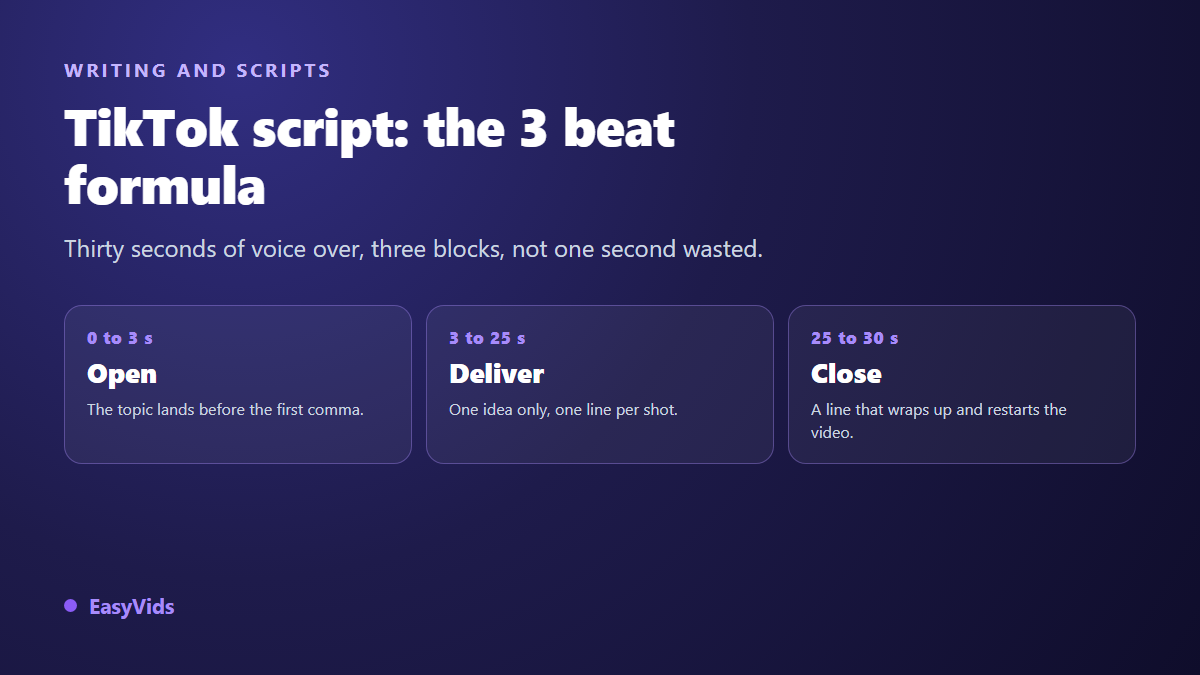
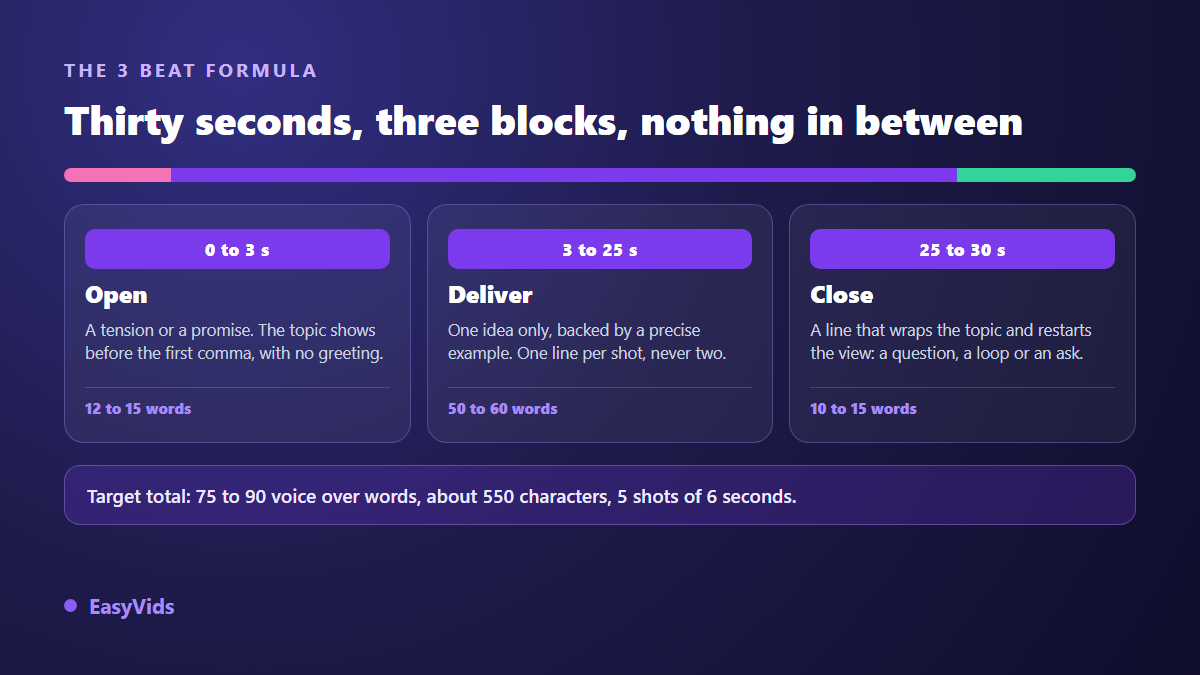
A thirty second TikTok script runs in three beats: an opening of 12 to 15 words that names the subject before the first comma, a delivery of 50 to 60 words that carries one idea and proves it, and an exit of 10 to 15 words that closes and restarts the loop. Target: 75 to 90 words, around 550 characters, five shots of six seconds. Write the whole text, read it aloud against a stopwatch, cut whatever overruns.
Why thirty seconds are not three minutes compressed
On a long video, the viewer chose to be there. A title pulled them in, a thumbnail convinced them, and they grant a few seconds of patience upfront. On a short video nobody chose anything: the feed pushed it, the thumb is already moving, and nothing has been promised. Writing changes purpose. It no longer accompanies, it holds.
The practical consequence is blunt. An intro, a context, a setup: those three things cost seconds a short video does not have. Everything that serves to build a story across several minutes in our complete video script guide has to be compressed or dropped here. Short form keeps the promise and the proof, and gives up the setup.
The second difference is pace. Documentary narration reads at around 150 words per minute. Short form reads faster, closer to 170 or 180, because the voice rides a tight edit. That gap in delivery is exactly why the same thirty seconds hold anywhere between 75 and 90 words.
Beat 1: the first three seconds decide the rest
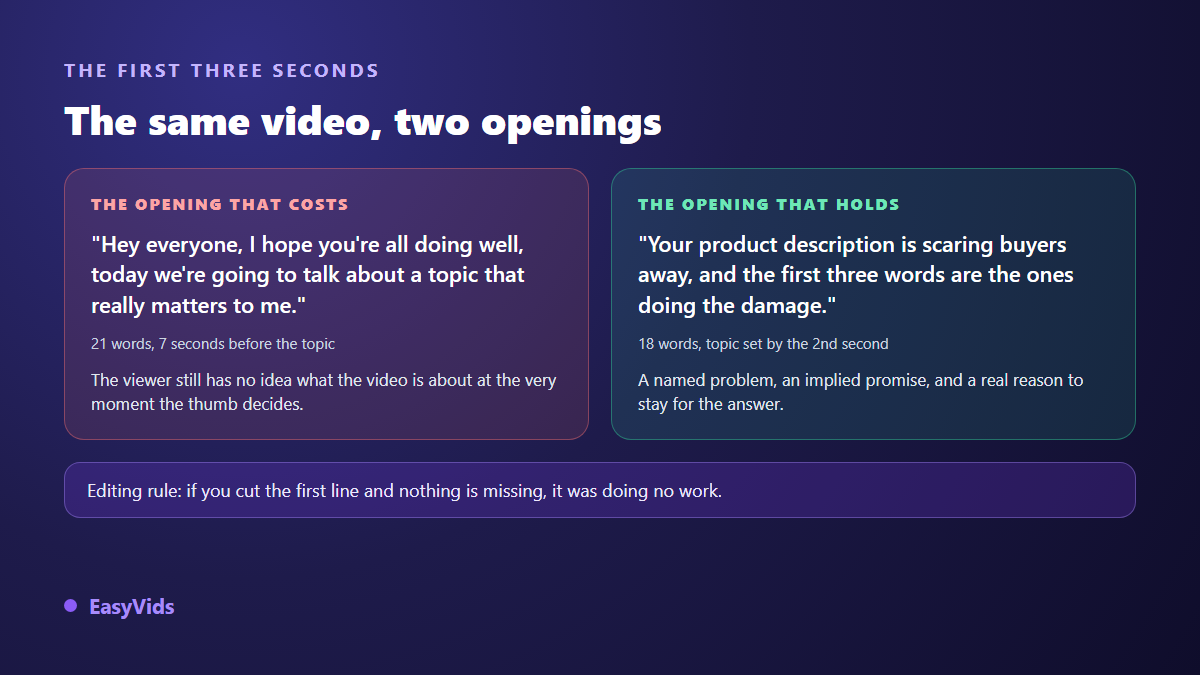
The first block does not narrate, it points. In 12 to 15 words it names a problem, a promise or a tension, and it does so before the first comma. The editing rule fits on one line: delete your opening sentence, and if nothing is missing, it was never doing any work.
The most expensive openings are the politest ones. A greeting, a hope that everyone is doing well, an announcement of what is coming, and seven seconds are gone, a quarter of the video, while the viewer still does not know the subject.
The useful habit is to write three openings for the same script, then keep the most concrete one. A concrete opening contains a name, a number, a place or a visible action. An abstract opening promises tips, secrets or things you need to know, and gives the eye nothing to look at.
Beat 2: the delivery carries one idea
The middle block runs about twenty seconds. This is the part beginners overload: three tips instead of one, two examples instead of none, and a video nobody remembers. A short video carries one idea. If you have three, you have three videos.
Internal structure matters as much as content. Each sentence maps to a shot, so to an image that changes. Two sentences stacked on one shot create a dead zone, and that is precisely where viewers leave. Four patterns fill those twenty seconds well.
- The demonstration: you show the move while the voice comments on it, never announcing in advance what the image is about to show.
- The rule of three: three short points, one per shot, ordered from the most obvious to the most surprising.
- Before and after: the starting state, the switch, the result, in three sentences and three clearly different images.
- The story: a situation, a complication, a resolution, useful when the subject is an anecdote rather than a tip.
- The correction: the mistake everyone makes, why it costs, and the move that replaces it.
Whichever pattern you pick, save the best part for the end of the block rather than its start. A viewer who makes it past second ten usually stays to the end, provided a fresh reason to stay appears roughly every five seconds.
Beat 3: the exit that restarts the loop
The last five seconds neither summarise nor thank. They do one of three things: ask a question that invites a comment, loop back to the opening line so the replay feels deliberate, or request one precise action.
The loop deserves real work, because it is the only writing device that mechanically lengthens watch time. It means ending on a phrasing that flows straight into your opening, so a replayed video reads as one continuous sentence. For the requested action, our 21 call to action formulas replace the bolted on subscribe plea that pushes people away.
The word budget for thirty seconds
Writing blind always produces scripts that run long. The fix is a ratio between characters and seconds. Across our own productions, 110 characters of voice over last about six seconds, which gives a comfortable shot, neither rushed nor slack. Thirty seconds therefore fit inside roughly 550 characters.
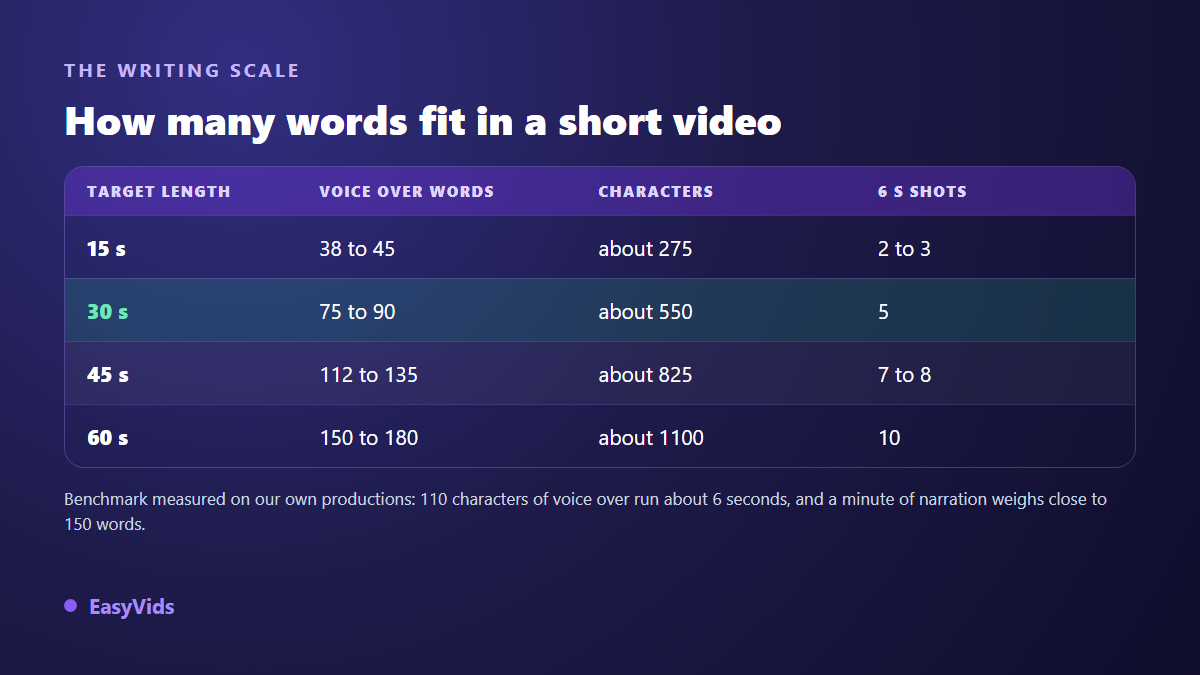
The budget works at two moments. Before writing it sets a target, which stops you drafting three hundred words to keep eighty. After writing it works as a check: paste the text into a character counter and you know whether the video fits without forcing the pace. Speeding up a voice to squeeze in an overlong script is audible instantly, and costs more viewers than the cut you were avoiding.
Write for the ear and the eye at once
A large share of the audience watches with the sound off, on a bus or in a waiting room. A short script has to stay readable on its own. The effect on the writing is concrete: sentences end quickly, subordinate clauses disappear, and the words carrying the information land early rather than late.
On screen text rarely repeats the full sentence. It keeps three to five words, the ones that carry meaning, synced to the voice. That is the principle behind word by word animated captions, and it is also why a script written in short sentences captions far better than one written in long ones.
A complete TikTok script, word for word
Here is the formula applied to an online shop subject. The text runs 84 words, reads in about thirty seconds, and every line matches one shot.
- Shot 1, opening: "Your product page is scaring buyers off, and the first three words are the reason."
- Shot 2: "Most pages open with the product name. Nobody buys a name."
- Shot 3: "Open with the moment the customer uses it: morning, on the train, before a meeting."
- Shot 4: "Material, size and warranty come after. That information reassures, it never triggers anything."
- Shot 5, exit: "Reread your first line. If it describes an object instead of a situation, you know which words to change."
Notice what the script leaves out: no greeting, no announcement of what is coming, no thanks, no sentence commenting on the video itself. That economy is what frees the twenty seconds that matter.
Writing TikTok scripts with AI without sounding generic
A language model writes fast, and it writes flat when the brief is vague. Asking for a TikTok script about marketing returns exactly what everyone has already posted. Three settings change the outcome: an idea stated as one precise sentence, a length expressed as video duration rather than a word count, and a deliberately chosen tone.
In our writing workspace, length is set in target minutes of video or in words, tone is picked from a list or left to the model depending on the idea, the language is selected, and a free instruction field takes your constraints: the vocabulary of your niche, a banned phrase, a sample of your own style. An optional multi pass review then has the text corrected before delivery, which removes most of the tells of machine writing. What the word free actually covers is unpacked in our guide to AI script generators, and plan details live on the pricing page.
From script to video file
A finished script is not yet a video. The next step splits it into shots, then gives each shot an image or a clip. Splitting is set by target shot length, six, eight or ten seconds, and a counter shows the resulting number of scenes immediately. Thirty seconds in six second shots gives you five.
Aspect ratio is chosen before generation, never after. A video designed vertical stays vertical from the first image to the exported file, with no crop that cuts heads off. The full path from written idea to a vertical video ready to post is laid out in our method for turning written text into a TikTok video, and the EasyVids studio keeps writing, voice, visuals and editing in one place.
What the platform rewards, and what you must disclose
Two public rules are worth knowing before you fix your video lengths. According to the TikTok help centre, the Creator Rewards Program only counts videos longer than one minute, so a thirty second video works on reach, followers and traffic rather than on direct payouts. Many creators alternate for that reason: short videos recruit, longer ones earn.
The second rule is disclosure. TikTok community guidelines require realistic AI generated or edited content to be labelled, and the platform announced in 2024 that it would automatically read the provenance data attached to files under the C2PA standard. A script written with AI help raises no issue by itself: realistic images and people are what call for a label.
Frequently asked questions
How many words for a 30 second TikTok script?
Between 75 and 90 words, roughly 550 characters. The range depends on your delivery: a measured read sits near 150 words per minute, a punchy short form read climbs toward 180. Write it, read it aloud against a stopwatch, then cut rather than speed up.
Should I write word for word or improvise on camera?
Word for word for the opening and the exit, looser in the middle if you are comfortable on camera. The two blocks that decide the outcome are exactly the ones improvisation ruins, because they need dense phrasing that comes from rewriting, never from a first take.
Can a 30 second video earn on TikTok?
Not directly through the Creator Rewards Program, which according to the TikTok help centre only counts videos over one minute. Short form still works to gain followers, send traffic to a shop or an offer, and support brand deals, which are negotiated on audience rather than on duration.
How do I stretch the three part formula to a full minute?
The opening and the exit keep their size, around 12 to 15 words each. The middle block doubles and splits into two movements separated by a reset: a question asked out loud, a change of setting, an image that surprises. Without that internal reset, a minute of short form sags in the middle.
Do TikTok, Reels and Shorts need different scripts?
The body can stay identical, the exit cannot. Each platform pushes a different action, and asking for a comment does not land the same way as sending viewers to another video. Rewrite the last five seconds per platform and keep the rest as it is.
A TikTok script that works is not an inspired text, it is a calibrated one: three blocks, one idea, a word count known in advance, a chosen closing line. Write your next script with that budget in front of you, time it, then split it into five shots. To write, split, illustrate and edit in one place, create your account and run your first script straight away.