Your offer is solid, your page is live, and yet the video meant to convince gets closed before the thirty second mark. Nine times out of ten the edit is not to blame. A video sales letter script fails because it talks about the product before it talks about the buyer, or because it reaches the offer without having cleared a single objection. No camera rescues a text that sells in the wrong order.
A VSL puts the written sales letter on screen: one idea, one offer, one action requested at the end. This page gives you the seven step framework, what each block has to contain, and how to turn the text into a publishable video. If you want the fundamentals of writing for the screen first, our complete guide to video scripts covers the groundwork. Everything here points at one thing: the buying decision.
The short answer: what a VSL that holds contains
An effective sales video chains seven blocks in this order: a hook that names the viewer's situation, the problem in their own words, the real cost of that problem, the solution and its mechanism, the proof, the offer with objections handled, then a single call to action. One idea per sentence, one breath between each. The rule that decides everything: nothing arrives before it has been earned. The product only appears once the problem is acknowledged, and the sale is only asked for once the proof has landed.
A sales video script is not a product presentation
The confusion is expensive. A presentation describes what the product does: functions, options, specifications. A sales video describes what the viewer's life becomes. The first text is written from the seller's point of view, the second from the buyer's. You recognise the first by its vocabulary: it opens with "we", stacks up lists, and uses words only the manufacturer says out loud.
The test fits in one question. Take every sentence of your script and ask what the viewer gains from it. If the answer is "they learn something about the company", the sentence goes. That filter applies at every length, from a thirty second cut to the long form video behind a high commitment offer. It also applies to product page videos, and our guide to product video for ecommerce covers what makes those different.
The VSL framework in 7 steps
The seven steps are not a ritual. Each one answers a question the viewer is asking, in the exact order it arrives. Skipping a block saves no time, it leaves an objection open that will block the decision further down. The framework descends directly from the attention, interest, desire, action model formalised by the American advertising figure Elias St. Elmo Lewis at the turn of the twentieth century, to which online selling added two blocks that have become indispensable: proof and objection handling.
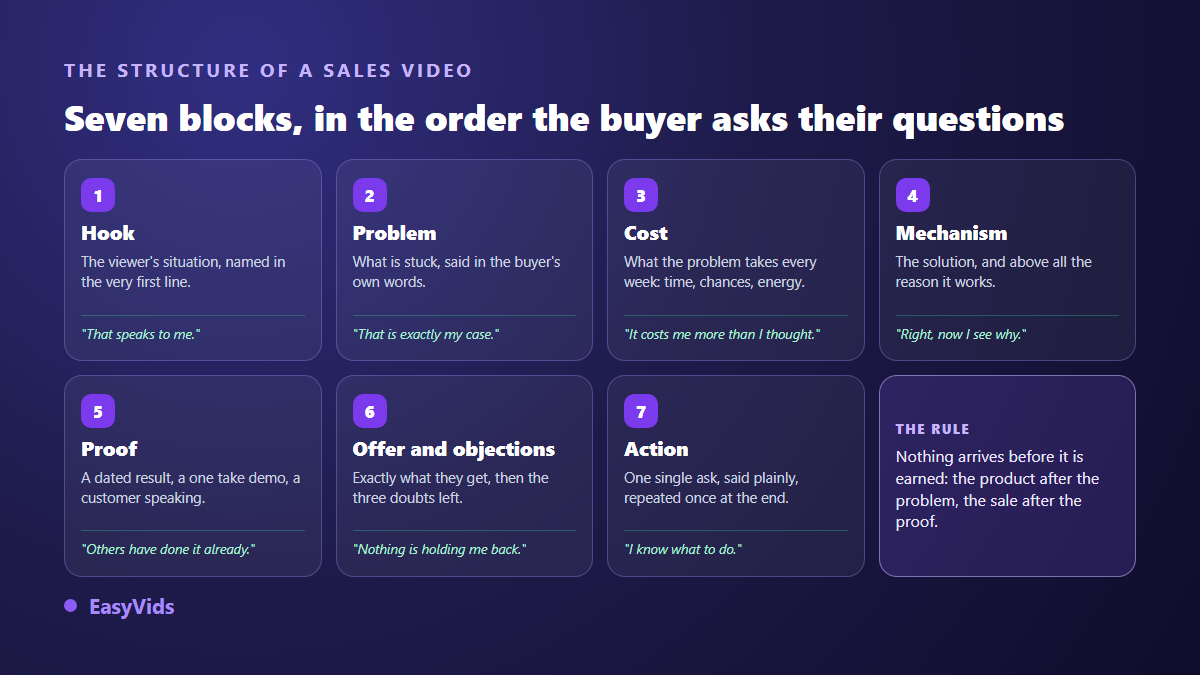
- Hook: the viewer's situation named in one sentence, within the first three seconds.
- Problem: what is stuck, phrased in the words the buyer would use.
- Cost: what that problem takes every week in time, missed chances or energy.
- Solution and mechanism: what you offer, and above all why it works.
- Proof: a verifiable result, a filmed demonstration or a genuine testimonial.
- Offer and objections: exactly what they receive, then the three remaining blockers.
- Action: one request, plainly worded, repeated once at the very end.
Those seven blocks also read as a shot list: each becomes one or several scenes with its own image on screen. That breakdown is what makes production mechanical, and our method for turning a finished script into an edited video takes over from there.
Step 1: a hook about the viewer, not about you
The opening seconds decide everything else. A start built on a brand name, an intro jingle or an animated logo loses a large share of the audience before the first useful sentence. A winning hook names a situation the viewer recognises instantly, with no detour. Write it last, once the rest of the script exists: only then do you know which promise you can actually keep.
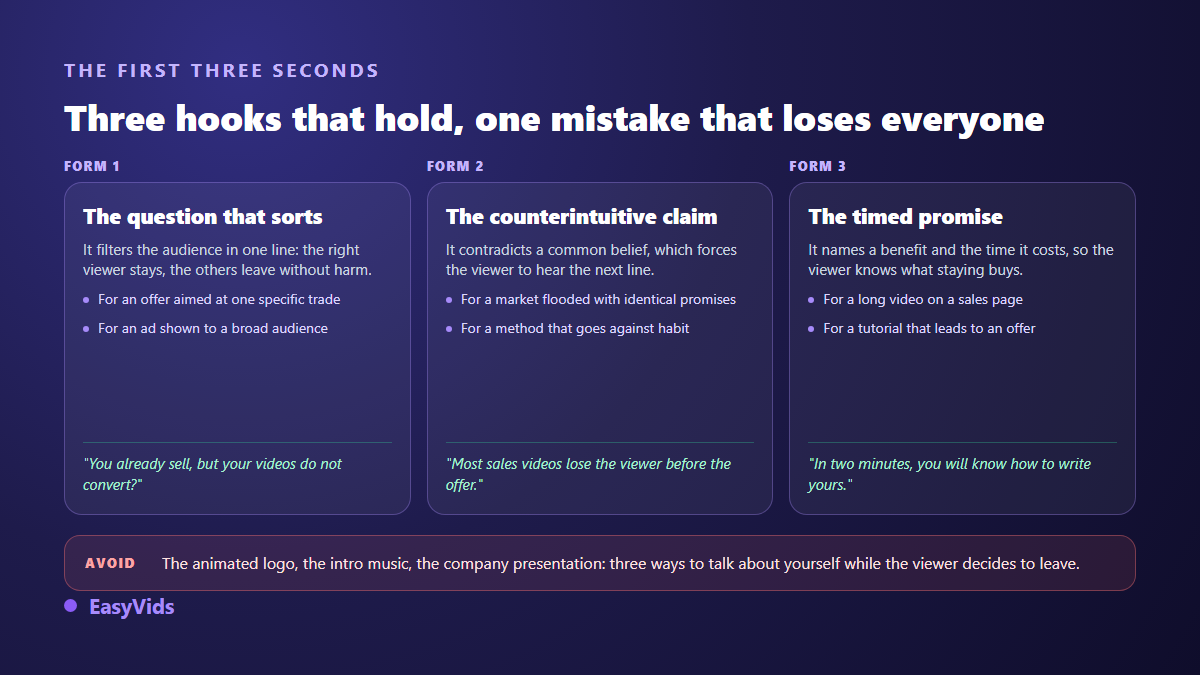
Three formats hold up almost everywhere. The qualifying question sorts the audience and keeps the people your offer concerns. The counter intuitive statement contradicts a common belief, which forces the next sentence to be heard. The timed promise announces a benefit and what it costs in minutes, so the viewer knows what they are buying by staying. Pick one, hold it, then move straight into the problem.
Steps 2 to 4: the problem, its cost, then the mechanism
State the problem in the buyer's vocabulary, never in the trade's. Reread the questions people actually ask you, the support inbox, the comments under your posts: the exact wording is already there. One sentence lifted word for word from a customer beats a clever sentence written at a desk.
Cost turns an annoyance into urgency. Express it in lost hours, missed opportunities or accumulated fatigue, never as a miracle earnings claim: Meta's advertising rules prohibit unrealistic outcome claims, and a platform rejecting your ad costs more than a careful sentence. Stay specific, stay verifiable.
The mechanism is the step most often missing, and the most decisive. Saying your method works is not enough: say why it works. Which principle, which sequence, which difference from what the buyer already tried without success. Without a mechanism your solution looks like every other one, and the viewer postpones the decision indefinitely.
Steps 5 and 6: proof, then the offer and its objections
Proof is the part people rush most, although it carries the decision. A dated result, a demonstration filmed in a single take, a dashboard capture, a customer describing their specific case: all of it weighs more than a superlative. The United States Federal Trade Commission guides on endorsements require testimonials to reflect genuine experience and any compensation to be disclosed. That requirement does not slow you down, it protects you.
The offer describes exactly what the buyer receives, in the order they will use it. Then come the objections, and there are never twenty of them: three or four recur in almost every sale. Name them out loud before the viewer forms them silently, because an objection you raise becomes an argument, while an objection you hide becomes a doubt.
- "I have no time": show the first concrete action, the one that takes a few minutes.
- "This is not for me": name their exact case, including the complete beginner.
- "I already tried": explain what used to fail, and what your mechanism changes.
- "What if it does not work": say what happens then, guarantee, support or free trial.
- "Why now": give an honest reason, a date or a limited seat, never a fake countdown.
Step 7: one call to action, worded the way you speak
A video that offers three different actions gets none of them. Pick the one that matters, say it in a plain sentence, then repeat it once at the very end. Spell out what happens after the click: someone who knows where they land clicks more readily than someone guessing. On YouTube, end screens can only sit on the final seconds of a video according to the YouTube help centre, so leave room for one and do not cut your edit on the last spoken word. Put that request on screen as well, for the share of the audience watching muted: our guide to kinetic typography shows how to lock key words to the rhythm of the voice.
How long should a video sales letter be
The right length answers every objection and adds nothing more. A simple, low commitment product sells in thirty to sixty seconds. A high commitment offer often needs five to fifteen minutes, because the mechanism has to be installed and the proof stacked. Short form is not a trimmed version of long form: it drops whole blocks and bets everything on the hook and the demonstration.
To convert a duration into a word count, one rule of thumb is enough. Across our own scripts, one minute of voice over runs to roughly 150 words, about 1,000 characters. A seven minute video therefore sits around 1,050 words. Write to the target length from the first draft rather than cutting at the end: a trimmed text almost always keeps transitions that lead nowhere.
The mistakes that lose people before the offer
Failing scripts resemble one another, and their flaws are fixable without touching the substance. Run this list over your text before you record it, sentence by sentence, out loud.
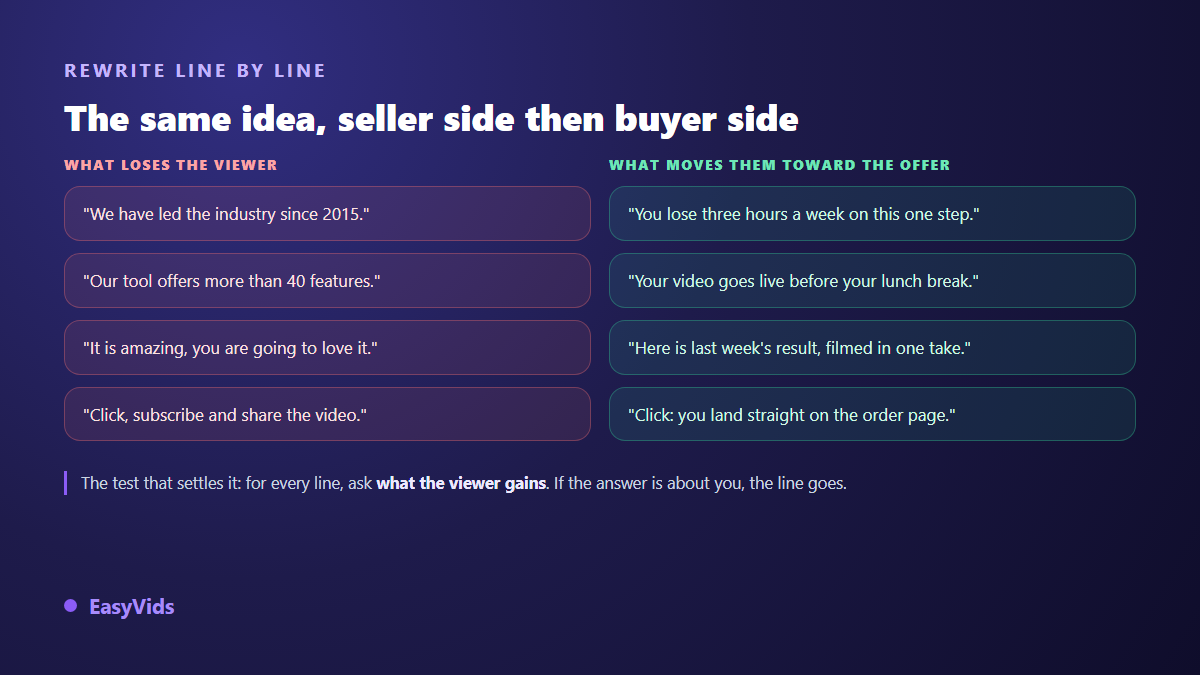
- An intro that introduces the company before it mentions the viewer.
- Features listed with no matching benefit, like a spec sheet read aloud.
- Superlatives standing in for proof: incredible, unique, outstanding.
- An ignored objection, which resurfaces in the viewer's head at checkout.
- Several competing calls to action inside the same video.
- A text written to be read with the eyes, full of sentences that break when spoken.
Writing your VSL with AI without ending up with robot copy
A language model writes fast, and it writes flat if all you ask for is "a sales script". The difference lives in the brief. Give it the product, the target buyer, the main objection, the chosen angle and the target length. On EasyVids, writing happens in the scripting workspace: you state your idea, set the tone, the language and the length in words or in minutes of voice over, and add your personal instructions, which stay saved on your account for every later draft.
Two settings genuinely change the result. Multi pass writing produces a first draft, submits it to a critical review that hunts inconsistencies and drops in intensity, applies the corrections, then runs a final check before delivery. For a specific product, a dedicated mode starts from its details, its photo and even the text of a document you upload, and lets you impose the selling angle: problem and solution, demonstration, before and after, storytelling or testimonial. The logic matches a well built video prompt: whatever you leave unspecified, the model invents for you.
From finished script to published video
A validated script turns into a production plan: visual universe, characters, settings, scene breakdown. The EasyVids studio then chains consistent images, the voice over and the edit, with every shot matched to the real duration of its narration. Aspect ratio is chosen before generation, 16:9 for a sales page, 9:16 for vertical feeds, 1:1 for a square placement.
Two things deserve attention at this stage. The voice carries half the credibility of a sales video: read too fast it sounds like a call centre pitch, read steadily it gives the mechanism time to land. And spending is steered scene by scene, a fast render for drafts and a careful one for the published cut; the plans are laid out on the pricing page.
Frequently asked questions
Does a sales video need to show a face?
No, and many high performing sales videos show nobody. A face helps when trust in the person matters, as with consulting or courses. For a physical product, a filmed demonstration usually outweighs a presenter talking to camera.
How long does it take to write a video sales letter script?
Allow an hour for an honest first draft if you already know your customers' objections, and a full day if you still have to collect them. With writing assistance the draft arrives in minutes, but collecting the objections remains your job, and it is what decides the quality of the text.
Do I have to disclose that the video was generated with AI?
Platforms mainly ask you to disclose realistic synthetic content that could mislead viewers, for instance a real person appearing to say something they never said. YouTube provides a disclosure toggle in its upload form, according to its help centre. An illustrated sales video carrying your own message does not raise that issue, and transparency stays the safest choice.
Can the same script serve an ad and a sales page?
Rarely as it stands. An ad speaks to someone who was not looking for you: it needs a sharper hook and a shorter promise. A video sitting on a sales page speaks to someone who already clicked: it can take the time for the mechanism and the proof. Keep the same offer, rewrite the opening and the ending.
How do I know whether my script actually works?
Read the retention curve rather than the view count. A drop in the opening seconds accuses the hook. A drop just before the offer points at a weak mechanism or thin proof. Test one variable at a time, otherwise you will never know what changed.
A good sales video is recognised by the order in which it answers the buyer's questions, not by its production value. Write the framework, cut everything that does not serve the decision, then produce. To write your first script and turn it into a video straight away, creating an account opens the scripting workspace and the full studio, with no bank card required.