Your video looks clean, the voice is fine, and the retention curve still collapses before the fifteen second mark. The topic was not the problem. What was missing is video storytelling: a reason to stay, planted in the first sentence and renewed every ten seconds. Viewers rarely leave because a video is bad. They leave because nothing is holding them anymore.
A story does not hold attention because it is beautiful. It holds attention because it leaves a question hanging and delays the answer. This page walks through the structure that produces that effect, beat by beat, with the turning points to place and the way to turn a written story into shootable scenes. For sentence level craft, rhythm, punctuation and phrasing, our complete video script guide is the companion piece.
The short answer
A video gets watched to the end when it moves through five beats: a situation set up in two sentences, a break that destroys the balance, an escalation where each step makes the previous one worse, a turn in the middle, and an ending that finally answers the opening question. One rule links them all: never close a question without opening another. That debt of answers, not the edit, is what keeps a thumb away from the next video.
Viewers do not leave because of your topic
Before changing subject, look at where the drop happens. The YouTube Help Centre documents an audience retention report showing, moment by moment, how many viewers are still there, with a separate measure for the opening seconds. That report rarely says a topic is weak. It shows sharp drop-offs at precise points, and those points almost always share one cause: a promise resolved too early, or never made at all.
The mechanism is simple. Attention is lent, never given. A viewer stays while a question is still open: who is this person, how does this end, why does that number make no sense. The moment the answer lands, attention becomes available again, and another video sits one gesture away. Writing a story means managing a queue of questions, not stacking information.
The five beats of a story that holds
The shape is old. The German playwright Gustav Freytag described a five part dramatic curve back in 1863, in his Technique of the Drama: exposition, rising action, climax, falling action, resolution. What social formats changed is the scale. You have seconds for the exposition, not three acts.
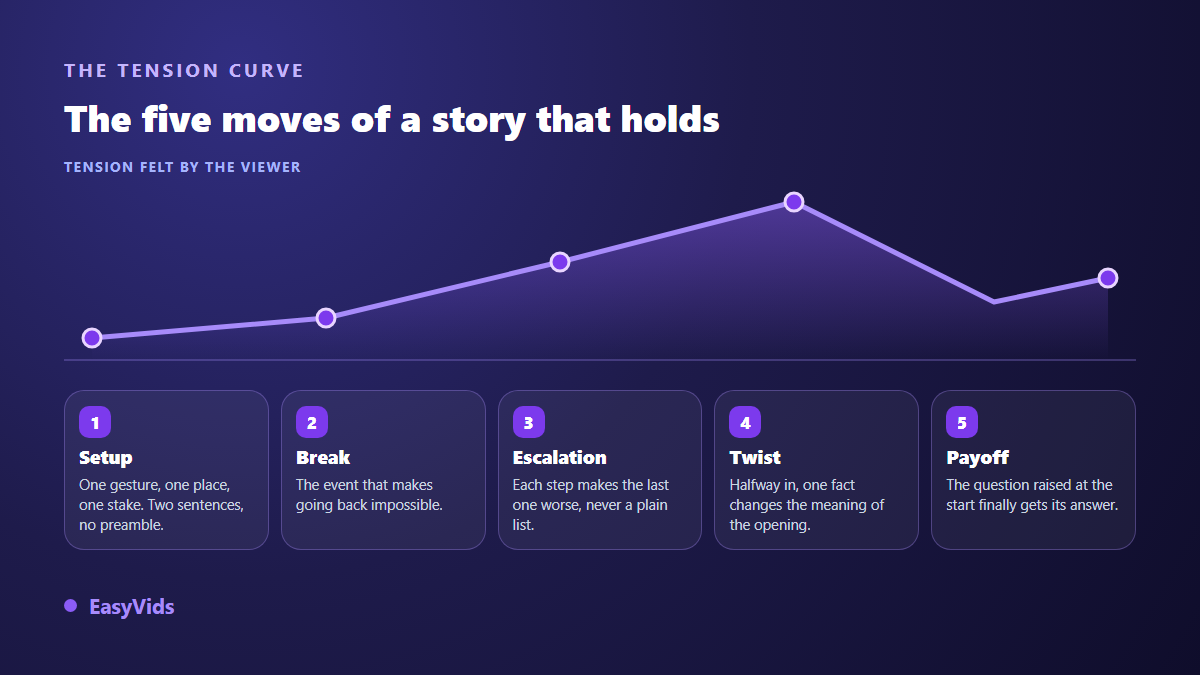
- Situation: who, where, what is at stake. Two sentences, and they already contain an anomaly.
- Break: the event that makes going back impossible. Without it you have a description, not a story.
- Escalation: three or four steps that make things worse, each one caused by the last.
- Turn: in the middle, one piece of information changes the meaning of everything before it.
- Ending: the opening question finally gets its answer, in one sentence, with no commentary bolted on.
Kurt Vonnegut liked to plot stories on a graph, and called the most common shape man in a hole: someone falls in, someone climbs out. Most videos that work are that shape, compressed. A cooking channel, a company story and a product video all follow the same curve with different stakes.
Beat 1: open on action, never on context
The opening sets a situation, not an explanation. Start on a gesture, a line spoken out loud, a broken object, a result nobody expected. Context gets fed in later, in small doses, once the viewer wants it. The six sentence template shared by Emma Coats while she was a story artist at Pixar captures the sequence: once upon a time, every day, one day, because of that, because of that, until finally. The first two beats install the ordinary in two lines, the third one breaks it.
Beat 2: the break lands before the ten second mark
The break is the event after which the opening situation is no longer possible. It is the real start of your story. On a one minute video, place it within the first ten seconds. On a long format you can wait until the thirtieth, rarely beyond. Quick test: delete your first sentence and read again. If the story starts better without it, that was context in disguise, and there are probably three more behind it.
Beat 3: escalation, the cure for a soft middle
The middle loses the most viewers, because it usually gets written as a list. Escalation is not enumeration: every step has to make the previous one worse or reveal its cost. Join your transitions with because of that rather than and then. Causation builds a slope, juxtaposition builds a catalogue.
The second safeguard is variation. When three passages in a row share the same length, tone and framing, the ear checks out even when the substance is good. Alternate a long sentence and a short one, a wide shot and a close up, an action and a reaction. Rhythm is won in the cutting, never by speeding up the voice.
Beat 4: the turn in the middle
The turn is where one piece of information changes the meaning of everything before it. The workshop was not empty by accident. The unhappy customer was right. The product worked, just not for the intended use. Place it in the middle rather than at the end: a final twist rewards the people who stayed, a central twist keeps the ones who were about to leave. On a three minute video, aim for the ninetieth second, exactly where retention usually dips.
Beat 5: land it, and skip the moral
The ending answers the question you opened with, then stops. The most common mistake is adding a lesson: the viewer has just worked it out alone, and telling them what to feel undoes the work. If there is a moral, it already lives in the facts you told. Keep the last line short and concrete, then move straight to what you want the viewer to do next.
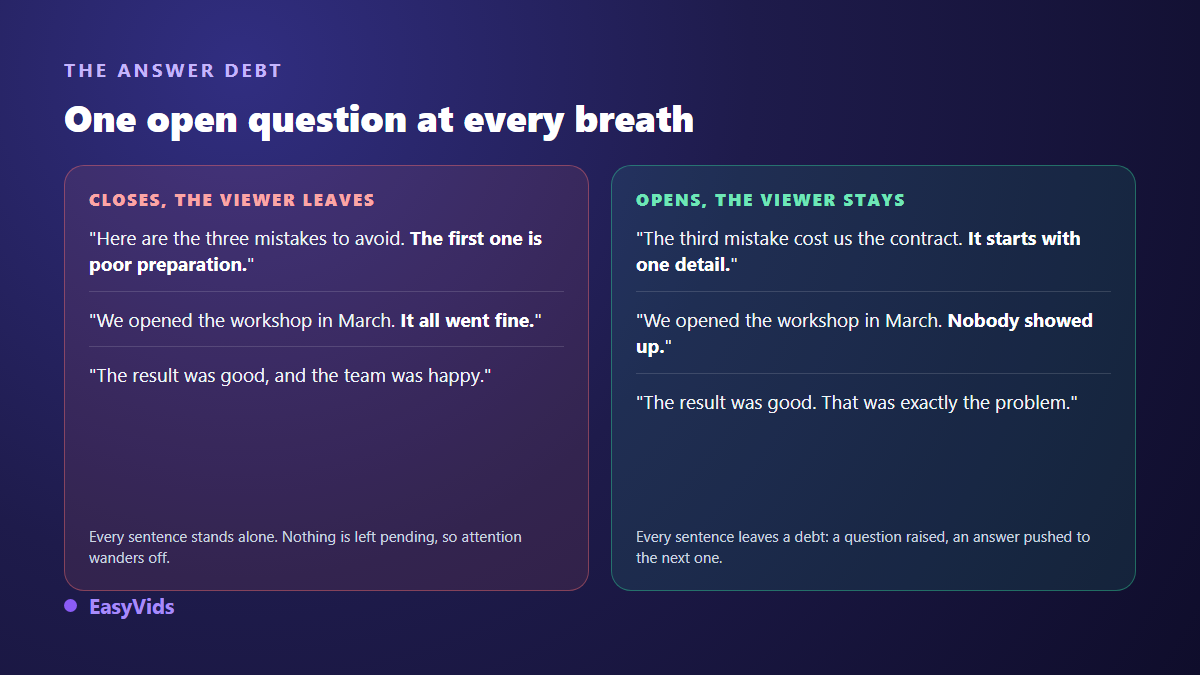
One open question per breath
Read your text paragraph by paragraph and ask a single question at each break: is anything still unresolved? If not, that paragraph stands on its own, and the viewer can leave without frustration. They will. The writing rules we apply inside the studio push this onto the model: every paragraph ends on unresolved tension or an open question, except the last one.
- Information withheld: that one detail cost us the contract.
- A contradiction stated but not explained: the result was good, and that was exactly the problem.
- A deadline: two days left.
- An unexpected reaction: nobody answered.
- A bounded promise: the third point is the only one that really matters.
Set the length before you write
A structure needs room to unfold. Think in minutes of voice over rather than characters: one minute of narration runs to roughly 150 words at a normal pace. One minute holds five very tight beats, three minutes give them air, six minutes call for a second turn or the middle sags. Those three durations are the default settings in our script generator, with a custom length when a format demands it.
From story to film: cutting into scenes
A story written for video is not a block of text, it is a run of short paragraphs, each of which becomes a scene. The constraint has a useful side effect: it enforces narrative discipline, because a paragraph carrying no new idea becomes obvious the moment you have to find it an image.
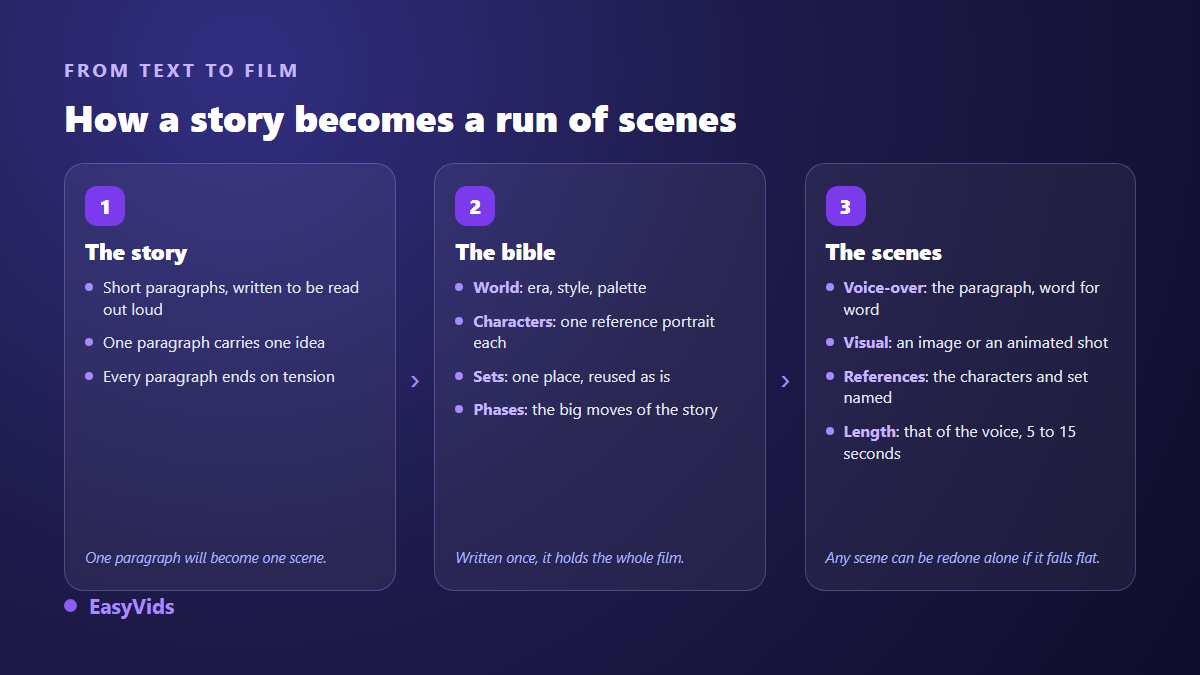
Inside the EasyVids Director, that step is explicit. A first pass builds a bible: the visual universe, one reference portrait per character, one prompt per location, and the phases of the story. A second pass writes the scenes, each carrying its paragraph word for word as voice over and naming the references that must appear on screen. The plan stays readable and editable before generation, and any single scene can be replayed on its own if its image or its voice disappoints, without rebuilding the whole film.
The same story in vertical
Vertical does not remove the structure, it compresses it. Five beats fit inside thirty seconds provided you merge situation and break into one sentence and place the turn around the fifteenth second. The opening then carries an outsized load, which is why the first instants get so much care on those platforms. Plan the framing while writing too: a story built for landscape and cropped later loses half its shots.
Frequently asked questions
How long should a video story be?
Three minutes suits most complete stories: the structure can breathe without needing a second plot line. Under a minute, merge the situation and the break into one sentence. Past five minutes, plan a second turn, otherwise the middle sags.
Do you need a character to tell a story?
Yes, in the broad sense. You need someone things happen to: you, a customer, a team, sometimes an object followed like a character. A subject with nobody carrying it becomes a presentation, and a presentation is judged on immediate usefulness, not on the urge to know what happens next.
Does storytelling work for a product video?
It works better than a head on demonstration, as long as the tension is real. Start from the problem lived before the purchase, show the attempt that fails, then the moment the product changes something. The product becomes the consequence of the story rather than its subject.
Can an AI written story sound genuine?
Yes, if you give it constraints of form rather than a vague theme. Instructions that ban clichés, repeated sentence openings and moralising conclusions, and that demand tension at the end of every paragraph, produce a far tighter text than a plain request for a story. Reading it out loud remains the final judge.
How do I know my structure holds before producing the video?
Read your text out loud with a timer and note the second your own attention drops. That point almost always matches the one where your viewers leave. Fix the text right there before generating a single image: a failed scene can be redone, a story without tension has to be rewritten.
Narrative structure is built on the text, never in the edit. Set the situation in two sentences, break the balance early, escalate by consequence, turn the meaning in the middle, answer at the end, and check that no paragraph closes on itself. Visuals, voice and music follow a story that holds, and never the other way round. To write yours and watch it become a run of consistent scenes, create your account and explore the EasyVids creation studio.