A full song, vocals included, from two typed sentences. The demo always lands. Then the novelty fades, and you go looking for a Suno AI review before spending time or money on it. Fair enough. A fifteen second clip shared on social media tells you nothing about the full track, heard on headphones, sitting under a video, played again the next day.
You will not find an invented ranking here, nor a timed test nobody could reproduce. You will find what the tool really does, what you hear in every AI generated song, a five point listening checklist you can run in three minutes, and the rights question, the only one that can genuinely cost you. If the field is new to you, our guide to AI music generators covers the basics first.
The short answer
Suno is still the most polished consumer tool for getting a complete, sung track out of a plain description. On genres with strong conventions, pop, rap, folk, gospel, afrobeat, the output survives a first listen without trouble. Three weaknesses come back every time: pronunciation in languages other than English, holding a long track together, and a flattened mix with little width. For a birthday song, a jingle, a channel intro or a video soundtrack, it is more than enough. For a release you will defend in front of trained ears, plan on editing.
What Suno actually does
The service turns text into a finished audio track: backing, sung vocals, structure. According to the Suno help centre, two workflows coexist. The first is a free description, a few words of genre and mood, and the engine writes the lyrics itself. The second, custom mode, lets you supply your own lyrics and your own style tags. That second route changes everything, and we come back to it below.
Around that core, the editor lets you extend a track that ends too soon, generate variations, and pull separated stems on paid plans. The American company behind the service opened its platform to the public in late 2023 and has shipped successive model versions since, each announced as cleaner on vocals. Nothing exotic in that list: it is the category standard, and rival engines offer roughly the same.
- A downloadable audio file, full structure, with vocals or instrumental.
- Lyrics, written by the engine or used exactly as you supply them.
- A style driven by keywords: genre, instruments, mood, tempo.
- Several proposals from one brief, to compare before you keep one.
What you hear on the second listen
The first listen is misleading, and not only with Suno. Ears are generous with a sung voice, especially when they know no human sang it. The second listen is the honest one. The flaws surface, always the same ones, and that is where publishing is decided.
Across our own AI song generations, four flaws show up often enough to be announced in advance. Consonants turn mushy as soon as the delivery speeds up. The timbre shifts slightly between verse and chorus, as if two singers were taking turns. Endings resolve with a hard cut instead of a real landing. And the whole thing sounds narrow, as if the mix had been flattened with a roller: everything at one level, nothing in front, nothing behind.
The five point listening checklist
This is the method we run before keeping or dropping a track. It takes three minutes, it needs headphones, and it saves you from publishing a song you will find weak a week later.
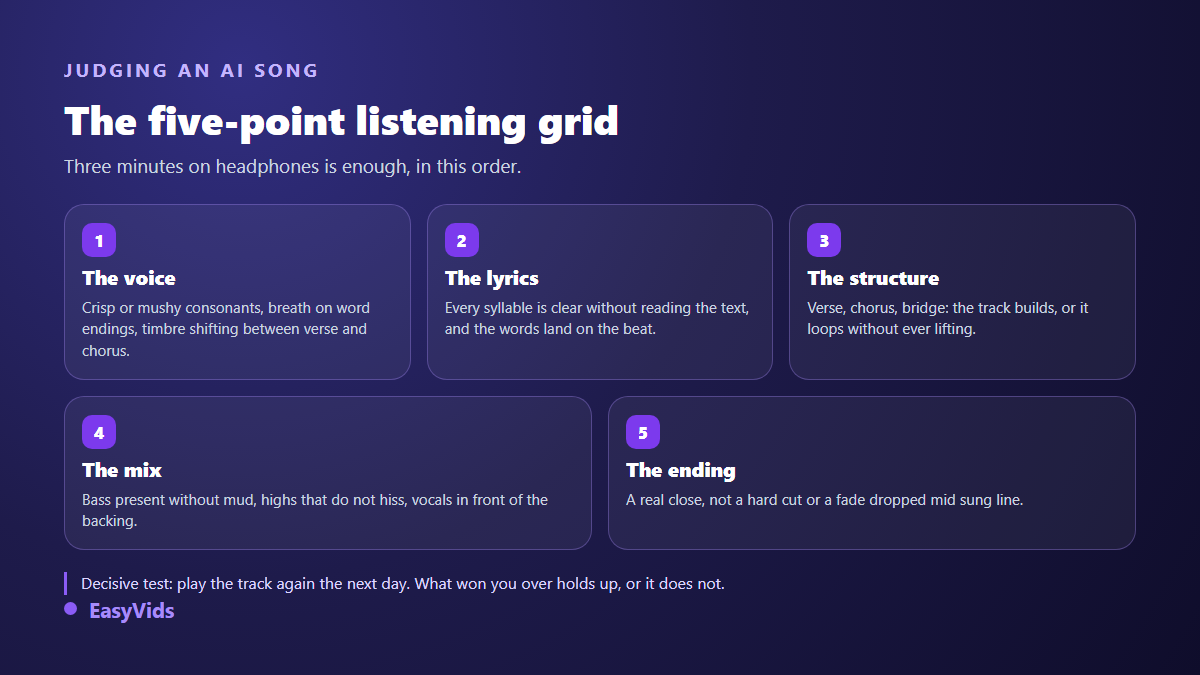
- Vocals. Crisp or swallowed consonants, breath on word endings, timbre steady from start to finish.
- Lyrics. Every line should be understandable without reading the text, and the words should land on the beat.
- Structure. Verse, chorus, bridge: the track has to build somewhere, not loop in place.
- Mix. Readable bass, highs that do not hiss, vocals in front of the backing rather than glued into it.
- Ending. A real landing beats a fade dropped in the middle of a sung line.
One last test, free and final: play the track again the next day, outside the context of the generation. The novelty is gone, only the song remains. What impressed you either holds up, or it does not.
What holds, what breaks
The tool shines on one precise territory and breaks on another, equally precise. Knowing where the border runs saves hours of pointless retries.
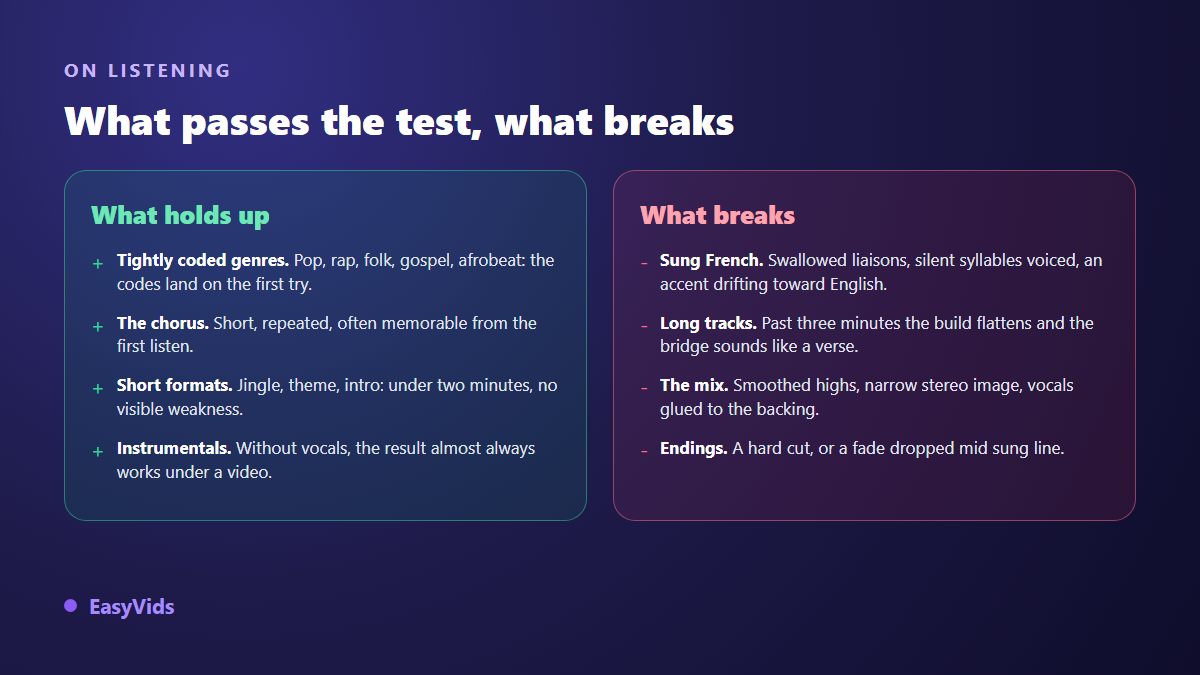
On the solid side: genres with strong conventions. Pop, rap, gospel or afrobeat come out on brief from the first attempt, because those styles rest on patterns the model has heard at scale. Short formats also do well. Jingle, channel intro, opening theme: under two minutes, no weakness shows. Instrumentals stay the most reliable mode, for the simple reason that they remove the hardest part.
On the fragile side: length and vocals. Past three minutes the progression flattens, the bridge sounds like one more verse, and listeners drift. The voice remains a convincing but smoothed imitation, without the micro accidents that make a singer move you. Add a narrow mix and you get a track that works on a phone and disappoints on good headphones. That gap is exactly the gap between private use and public release.
Sung pronunciation, the real dividing line
The demos circulate in English, and that is no accident. Singing in French, Spanish or Portuguese is harder for a model, for concrete reasons. Liaisons and elisions depend on context, and the engine sometimes decides at random. Silent vowels are sung in some phrases and dropped in others, and that elasticity is precisely what makes a melody sound native. Stress patterns also differ from English, so emphasis lands in the wrong place.
The result is audible straight away. A final syllable gets pushed where nobody would push it, a liaison disappears, a word slips into an English accent. Nothing disqualifying for a family song played once. Genuinely awkward for a brand, a channel or an artist building an identity.
Two habits limit the damage. Write short lines with simple words and few tricky junctions. And build the chorus on open vowels, which forgive a lot. Five minutes of rewriting changes how the whole track is perceived.
Lyrics matter more than the engine
This is the least intuitive observation in this review. The difference between a painful song and a song you keep rarely comes from the model, it comes from the text you feed it. Worked lyrics, with a short chorus and one concrete image per verse, lift the result a full notch on any tool. Style tags matter too, and our collection of AI music prompts sorted by genre gives formulas you can reuse directly.
Rights, licence and monetisation
Two questions get confused constantly, and they need separating. The first concerns model training. In June 2024, the RIAA announced lawsuits on behalf of the major American labels against several music generation services, Suno among them, over the recordings used to train their models. Agreements between record companies and the operators of those services were announced from late 2025 onward. That dispute is about training, not about the song you generate.
The second question, the one that affects you, is what you may do with the track you obtain. It is settled in the terms of service, not in the news. According to the terms published by Suno, commercial use of generated tracks is reserved for paid plans, with the free tier limited to non commercial use. Check the version in force on the day you publish, because these texts change. We unpacked ownership, exclusivity and distribution in our article on AI music and copyright.
On YouTube the rule is simpler than people assume. According to the YouTube help centre, monetisation depends on the originality and added value of a video, not on the tool used to make it. The platform has also asked creators, since March 2024, to disclose realistic synthetic content in YouTube Studio when it could mislead viewers. Content ID claims run on a different mechanism, fingerprints filed by rights holders, and our guide to AI music on YouTube explains how to answer one.
What a generated song really costs
No figures here: the grids move too fast for an article to freeze them. The mechanism does not move. These services run on credits, one generation spends one unit, and a failed attempt spends as much as a successful one. The real cost is not the advertised plan, it is the number of attempts before you get a keeper. We broke that logic down for video in our comparison of what an AI video really costs, and it transfers line for line to music. Our own plans sit on the pricing page.
Suno alone, or a full studio
The decision is not about raw model quality, which shifts every quarter. It is about what happens to the song once it exists. A music only tool stops at the audio file. If that file has to end up under a video, with a voice over, visuals and captions, the chain starts again somewhere else, with another account to learn.
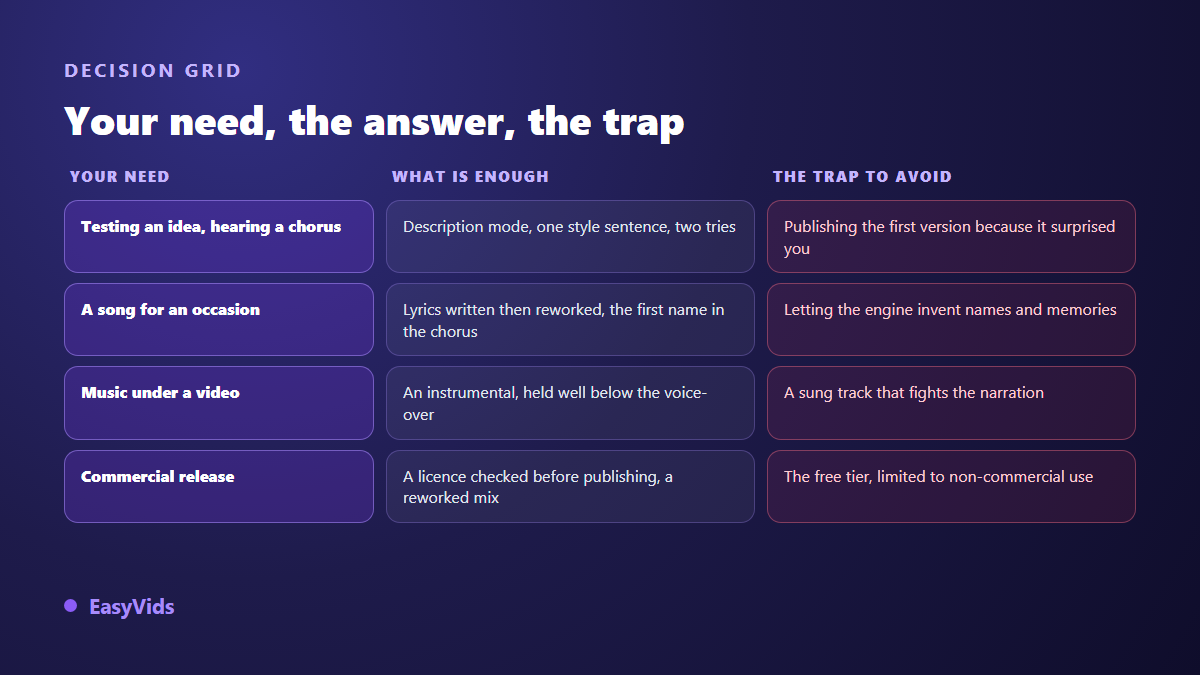
Our Music Studio answers the other half of the problem. You pick an occasion from ten ready made ones, add a name and a message, choose a style, a mood and a tempo. The studio writes the lyrics, you edit them freely, then it produces the song, sung or instrumental. Generation runs server side, so you can close the page and come back to it, and the history keeps both your songs and the lyrics already written. The file then sits under a video made in the EasyVids studio, or drops onto an audio track in the online editor.
Frequently asked questions
Is Suno free?
There is a free tier, with a limited number of daily generations and non commercial use, plus paid plans that open commercial use. The details change regularly, and the service pricing page is what counts on the day you sign up. The point to remember: free and publishable are not the same thing.
Can I release a generated song on streaming platforms?
Technically yes, on two conditions. Your licence must cover commercial use, and your distributor must accept generated tracks. Distribution platforms each have their own disclosure policy, and several now refuse catalogues mass produced with no artistic input. Disclose rather than hide: hiding is the problem, never the tool itself.
Can people tell a song was generated?
Untrained ears usually cannot, especially on a short track played through a phone. Trained ears can: the flattened mix, the slightly too perfect steadiness of the singing and the endings give it away. The gap narrows with every model version, but it is still there, and it widens as soon as the song runs past three minutes.
Can I make it sing in my own voice?
That is not what these tools promise, which is healthy. Making an identifiable voice sing without permission raises a personality rights question, separate from copyright in the music. The subject deserves its own treatment, and our article on AI voice cloning and the law sets out what consent changes in practice.
How long should the song be?
Between ninety seconds and three minutes for a personalised song, under thirty seconds for a jingle or a channel theme. Past three minutes the structure loosens and attention drops. If you need length, two short tracks beat one that drags.
An honest verdict fits in two sentences. Suno now delivers a complete song most listeners will accept without blinking, and it replaces neither a writer, nor a mix, nor the voice of someone with something to say. Treat it as a fast instrument and keep control of the text, because that is where the difference is made. To walk the same chain, from brief to song and from song to video, creating an account opens the Music Studio with no bank card.