Your ebook is written, proofread and laid out. The cover holds up. What remains is the one question that decides everything else: where to sell it. Plenty of indie authors stall right there, because selling an ebook is not a tool choice, it is a channel choice. And every channel takes something in exchange for what it gives.
A marketplace brings you readers you would never have reached, then keeps the relationship with them. Your own store keeps the margin and the email addresses, provided you bring the traffic yourself. Between those two extremes sit five more ways to get paid, each suited to a different kind of book. This guide walks through all seven. If your manuscript is not ready yet, our complete guide to creating an ebook with AI covers the step before this one.
Where to sell ebooks online: the short answer
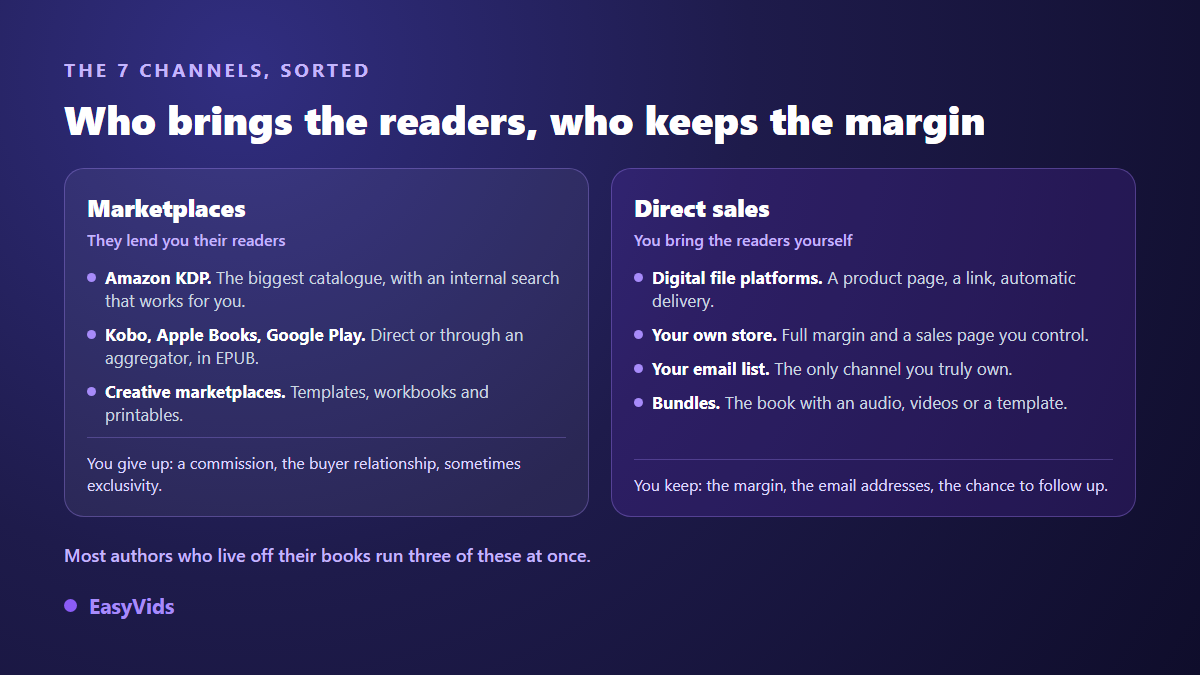
Seven channels hold up: Amazon KDP, the other digital retailers such as Kobo, Apple Books and Google Play Books, creator file platforms, your own store, creative marketplaces, your email list, and bundles that pair the book with coaching or a course. The starting rule fits in two sentences. With no audience, begin on a marketplace: it lends you its readers while you build your own. With an audience, even a small one, sell direct: you keep the margin and, more importantly, the email address of every buyer.
What a single ebook sale actually requires
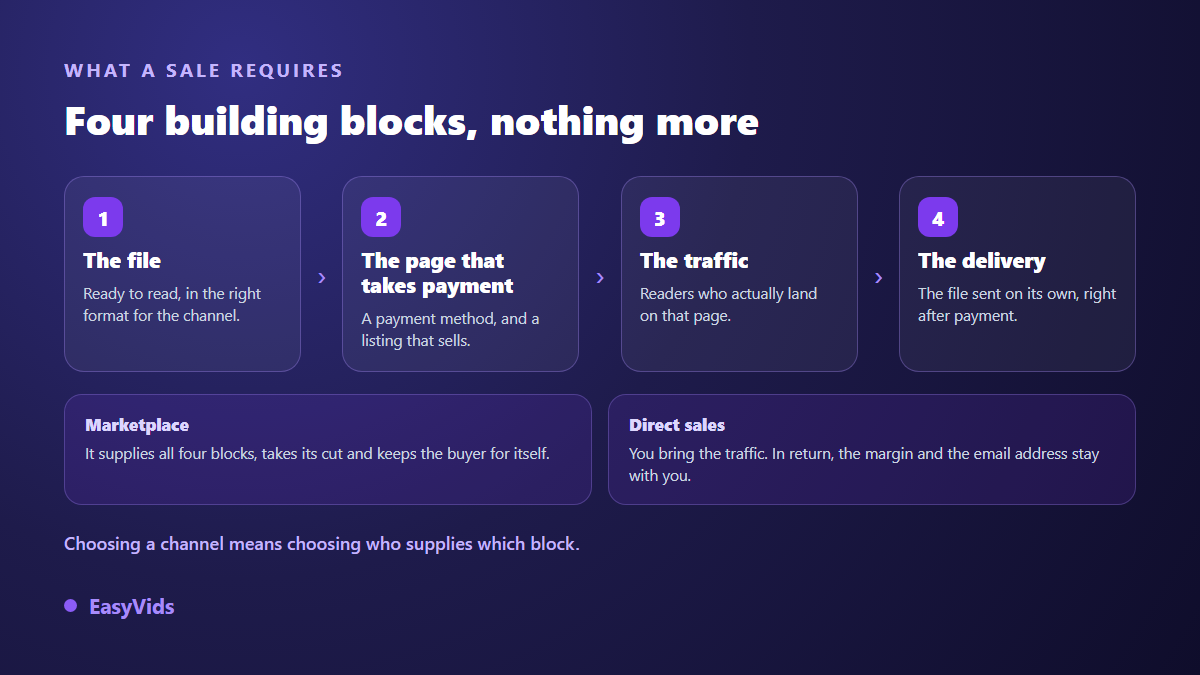
Before comparing anything, look at what has to come together for a stranger to walk away with your book. Four building blocks, no more: a readable file, a page that takes payment, traffic arriving on that page, and automatic delivery once the payment clears. A sales channel is nothing more than one way of assembling those four blocks. Amazon supplies all four and takes its cut. A file platform supplies three and leaves you the traffic. Your own store supplies none until you have built it.
The block beginners underestimate is the last one. Sending files by hand works while you sell three copies a week, then turns into a second job with its missed emails and unhappy buyers. Any serious setup delivers the file on its own, through a link limited in time or in number of downloads. Our roundup of ways to sell an ebook with no website shows the simplest arrangements, the ones you can put in place in an evening.
Channel 1: Amazon KDP, the one that brings readers
Kindle Direct Publishing stays the first reflex for one precise reason: it is the only channel where strangers find your book without any promotion from you. Amazon internal search works while you sleep, and the product page carries a trust few sales pages ever reach. The same upload also opens a print on demand paperback, with no stock and no cash up front.
Two trade offs, and they weigh. First the commission, whose rate depends on the royalty option you pick and on conditions detailed in the KDP help pages. Then buyer anonymity: you will never know who bought, so you cannot offer them your next book without going through Amazon again. The KDP Select programme adds digital exclusivity in 90 day terms in exchange for inclusion in Kindle Unlimited, according to the terms Amazon publishes. Sign it knowingly: for the length of that term, the digital edition cannot be sold anywhere else, your own site included.
Channel 2: the other retailers and the aggregators that reach them
Leaving Amazon behind costs little and often pays more than expected, especially outside English speaking markets. Kobo Writing Life, Apple Books and Google Play Books all take indie authors directly through their own portals. Aggregators such as Draft2Digital, PublishDrive or StreetLib do the same job from a single upload: one file in, distribution to many stores and libraries, royalties passed back, a share taken along the way. Their author pages list the stores covered, and that list shifts from year to year.
Format decides everything here. These retailers expect EPUB, text that reflows to the size of the screen, not a fixed page PDF. According to the KDP help pages, manuscripts are uploaded as EPUB, DOCX or Kindle Create KPF files. A beautifully laid out PDF sells very well direct and reads badly on an e-reader, so plan a conversion if your book was born as a PDF.
Channel 3: creator file platforms
These services do one thing well: host the file, take the payment, deliver the download link. A product page takes minutes to build, the link travels in a profile bio, at the end of a video or inside a newsletter, and the sale closes without a website. Gumroad, Payhip, Ko-fi and Sellfy all work this way, with a commission per sale and, for several of them, a capped free tier.
One detail is worth a great deal once you sell across borders. Some of these platforms act as merchant of record: Lemon Squeezy and Paddle claim that status in their documentation, and Payhip states that it handles European digital VAT for its sellers. The platform then collects and remits the tax on your behalf. On a digital product sold in several countries, that single line saves weeks of paperwork.
Channel 4: your own store
A store built on Shopify, WooCommerce or an equivalent gives you everything back: the full margin, the buyer email address, complete freedom over the sales page, and the chance to offer a second product right after checkout. It is the channel that pays the most per sale, with no serious rival.
It also asks the most. A digital download extension to deliver the file, a sales page that convinces without a catalogue behind it, a payment provider, and above all traffic: nobody stumbles onto a store by accident. This channel earns its place once a source of audience already exists, a video channel, a newsletter, an active social account. Before that, it leaves you alone in front of a counter stuck at zero.
Channel 5: creative marketplaces
Etsy accepts digital files and delivers them automatically after payment, according to its seller help centre. What sells there is practical: planners, workbooks, templates, printables, highly visual guides. A novel does poorly. A well designed exercise book sells every day, because buyers arrive intending to download something useful straight away. Layout matters more than page count, which explains the room taken by low content books.
Channel 6: your email list, the only asset you own
An email list is not a sales channel in the technical sense. It is the only asset you genuinely own. Every other channel rents you an audience and can change its rules overnight. An email address stays yours when an algorithm turns or a platform shuts down.
The sequence that works needs no special talent: a first ebook given away in exchange for an address, a short series of messages that deliver real value, then a paid book offered to people who already read you. The purchase rate has nothing in common with a cold page. It is also the only channel where you can follow up, test two titles and ask for feedback before writing the next book.
Channel 7: selling in a bundle
An ebook sold alone stays an ebook. The same ebook paired with an audio version, a short video series or an hour of live guidance changes category in the buyer eyes. It is the least crowded channel, simply because it asks a little more work than the other six.
Choosing a channel: three questions are enough
The right channel does not follow from the book alone, but from your situation on the day you publish. Three questions settle it, in this order, and a fourth joins them as soon as a second title is planned.
- Do you already have an audience that reads you? No: start on a marketplace, it lends you readers. Yes: sell direct and keep the margin and the emails.
- Is your book read or used? Long form text goes out as EPUB to the retailers. Anything printed or filled in goes out as PDF to creative marketplaces.
- Are you selling in several countries? If so, favour a platform acting as merchant of record: it handles tax collection for you.
- Do you plan a second book? Then collect email addresses from the very first sale, whatever the channel, with a bonus page at the end of the file.
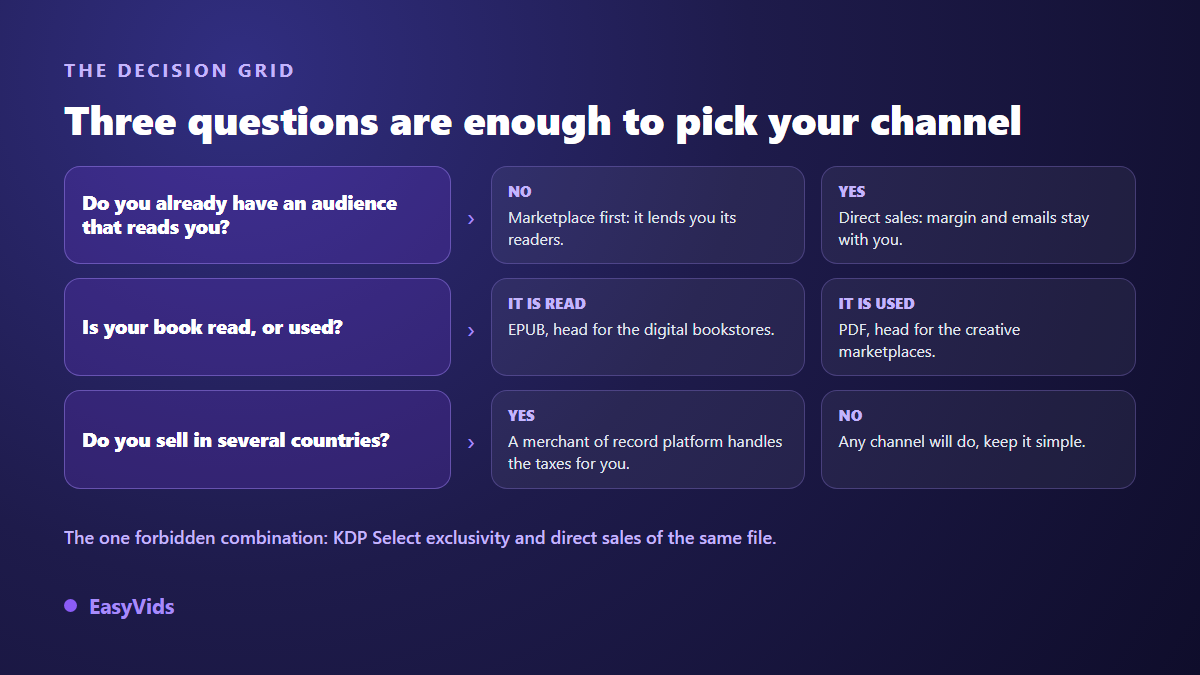
Nothing forces you to stop at one channel, and most authors who live off their books run three at once: a marketplace to be found, direct sales for the margin, an email list to bring everyone back. The only genuinely forbidden combination is KDP Select exclusivity alongside direct sales of the same digital file.
Mistakes that cost sales
- Publishing the same PDF everywhere: retailers reject it or make it painful to read on an e-reader.
- A rushed cover: it is the first and often the only thing a buyer looks at before clicking.
- A sales page that describes the book instead of describing the result the reader gets.
- No email capture at all, which turns every sale into a customer you lose track of.
- A title written for you rather than for the platform internal search, still the main discovery engine.
- Waiting for perfection: a book fixed after thirty sales beats a perfect book nobody ever reads.
Preparing the file before you list it
A book that sells comes in three pieces, never one: the file itself, a cover that stops the eye in a grid of thumbnails, and the copy that carries the sale. All three are produced in one place inside the EasyVids studio. The ebook page writes the book chapter by chapter from an outline you approve and edit, illustrates it, produces the cover, then delivers a downloadable PDF and a formatted HTML page. It also generates cover variations as a square thumbnail, a wide banner and a vertical story, a short sales page, a thirty second video ad script and three social hooks. One honest note: the output is PDF and HTML, not EPUB, so a conversion is still needed for retailers that require it. Plans are listed on the pricing page.
Frequently asked questions
Do I need a website to sell an ebook?
No. A creator file platform is enough: it hosts the book, takes payment and delivers the download link. A website becomes useful later, when you want control over the sales page, several products on offer and the whole margin.
Can I sell the same ebook on several platforms?
Yes, unless you enrolled the digital edition in KDP Select, which requires exclusivity in 90 day terms according to the terms Amazon publishes. Outside that programme, nothing stops you from being on a marketplace, your own store and a file platform at the same time.
Which file format should I sell?
EPUB for digital retailers, because the text adapts to the e-reader screen. PDF for direct sales and for anything printed or filled in. Many authors include both in the same purchase, which settles the question and raises perceived value.
How do I stop the ebook from being shared freely?
No protection is absolute, and heavy locks mostly punish honest buyers. The reasonable measures are a download link limited in time or in number, a discreet watermark carrying the buyer name, and a rights notice inside the book. The rest rests on the relationship, not on technology.
How long before the first sales come in?
Nobody can promise you a date, and be wary of anyone who does. What is observed: an offer sent to an existing list reacts within hours, while a listing dropped on a marketplace takes weeks to find its place in internal search. The first depends on your audience, the second on the work put into the title, the cover and the listing keywords.
Pick the channel that matches what you have today, not what you hope to have in a year. A marketplace to be found, direct sales to be paid properly, an email list so you never start from zero on the next book: that order has served thousands of indie authors. To prepare the file, the cover and the sales copy in one place, create your account and start a first book from the EasyVids studio.