Your images look clean, sometimes genuinely good, and the same question always arrives: would anyone pay for them? Selling AI-generated images works, and contributors do it every day. The topic sits between two opposite myths. One says every stock library slammed the door on generated content. The other promises passive income the moment you upload a thousand files. Both are wrong, and everything happens in the space between them.
The truth fits in one sentence: every platform wrote its own rule, and those rules cover three questions only. Is generated content accepted? Must it be disclosed? What does the image actually show? Once those are settled, selling AI visuals looks like any other stock business: a wanted subject, a clean file, accurate keywords. If you want the wider picture first, our overview of serious ways to monetise AI puts this route next to the others.
The short answer
You can sell AI-generated images on several major platforms, provided you flag them as generated. Adobe Stock, Alamy, Freepik, Dreamstime and Vecteezy accept generated content with a dedicated label. Shutterstock, Getty Images and iStock do not accept generated content uploaded directly by contributors. Outside stock libraries, print on demand, digital products and direct sales stay open, each with its own transparency duty. The real sticking point is not selling, it is protection: an image produced from a plain prompt does not automatically give you copyright over it.
The platforms that accept generated images
The open camp organised itself quickly, because buyers asked for it. None of these sites lowered their quality bar, though: generated content goes through the same review as everything else, with one extra rejection reason, the missing label.
- Adobe Stock accepts generated images. Its contributor guidelines ask you to tick the « Generated with AI » box at submission, and forbid naming a living artist or a brand in titles and keywords.
- Alamy also accepts generated content, as long as it is flagged in the file information.
- Freepik runs a dedicated section for generated visuals and accepts matching contributions.
- Dreamstime accepts generated images with an explicit declaration at upload.
- Vecteezy files generated content in a separate category, again on disclosure.
- Digital product marketplaces and print on demand sites follow another logic: what you sell there is an object or a file, not an image licence.
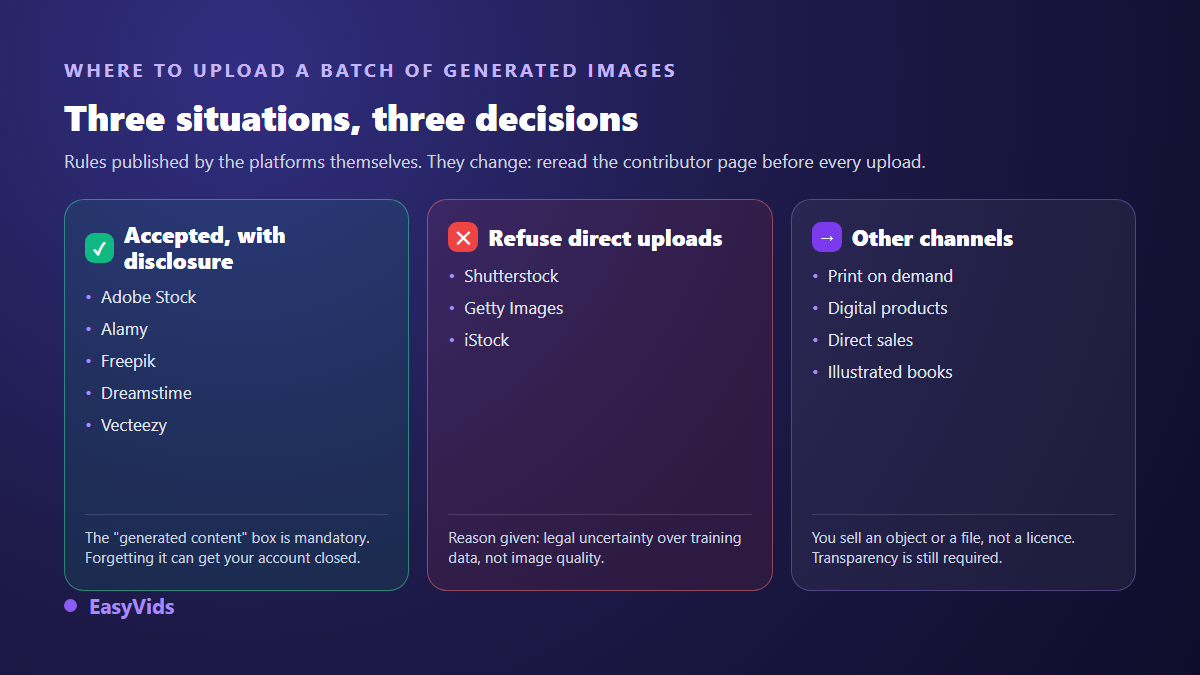
One detail that saves hours: these rules move. A platform closed yesterday may open, an open one may tighten overnight. Reread the contributor page before every upload campaign, the way a photographer checks specifications before delivery.
The ones that refuse, and what it means for you
Shutterstock announced back in October 2022 that it would not accept generated images uploaded directly by contributors, while building its own generator and a fund for artists whose work fed the training data. Getty Images and its iStock subsidiary took the same route in September 2022, citing legal uncertainty around training sets.
These bans are not about image quality. They are about the rights chain upstream. A library selling licences has to promise an advertiser that the visual will not expose them. While that promise stays hard to make, the door stays shut. The practical takeaway is simple: do not prepare a batch for those sites, and never pass generated images off as photographs. An account closed for false declaration does not reopen, and your sales history leaves with it.
Disclosure, the rule that comes back everywhere
Whether you upload to a stock library, publish an illustrated book or sell a poster, the same duty returns in different shapes: say that the image was generated. Amazon asks self publishers to declare AI-generated content at publication in its KDP programme, images included. Etsy asks sellers to describe honestly how an item was made, which covers the role of AI. The European Union's artificial intelligence regulation sets transparency duties on generated content in its article 50, with machine readable marking. And the C2PA technical standard, backed by a coalition of software and media companies, defines exactly the provenance metadata format platforms are starting to read.
Remember the principle rather than the list. Disclosure is not a penalty, it is what makes your work sellable and defensible. Platforms reason identically about other generated media, as our piece on AI music and copyright shows.
Copyright: what you actually own
This is the least understood point, and it deserves a blunt answer. Selling an image and holding copyright in that image are two different things. You can commercialise a file without being its author in the legal sense.
The United States Copyright Office, in its January 2025 report on the copyrightability of AI-assisted works, holds that a prompt, however long and crafted, does not make you the author of the output. An identifiable human creative contribution is required. Registration stays possible for the part you genuinely composed: an edit, substantial retouching, a layout, a curated selection. The purely generated part has to be excluded from the claim.
For a seller the consequence is concrete. Someone can reuse your image without you having the same recourse a photographer would. All the more reason to sell something other than a lone file. A coherent collection, a held style, a precise purpose are far harder to copy than a single visual, and the consistent character method gives a series exactly that kind of unity.
Finally, check what your tool grants you. The EasyVids terms of use state, in their section on generated content, that your images, videos, voices and music belong to you within the limits of the rights granted by the underlying model providers, and that you may exploit them commercially. Not every generation platform is that explicit, so read the clause before building a business on it.
The content that gets a whole batch rejected
Rejection reasons repeat from one site to the next, and they depend less on technique than on what the image shows. A whole batch can fall over a single one of them, because the reviewer assumes the rest deserves the same suspicion.
- Recognisable real people: a generated celebrity face still infringes image rights and, in several countries, personality rights.
- Brands, logos, packaging and protected characters, even half visible or blurred in the background.
- Landmarks and artworks restricted for commercial use, exactly as in photography.
- Prompts naming a living artist or studio to imitate their style: Adobe Stock forbids this explicitly in its title and keyword guidelines.
- A generated image submitted as editorial illustration: news content requires a genuinely photographed scene.
Building a file that is technically sellable
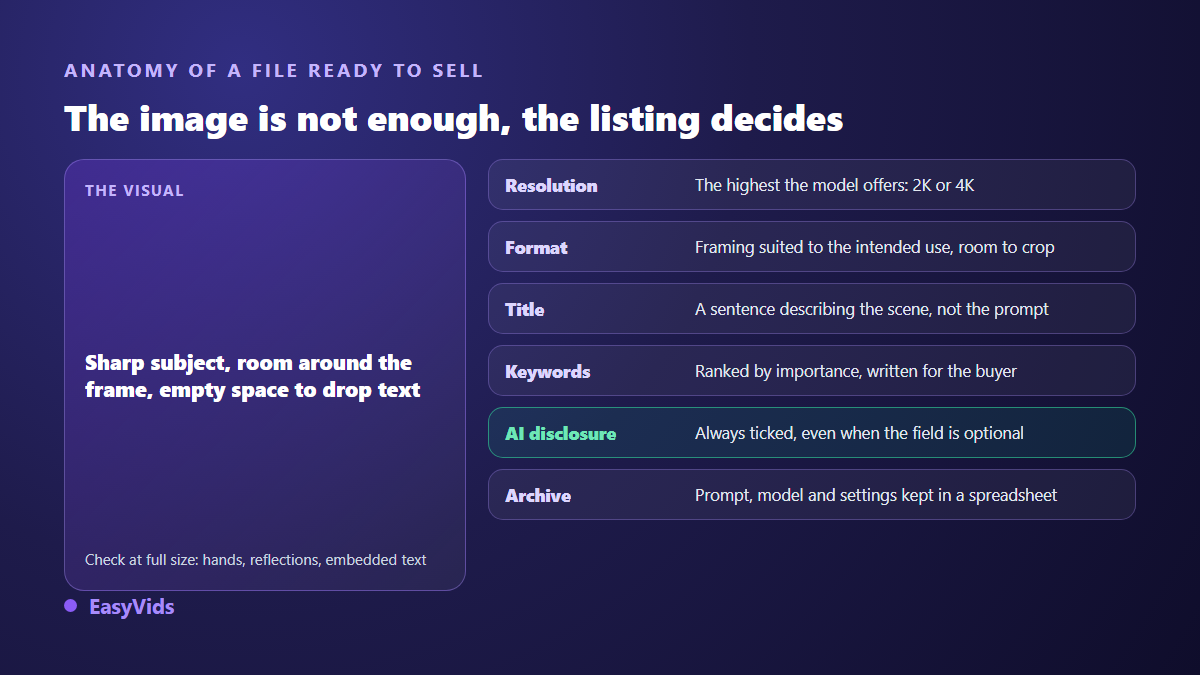
A good image poorly prepared gets rejected as surely as a bad one. Stock libraries enforce resolution floors, and Adobe Stock asks for at least four megapixels per file in its contributor requirements. Generating small therefore kills the submission before review even starts.
This is where model choice matters more than prompt beauty. In the studio, recent image models output in 1K, 2K and 4K, with framing options beyond 16:9 and square, including 4:3, 3:4 and 21:9. For stock work, always take the highest resolution the model offers, and leave room around the subject: buyers crop almost every time, and they often hunt for empty space to drop their text.
- Inspect the image at full size, never in a thumbnail: hands, text and reflections only betray themselves at full scale.
- Remove or fix any unreadable embedded text, a very common rejection reason on generated work.
- Give the file a descriptive name, and write a title that describes the scene in one clear sentence.
- Rank keywords by importance, thinking about what a buyer will type, not what your prompt contained.
- Tick the generated content declaration every single time, even when the field looks optional.
- Keep the prompt, the model and the settings in a spreadsheet: you will need them to rebuild a variant months later.
The subjects that actually sell
Generated content does not sell at random. It sells where photography is expensive to produce and demand never fades: abstract concepts, office scenes, backgrounds, textures, editorial illustration, seasonal visuals. Travel, documentary and news stay photographers' ground, for one simple reason: the buyer wants a real place on a real date. Two niches stand out for beginners. Ecommerce visuals first, because demand is constant and formats are standardised, and our product photo prompt formulas hand you the structure brick by brick. Backgrounds second, heavily searched and easy to decline into consistent series.
The method, from prompt to submission
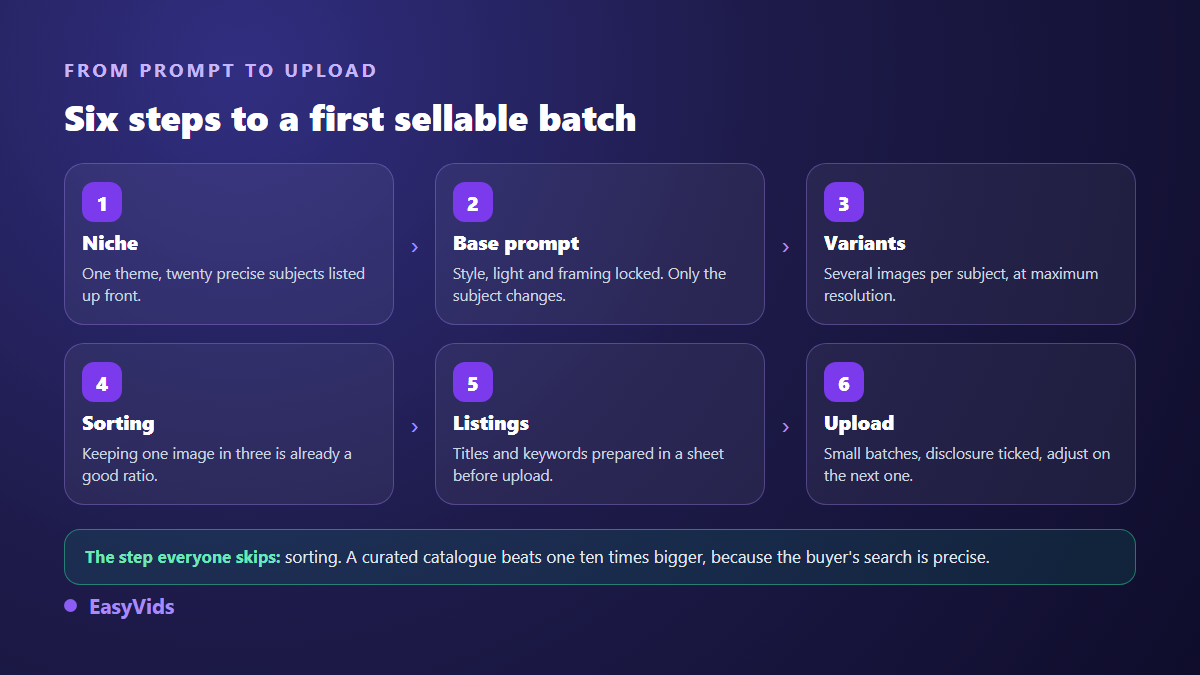
Here is the sequence we recommend for a first batch. It fits in half a day and gives a measurable result, unlike mass generation with no direction.
- Pick one niche, only one, then list twenty precise subjects inside it.
- Write a reusable base prompt fixing style, light and framing, and change only the subject from one image to the next.
- Generate several variants per subject, at the highest resolution available.
- Cull without mercy: keeping one image in three is already a good ratio.
- Prepare titles, keywords and files in a spreadsheet before uploading anything.
- Submit in small batches, log what is accepted and what is refused, adjust the next batch.
Generation is by far the fastest part. The studio produces several variants of one prompt in a single run and accepts reference images, which holds a style across a series without rewriting everything, and our AI image generator guide walks through those settings. Files then download at full resolution, ready for the submission form.
Selling outside stock libraries
Stock is neither the only channel nor necessarily the best one. Print on demand turns a visual into an object: poster, print, cushion, garment. You no longer sell a licence but a product, and the buyer judges the finished result. Digital products come next: wallpaper packs, texture bundles, illustrations sold to other creators. Then direct sales on your own page, which keep the customer relationship whole. An illustrated book belongs to the same family, with rules of its own, and the disclosure duties on Amazon KDP apply to the cover as much as to interior images.
The mistake that sinks most portfolios
Volume without direction. A thousand random images build a catalogue nobody finds, because nobody searches for « nice picture ». A hundred images on a precise theme, cleanly declined and carefully named, surface in real searches: a buyer who lands on one image from your collection comes back for the next ones.
The second mistake treats the file sheet as paperwork. On a stock library your keywords are your storefront. Describe what the buyer will look for: the concept, the use, the emotion, the space left for text. Not the name of the model that generated the picture. The logic holds elsewhere too, and our breakdown of YouTube monetisation rules for AI content shows the penalty always targets content without contribution, never the tool.
Frequently asked questions
Can you sell AI images on Shutterstock?
Not by uploading them from a contributor account. Shutterstock closed that door in October 2022 and offers its own generator instead, with a contributor fund for artists whose work fed the training data. Getty Images and iStock have applied the same ban since September 2022.
Do you have to disclose that an image was AI-generated?
On the platforms that accept it, yes: disclosure is part of the submission terms, and skipping it risks account closure. Amazon requires it for books published through KDP as well. Treat the label as one field of the product sheet, alongside the title and the keywords.
Is an AI-generated image protected by copyright?
Not automatically. The United States Copyright Office, in its January 2025 report, considers that a prompt alone does not create authorship and that a human creative contribution is required. You can still sell the image, but your protection covers what you genuinely composed around it, not the raw model output.
What resolution do stock libraries require?
Aim for the maximum your model offers. Adobe Stock asks for at least four megapixels in its contributor requirements, and a 2K or 4K output keeps you clear of technical rejection while leaving buyers room to crop.
Can you sell AI images featuring people?
Imaginary people, yes, and it is a common use. Recognisable real people, no: a celebrity, a public figure or a face traced from an identifiable photograph invites a claim. When in doubt, change the features enough that no comparison holds.
Selling AI-generated images is not a lottery. A chosen niche, a held style, a high resolution and honest disclosure are enough to clear review, and the rest is series work built batch after batch. To produce your first variants at full resolution and test a whole niche today, create a free account and run a first batch from the EasyVids studio. Plan details live on the pricing page.