You can already generate a decent video. The render holds up, the voice over works, the export is clean. One question still blocks everyone at the same point: who pays for this. Learning to sell AI-generated videos has very little to do with your technical skill. It has everything to do with how you frame the offer, who you put it in front of, and what sits inside the folder you hand over.
The demand is real and very specific: a store that needs three ads a week, a company with no shooting budget, a creator who wants to post daily without spending every evening on it. This guide walks through seven outlets that genuinely find buyers, with the typical client, the expected deliverable and how to produce it. To place video alongside the other income routes, our overview of the serious ways to monetise AI covers the wider picture.
The short answer
You do not sell AI videos, you sell a delivered outcome: a number of videos, in a defined format, for a defined platform, inside an announced deadline. The buyers who answer fastest are online stores, brands testing ad creatives, companies that need a presentation film, creators who outsource their production, and private clients for occasion videos. The turning point is never the tool. It is moving from a technician's pitch to a fixed scope offer.
What clients buy, and what they never ask about
Nobody orders an AI video. They order an ad that gets clicks, a presentation that reassures, an episode that ships on Tuesday. The model you used, the number of scenes, the way you wrote the prompt: none of that enters the decision. What enters is the visible result and the workload they no longer carry. Mastering the production chain still matters on your side, and our complete guide to AI video generators breaks down every step, but that skill stays backstage.
Seven outlets that find buyers
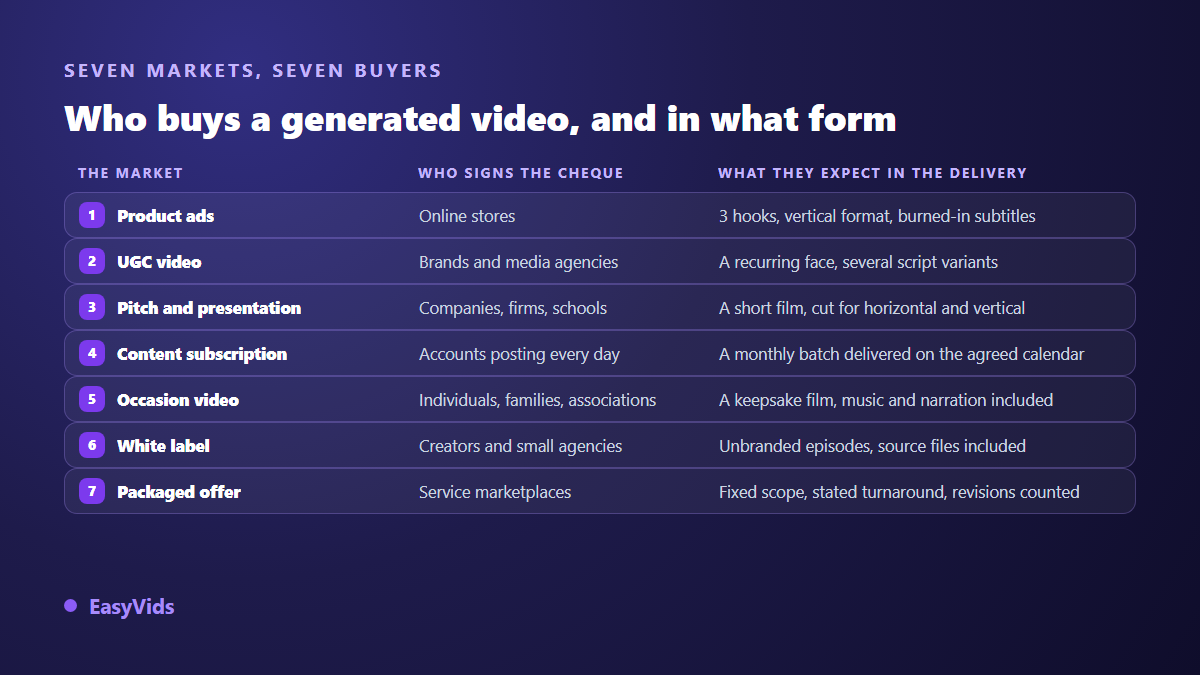
They are not equal. Some close within days because the buyer already has an advertising budget open. Others need trust, which means time. The table below sorts them by buyer and by expected deliverable.
1. Product ads for online stores
This is the fastest outlet to convert, because the budget already exists. A merchant spending on ads needs fresh creatives constantly, and each one wears out within weeks. You start from their product photos, generate several vertical versions with a different hook each time, and deliver with burned in captions. The strongest move costs you nothing: rebuild one variation on their own product before you even mention a quote.
2. UGC video for brands and agencies
A brand testing ads wants a believable face talking to camera about the product. Recruiting creators is slow, and every new variation means another shoot. Generated UGC solves that: the same character from take to take, a different script in each version. The deliverable comes down to three things, a recurring face, several testable hooks and a clean vertical format. Consistent characters exist precisely for that, holding one face across a whole run of variations.
3. Company presentation and pitch films
Plenty of organisations need a presentation film and give up when they see an agency quote. Consultancies, schools, associations, trades, software vendors: the demand is wide and poorly served. The typical deliverable is a short film of around ninety seconds, cut for horizontal on the website and vertical for social. This market pays better per unit than single ads and renews less often. In exchange it demands real writing, because a weak company film is obvious immediately and stays online for years.
4. Monthly content retainers
What actually stabilises income is not one-off sales, it is recurring commitment. An account posting daily needs a pipeline, not a video. You offer a monthly batch delivered on an agreed calendar, with the number of videos and the number of revisions written down. The benefit runs both ways: your workload becomes predictable, and the client stops comparing every order against a rival quote. It is also where batch production pays best, since your style and templates carry over month after month.
5. Occasion videos for private clients
Weddings, birthdays, farewells, tributes, announcements: these requests arrive by word of mouth and rarely get haggled over, because emotion outweighs supplier comparison. The deliverable is a keepsake film built from the photos and clips the family supplies, with music and sometimes narration. The classic trap is underestimating how long media collection takes. Ask for all the material in one go, with a deadline, before you start anything.
6. White label production for channels and agencies
Creators and small agencies already sell videos but no longer have time to produce them. They subcontract. You deliver unsigned, with source files, and you never appear in front of the audience. Volume makes up for the missing credit, and these clients come back monthly. Settle one point in the first exchange: ask where the videos will be published and under which rules, because editorial responsibility stays with your client. The monetisation rules for an AI-assisted channel are worth knowing on both sides.
7. Packaged services on freelance marketplaces
Fiverr, Upwork and their equivalents are an imperfect but real starting market: demand walks in on its own, which counts for a lot when you have neither a client list nor a reputation. The trade-off is heavy pressure on scope. Publish a narrow offer rather than a general one, with a set number of videos, a deadline and counted revisions. The same marketplaces move other deliverables from the same toolkit, as our piece on selling AI images shows. Stock libraries are a different matter: their rules on AI-generated submissions vary by platform and change often, so read the contributor page before uploading.
The delivery pack that gets you recommended
A client does not only judge the video. They judge how it arrives. One link to a badly named file reads as sloppy work, even when the edit is excellent. A tidy folder does the opposite, and it earns referrals more reliably than any follow-up email.
- Clearly named files: client, product, format, version number.
- Every requested ratio exported separately: vertical, horizontal or square depending on the platform.
- Captions delivered as a separate SRT file, on top of the burned in version.
- A clean version with no on-screen text, for when the client wants to translate or rework it later.
- A short note restating the agreed scope, the revisions left and the usage granted.
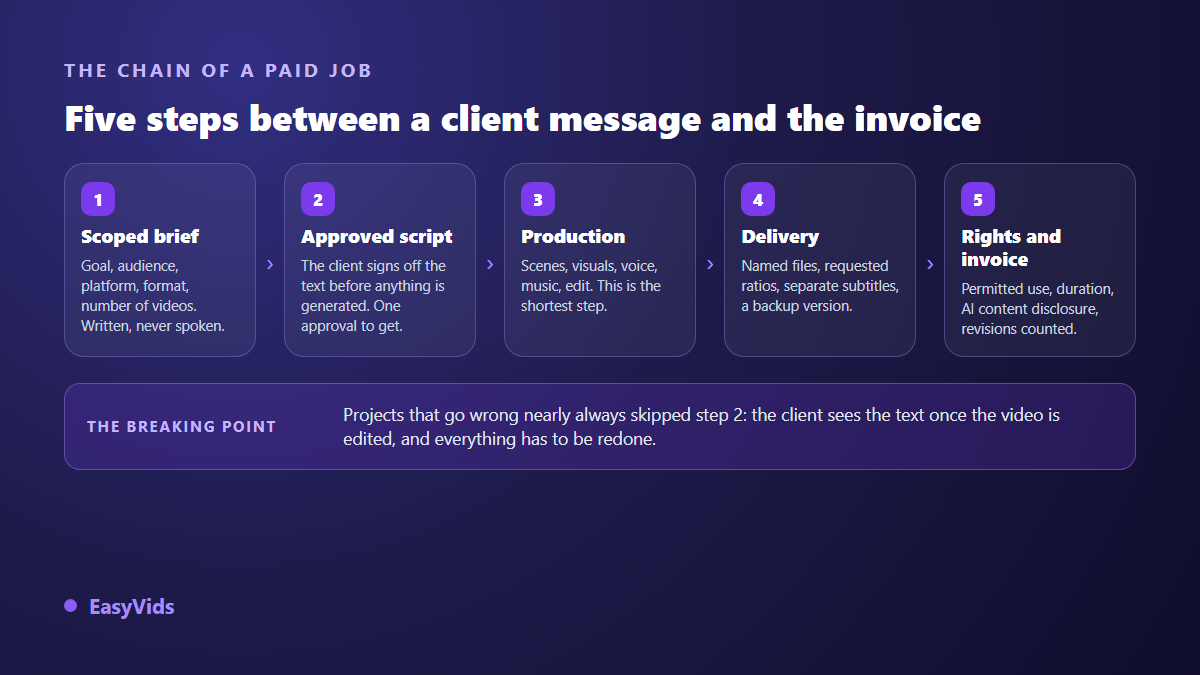
The step that rescues the most projects is the second one: get the text signed off before you produce anything. Across our own productions, the expensive back and forth almost always comes from a client discovering the script once the video is already edited. Written approval takes minutes to obtain and turns everything after it into plain execution.
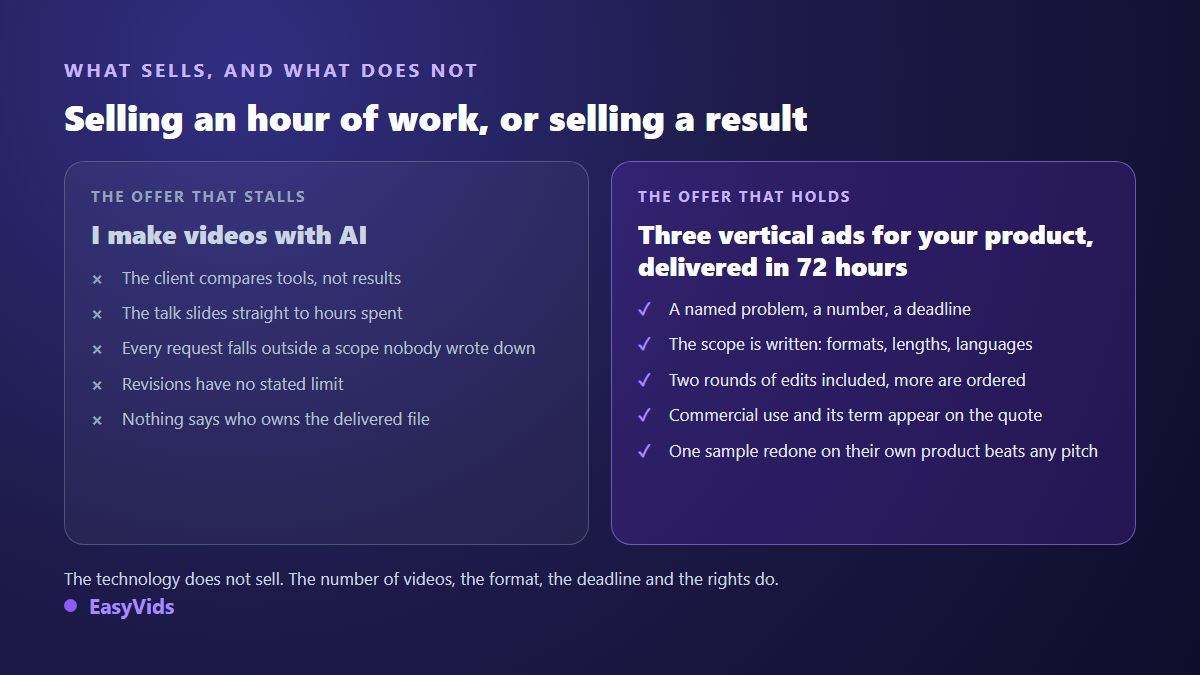
Price the deliverable, not your hours
Billing by the hour punishes you for being fast, which is the exact opposite of what you want when speed is your advantage. Sell a deliverable: a number of videos, a format, a deadline, a number of revisions. The client knows what they are buying, you know what you owe, and the conversation stops being about your calendar. Think about basket size too, since an ad rarely sells alone: it travels with a vertical cut, a cover visual, sometimes a thumbnail. On costs, keep track of what each project consumes. A credit system lets you draft with a fast model and finish with a stronger one, and our plans are laid out on the pricing page.
Rights, disclosure and what you cannot resell
Before any commercial work, check what your studio's terms allow. At EasyVids, article 4 of the terms states that the content you generate belongs to you, within the limits of the rights granted by the underlying model providers, and that you may use it commercially. The same page forbids reselling access to the service without a written agreement. In short: you sell your videos, never accounts or access to the tool.
On the distribution side, platforms expect disclosure. According to the YouTube Help Centre, creators must flag realistic content that was generated or altered with digital tools inside YouTube Studio, and the platform then shows a label to viewers. TikTok's community guidelines apply comparable logic to realistic AI-generated content. In Europe, article 50 of the AI Act sets a transparency obligation for generated or manipulated content, applicable since August 2026. Put these points in the quote rather than after delivery: your client needs to know what they will have to declare. Two checks never delegate either. Never use a real person's face or voice without written consent, public figures included, and make sure the music cleared for commercial use on the target platform, otherwise the claim lands on your client and then on you.
Landing your first three clients with no ad budget
Your first client will not come from an advert. They come from a targeted demonstration. Pick ten businesses whose videos are weak, rebuild one of them for a single company, and send it with no strings attached. The reply rate on finished work bears no relation to the reply rate on a standard cold message.
Frequently asked questions
Is it legal to sell an AI-generated video?
Yes in the vast majority of cases, on three conditions: respect the terms of the tool that produced it, respect the rights of the people and brands appearing on screen, and respect the disclosure rules of the platform where it will run. The overlooked risk is rarely the footage itself, it is the music and the faces.
Should you tell clients the video is AI-generated?
Yes, and it belongs in the quote. It is not a weakness to hide: it explains your turnaround and your ability to deliver several variations of the same message. It is also practical, since your client may have to declare the content at publication time depending on the platform.
How many videos can one person deliver per week?
Far more than traditional production allows, provided you never start from scratch. The real constraint is no longer rendering, it is review and client communication. An organised freelancer with script templates and a fixed visual direction sustains several short videos a day without losing quality.
Which outlet pays fastest for a beginner?
Product ads for online stores, without hesitation. The budget exists, the need renews weekly, and the demonstration is immediate since you can rebuild a creative from the merchant's public photos. Company films pay better per unit, but the decision cycle is much longer.
The real work is not producing better videos than everyone else. It is writing an offer someone can buy in one sentence. Pick one outlet from this list, write down the exact scope of what you deliver, then build a demonstration for one specific company before contacting anyone. To produce that first demonstration today, create your account and use the full studio, from script to final edit.