Your ebook is finished. The file looks good, the cover works, and one question is left: how do you sell ebooks without a website? Setting up a store, picking a host, wiring a checkout, arranging file delivery after payment, that is weeks of work and a skill you may have no interest in learning for a first book.
Here is the good news: a website was never the essential piece. It performed four specific jobs, and each one now has a replacement you can set up in an evening. This guide starts from the moment your file exists. If you are not there yet, our complete guide to writing an ebook with AI covers the step before, from choosing the subject to a laid out file.
Selling an ebook without a website: the short answer
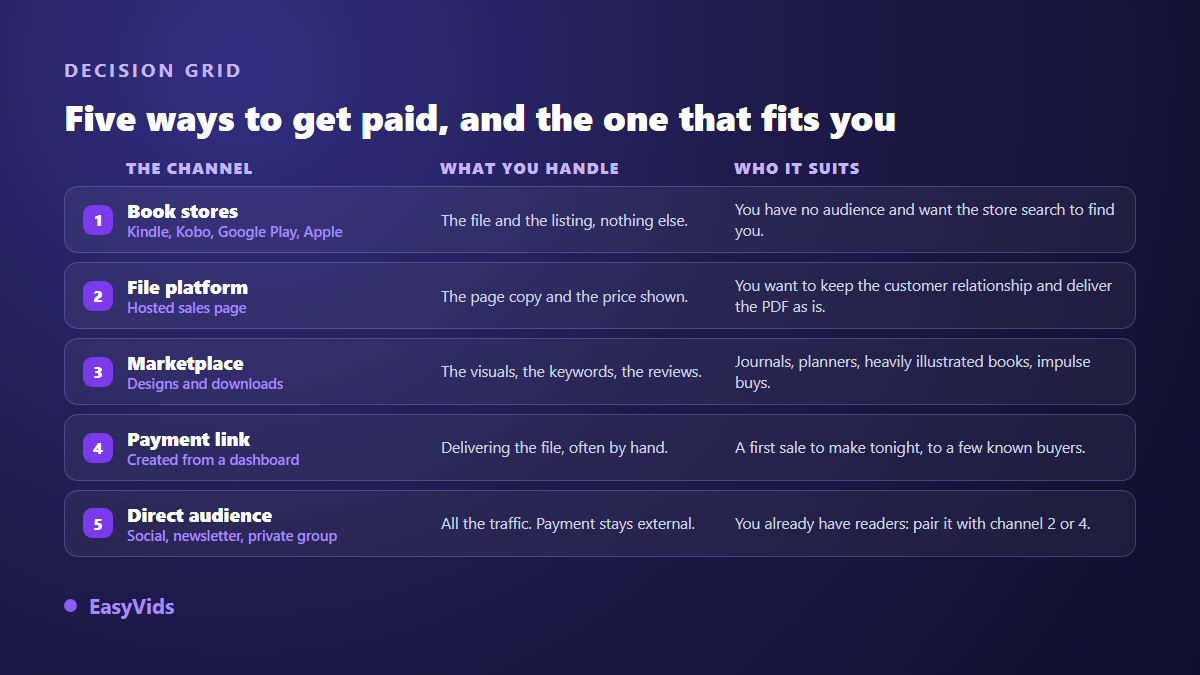
You have five channels, from the most hands off to the most manual: the online bookstore, the digital product platform, the creative marketplace, the standalone payment link, and direct selling to an audience you already own. The first three host your page, take the payment and deliver the file for you. The fourth takes the money but leaves delivery to you. The fifth brings buyers and never handles payment, so it always pairs with another one. For a first sale this week, open an account on a digital product platform, upload your PDF, write the page, share the link.
What a website actually did, and what replaces it
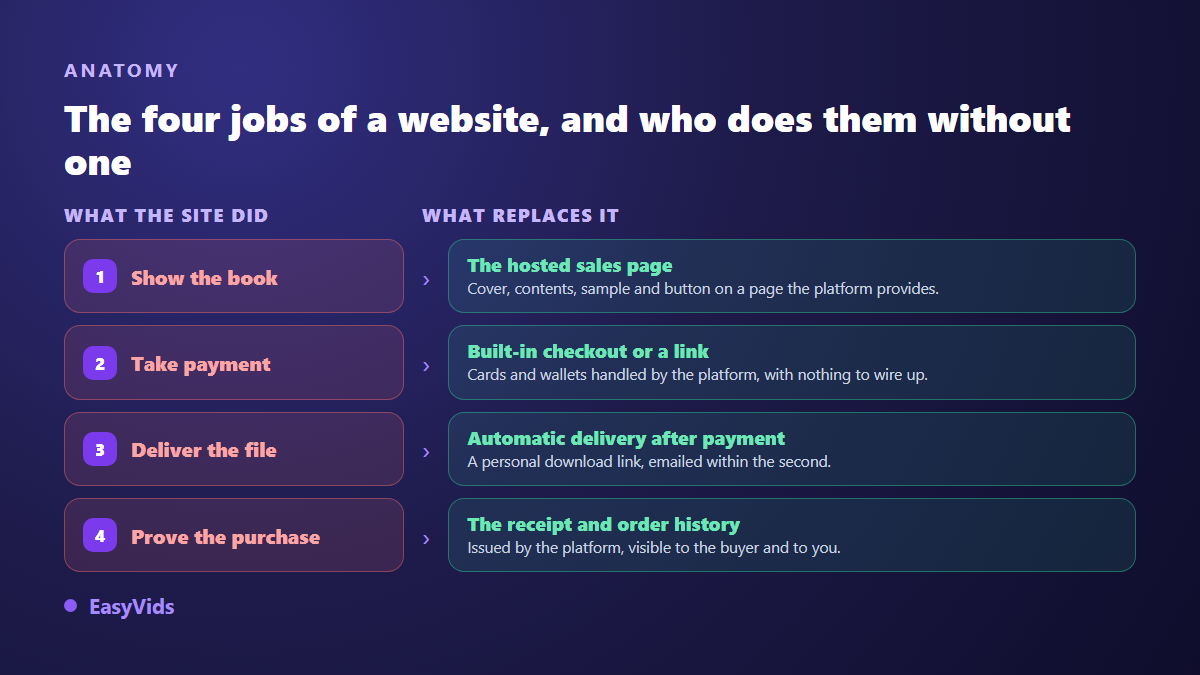
A storefront is not one object, it is four jobs bundled together: show the book, take payment, deliver the file, prove the purchase. Seen as a block, they look out of reach. Taken apart, each one has an immediate replacement, free or inexpensive.
Option 1: the online bookstore
You hand your book to a distributor, it becomes a listing inside a busy store, and the store handles everything else. Amazon KDP, Kobo Writing Life, Google Play Books and Apple Books all work this way, with no entry fee and no site on your side. The real advantage is not the checkout, it is the traffic: readers are already typing your subject into the store's search bar.
Two trade offs. The distributor keeps a share of every sale, published on its royalty page, and it dictates the format. According to the Kindle Direct Publishing help pages on manuscript formats, the Kindle store expects a reflowable file whose text adapts to the screen and to the reader's font settings. Your laid out PDF does not belong there, keep it for direct sales. Filing rules and the AI content disclosure box are covered in our article on Amazon KDP and AI written books.
Option 2: the digital product platform
These services exist for exactly one purpose: selling a file when you have no website. You create an account, upload your PDF, write the page copy, set your price, and you get a public address to share. Gumroad, Payhip and Ko-fi belong to this family. As soon as payment clears, the buyer automatically receives a download link, and you keep their email address.
For a first book this is the best compromise, for three reasons. Your PDF ships as it is, with no conversion and no layout loss. The page looks like a real sales page, with cover, description, sample and button. And you keep the relationship with your buyers, which the big stores never allow. In exchange, nobody finds you on their own: here, the traffic is yours to bring.
Option 3: the creative marketplace
Marketplaces for handmade and creative goods accept digital downloads, and their shoppers mostly look for printable products. A heavily illustrated book, a guided journal, a planner or a workbook sells far better there than a two hundred page essay. Disclosure rules for AI assisted products change regularly on these platforms: read the seller standards page of the marketplace you target before publishing your listing. If that format appeals to you, our guide to low content books covers what sells and how to build it.
Option 4: a payment link on its own
This is the fastest route, and the most manual. Consumer payment processors let you create a checkout link from their dashboard, with no code and no website. You paste that link into a message, a post or your profile bio, the buyer pays, you get the notification. The limit is blunt: the link collects money, it does not deliver. You send the file by hand, or you set a confirmation page that points to the download. That works fine for ten buyers, far less for a hundred. Treat this channel as a way to validate the book before you spend an evening on a proper sales page.
Option 5: selling to an audience you already have
A channel, a social account, a newsletter or a private group beats a website: those people already read you. Your page link goes in the profile bio, at the end of a video, in your message signature. One confusion is expensive here: this audience brings buyers, it collects nothing. It always pairs with option 2 or option 4.
The file you deliver decides your refunds
A disappointed buyer rarely complains about the content. They complain about the presentation. A PDF with no title page, no table of contents and no page numbers reads like a document exported in a hurry, however carefully it was written. On books produced with our writing workshop, the layout is composed on the server before download: every chapter opens on a fresh page, and the table of contents is clickable with real page numbers.
- A title page carrying the title, the subtitle and your author name.
- A clickable table of contents, which doubles as an argument on your sales page.
- Real page numbers, essential the moment a reader wants to quote a passage.
- A full page cover, matching the page proportions, with nothing cropped off.
- A credits page: version date, contact address, terms of use for the content.
- A clean file name carrying the book title, never "final document v3".
A sales page fits in seven blocks
Without a website, your sales page is a plain text field on the platform you chose. Its length matters less than its order. Readers decide in about thirty seconds, and they look for the same information in the same sequence every time.
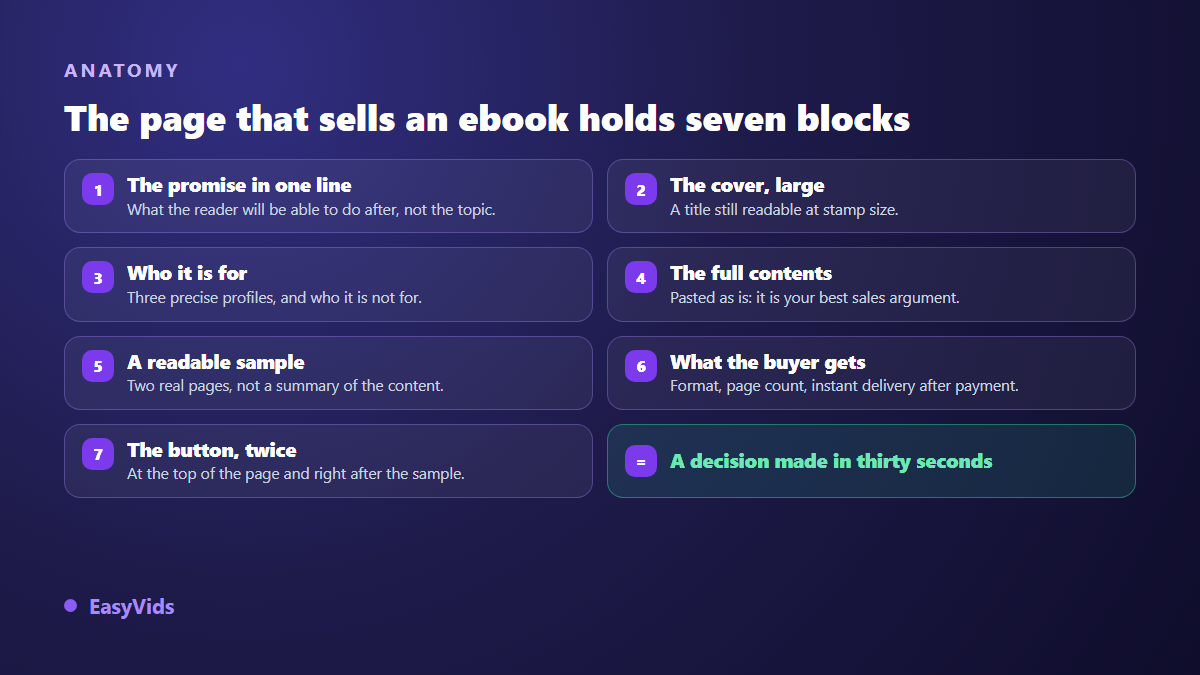
Two blocks are systematically skipped, and they carry the most weight: the full table of contents, pasted as it is, and a genuine two page sample. The first shows the scope of the work, the second proves the reading is pleasant. Nothing replaces a sample when the buyer does not know you yet.
The visuals that decide the click
Your cover will be seen small: in a search results list, in a social feed, in a private message. A title that stays readable at stamp size beats a gorgeous illustration nobody can decipher. Then plan three variants, because every place you talk about the book asks for a different shape: a square thumbnail, a wide banner, a full screen vertical. In our ebook workshop those three creatives are composed from the generated cover at 1080 by 1080, 1600 by 600 and 1080 by 1920 pixels, with the title drawn as real text over the image rather than generated by the model, which is the only way to get clean letters. Our guide to illustrated AI ebooks explains why image models write so badly.
What you cannot prevent
Be clear about protection. A PDF sold as a download can be reshared, and no setting makes that impossible. Serious platforms cap downloads per buyer and issue personal links, which discourages casual sharing but not determined sharing. Treat it as an acceptable loss and spend your energy on the content and on updates instead. One habit pays off: date your version on the credits page and keep a contact address, so you can send a second edition to early buyers for free.
Rules worth checking before your first sale
Three points, in this order. AI disclosure first: according to the Kindle Direct Publishing help pages, a book whose text or images were generated must be declared during the publishing form. Your seller identity next: platforms ask for tax information before the first payout, so prepare it in advance. Local obligations last, which depend on your country of residence rather than the platform's. Ask the relevant authority before you publish, since that is the only source that applies to your situation.
Frequently asked questions
Can you really sell ebooks without a website?
Yes, and it is the most common setup among independent authors. Bookstores and digital product platforms host the page, take the payment and send the file. A website becomes useful later, once you sell several titles and want your catalogue in one place.
Which file format should buyers receive?
For direct sales, a laid out PDF is perfect: it opens everywhere, on phones and computers, and your layout is respected exactly. For an e reader store you need a reflowable file whose text adapts to the font size the reader picks. Many authors end up offering both.
Do I need a registered business to sell an ebook?
That depends entirely on your country of residence and on how regularly you sell. Platforms will ask for tax details to pay you, but they never rule on your legal status. Ask the relevant authority before your first sale rather than after.
How do I set a price with no reference point?
Look at comparable books in the store you target, on the same subject and with a similar page count. A practical book that saves the reader time sits higher than a narrative one. And remember a price takes two clicks to change: start, watch the sales, adjust.
How long between a finished file and a first sale?
On a digital product platform, a few hours: the page is live as soon as you save it. On a bookstore, expect a review delay, which the Kindle Direct Publishing help pages state can run up to seventy two hours. The real wait is not technical, it depends on the day you start talking about the book.
A website is a consequence of sales, never a condition for them. Pick one channel, upload the file, write the seven blocks of your page, then give yourself a week to make the first sale. You will learn whether your subject finds its reader, which no website could have told you faster. If the book is still to be written, creating an account opens the writing workshop, the illustrations and the cover in one place, and the EasyVids studio takes care of the promotional video afterwards.