You have scrolled past it a hundred times: bold captions marching up the screen, a calm voice recounting a family betrayal, a loop of gameplay running behind it. Reddit story videos pull in millions of views a day, and the recipe looks simple enough to copy in one evening. Reality lands around week three, when views collapse or monetisation is denied without much explanation.
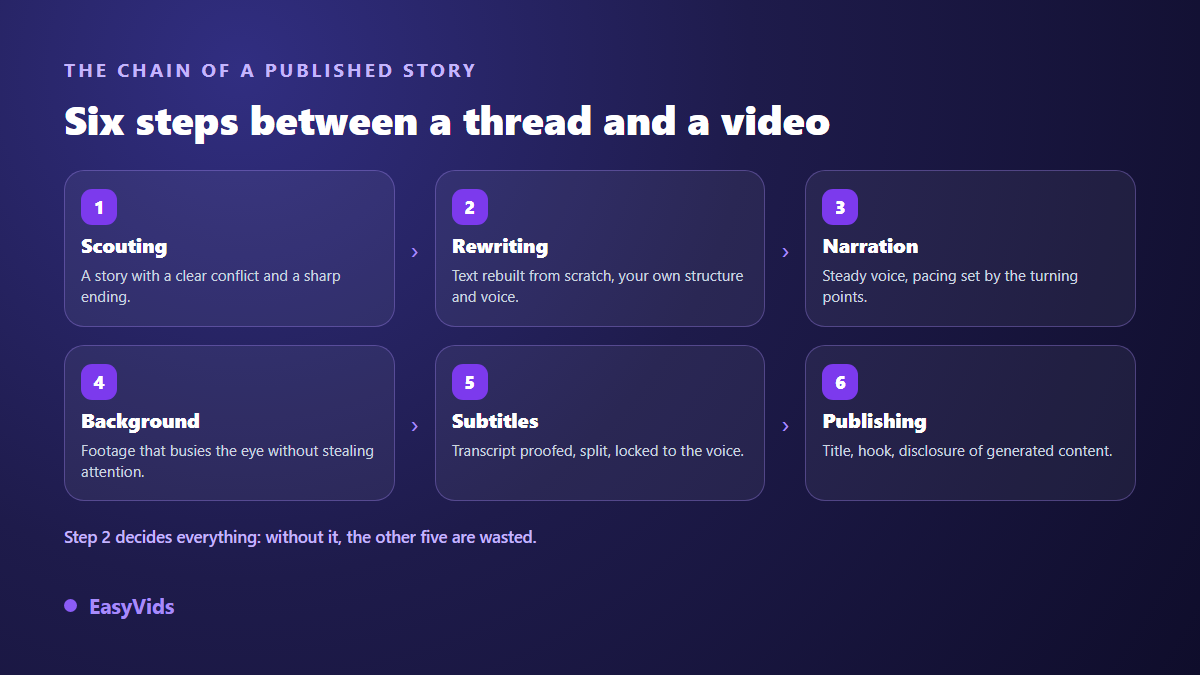
The failure is almost never technical. It comes from what most new channels do on day one: take somebody else's text, run it through a synthetic voice, publish. That shortcut creates two separate problems, one legal and one commercial, and they always end up meeting. This guide covers both, then walks the rest of the chain: picking the story, narration, background, captions, and publishing rhythm.
The short answer
A story video tells one short, intense narrative carried by a voice over, highly readable captions and a deliberately quiet background. The forum post is not yours: you keep the situation, you rewrite the wording completely, and you change every name or detail that identifies a real person. Production and editing come next, and an AI video studio compresses them dramatically. One rule decides whether the channel survives: platforms pay for original work, not for recycling.
Why short personal stories hold attention
The appeal has nothing to do with the synthetic voice or the gameplay behind it. It comes from the structure of the story itself. A post that climbs a forum already contains what a screenwriter hunts for: a first person narrator, a moral dilemma, an antagonist, a twist, and an open question. Thousands of readers did the filtering before you ever opened the tab.
First person adds its own pull. The viewer starts asking what they would have done, and that single question carries them to the ending. Comments turn into a courtroom, which lifts engagement and stretches watch time. You are not distributing information, you are handing out a verdict to reach. That has a direct consequence on production: everything that is not the story must get out of its way.
Picking a story worth telling
Popular does not mean filmable. A post can grip you on the page and collapse out loud, because the eye can go back while the ear cannot. These are the filters that separate a usable story from an entertaining one.
- A first person narrator involved in the events, not a bystander reporting them.
- A conflict stated in the first three sentences, with no long setup.
- Stakes anyone understands without context: family, money, work, friendship, neighbours.
- At least one twist in the middle, or attention drops halfway through.
- A clean ending, even a bitter one. An unresolved story costs you subscribers.
- Sensible length, because a huge post cuts badly and loses its rhythm in the edit.
- Nothing sensitive: explicit violence, sexual content, a child at risk, an identifiable case.
One more filter saves wasted work: check whether the story has already been told. The most visible posts get narrated by dozens of channels within days. A quieter story told well always beats one your audience heard three times last week. The same spotting work carries over to neighbouring formats, and our guide to a faceless true crime channel shows how it applies to criminal cases, where the sources are public.
Rewrite, never copy
Here is the section most tutorials handle in two lines. A forum post belongs to the person who wrote it. The host gets a licence to display and distribute it, but that licence does not pass to you, and it certainly does not authorise a monetised video built on the text. The principle is stated plainly in the platform's own user agreement, which confirms that authors keep the rights to what they post.
The good news sits in a simple distinction: ideas, situations and facts are not protected, expression is. You may tell the same story, provided you rebuild the text end to end in your own words, your own order, your own point of view. This is not cosmetic paraphrasing where every third word gets a synonym. It is a rewritten story that keeps nothing but the shape of the original.
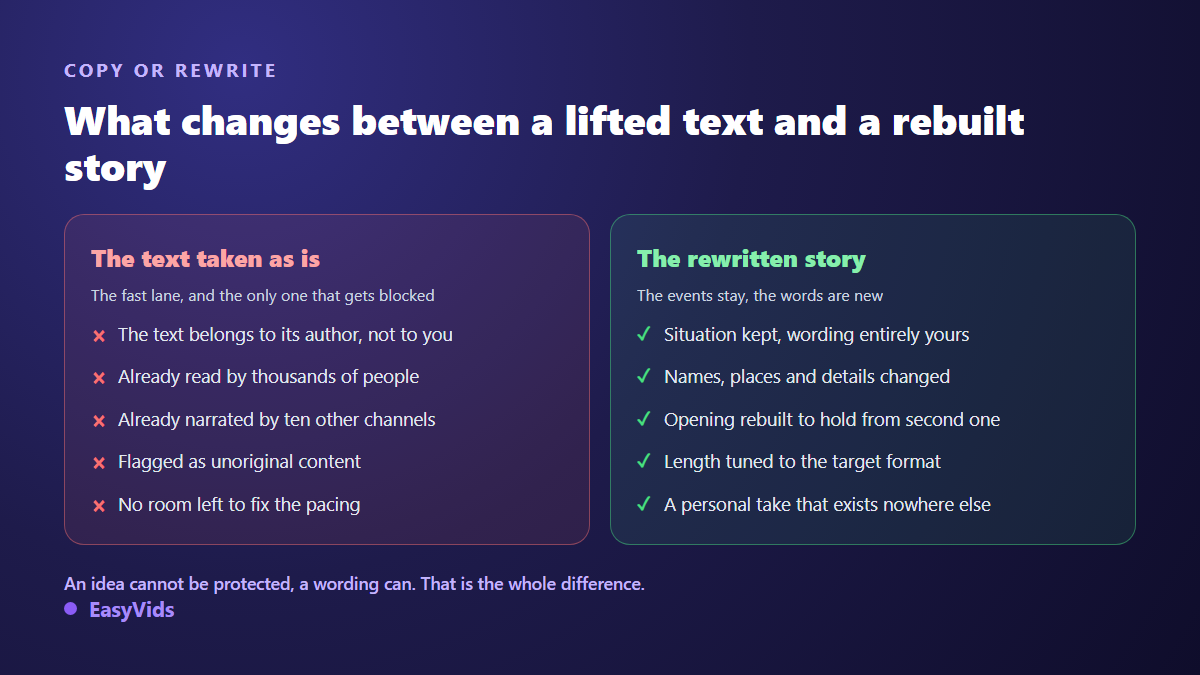
In practice the rewrite always follows the same moves. Change names, places and ages, because nothing justifies exposing real people to an audience they never chose. Rebuild the opening, since the first seconds decide the rest and a post written to be read rarely starts in the right place. Then add what the original lacks: framing, a personal observation, a reworded ending. Our writing tool runs a multi pass mode where a first draft is reviewed by a critical editor, corrected, then checked before delivery, which avoids the flat prose of single shot generation.
Narration is what actually carries the story
The voice is the only actor in your video. Too fast turns a drama into a news bulletin; too slow loses the viewer before the first twist. The workable range sits around one hundred and forty to one hundred and sixty words per minute for narrative, slowing down on the lines that carry a revelation. We covered this in our guide to natural sounding AI voice over, where most of the work happens in the writing rather than the settings.
Two decisions matter more than the rest. Timbre first: a female voice narrating a male narrator creates a dissonance viewers feel without naming it. Punctuation second, because it is your only tempo control. A full stop makes a real pause, a comma a breath, an ellipsis a hesitation. Write punctuation for the ear, not for the grammar book.
- A voice consistent with the narrator, in gender and apparent age.
- A steady pace that slows on revelations and numbers.
- Short sentences, because what reads well does not always hear well.
- No raw acronyms or abbreviations, which synthetic voices mispronounce.
- A full listen before publishing, eyes closed: tone errors are heard, never seen.
- One narrator per video, unless dialogue justifies a clearly separate second voice.
The background: occupy the eye, do not steal it
The background has exactly one job: stop the eye from leaving. It tells nothing and must tell nothing, because any attention it takes is attention lost from the story. That is precisely why repetitive gameplay took over the format. It moves constantly while demanding nothing.
- Continuous slow motion, with no hard cuts and no bright flashes.
- Low contrast, so captions stay readable on top of it.
- No text baked into the background: it competes directly with the caption.
- A stable palette across videos, which is what gives a channel its identity.
- Nothing recognisable that belongs to someone else: logos, brands, licensed characters.
- A shot that works muted, since the background never needs its own audio.
Generated backgrounds change one thing that matters: they are yours. Captured gameplay remains a publisher's creation, and its reuse depends on rules you do not control. Shots produced from your own instructions, or stills animated with a slow camera move, avoid that ground entirely and give the channel a look people recognise from the thumbnail. The same reasoning applies to sound: a bed produced for your own channel avoids rights claims, and our guide to AI music generation explains how to get an instrumental that never covers the voice.
Captions are the spine of the format
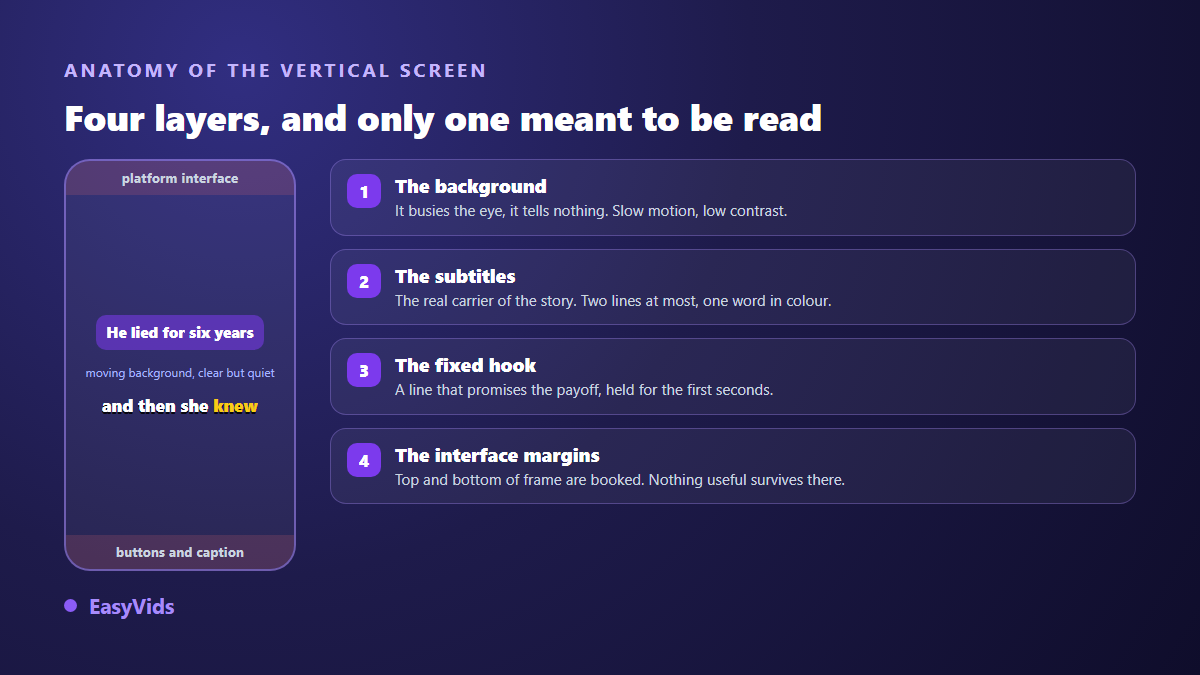
Here captions are not an accessibility extra, they are the primary medium. A large share of the audience watches muted and reads the story instead of hearing it. Sloppy captions do not trim your audience at the edges, they erase it.
Three rules hold the standard. Two lines maximum, never three, and a short line beats a full one. Place the text in the middle of the frame rather than the bottom, where the interface and its buttons cover everything useful. Break lines on meaning, never inside a noun phrase. The online editor transcribes your narration and returns a timed caption file you correct before burning it in, and that review takes minutes while removing the mistakes that make people swipe away. Keep the file next to the project even when you burn the text in: it is your fallback for descriptions, translations and reposts.
The originality platforms actually require
This is where most story channels stop, and rarely for the reason they assume. Monetisation depends on an authenticity requirement: content must be original and add something, not simply assemble material produced by others. The rule is public and documented in YouTube's criteria on inauthentic content, which explicitly targets mass produced, repetitive output.
Three consequences follow. A copied text read by a synthetic voice ticks every box for refusal. A channel whose videos are identical in structure, background and delivery starts to look automated even when the texts are genuinely rewritten. And using AI is not banned: what gets penalised is the absence of human contribution. Disclose realistic generated content at upload, keep a record of your rewrites, vary your angles. Common usage questions are answered in our FAQ.
What a story channel really earns
Nobody can promise you an income, and any number you find elsewhere deserves suspicion. A story channel earns through platform ad revenue, through branded content once an audience exists, and through your own digital products. The last two usually pay better than the first, and both demand an audience that trusts you, which means a channel with a recognisable voice. The real budget is time, not equipment: spotting, rewriting, narrating, backgrounds, captions, publishing. We put the orders of magnitude side by side in our breakdown of what a video really costs, and the plans themselves live on the pricing page.
Producing in batches
Channels live on consistency, and making one video at a time is the surest way to quit within a month. Work in batches: one session to fill a backlog of stories, one to rewrite, one to produce. Our step by step guide to publishing on YouTube describes that rhythm, and it transfers almost unchanged to story content.
- A backlog of at least ten spotted stories before the first video is produced.
- A reusable skeleton: hook, setup, escalation, twist, ending, closing question.
- Sessions grouped by task type, never one whole video from end to end.
- One background style and one caption style, decided once and replayed.
- A pre publish check: caption spelling, audio level, generated content disclosure.
- Two weeks of finished videos in reserve, the only real defence against a busy week.
Frequently asked questions
Can I use a Reddit story without permission?
You can retell the events; you cannot reproduce the text. The author keeps the rights to what they wrote, and the host cannot hand you that right. The safe practice is a full rewrite in your own words, with names, places and identifying details changed.
Should I credit the original post?
Crediting is not permission: a mention does not make wholesale reuse lawful. Saying that a story is inspired by an account read online is still honest with your audience and protects you from accusations of inventing events. Do both: rewrite, and stay transparent about the origin.
Are story videos monetisable?
Yes, when they are original. Narration laid over a copied text and a borrowed background falls squarely under the inauthentic content rule. A rewritten story, worked narration, visuals you own and a personal comment change the case entirely.
How long should a story video be?
Two formats coexist. Short vertical, around a minute, demands a story stripped to the bone and a hook in the first second. Long horizontal collects several stories around a theme and lives on cumulative watch time. Start short: it teaches rhythm faster and mistakes cost less.
Own voice or generated voice?
If you enjoy recording and your voice carries, keep it as a signature. Generated voices win on consistency, on languages you do not speak, and on days when you are hoarse. Plenty of channels mix both: a generated voice for the story, their own for the closing comment.
A story channel is not defined by its tools but by two moves nobody will automate for you: choosing a story worth three minutes of attention, and rewriting it enough that it becomes yours. Narration, background, captions and export fall into place once the method exists. Pick one story this week, rewrite it completely, produce a single video, then watch exactly where viewers drop off. The EasyVids studio keeps writing, voice, visuals and editing in one place, and creating an account lets you test your first story today.