Your videos collect views and your store stays quiet. That is the most common situation in ecommerce, and it rarely has anything to do with the product. Most TikTok ad examples worth copying share one trait: they earn attention in a feed where nobody asked to see them, then walk a stranger to a buying decision in under thirty seconds.
None of that is improvised. These videos follow a small number of recognisable patterns you can repeat across an entire catalogue. This guide breaks down seven formats that hold up, the structure behind them, the platform rules worth knowing, and how to produce each variation without filming. If you are starting from scratch, our complete guide to product video covers the fundamentals that apply to every marketplace.
The short answer
A TikTok video that sells has four beats: a visual hook inside the first three seconds, a problem the viewer recognises instantly, proof shown in close up, and one single call to action. The frame is vertical, the useful length usually sits between fifteen and thirty-five seconds, and the video has to make sense with the sound off. The seven formats below are seven ways to fill those four slots, depending on the product and on your buyers' main objection.
Why a TikTok ad works nothing like a normal ad
On a product page, the visitor is already curious. In a TikTok feed, nobody is waiting for you. Your video competes with a cat, a recipe and a joke. The consequence is blunt: the sales argument starts after attention is won, never before. A video that opens on a logo or a polished packshot has already lost half its audience.
The second difference is tone. TikTok sums up its own advice to advertisers with the line that has become the signature of its TikTok for Business hub: do not make ads, make TikToks. In practice that means a handheld frame instead of a tripod, a voice talking to one person rather than an audience, a fast cut, and the product used in a real situation instead of floating on white. An ad that looks like an ad gets scrolled past.
The first three seconds decide everything else
What you show before the third second determines the rest. Not what you say: what you show. An unusual gesture, a broken object, a result already visible, a hand doing something unexpected. On screen text reinforces the image, it never replaces it, because viewers read faster than they decide to stay.
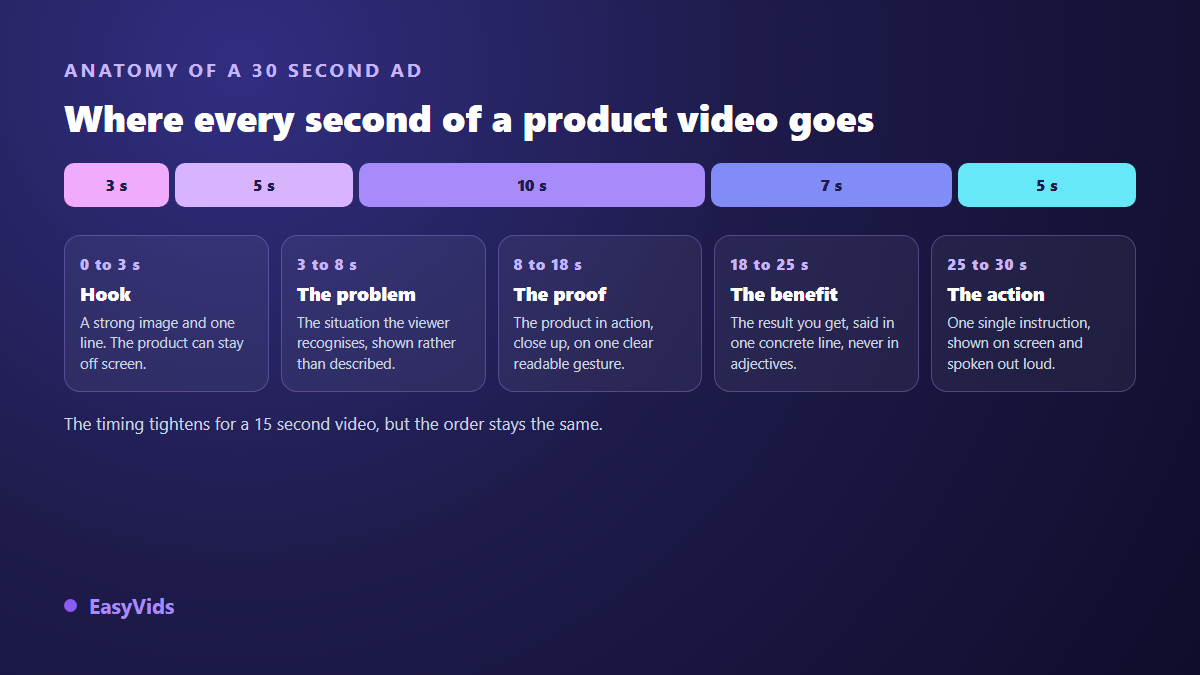
The rest follows one logic: show before explaining, explain before asking. Proof takes the biggest block of time because proof is what converts a lukewarm viewer. The call to action lands last, holds one instruction, and works better shown on screen as well as spoken. Two competing instructions in one video means zero instructions followed.
Seven product video formats that convert
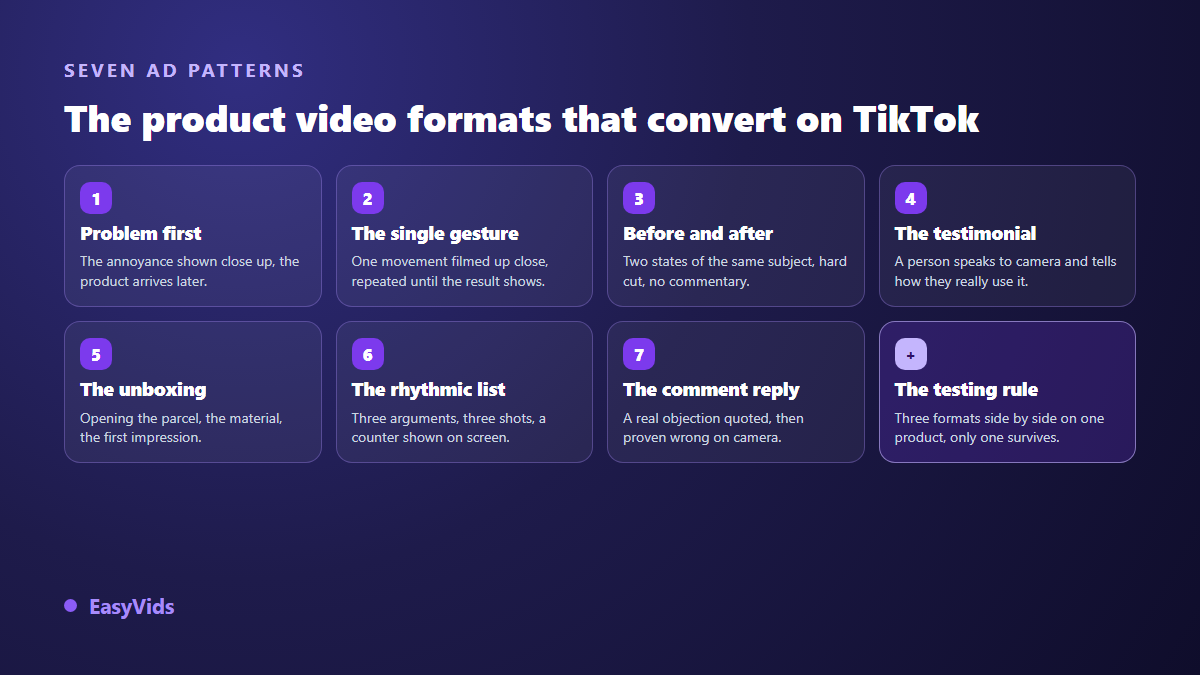
None of these seven patterns beats the others in the abstract. Each one answers a specific blocker in the buyer's head: they do not understand what it does, they doubt it works, they worry about quality, they cannot picture themselves using it. Pick the format that addresses the dominant blocker, not the one you find prettiest.
1. Problem first, product second
The video opens on the annoyance, shot close: the zip that jams, the tangled cable, the stain that will not lift. The product only appears around the sixth second, once the viewer has recognised themselves. It is the most versatile pattern, and the only one that works when your product solves a problem people stopped noticing years ago.
2. The single gesture demo
One movement, filmed in close up, repeated until the result lands. The product folds, absorbs, cuts, clicks into place. No voice over in the opening seconds, just the sound of the gesture. This format wins when the value is visible in three seconds, and fails when it needs explaining. Test it as a single shot first: if the demo does not hold on its own, no edit will rescue it.
3. Before and after
Two states of the same subject, split by a hard cut. Its strength is legibility, since the viewer understands without a word. Its weakness is credibility, because the device is worn out and audiences suspect staging. The fix is to show the transition rather than the two extremes, even for a second, and to keep identical framing, lighting and angle on both sides.
4. The face to camera testimonial
A person talks to the camera, with no visible script, and describes a real use. This is the format that reassures on quality and service, so it belongs wherever your sales stall on trust rather than on understanding. The three part structure that works, doubt then use then result, is laid out in our method for customer testimonial videos, and it transfers straight to vertical.
5. The unboxing
The parcel opening, the material felt between fingers, the first reaction. This one sells the delivery experience as much as the product, which makes it obvious for anything judged by touch: clothing, cosmetics, stationery, accessories. It demands real care on lighting and sound, because the rustle of the paper and the sharpness of the close up carry the emotion.
6. The rhythmic list
Three arguments, three shots, a counter on screen. The format gives viewers an explicit reason to stay: they are waiting for point three. Keep three items, never five, and make the last one the strongest. Every argument has to be shown, not listed, or the video collapses back into a conventional commercial.
7. The comment reply
You quote a real objection on screen, then answer it in pictures. It is the most native pattern on the platform, the one that looks least like an ad, and the only one that turns a public doubt into a selling point. It does require having published already, which makes it an excellent second cycle: the objections under your first videos become the scripts for the next ones.
Frame, length and the zones the interface covers
Vertical is not an aesthetic preference, it is the entry ticket. The ad specifications published by TikTok Ads Manager recommend a 9:16 ratio at 1080 by 1920 pixels, and a video uploaded in 16:9 arrives wrapped in bars that make it look recycled. Exact dimensions, accepted codecs and maximum file weight are gathered in our TikTok video format sheet.
The second reflex is the safe zone. TikTok publishes one in its advertiser resources, because the handle, the caption and the button column eat the bottom and the right edge of the frame. Anything important placed there, an offer, a logo, a key line of text, disappears on half the devices. Keep your information in the central third and check on a real phone before publishing.
Sound is part of the sales argument
TikTok is the platform where sound matters most, and also the one where it carries the most legal weight. Its help centre is explicit: the general catalogue is meant for personal use, while business accounts get a commercial music library built for promotion. A selling video cut over a borrowed trending sound risks losing its audio, or the whole post. A track generated for you, or one from the commercial library, settles the question for good.
Captions are not an extra
Part of your audience watches with the sound off. Another part has sound on and still reads, because on screen text speeds up comprehension. Either way, short and sharp captions placed clear of the interface buy you watch time, and watch time drives distribution. Automatic transcription handles the first pass, and your job is trimming and placement.
Producing all seven formats without filming
The real obstacle is logistics, not creativity: seven formats across a catalogue means dozens of shoots. This is where generation changes the maths. From one clean photo of your product used as a visual reference, a generator produces vertical shots of a few seconds that keep the shape, the colour and the label of the object. You describe the scene, the light and the gesture, and you get the shot without ordering a sample or booking a studio.
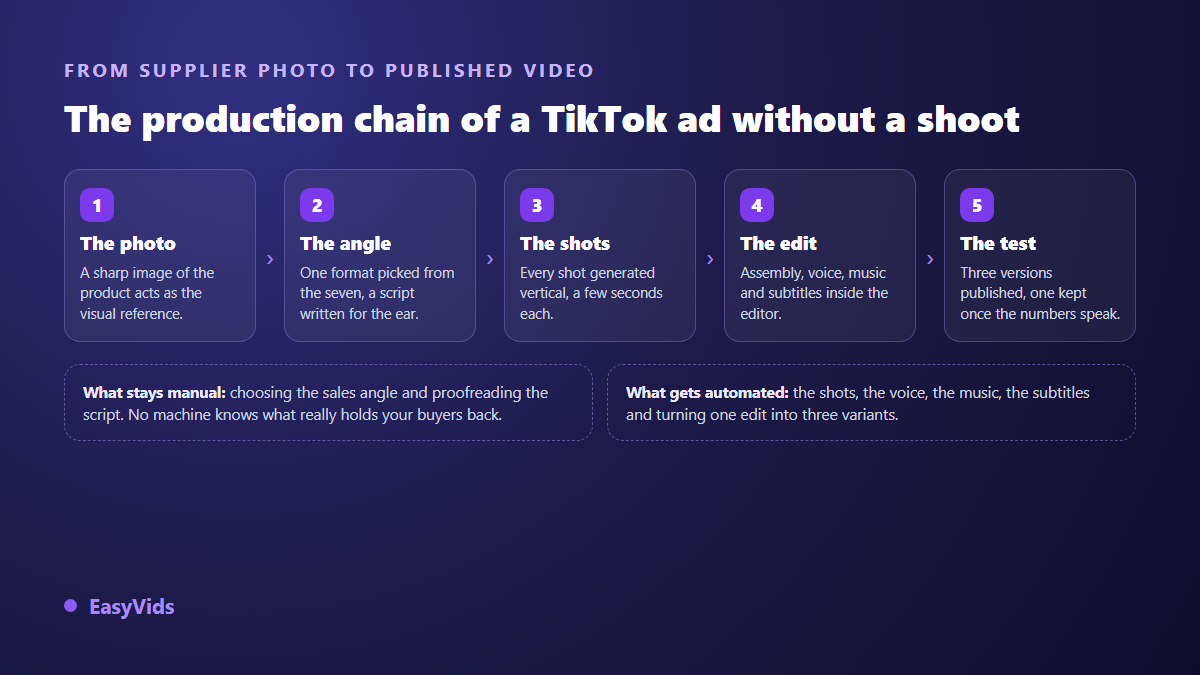
Assembly follows the same path. Generated shots, voice over, music and captions come together in an online editor, where automatic transcription writes the captions from the audio of the edit itself. The approach mirrors our UGC production method for dropshipping, applied here to vertical. The whole studio runs in the browser, and the plans are laid out on the pricing page.
Three variations beat one perfect cut
The costliest mistake in method is polishing a single video for two days. Nobody knows in advance which pattern will sell: the testimonial wins on one product, the demo crushes everything on the next. Publish three angles of the same product, change one variable at a time, and let the numbers decide. The full testing logic sits in our winning product validation method.
- Keep the same offer and the same call to action across all three variations, or you are no longer testing the format.
- Change one element between two versions, usually the hook in the first three seconds.
- Let them run long enough for the numbers to mean something.
- Read the retention curve before the view count: a sharp drop at second two condemns the hook, not the product.
- Keep the winner, split it into three new variations, and start again.
What TikTok asks when the video is AI generated
TikTok community guidelines require realistic AI generated or AI edited content to be clearly labelled, using the toggle offered at publication. The platform announced in May 2024 that it would automatically label uploaded content carrying Content Credentials, the metadata defined by the C2PA standard. A generated product ad sits squarely inside those rules: allowed, provided it is disclosed.
Two more obligations are worth knowing. TikTok asks creators to switch on the branded content disclosure when a video promotes a product under a paid or partnership arrangement. And its advertising policies prohibit misleading claims, particularly before and after sequences promising a result the product does not deliver. A generated image excuses nothing: the promise still has to be true.
Frequently asked questions
How long should a TikTok product video be?
Fifteen to thirty-five seconds in most cases. Shorter, and the proof has no room. Longer, and you need a genuine story to hold attention. The platform accepts far longer uploads, but a product ad rarely gains from stretching: cut anything that neither shows, nor proves, nor asks.
Do I need the product in hand to make the video?
No for testing an angle, yes for the video that will carry your scaling. A sharp supplier photo is enough to generate faithful vertical shots and to learn which format catches. Once a product takes off, one real filmed shot adds credibility nothing else replaces, especially on textures and gestures.
How many videos should I publish per product?
Three to begin with, in three different formats, published close together. Then split the winning format into hook variations. A product that never went past three videos has not been tested, it has been tried once.
Are AI generated videos allowed on TikTok?
Yes, and the community guidelines say so explicitly, provided realistic AI content is labelled. What gets penalised is the missing disclosure, a misleading claim about the product, or using someone's likeness without consent, not the production technique itself.
Should I pay for ads or post organically?
Start organic: it is the only honest way to learn whether your format holds without budget behind it. A video that retains nobody unpaid will retain nobody paid. Once a format stands out, paid distribution repeats a measured success instead of manufacturing one.
Selling on TikTok is a question of pattern and repetition, not of equipment. Take your most promising product, write three hooks, produce three vertical variations and publish them this week. To build those shots from a single photo, creating an account opens the full studio, and the EasyVids studio brings generation, voice, music and editing into one place.