The parcel arrives, you film yourself opening it, you post. Two hundred views, no orders. The camera is not the problem. An unboxing video that sells does not narrate a package being opened: it answers, in order, the questions a buyer is already asking on your product page and that photos leave hanging. How big is it really? Does the material hold up? What else is in the box?
The format carries a reputation for being lazy content because it is almost always improvised. A camera rolling, a cardboard box, and twenty seconds of tape before anything appears. A tight script and a shot list decided before the box is opened are enough to flip the result. Both are below, timed, followed by a way to build the shots when you own neither a studio nor a sample. This piece extends our guide to product video, which covers the full range of formats a store needs.
Unboxing video: the short answer
An unboxing video shows a parcel being opened and its contents discovered, from the sealed box to the first use. It runs in six beats: the sealed parcel, the opening, the inventory, the detail that decides, the first use, the verdict. Budget thirty to forty five seconds for a vertical feed, two to four minutes for a long version. The text is written shot by shot, one sentence per shot, and the length of the voice sets the length of the picture. That order matters more than camera, lighting and set combined.
What buyers actually come for
An unboxing does not sell because it shows a product. It sells because it removes a doubt the listing leaves standing. The listing states dimensions, the unboxing makes them tangible by putting the object in a hand. The listing names what is in the box, the unboxing lays it all out on a table at once. The listing promises a finish, the unboxing shows it at a raking angle, reflections and irregularities included.
Hence a useful distinction when you pick your format. A demonstration proves a specific use, an unboxing proves conformity: what arrives matches what was promised. The two complement each other rather than replace each other, and our five shot method for a product demonstration covers the other half of the job.
The six beat script, timed
The order below is not decorative, it follows the attention curve. Each beat settles one question, and the next question only arrives once the previous one is handled. A video that skips a beat leaves a doubt behind, and that doubt is enough to stop a hand from ordering.
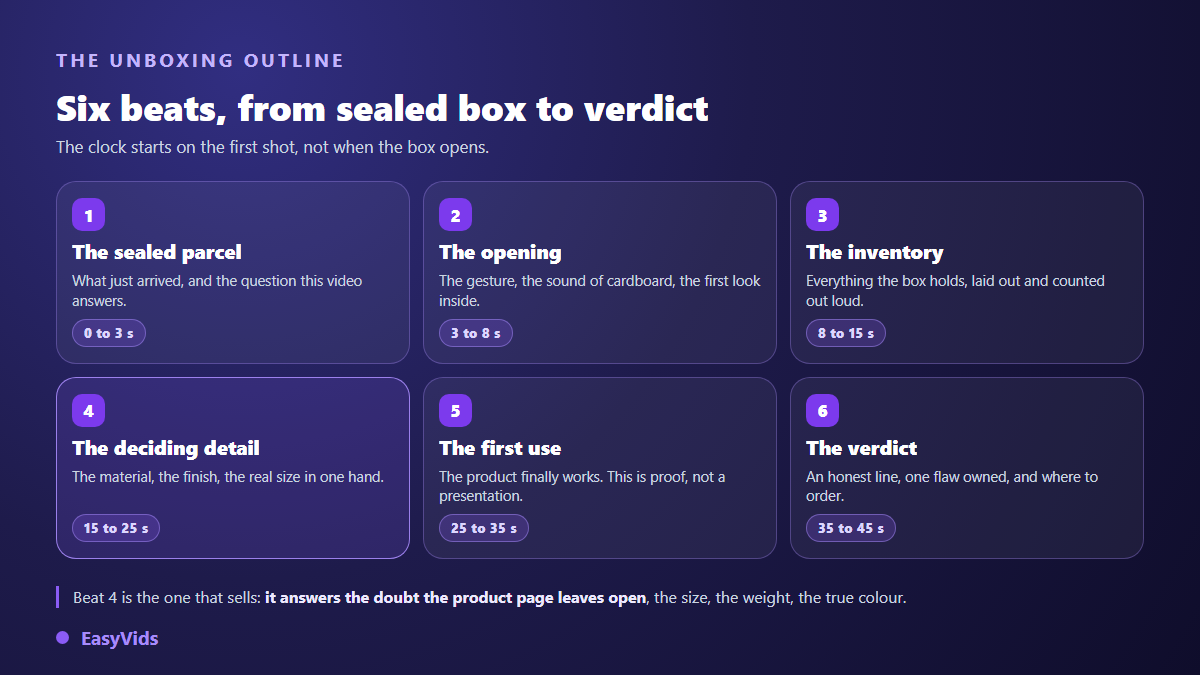
- Beat 1, the sealed parcel (0 to 3 seconds): the box, a hand, and the question the video will answer.
- Beat 2, the opening (3 to 8 seconds): the gesture and its sound. The box must be open before the eighth second.
- Beat 3, the inventory (8 to 15 seconds): everything laid out at once, counted out loud, accessories included.
- Beat 4, the detail that decides (15 to 25 seconds): the material, the finish, the real size in a hand.
- Beat 5, the first use (25 to 35 seconds): the product finally does its job. One whole gesture, no cut in the middle.
- Beat 6, the verdict (35 to 45 seconds): one summing up sentence, one named flaw, and where to order.
One rule outranks the rest: the clock starts on the first shot, not when the box opens. Across our own short form generations, versions where the box is still sealed past the eighth second lose their audience before the product appears. If the parcel resists, show the end of the gesture rather than its start. Nobody ever bought anything for the quality of the tape.
The shot list that goes with the script
A script without a shot list ends up as voice over laid on approximate footage. The shot list turns the text into work you can execute: one line per shot, with what is seen, what is said over it, and the target length. It serves the person filming as much as the person generating images, and it survives changes of mind because it makes gaps visible.
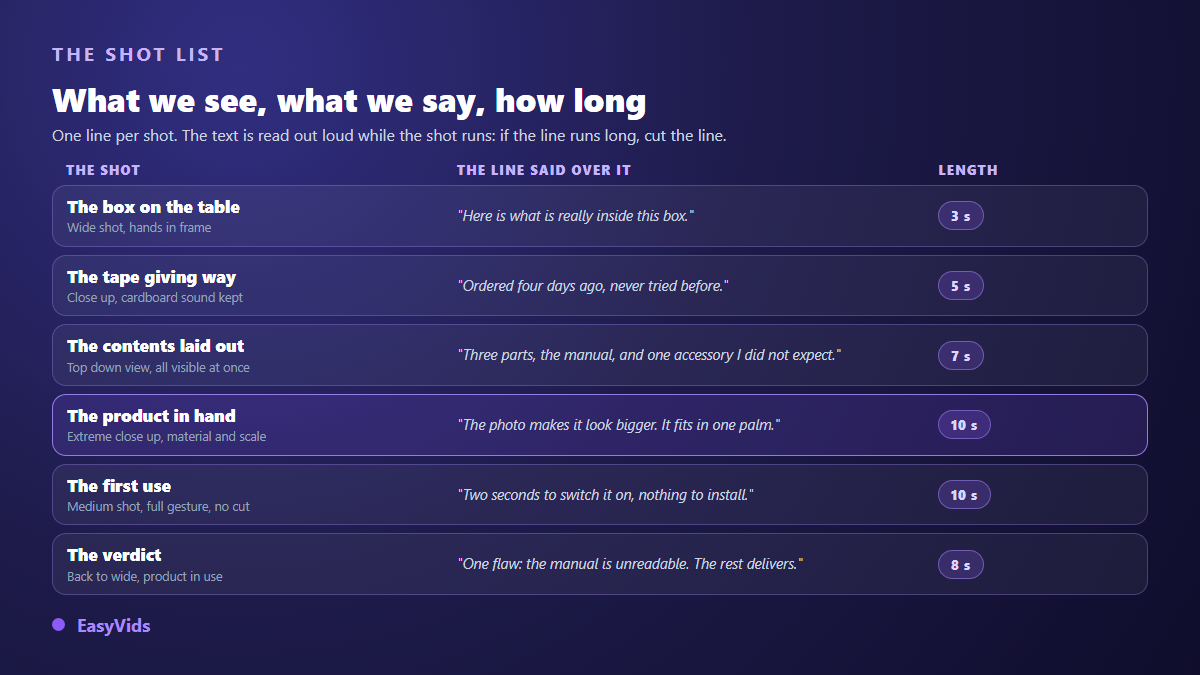
Matching sentences to shot lengths avoids the most common flaw, a comment that overruns its picture and forces the delivery to speed up. Count roughly two and a half words per second at a natural pace, about fifteen words for a six second shot. Write the line, time it out loud, cut the surplus before you open any editor.
Writing the words: say what the picture cannot
The voice does not describe the image, it completes it. On a shot showing a black box, saying "and here we have a black box" adds nothing. Saying "it weighs less than a paperback" adds what the screen cannot carry. That division of labour is the only writing technique that really counts in an unboxing: the picture gives shape, the voice gives scale, texture, setup time, delivery delay.
When those lines have to be produced across a whole catalogue, a marketing script generator writes the first draft from the product name, its description and a chosen selling angle: problem then solution, demonstration, before and after, story, or testimonial. You set the length in words, which amounts to setting the duration, and the output language. The draft always needs a pass to strip out superlatives, yet it saves most of the time on a dozen references.
Five mistakes that lose viewers
The same flaws come back from one unboxing to the next, and none of them is a hardware issue. All are fixed at the writing stage, before the first shot, which makes them free to repair.
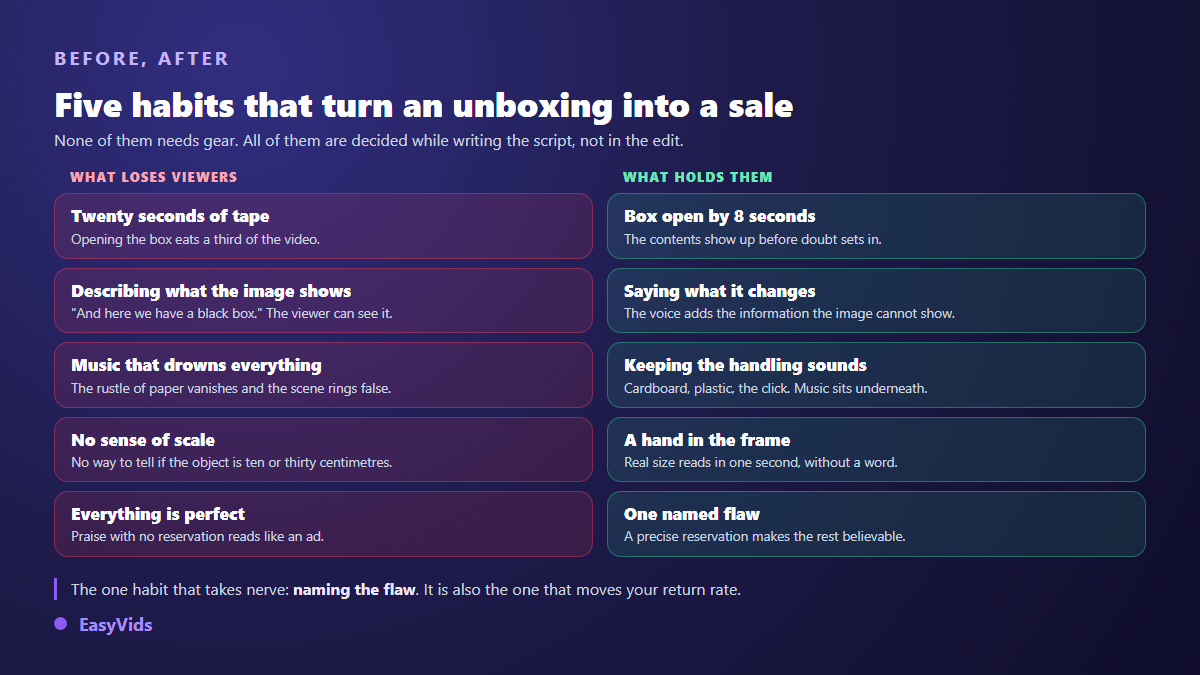
The fifth habit deserves a sentence of its own. Naming a precise flaw does not weaken the sale, it makes it possible: a concrete reservation lends credibility to everything else, and it cuts returns by correcting an unrealistic expectation before the order rather than after. An unboxing with no reservation at all reads like an advert, and gets watched like one.
Building the shots without a camera
Filming an unboxing assumes you have the product, a clear surface, steady light and time to start over for every reference. Current video models accept a starting image, and that changes the maths for a seller: your product photo supplies the shape, the colour, the label and the proportions, while the model handles motion only. Pick vertical, square or horizontal before generating rather than cropping afterwards, so the product never drifts off the edges.
Two cautions are worth repeating. Printed text on packaging often warps during generation: frame the logo at three quarters, or cover it in the edit with a clean element. And the hand doing the handling remains the delicate part for image models, which argues for simple, short gestures held in a single shot. On the budget side, everything comes down to how many shots you generate, and the detail of our plans lives on the pricing page.
The edit: captions, on screen text and the sound of cardboard
Sound carries half the realism of an unboxing. Tape peeling away, plastic crackling, a clasp clicking: those noises describe the material better than any sentence. Keep them audible and sit the music well below them, around a fifth of their level. A soundtrack that flattens the handling noises turns the scene into an advert, and viewers feel it before they can explain it.
The rest of the edit is three moves. Captions are generated from a transcript and laid down in short segments, seven words at most in our editor, which follows the rhythm of speech. On screen text handles what the voice does not say: the exact model reference, the colour name, the contents of the box. And switching between aspect ratios happens inside the project, repositioning blocks before export, rather than cropping a file that has already been rendered.
Match the length to where the video will be seen
One shot list gives several lengths with no rewriting. You cut, you never extend: a shot added afterwards always shows, because it was not designed alongside the others.
- Vertical feed: thirty to forty five seconds, four shots, verdict announced by the halfway mark.
- Long version: two to four minutes, every beat, inventory commented piece by piece.
- Product page: fifteen to twenty seconds, no voice, burnt in captions, a clean loop.
- Paid ad: the vertical cut, hook moved to the very first shot, call to action doubled on screen.
- Order follow up message: the short cut, to fill the wait between purchase and delivery.
The product page version needs particular care: it will be seen without sound, often on autoplay. Shopify help documentation states that a listing media gallery accepts video alongside photos, and marketplaces offer comparable slots to sellers enrolled in their brand programmes. Plan a silent, captioned cut from the start. If you sell without ever handling the goods, our method for producing presentation videos without a creator shows how to build those shots from supplier images alone.
Gifted products and paid partnerships: what must be disclosed
An unboxing made with a product sent for free, or under a commercial agreement, falls under advertising rules, and disclosure is not optional. The Endorsement Guides of the United States Federal Trade Commission, in their 2023 revision, require any material connection between the endorser and the brand to be disclosed clearly and conspicuously, including when the product was simply gifted.
Platforms add their own tools. The YouTube Help Centre describes a checkbox in YouTube Studio for declaring a paid promotion, which displays a notice at the start of the video. TikTok asks creators to switch on the branded content setting before posting, and Instagram offers a paid partnership label. In France, the law of 9 June 2023 on commercial influence requires the wording "Publicité" or "Collaboration commerciale" to stay legible throughout the promotion. Check the rules in your own market before publishing: they move fast, and a video circulates for a long time.
Frequently asked questions
Do I need to own the product to make an unboxing video?
For an unboxing presented as your own experience, yes: describing the arrival of a parcel you never opened is a deceptive claim. For a presentation video of an item you sell, no, provided you do not dress it up as a buyer review. The difference sits in the point of view you announce, never in the technique.
How long should a vertical unboxing be?
Thirty to forty five seconds for a first attempt. The constraint is not the platform limit, which is far higher, but the number of genuinely useful shots: four shots held well beat ten shots rushed through. Extend only when the box holds many items worth covering one by one.
Do I have to show my face?
No. Hands are enough, and that framing dominates the format anyway: the viewer's eye stays on the object, where the decision happens. A face becomes useful when you are giving a strong personal opinion, or building an audience around yourself rather than around a catalogue.
Can an unboxing be generated from a single product photo?
Yes for shots where the object sits still or is handled simply, feeding the photo in as a starting image so shape and label stay faithful. No for a complete unboxing in one render: the result comes shot by shot, then at assembly. It takes longer to describe than to do.
Are generated unboxing videos monetisable?
What platforms penalise is repetitive mass produced content with no contribution, not the use of AI itself. An unboxing written, edited and commented with a point of view and an honest reservation sits within the rules. Add the partnership disclosure as soon as the product was supplied to you.
An unboxing that sells is decided before the camera: six beats, a shot list, one sentence per shot, one flaw owned. The rest is execution. To write the script, generate the shots from your photos and edit them in one place, creating an account opens the full studio, no bank card needed. The EasyVids studio brings writing, generation and editing into a single flow.