You wrote a script meant to help someone fall asleep. You paste it into a speech tool, you hit generate, and what comes back is a news anchor: crisp, confident, wide awake. That is what almost everyone runs into the first time they look for an AI ASMR voice. The file is clean, the diction is flawless, and it relaxes nobody.
The model is barely to blame. A speech engine reads the way it was trained to read, which means clearly, so that everyone understands. Whispering is not a technical setting, it is an acting intention, and an intention has to be spelled out. The rest comes down to the script you hand over and the level you mix it at. If synthetic speech is new to you, our complete guide to AI voiceovers covers the ground this article assumes.
The short answer: a whisper is requested, not adjusted
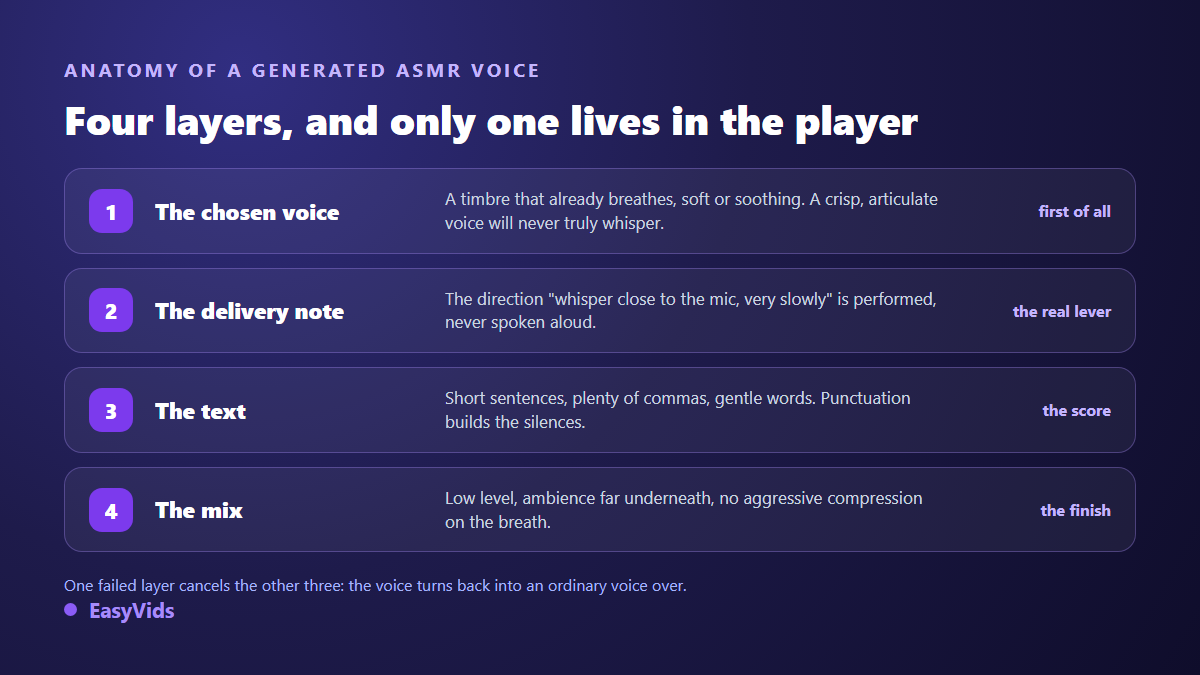
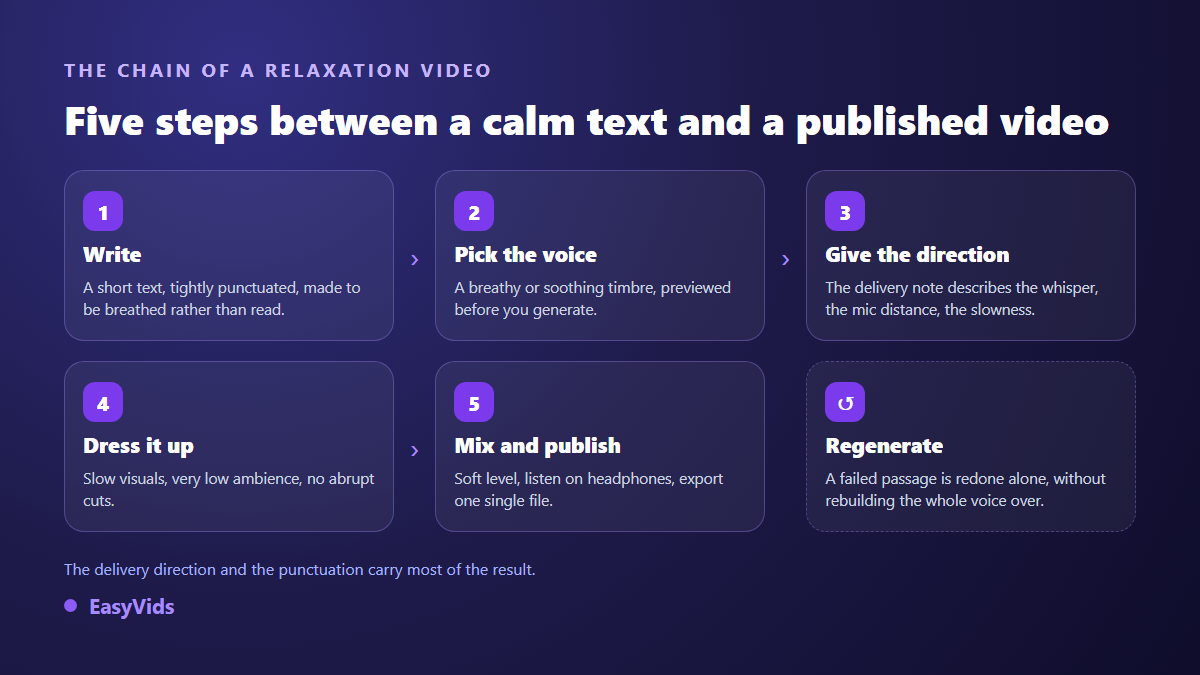
A convincing AI ASMR voice needs four things, in this order: a model that accepts a reading style written in plain language, a voice whose timbre is already breathy or soothing, a script cut into very short sentences, and a deliberately quiet mix. The reading instruction carries most of the result. It moves the delivery from presentation mode to confidence mode, which no speed slider can do.
What your audience is actually after
ASMR describes a tingling sensation across the scalp and neck, triggered by certain sounds. The term autonomous sensory meridian response was proposed in 2010 by Jennifer Allen, who ran an online discussion group about those sensations at the time. The first academic survey on the subject, by Barratt and Davis in the journal PeerJ in 2015, places whispering among the most frequently reported triggers, ahead of slow gestures and object handling sounds.
The practical takeaway: your viewer is not there for information, they are there for a sensation. A slightly mispronounced word will not bother them. A jump in volume, a sentence that lands too crisply, an abrupt cut will pull them straight out of the state they came for.
The reading style, the instruction that changes everything
In the studio, the reading style is a free text field sitting right next to the voice picker. You write a direction there, the way you would brief a voice actor before a take. It is passed to the model ahead of your text, it shapes the delivery, and it is never spoken aloud. The field only appears on the model family that knows how to interpret it, the one the studio calls Model V1 (reading styles); the other models ignore it. We covered the general mechanism in our piece on the settings that make a voice sound natural.
A good instruction describes four things: the vocal gesture, the distance to the microphone, the pace and the intent. The word whisper on its own gives a lukewarm result. The same instruction fleshed out changes the take completely. Write it in the language of your script: an English instruction on an English text stays the most reliable pairing.
- Whisper very close to the microphone, extremely slowly, as if not to wake anyone.
- Murmur in a soft breathy voice, letting the ends of sentences trail off.
- Read in a gentle, soothing voice, like a guided meditation before sleep.
- Speak very quietly, almost without voice, pausing after every sentence.
- Tell this under your breath, in a confiding tone, never rising in intensity.
- Breathe the words out calmly, like a lullaby told to a child falling asleep.
Pick the voice before writing the instruction
A whispering instruction applied to a crisp, energetic voice returns a crisp, energetic voice speaking more quietly. The starting timbre counts as much as the direction. The voice catalogue labels every timbre in plain words: breathy, soft, soothing, relaxed, light, warm. Those six are the ones worth your time, and you can rule out anything described as firm, crisp or energetic. A preview button plays the voice on a sample sentence before you generate anything, which saves you from spending credits to find out a timbre does not fit.
Once you have found the voice, stop changing it. Recognising a timbre is part of what brings a relaxation audience back. The studio also keeps your reading style on your account, so it applies to every voiceover you generate afterwards, on every page, without pasting it again each time.
Writing a script that lets itself be whispered
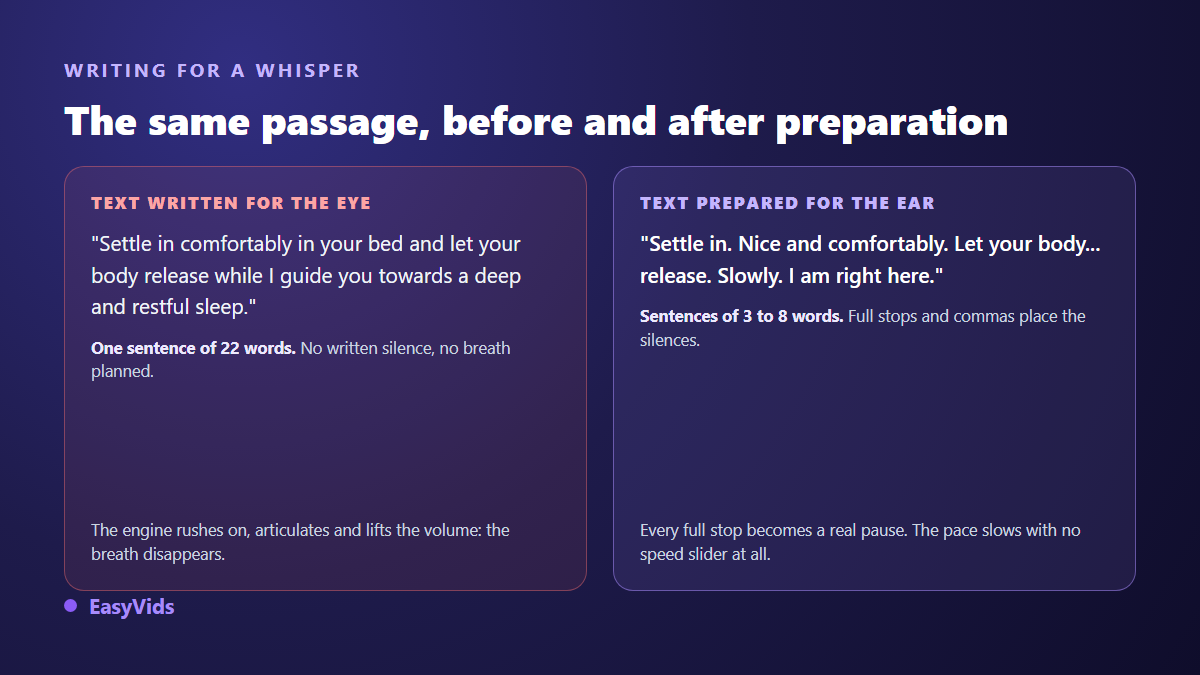
A speech engine reads punctuation the way an actor reads a score. A full stop creates a pause, a comma a breath, an ellipsis a hesitation. A relaxation script written in long flowing sentences therefore produces, mechanically, a continuous and hurried delivery. Cut it down. Sentences of three to eight words, plenty of full stops, a few deliberate soft repetitions: that is what manufactures slowness, far more than any speed control.
Think in minutes rather than characters. Ordinary narration sits around 150 words per minute; a slow whisper drops well below that, often around 90 to 110 words per minute across our own generations. A thousand word script therefore gives you a good ten minutes of audio, not seven. On volume, the studio accepts up to 100,000 characters in a single request: past 3,000 characters the text is split, the parts are generated in parallel and merged into one MP3 file, which puts a long session within a single click.
The honest limits of a synthetic whisper
Speech synthesis produces a voice, not a recording session. It reproduces neither binaural capture with two microphones, nor mouth sounds, nor fabric brushing against a membrane. If your channel rests on those physical triggers, AI will not stand in for them. One more common pitfall: sibilance. At very low intensity, s and sh sounds come forward more than the rest and get unpleasant on headphones. When a sentence hisses, the fastest fix is to rewrite it so the sibilants stop stacking up, then regenerate that passage alone.
What synthetic speech does very well, on the other hand, is calm narration: sleep stories, guided meditations, long form readings, descriptive walkthroughs. Those are formats where the writing carries as much weight as the sonic texture, and where producing an hour of audio with no studio and no recording session changes the whole economics of a channel.
Mixing, where relaxation videos usually fall apart
A badly mixed whisper turns back into an ordinary voiceover. According to the YouTube help centre, playback applies loudness normalisation: it turns down videos louder than the target, it does not turn up the quieter ones. Pushing the level at export therefore buys you no presence at all, and flattens your dynamics for nothing. Mix low, leave air, and trust the viewer to raise their own headphones.
- Always monitor on headphones: whisper defects are inaudible on laptop speakers.
- Keep the ambience well under the voice, around a fifth of its level.
- Avoid heavy compression: it lifts the breath and turns it into noise.
- Never cut hard between two sound beds, cross fade over a second at least.
- Leave one or two seconds of silence at the top, before the first sentence.
- Listen to the ending: many relaxation videos finish on a dry cut that wakes people up.
The picture, which has to be forgotten
A relaxation video does not need editing. It needs a shot that barely moves and never surprises. A gently animated photograph often beats a generated clip, because it keeps a slow and predictable motion; seven ways to add movement to a still image reviews the usable techniques. One rule holds it all together: no abrupt brightness change, no rhythmic cutting, no animated text.
Publishing without getting cut
Two points deserve attention before you upload. According to the YouTube help centre, partner programme monetisation rules have referred since July 2025 to inauthentic content rather than repetitious content: what is targeted is mass produced series with no contribution of your own, not the use of a synthetic voice. A session you wrote yourself, with its own progression and its own visual treatment, stays within the rules. On the production budget, a credit system lets you compare several voices on a short excerpt before committing to a long session, and the details sit on the pricing page.
The second point is transparency. The European regulation on artificial intelligence requires, in its article 50, that artificially generated content be identifiable as such, a section applicable since 2 August 2026. Stating in your description that a synthetic voice was used costs nothing and defuses any suspicion. Music helps here too: a very low ambience bed fills the void behind a whisper, and our guide to the AI music generator explains how to get an instrumental with no vocals.
Frequently asked questions
Can an AI voice really trigger ASMR?
For part of the audience, yes, as long as the whisper is clean and steady. For people who respond to physical triggers such as mouth sounds, tapping or binaural capture, a synthetic voice stays incomplete. The honest rule: AI excels at calm narrative formats, far less at pure sound ASMR.
What reading style gives a real whisper?
Describe the gesture, the distance and the slowness in one sentence, for instance whisper very close to the microphone, extremely slowly, as if the listener were already asleep. A one word instruction only makes the delivery slightly softer. Test two or three phrasings on the same short paragraph before committing a long script.
Can I generate an hour long session in one go?
Yes. The studio accepts up to 100,000 characters per request, roughly one hour and forty minutes of audio. Past 3,000 characters the text is split automatically, the parts are generated in parallel, then merged into a single MP3 file you can download.
How do I fix a sentence that hisses or lands badly?
Do not regenerate the whole voiceover. Rewrite the sentence to break up the stacked sibilants or add a comma, then relaunch that passage only. On a production split into scenes, every voiceover regenerates independently of the others.
Are ASMR videos made with an AI voice monetisable?
Yes, under the same conditions as any other video: content you wrote, a contribution of your own, no assembly line series. What platforms penalise is mechanical repetition, not the tool used to produce the voice.
A good AI ASMR voice does not come down to the engine, but to four linked decisions: an already soft timbre, a reading instruction written like an actor's direction, a script cut short, and a mix that stays low. Write three minutes of script, compare two voices and two instructions, and a quarter of an hour will tell you what works for your channel. Creating an account is enough for that first test, and the EasyVids studio brings the voice, the ambience and the edit together in one place.