Your character is drawn, it moves, it opens its mouth. And it sounds like a voicemail greeting. That is where most animation projects stall: the picture holds up, the voice gives everything away within ten seconds. Looking for a cartoon voice generator is not looking for a filter that raises the pitch. It is looking for a voice actor who does not exist.
That actor can be built. Not by scrolling a list of voices until one of them sounds right, but by setting three things almost nobody sets: the grain of the voice, the way the line is performed, and the punctuation of the text. This guide follows the whole method, from casting a single character to a five voice exchange. If speech synthesis is new ground for you, our complete AI voice over guide covers the basics before the acting starts.
Cartoon voices in three lines
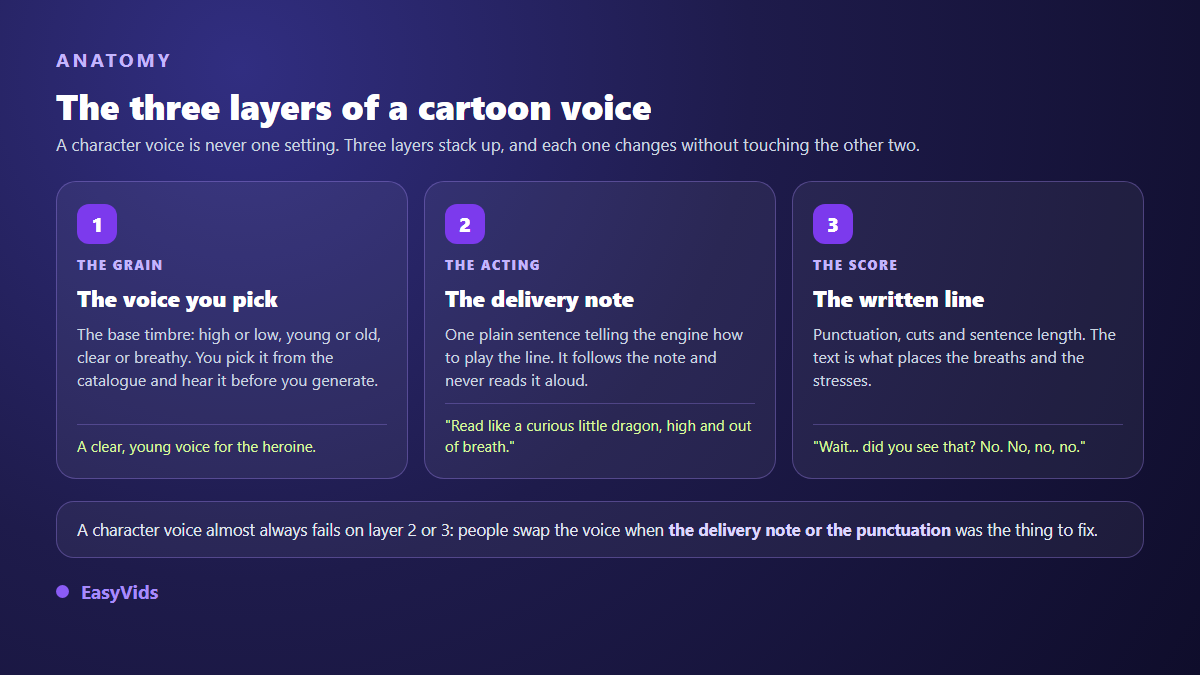
A character voice is built in three layers. The timbre comes from a voice catalogue, chosen by ear. The performance is written in plain language, as a direction: read like a small curious dragon, high pitched and out of breath. The text places the breathing through its punctuation. Timbre gives the grain, direction gives the role, punctuation gives the rhythm. The same voice plays the hero and then the villain once you change the direction.
Timbre alone never makes the character
The opening mistake is auditioning twenty voices hoping one of them sounds cartoon. None of them will, because catalogues are built for narration: they offer grains, not roles. A voice labelled playful is still a playful voice reading a text, equally far from a hysterical squirrel and a shopping channel host.
What is missing is not in the list, it is in the direction. Modern synthesis engines accept a performance instruction written in ordinary language and carry it out without ever speaking it aloud. It is the same lever used to fix a flat delivery, as our breakdown of the settings that make an AI voice sound natural explains. For a character, you are no longer fixing anything: you are composing.
The performance direction does the real work
A reading direction is a short sentence, placed before the text, describing the performance you expect. It is never spoken: the engine treats it as a stage note. In the EasyVids studio the field is called the reading style, and it travels with a full voice over as easily as with one character inside a dialogue.
A direction that works describes three things: the age and body of the voice, the dominant emotion, the pace. Old voice is not enough. Read very slowly, aged and tired, with long pauses gives you a grandfather. Add the situation when it changes everything: as if whispering so as not to wake the others reshapes the same line without touching the timbre.
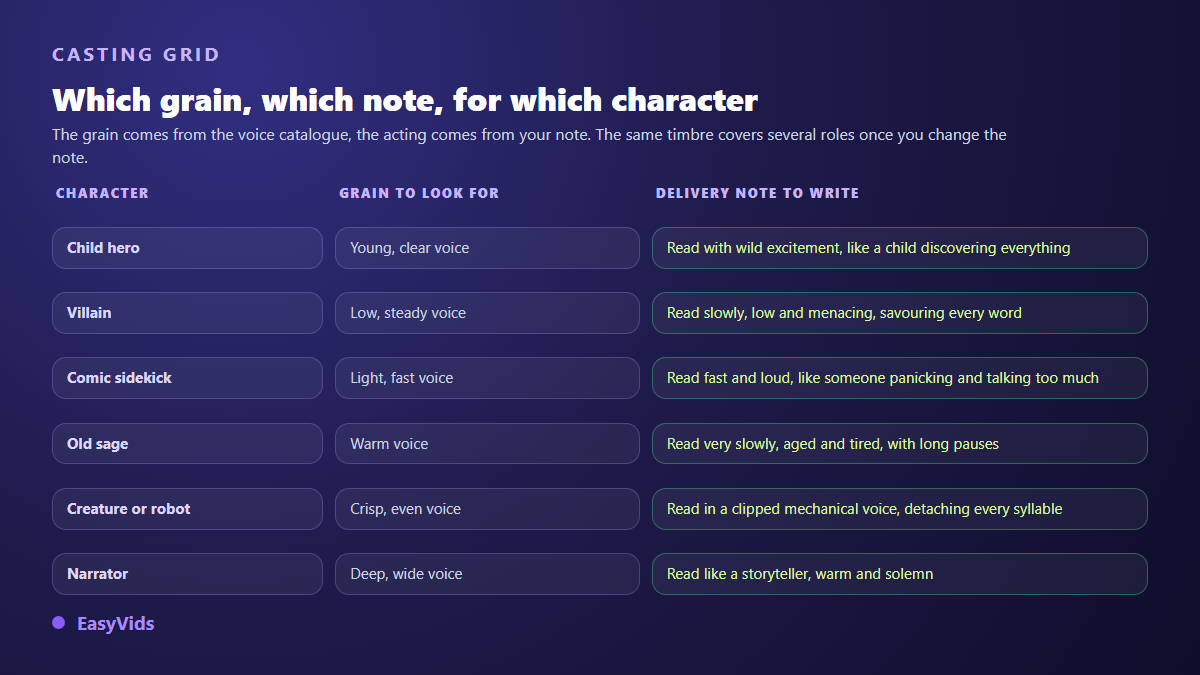
- Child hero: read with overflowing excitement, like someone discovering everything.
- Villain: read slowly, in a low threatening voice, savouring every word.
- Comic sidekick: read fast and loud, like someone panicking and talking too much.
- Creature or robot: read in a mechanical, clipped voice, detaching every syllable.
- Storyteller: read like a fireside narrator, warm and solemn, taking your time.
Write the line like a score
A synthesis engine does not understand your story, it reads signs. Punctuation is its only breathing cue, sentence length its only intonation cue. An animation line that survives playback is almost always shorter and choppier than the same line written to be read on a page.
Three habits change the result. Cut with a full stop rather than a comma whenever you want a clean silence. Repeat a word to mark panic: No. No, no, no. performs itself. And spell interjections the way they sound, because the engine pronounces what it reads and nothing else: a short Aaah and a stretched Aaaaaah do not last the same time.
Several characters in the same exchange
A cartoon is rarely a monologue. The turning point arrives when two characters answer each other: generating each line on its own, then gluing the files together by hand, takes longer than the animation itself, and the joins are audible.
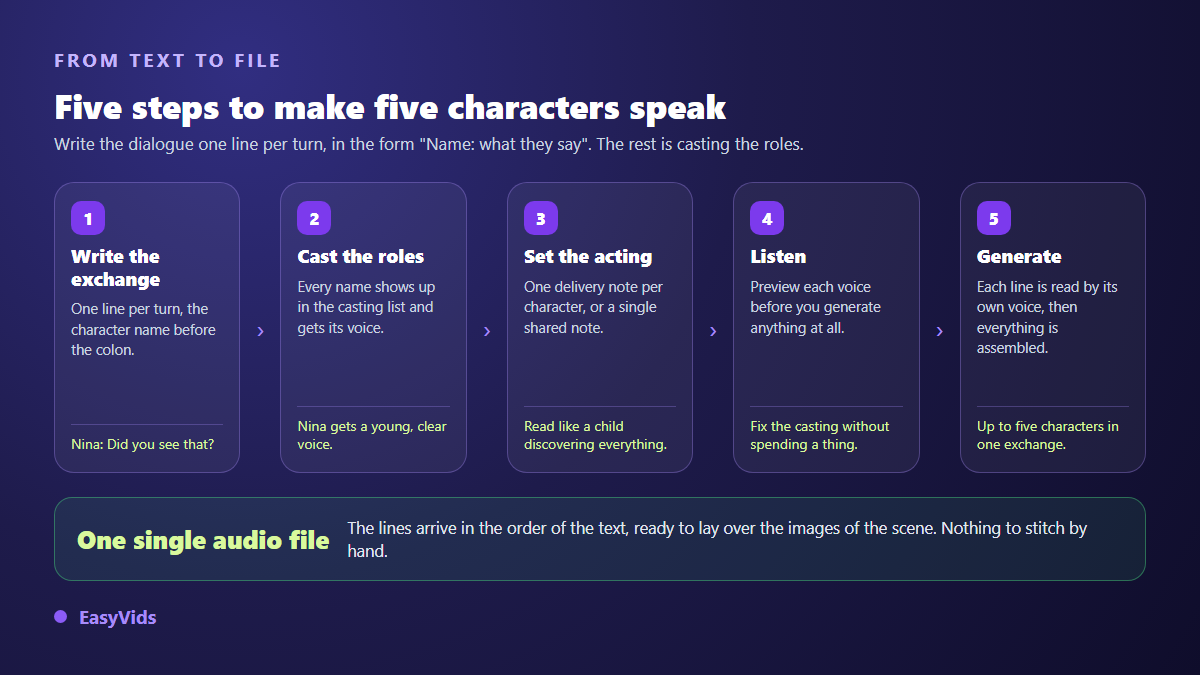
That is what the multi voice dialogue page in the studio solves. You write the exchange one line per turn, in the form Name: what they say. Every name appears in a cast list, where you assign its voice and, if you want, its own performance direction. Up to five characters can answer each other in the same exchange, and you get back a single audio file with the lines already in order.
Casting without two voices blurring together
The most useful casting rule fits in one sentence: two characters who talk to each other never share a register. If your heroine is bright and fast, her sidekick is deep and slow, whatever their gender. Ears separate voices by contrast, not by identity, and that contrast is what lets a viewer follow an exchange without watching the screen.
Listen to every voice before generating anything: a demo clip plays straight from the selector, at no cost. That is the moment to fix the cast, not after the render. What each plan includes is on the pricing page.
Cloning a voice for a recurring character
Catalogue voices cover most roles. They hit their limit when a character returns episode after episode and has to become recognisable, or when you want to perform your own characters without recording every line. Cloning answers both cases: you supply an audio sample to a cloning tool, and the resulting voice behaves like any other synthetic voice.
Sample quality matters more than sample length. A short clean recording, free of music and echo, produces a better copy than a long noisy file. Cloning is not a grey area either: reproducing someone else's voice requires their explicit consent, and our article on the legality of voice cloning sets out what that consent has to cover. An invented character voice sidesteps the question entirely, which makes it the default choice for a series.
The voice holds, the character has to hold too
A good cast will not save a character whose face changes in every scene. It is the most visible flaw in AI made cartoons: the hero loses a lock of hair, the colour of a jacket, sometimes an age. The fix is not in the prompt but in the references: one reference image of the character, reused in every shot, holds where a repeated description drifts. The full method is in keeping the same character from scene to scene.
In the EasyVids Director, that step is part of the production plan. The tool reads your script, extracts the characters and the sets, then builds a reference sheet for each one before the first scene is drawn. Scenes then cite those references, and the cartoon gains a visual continuity that matches its soundtrack.
From the voice to a finished animated video
Once the audio is ready, it has to sit on moving pictures. Two routes open up. The first starts from images generated in an animation style, then animates them one by one: several video models accept a starting image and add motion to it, which preserves exactly the character you approved. The second animates shapes, text and illustrations, ground covered by our motion design guide.
Either way, shot length follows the real length of the voice, never the reverse. A four second line calls for a four second shot. That principle drives the whole chain described in our AI video generator guide, and it applies to animation exactly as it applies to live action.
The mistakes that expose a cartoon voice
Across our generations the same flaws come back, and none of them come from the engine. They all come from a writing or casting decision.
- A vague direction: funny voice produces nothing, read like someone holding back a laugh produces a performance.
- The same reading style for everyone: the exchange turns into a two headed monologue.
- Lines written to be read: long, full of clauses, with nowhere to breathe.
- Caricature pushed too far: a very high pitched voice held for more than a few seconds becomes painful.
- Music sitting too close to the voice level, erasing the very nuances you just set.
- A character whose voice shifts between episodes, because the voice and the direction were never written down.
What platforms and the law expect
Two questions come up as soon as an animation project goes past the test stage. The first is disclosure of synthetic content. According to the YouTube help centre, the duty to flag altered or generated content targets material a viewer could mistake for reality, not clearly unrealistic content, with animation given as an example. A cartoon therefore falls outside that case, which is no reason to skip a check of the rule in force on the day you publish.
The second is the voice itself. The European Union artificial intelligence regulation provides, in its article 50, that artificially generated audio or video be disclosed, with an explicit accommodation for evidently artistic or fictional works, where the disclosure is given in a way that does not spoil the work. On cloning, however, no accommodation replaces the consent of the person concerned: imitating the recognisable voice of a working artist or dubbing actor remains the riskiest ground there is.
Frequently asked questions
How do I get a high pitched cartoon character voice?
By pairing a naturally bright timbre with a direction that describes the excitement or the smallness of the character. Avoid raising the pitch afterwards with audio processing: the result turns metallic and tires the ear within seconds. Caricature is performed, not filtered.
How many characters can speak in one dialogue?
Up to five characters in a single exchange on the multi voice dialogue page, each with its own voice and reading style, for one audio file at the end. Beyond that, split the scene: nobody follows more than three or four voices in a row, however well contrasted they are.
Should I clone my own voice to play every role?
It is neither necessary nor always desirable: a clone keeps your timbre, so your characters end up sounding alike. Cloning serves a recurring lead or a brand signature. For the rest of the cast, the catalogue plus written directions give far more variety.
Can an AI voice sing a cartoon theme tune?
No, voice over engines speak, they do not sing. A theme tune or a nursery rhyme belongs to a music generator, which composes and performs the lyrics. Keep the spoken voice for dialogue and the sung voice for the songs, rather than forcing both through the same tool.
How do I keep exactly the same voice between episodes?
Write down, for every character, the engine, the exact voice and the direction word for word, then store those three items with the character reference sheet. A direction rephrased from memory gives a slightly different performance, and the gap shows first on secondary characters, which listeners remember more precisely than you would think.
A cartoon stands up when a character is recognised by voice before entering the frame. That takes no booth and no cast: a chosen timbre, a written direction, punctuated lines, and the same casting held from one episode to the next. To hand out your first roles, create an account and write a four line exchange: you will hear your characters within the minute. The rest of the chain, images, animation and editing, is waiting in the EasyVids studio.