You heard a demo that stopped you cold: the timbre of a famous singer, or an actor everyone recognises, saying words they never said. The temptation is immediate, especially for a video that has to hook in three seconds. Before you build anything on it, know this: whether a celebrity AI voice is legal has nothing to do with how convincing the clone sounds.
Two wrong stories dominate this topic. One says anything goes until somebody complains. The other says every synthetic voice is illegal. The truth is narrower and far more useful. A handful of principles hold almost everywhere, platforms act much faster than courts, and three legitimate routes give you the same sound without the exposure.
The short answer
Reproducing the voice of an identifiable person without permission is off limits for nearly every use you care about: advertising, product endorsement, monetised content, words they never said. Adding an AI generated label does not make it lawful. That label answers a transparency duty; it never replaces consent. Parody gets a narrow tolerance that varies by country and collapses the moment money is involved. What you are really after is a timbre, not a person, and a timbre is obtainable legally: our guide to natural sounding AI voice over shows that the result depends far more on the script than on the voice you pick.
A voice is not royalty free sound
A voice is an attribute of a person, exactly like a face. It identifies them, it gains commercial value once it becomes known, and that value belongs to whoever spent years building it. The legal question is not about the audio file you produce. It is about what that file makes listeners believe. If an ordinary listener recognises somebody, you are using their identity, whether you hired an impersonator, edited a recording or ran a generative model.
In the United States, protection comes from state level personality rights. Tennessee led with a law in force since 1 July 2024, the first to name voice explicitly, including a simulation of a voice, with civil and criminal consequences. At federal level, a bill covering digital replicas of voice and likeness was advanced unanimously by the Senate Judiciary Committee on 18 June 2026. It is not law yet, but the direction is unmistakable. France went further already: since May 2024 its criminal code expressly covers publishing algorithmically generated audio that reproduces a person's voice without consent when the artificial nature is neither obvious nor stated. Denmark has tied voice and appearance to copyright, which turns a takedown into a simple infringement claim.
Parody, tribute, impersonation: where the line sits
The line does not depend on your intent or on the tool you used. It depends on one thing: what a distracted listener concludes. As long as they know they are hearing fiction, you sit inside a zone of tolerance. The moment they could believe the person actually spoke, you are impersonating, and being funny changes nothing.
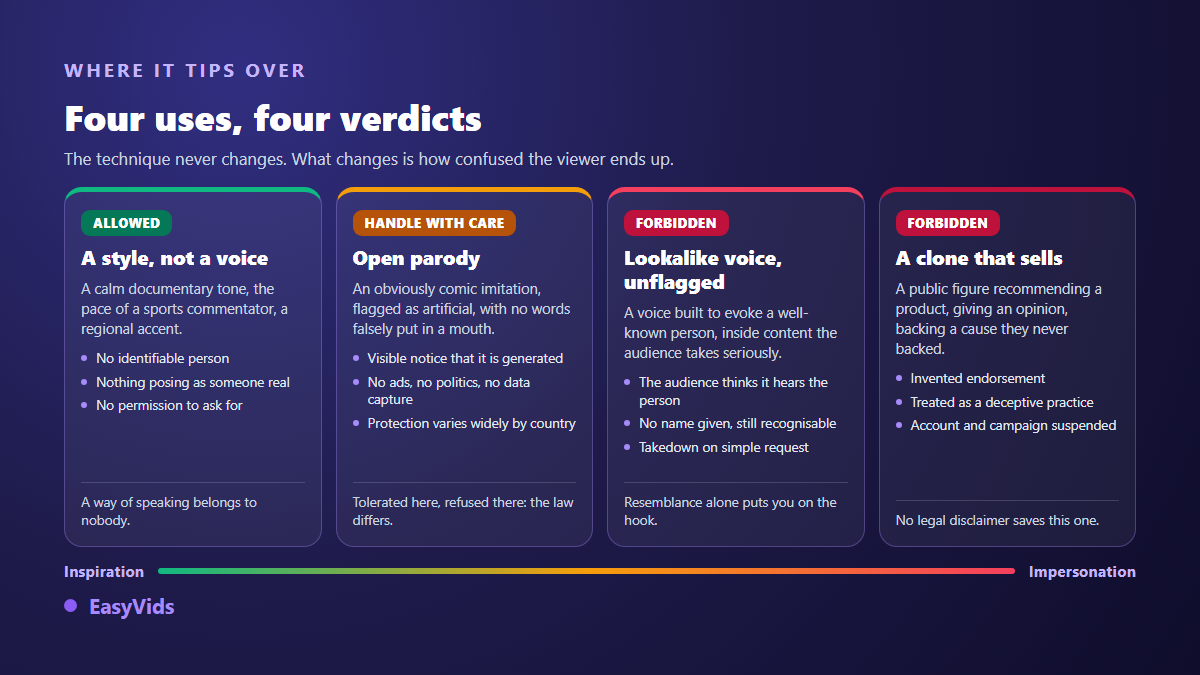
Parody is protected in several legal systems, but the protection is narrow. It assumes obvious comic intent, no possible confusion, and no harm to the person portrayed. It evaporates as soon as the content sells something, collects emails, raises donations or pushes a political line. Amusing content that sells is still content that sells.
- The content is realistic and nothing makes clear it was fabricated.
- The person appears to endorse a product, a brand, an investment or a candidate.
- Statements are attributed to them on serious topics: health, money, justice, news.
- Their name or fame is used to drive clicks in the title or the thumbnail.
- The content is monetised, sponsored, or advertises your own offer.
- The person has died and the family authorised nothing.
Copying a type of voice, on the other hand, is entirely fine. A deep documentary tone, the rapid delivery of a sports commentator, a storyteller cadence, a regional accent: none of that belongs to anyone. That is what most creators actually want when they type a famous name. They want the authority, the energy or the warmth attached to that voice, not the individual.
Four cases worth more than any warning
In April 2023, a track sung with the imitated voices of two very well known artists passed several million streams in days. It was pulled from every major streaming service at the record label's request, without a trial. Remember the mechanism rather than the anecdote: no judge ruled on it. A claim was sent to the platforms and processed within days. Success accelerated the takedown instead of shielding it.
In January 2024, the estate of a late American comedian sued the makers of an hour long special that imitated his voice and style. The video came down within a week. The case settled in April 2024 with a permanent ban on reposting it and on any use of his name, image, voice or likeness. Death does not release a voice: in many countries those rights pass to the heirs.
In July 2025, a federal court in New York issued an instructive ruling in a dispute between two voice actors and a speech synthesis company that had trained on their recordings. Copyright and trademark claims were largely dismissed, because the timbre of a voice is not a work of authorship. Claims based on the right of publicity, consumer protection law and contract were allowed to proceed. The lesson is clean: protection does not come from copyright, it comes from elsewhere, and it bites.
One positive case to close. In 2025, a video game with an enormous audience gave an iconic character the reconstructed voice of a late actor, with his family's explicit agreement. The use was authorised, and it still drew a union complaint from performers. Consent settles the main legal question. It does not automatically settle every other one.
What platforms remove, and how fast
Platforms do not wait for courts. Anyone who hears themselves imitated can file a privacy request directly: the video platforms' process explicitly covers AI generated or altered content that looks or sounds like a real person. The request must come from that person, the uploader gets 48 hours to take the video down themselves, and the platform reviews afterwards. It weighs how realistic the content is, whether it was disclosed, whether it carries parody or public interest value, and whether a public figure is shown in sensitive behaviour.
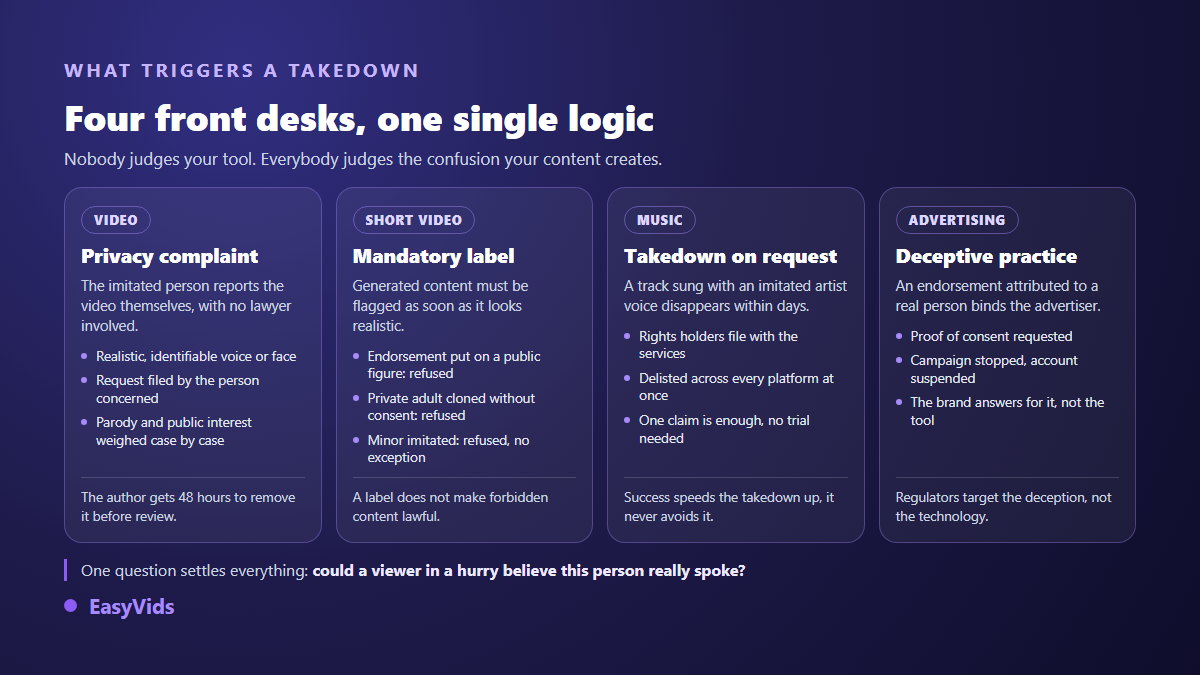
Elsewhere the logic is identical under different wording. On short video, realistic AI generated content must carry a label, and the label saves nothing: an endorsement attributed to a public figure who never gave one stays banned, as does cloning a private adult without agreement. Ad platforms ask for proof of consent before a campaign featuring a real person runs. In music, a rights holder claim is enough to make a track disappear everywhere at once.
- No identifiable real person is imitated, by voice or by name.
- If the content is realistic, the AI disclosure is visible from the first second.
- The synthetic content declaration is ticked at upload time.
- No opinion or endorsement is attributed to somebody who never gave one.
- Written consent for every voice used is archived with the project.
- Title and thumbnail do not imply a celebrity took part.
Disclosure is not permission
Two separate duties get confused constantly. Transparency means flagging generated content. Consent means getting agreement from the person portrayed. The first never replaces the second. In the European Union, the transparency obligations of the AI regulation apply since 2 August 2026: anyone publishing content that realistically imitates an existing person must say so clearly, at first exposure, in a way a human can perceive. A lighter form is allowed for evidently artistic or satirical works, provided the notice does not spoil the piece. A label keeps you compliant with the information duty and nothing else. An unauthorised clone stays an unauthorised clone, labelled or not.
The commercial risk arrives before the legal one
Most creators think in terms of lawsuit probability. That is the wrong calculation, because trouble never starts there. A removed video usually brings a strike with it, and two or three strikes close a channel built over two years. A suspended campaign freezes distribution at the worst moment. A client who later discovers their ad used an unauthorised voice does not come back, and they tell people. Then there is the quiet one: audience trust. A channel caught putting words in a celebrity's mouth loses exactly what it was trying to gain. Formats that last rest on a recognisable signature, never on a borrowed one. That is the principle behind our AI video studio: a well chosen voice, held steady across episodes, beats a spectacular and disposable imitation.
Three legitimate ways to get the voice you want
Down to practice. In almost every case we see, the real request is not that specific person's voice. It is a deep reassuring voice, a young fast voice, a neutral professional accent. Three routes get you there, all clean, and nothing stops you from combining them in a single project.
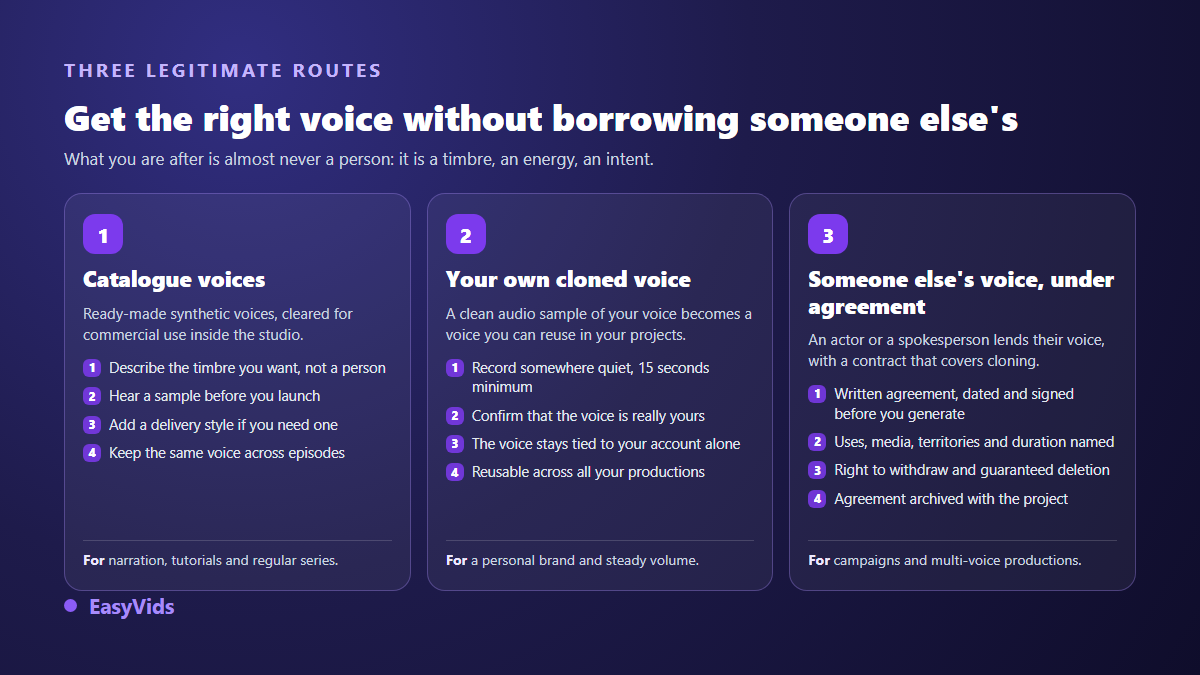
Catalogue voices are the default route. You pick a timbre from a list, hear it on a short sample before committing to a full narration, and keep the same voice across episodes. Some engines also accept a reading instruction written in plain language, such as read like a storyteller speaking to a child. It is never spoken aloud, it steers the whole delivery, and it is the single setting that brings a catalogue voice closest to a precise intention. The full tour of these options, from picking a timbre to dubbing an existing video, sits in our complete guide to AI voice over.
Cloning your own voice is the personal brand route. A clear audio sample, fifteen seconds at minimum for most tools, is enough to create a voice you can reuse across projects. Reputable services request a certification at every clone: you state that the voice is yours, or that you hold explicit permission from the person concerned. With them, the resulting voice stays attached to your account alone and never feeds a public catalogue.
A third party voice under agreement is the route for larger productions. An actor, a spokesperson or a company director lends their voice, and the contract covers cloning explicitly. Write that down plainly, because it fuelled the hardest disputes of the last two years: an older recording contract does not cover building a synthetic voice from existing tapes. These are two distinct permissions.
- Full identity of the person and a signature date, before any generation.
- Permitted uses: narration, advertising, fictional character, internal training.
- Media, territories and duration, with an explicit end date.
- Payment for the synthetic voice, separate from the original recording session.
- A withdrawal right, with a deletion deadline you commit to.
- A ban on sensitive subjects: politics, health, finance, religion, sexual content.
Describe a voice instead of naming a person
One practical difficulty remains: how do you ask for the right timbre if naming someone is off the table? Describe it. A proper name is a shortcut that is both risky and unreliable, since the output varies wildly. A precise description exposes nobody and sounds better. Serious engines reject prompts that name a public figure anyway, and a rejected prompt simply costs you time.
- Register: deep, mid, high, breathy or clean.
- Grain: smooth, gravelly, warm, slightly veiled.
- Perceived age and gender, instead of a specific individual.
- Pace: measured, fast, clipped, with marked pauses.
- Intent: reassure, warn, narrate, explain, sell.
- Accent and language, including the regional variant you want.
- Listening context: headphones on a commute, living room television, phone speaker.
That description replaces a celebrity name, and it is reusable as written. Note yours once, keep it with your brand guide, apply it to every episode. It is what builds a sonic signature and what makes a series recognisable, as we explain in our guide to making a YouTube video with AI.
Frequently asked questions
Can I use a celebrity voice for parody?
In some countries an obvious, non commercial parody that is clearly flagged as artificial gets a tolerance. It is narrow, it differs sharply between legal systems, and it disappears the moment the content sells anything or puts believable statements in the person's mouth. On top of that, a platform can remove the video even where a judge would have sided with you.
Is it legal if I say the voice was AI generated?
No, the disclosure is not enough. It answers a transparency duty, now explicit in the European Union, but it does not replace the consent of the person imitated. A labelled clone is still a clone. The label removes one criticism among several: that you hid the artificial nature of the content.
What if the person has died?
Death releases nothing. In many countries image and voice rights pass to the heirs, and several recent laws name deceased individuals explicitly. The fastest wins of the last few years were in fact brought by estates. Agreement from the family or the rights holders remains essential.
Can I hire an impersonator instead of using AI?
Switching tools does not switch the rule. A human imitation designed to make people believe a celebrity is speaking raises exactly the same issue, and the case law on sound alike voices in advertising predates AI by decades. What matters is the confusion created in the listener, not how the audio was produced.
The rule fits in one sentence: borrow a style, never an identity. It protects you legally, it protects you commercially, and it pushes you towards what works over time, a recognisable voice that is genuinely yours. Pick a timbre, write for the ear, keep your written agreements with your projects. Creating an account opens the studio so you can test your first narration today.