You generate a voice over, you play it back, and something is off. The words are right, the pronunciation holds up, and yet you hear a machine. That is the first wall everyone hits when chasing realistic AI voices: the fault almost never sits in the engine you picked. It sits in what you hand that engine, and in the direction you forgot to give it.
The good news is that intonation is steerable. A synthetic voice cannot guess the intent behind a sentence, so it applies an average reading, and that average is audible. Rewrite the text, describe the tone, cut differently, and you land on a result most listeners no longer separate from a studio recording. Our complete guide to AI voice over covers the whole chain; this piece focuses on the single most profitable link, the naturalness of the read.
The short answer
Work in this order: rewrite the script for the ear, short sentences and generous punctuation; add a reading direction that names a role, an emotion and a pace; pick a timbre that matches the subject rather than your personal taste; place the silences by hand. Those four moves change the outcome far more than swapping tools. Everything else, speed and level, gets settled by ear in two takes.
Why AI narration still sounds artificial
Every language carries traps. Liaison and elision depend on meaning rather than spelling, numbers are read differently depending on what they stand for, and a question asked without a question word survives on melody alone. An engine trained mostly on one language handles those cases unevenly, which produces the micro shifts that make a listener feel something is wrong without being able to name it.
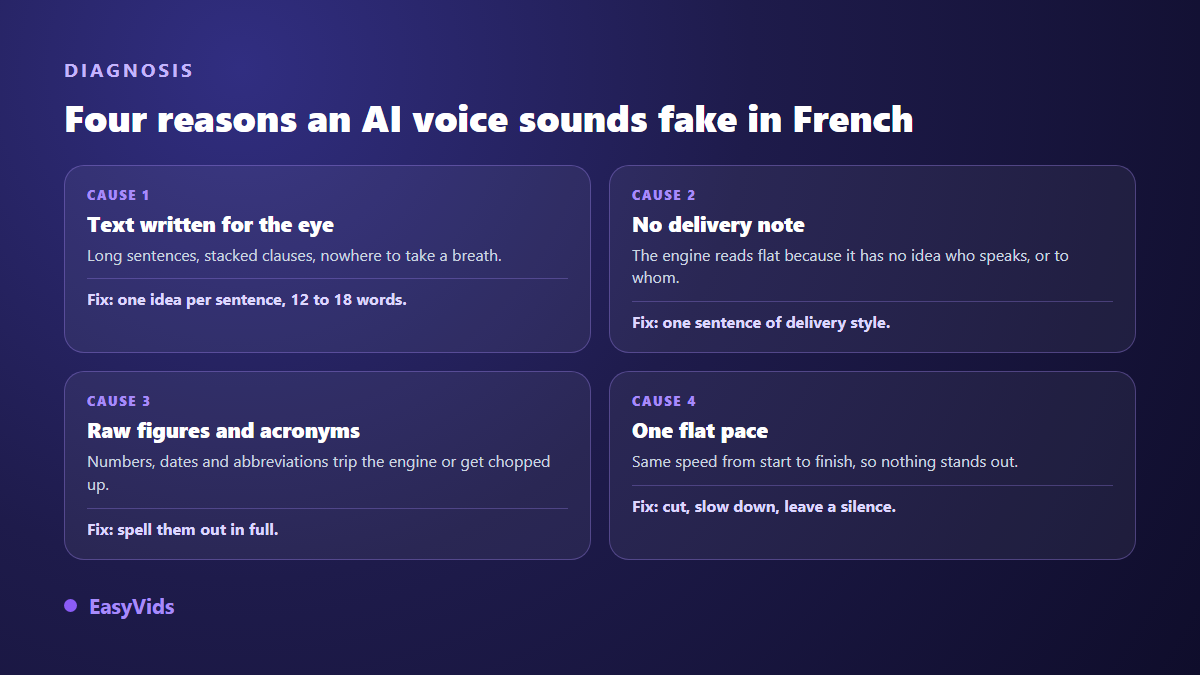
The second cause is far more ordinary, and it is on us. Most scripts sent to a synthesis engine were written to be read with the eyes. They stack clauses, line up modifiers, and leave nowhere to breathe. A human performer cheats the rhythm and steals a breath. An engine applies the text exactly as written. Across our own generations, one rewriting pass before synthesis improves the result more than moving from one engine to another.
Four flaws come back again and again. Each one takes a minute to fix, provided you can name the one you are hearing.
The script carries half the intonation
Writing for the ear means writing sentences you can say in one breath. One idea per sentence. Twelve to eighteen words on average. The verb early, so the listener knows straight away what you are talking about. The test is simple: the moment you have to read a sentence twice to understand it on the page, the voice will read it badly.
Punctuation then does work most people underestimate. Synthesis engines treat it the way a performer treats the markings on a score. A comma bends the line, a full stop drops it, a question mark lifts the ending, an ellipsis calls for hesitation. Use them for real instead of gluing everything into one continuous breath.
That leaves typography, the main source of swallowed or mangled words. Numbers, acronyms, dates and units are risk zones, because how you read them depends on context. One reflex settles nearly all of it: spell out in full anything whose pronunciation matters.
- One idea per sentence, twelve to eighteen words on average, the verb early.
- Punctuation everywhere: the comma breathes, the full stop lands, the ellipsis hesitates.
- Numbers written out in full whenever their pronunciation matters.
- Acronyms spelled the way you want to hear them, letter by letter or as one word.
- No abbreviations at all: write the long form, always.
- Spoken hinges you would actually say out loud, which give the voice somewhere to push off.
Reading direction, the instruction that steers the performance
This is the least known lever and by far the strongest. Some engines accept, alongside the text, a plain language performance instruction: you describe who is speaking, in what tone, at what pace, and the engine interprets it. In the EasyVids studio that instruction lives in a field called reading style, offered on the engine that supports it, with a panel of ready made examples.
One point matters above all: the instruction is never spoken aloud. It is interpreted, then dropped from the output. So you can be precise, and even bossy. A good instruction names three things: a role, an emotional state, a pace.
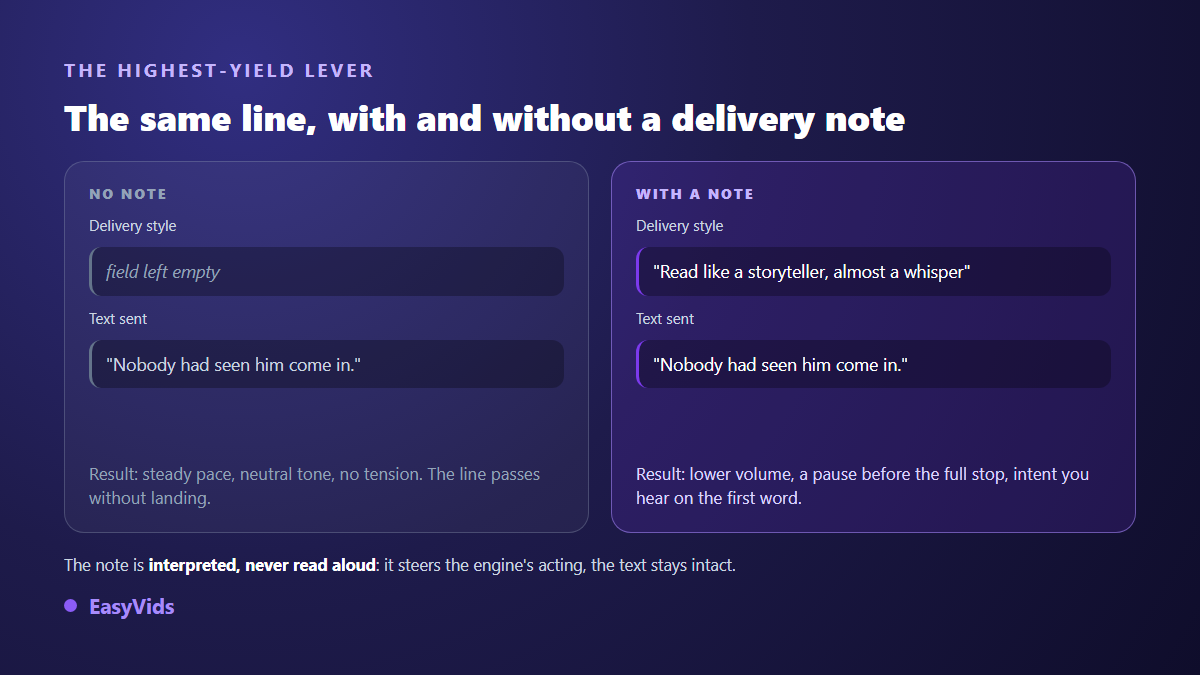
- Read like a captivating storyteller, in a warm and steady voice, for a narrative.
- Read like a TV news anchor, serious and brisk, for a news piece.
- Read with enthusiasm, like a high energy ad, for a promotion.
- Read in a soft, soothing voice, like a meditation, for calm content.
- Read like a wildlife documentary narrator, deep and mysterious, for an investigation.
Those five are the examples the studio ships with, and they are yours to edit. Keep one habit: always add a pace adjective, steady, brisk, rushed, on top of the emotion adjective. Pace is what gives a machine away, far more than emotion does. On a short message that has to land in seconds, the right tone for an advertising voice over is decided exactly here.
Choose the timbre, not the gender
Plenty of creators pick a voice in thirty seconds on a single criterion: male or female. Wrong criterion. Credibility comes from the match between timbre and subject. A deep, steady voice carries a story or an investigation. A bright, quick voice carries a tutorial. A breathy voice carries a confidence. The same sentence changes meaning depending on who says it.
The studio sorts its voices by character rather than by name: playful, deep and steady, firm, energetic, bright, soft, warm, soothing. The method that saves time is to shortlist three, have them read the same two sentences, then listen on the real surface: headphones first, phone speaker second. The voice that stays intelligible on the small speaker wins nearly every time, because that is where your audience listens.
Engine choice follows the same logic. Some favour performance direction, some favour pronunciation across long formats, some favour cloning. There is no best engine in the abstract, only a best engine for what you are producing today.
Pace, silence and cutting
Pace comes first. A comfortable narration sits around one hundred and forty to one hundred and sixty words per minute. Slower, listeners drift. Faster, they lose detail. If your read feels rushed, do not slow the engine down: cut text. A trimmed script read at normal speed always beats a full script read in slow motion.
Silence comes second. Half a second of nothing after an important line does more for attention than any sound effect. In practice you get it by splitting the sentence in two, or by dropping a full stop where you would have put a comma. Narration with no silence at all is narration people leave.
Cutting comes third. When a video is built scene by scene, every scene gets its own fragment of voice, which creates breathing room in the right places on its own. That is a quiet advantage of scene based work: rhythm gets settled in the edit rather than in the playback speed, as our guide to AI video generators sets out.
Cloning your own voice: what it solves, what it does not
Cloning starts from an audio sample of your voice, around fifteen clean seconds to get going, and produces a voice you can reuse on every later script. It is the only way to own a timbre outright, and it becomes decisive once your audience already knows you by ear.
Two limits are worth knowing beforehand. A clone reproduces a timbre, not a talent: a monotone sample gives a monotone clone, so record your sample performing for real, with variation. And not every cloning engine accepts performance instructions: you gain identity, you sometimes lose direction. On the sample length actually required, guesswork circulates widely, and we measured what it really takes.
Legally the rule fits in one sentence with no grey area: clone your own voice, or the voice of someone who gave explicit consent. Reputable services require a certification checkbox before any clone, and responsibility for what you produce stays with the account. For the edge cases, a public figure, a relative, commercial use, our review of voice cloning and the law walks through them one by one.
Several speakers: multi voice dialogue
A three minute monologue tires people out, however well it is read. As soon as your content can be said by two people, do that. The studio has a dialogue mode: you write each line prefixed with its speaker name, up to five speakers, you assign each one a voice and its own reading style, and you get back a single assembled audio file. The realism gain is immediate, for a mechanical reason: alternating timbres create breaks the ear reads as life. That is the natural shape of a podcast, a sketch or a question and answer exchange, and our guide to AI voices for podcasts covers how to dress the result.
Long scripts need one precaution
Past a few thousand characters, synthesis no longer happens in one pass: the text is split, the pieces are generated separately, then stitched back together. In the studio that split fires automatically past roughly three thousand characters, with several pieces processed in parallel so the wait does not grow. The precaution is to place the cuts yourself, at the end of a paragraph and never mid sentence. A joint on a comma is audible. A joint on a full stop is not. Keep the same engine and the same voice from start to finish of a project too: switching midway creates a timbre break nobody forgives.
The listening test before you publish
Run this pass before every export. It takes two minutes and catches most of what is left.
- Listen on a phone speaker, not only on headphones: that is your audience's real surface.
- Close your eyes and mark the exact point where your attention drops. That is where to cut.
- Check proper nouns, brand names and numbers, word by word.
- Confirm the music stays well under the voice, around a fifth of its level.
- Replay the first sentence alone: if it does not earn the second, rewrite it.
- Count the pauses: three minutes without one silence is three minutes nobody finishes.
Frequently asked questions
Can an AI voice be truly indistinguishable from a human?
On a short, well written piece, most listeners no longer tell the difference. On a long format, an attentive ear often picks up an unusual regularity, the sound of a read that never tires. That is exactly why cutting and silence matter so much: they are what breaks that regularity.
Should the voice script differ from the captions?
No, and doing so is a mistake. A script written for the ear captions beautifully, while the reverse is not true. Write one version, the one you would say out loud, and let the captions follow the voice word for word.
Why does my AI voice stumble on certain words?
Nearly always a rare word, a proper noun from another language, or an abbreviation. The most reliable fix is to respell that word phonetically in the text you send to the engine, then check by ear. Always test a brand name on its own before launching a whole batch.
How long does a three minute voice over take?
Synthesis itself runs in under a minute. Most of the time goes into rewriting the script and two or three attempts at the direction. Budget around twenty minutes for a result you are happy to publish, against several hours for a microphone take plus cleanup.
Can generated voices be used commercially?
The voices offered in the studio are meant for your productions, publishing included. For a cloned voice, whatever the tool, responsibility sits with you: you need consent from the person the sample came from. Plan by plan details are covered in the frequently asked questions and on the pricing page.
Natural sounding narration is not bought, it is built, and always in the same order: a script said out loud before it is sent, an explicit reading direction, a timbre matched to the subject, silences placed by hand. Take something you already published, apply those four moves, then compare the two versions: the difference lands on the first sentence. To try it now, create your account and generate your first voice over in the EasyVids studio.