Your visual is clean, your offer is clear, and the ad sells nothing. Viewers drop off before the second sentence. The footage is not always to blame: an AI voice over for ads that was badly cast, or read in the wrong tone, is enough to lose a buyer who was genuinely interested. A fifteen second format leaves no room to recover. Your narrator has time for roughly forty words, and every one of them has to work.
Tone is not a matter of taste, it is a production decision made before the first generation. It follows from what you sell, where the video will be seen, and the action you expect at the end. This article covers how to choose it, how to build it with a synthetic voice, and how to check that it works before you pay for distribution. For the general mechanics of synthetic narration, our complete guide to AI voice over sets the scene; everything here is pulled back to the short selling format.
AI voice over for ads: the short answer
A working ad voice over rests on three decisions, taken in this order. The register first: the friend who recommends, the expert who demonstrates, the announcer who announces, the customer who testifies. The word budget next: around forty words for fifteen seconds, hook included. The delivery instruction last, that plain language sentence you hand the engine before the text, along the lines of read with enthusiasm, like a high energy ad. Timbre comes at the very end, and it matters far less than those three settings.
Fifteen seconds is a word budget before it is a tone
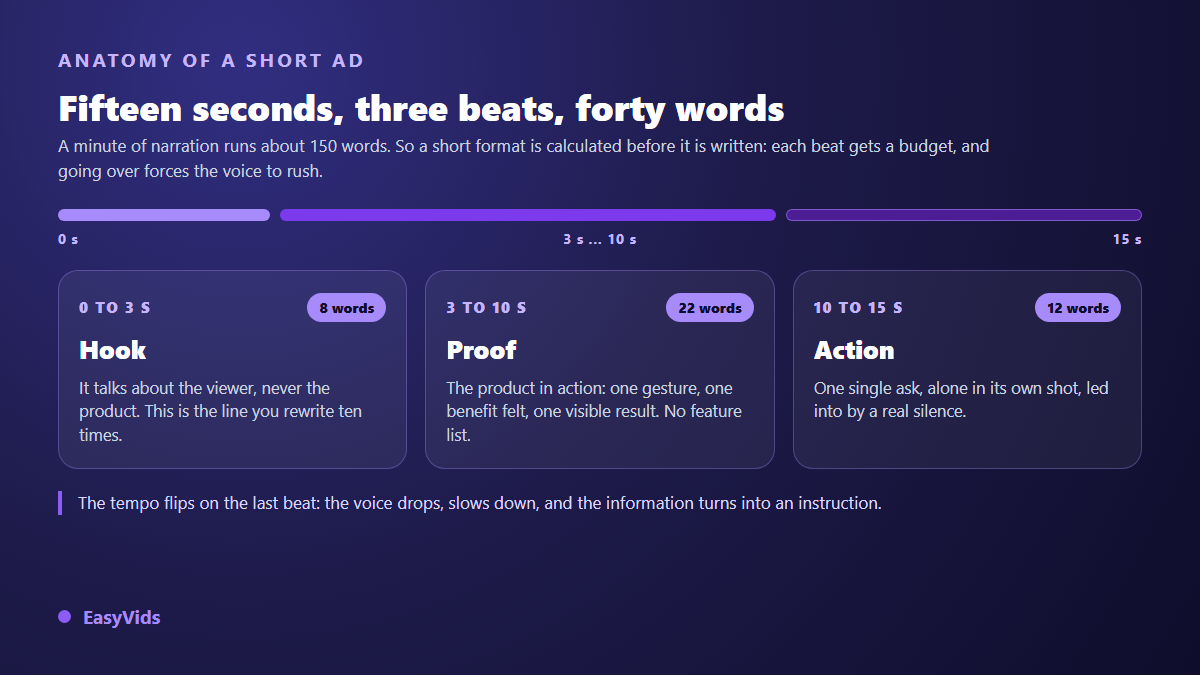
One minute of narration is roughly 150 words at a normal pace. Fifteen seconds therefore buy you thirty five to forty five, depending on the energy of the read. That is physics, not an artistic rule: go past it and either the voice speeds up and turns pinched, or your message overflows the slot you paid for.
The habit that saves these ads is writing the script backwards. Put down the closing line first, the one that asks for the action. Add the proof that makes it credible. Keep the hook for last, because that is the line you will rewrite ten times. Everything else serves the hook, never the other way round.
Our marketing script writer works to exactly that frame. The instruction sent to the model demands a hook that stops the viewer within the first three seconds, a middle that makes the product live through concrete benefits rather than a feature list, one proof or demonstration, then a single call to action. An ad with two calls to action has none.
The register is chosen before the voice
Register is the real setting. It follows from the product, its perceived price and the platform, not from your personal taste. An impulse accessory in a vertical feed is not told the way a professional tool is presented to a buyer comparing three offers. Mixing the two produces that shouted into the void feeling everyone scrolls past.
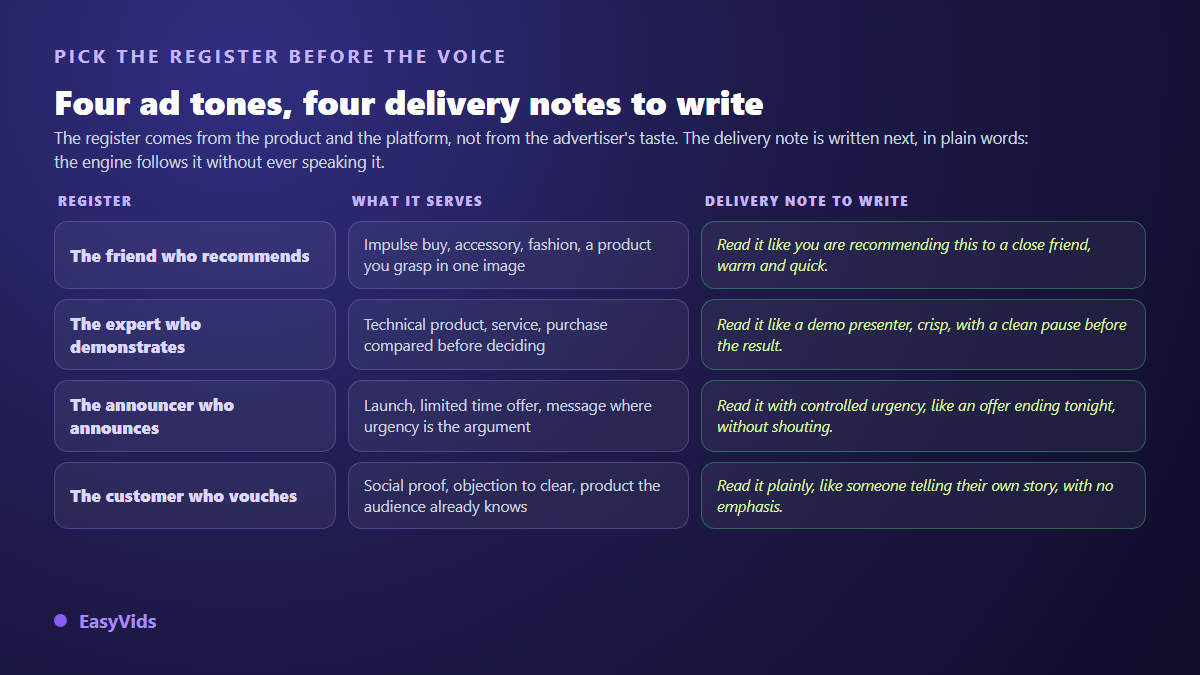
- The friend who recommends: spoken tone, short sentences, lively pace. Impulse buys, accessories, fashion, anything understood in a single image.
- The expert who demonstrates: measured tone, crisp articulation, deliberate silences. Technical products and services, where trust comes before the purchase.
- The announcer who announces: high energy, sharp attack, tight tempo. Launches and limited offers, where urgency is the message itself.
- The customer who testifies: almost conversational, no emphasis, hesitations written into the text. The hardest to pull off synthetically, because that naturalness is written, not voiced.
Once the register is set, it holds from the first shot to the last. A tone change mid ad does not read as nuance, it reads as a technical fault. It is also why the decision belongs before you open the voice catalogue: you then look for a timbre that serves an intention, instead of picking a nice voice and hunting for a role to give it.
Casting: what the voice catalogue really tells you
In our studio, voices sit in three model families under neutral names. Model V1 offers eighteen timbres described by character, from playful to deep, and it is the only family that accepts a delivery instruction. Model V2.5 targets narration. Model V2 offers a catalogue of French and English voices. For an ad, the family that accepts an instruction almost always wins, because it lets you direct the read instead of accepting it.
Casting is tested before producing. Every voice in the catalogue has a preview: one fixed sentence, generated once then served from cache, and it costs nothing to listen. A few minutes of comparison beat an hour of regeneration. Listen on a phone speaker rather than headphones, because that is how your buyer will hear the ad, between two videos, in a noisy room.
The delivery instruction builds the tone
The delivery instruction, called the reading style in our interface, is an ordinary sentence placed before the text. The engine treats it as stage direction and never speaks it aloud. It is the setting with the largest effect for the least effort, and the one almost nobody fills in. One of the examples shipped with the studio is cut for advertising: read with enthusiasm, like a high energy ad.
Three behaviours are worth knowing when you produce ads in batches. The instruction can be saved once on your account and then applies to every compatible voice over. It is frozen when you launch the production, so a change of mind halfway through cannot leave two tones inside one ad. And if a scene text already carries its own instruction, that one wins: the text stays in charge.
- Read as if you were recommending this product to a close friend, warm and quick.
- Read like a demo presenter, crisply articulated, with a clean pause before the result.
- Read with controlled urgency, like an offer that ends tonight, without shouting.
- Read the closing line slower than the rest, like an invitation.
Writing forty words that can be heard
An ad script is read out loud before it is generated: standing up, breathing only at full stops and commas. Every place where you run out of air is a place the engine will get wrong. Your punctuation is its only stage direction: a comma sets a short breath, a full stop a fall and a real silence, an ellipsis a wait, a colon an announcement.
Your brand name deserves a test of its own. Engines guess pronunciation from spelling, and invented names, acronyms and foreign words often come out wrong. The fix is mechanical: in the text sent to the voice, write what you want to hear, and keep correct spelling in the on screen captions. The other classic misreads are listed in our article on the settings that make a voice sound natural.
The call to action is the only line that should slow down
The end of an ad is a matter of tempo. The body can move fast, the last line has to come down: slower, lower, separated from the rest by a real silence. That contrast turns information into instruction, and it is written far more than it is edited.
The most reliable way to get it is to isolate that line in its own scene. Our automatic split targets around 110 characters per segment and cuts at sentence boundaries first, so a short closing line naturally ends up alone, with its own pitch curve and its own trailing silence. You can even give it a different instruction, since the one carried by a scene text overrides the global setting.
Avoid the double ask. Click the link and subscribe splits attention at the exact moment you need it whole. One ad, one action.
Testing three variants beats hunting for the perfect take
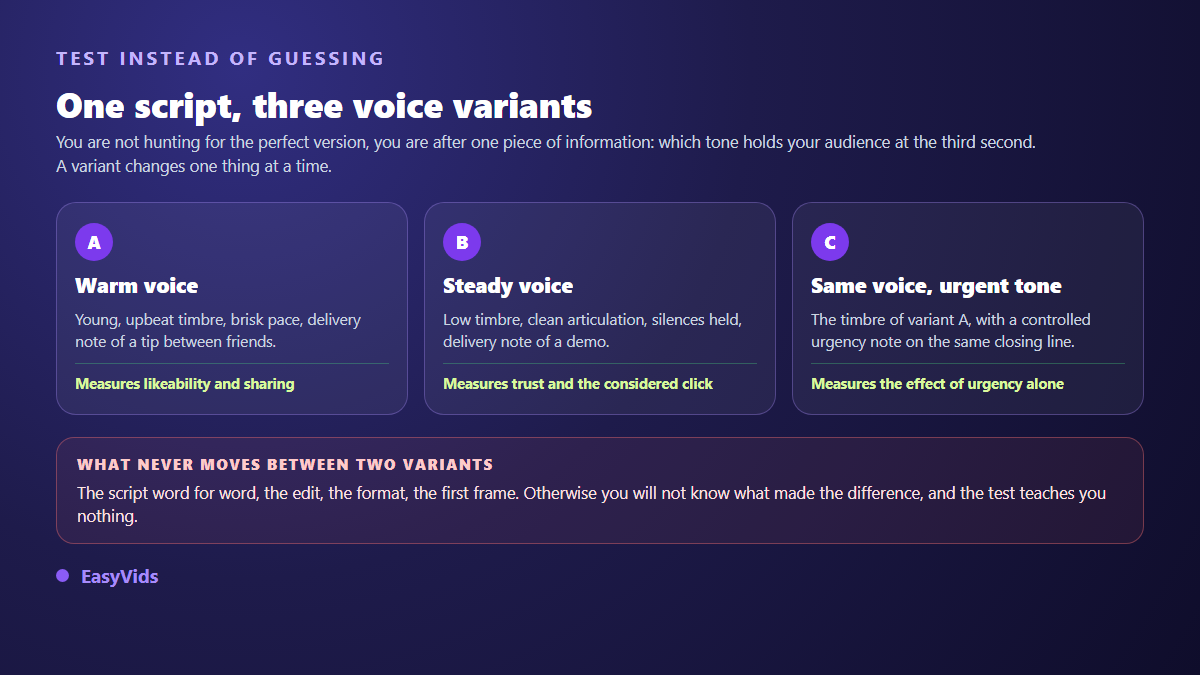
An ad is not judged by the ear of the person selling. The method that produces answers is to run the same script with two or three voices, or the same text with two opposite instructions, then distribute them side by side. You are not looking for the perfect version, you are looking for information: which register holds your audience at the third second.
The studio is built for that kind of trial. Voice over generates scene by scene, it can run while the visuals are still being produced, and a single scene regenerates without relaunching the whole job. Fix one line, listen again, move on. For the visual side of these variations, our product video guide covers how to decline one shot without rebuilding everything.
On spending, one rule avoids nasty surprises: draft with the most economical voice family and keep the finest one for the version that actually ships. Families are not billed at the same level, and the detail of our plans sits on the pricing page.
Sound off viewing, the constraint a voice cannot solve
Plenty of ad views happen with the sound off, especially in feeds where playback starts muted. Your voice over therefore needs a written double on screen. A word for word transcript is not the answer: display the strong words, the benefit, the proof, the call to action. On screen text repeats the argument, it does not duplicate the sentence.
That constraint reaches back into the writing. If your main argument exists only in the voice, it disappears for part of your audience. Write the ad so it still makes sense when only four or five displayed words are read, then let the voice add warmth, rhythm and intent.
Brand voice, cloning and disclosure
A brand that produces at volume gains from fixing a voice the way it fixes a colour. Two roads exist. Pick a catalogue timbre and never change it, which costs nothing but discipline. Or clone a real voice, yours or that of a performer you work with: reputable services require a signed certification before any cloning, and that box is not decorative.
On the rules, two markers are worth quoting as they stand. The European Union artificial intelligence regulation, adopted in 2024, sets transparency obligations for content generated or manipulated by AI. According to the YouTube help centre, the upload form asks creators to flag realistic content made with artificial intelligence. Imitating a well known personality to sell remains a bad idea, and we explained why in our article on the legality of voice cloning.
From product page to delivered file
The shortest path starts from your product listing. The studio writes an ad script from the name and description, at the length you set in words, with a selling angle you choose: problem then solution, demonstration, before and after, storytelling, testimonial, or left to the AI. For a digital product you can attach a document, and its text feeds the script instead of letting the model invent benefits. The result stays editable before anything is launched.
- Choose the register and the distribution platform before writing a line.
- Write, or have written, a script sized to the word budget of your format.
- Set the delivery instruction, then listen to two or three voice previews.
- Isolate the call to action in its own scene, with its own silence.
- Generate, listen on a phone speaker, regenerate only the scene that bothers you.
- Ship two tone variants side by side and keep the one that holds attention.
Frequently asked questions
How many words fit in a fifteen second ad?
Between thirty five and forty five, depending on the energy of the read. Count roughly 150 words per minute of narration and leave room to breathe. If your script runs over, cut words rather than speeding up the voice: a forced read is audible instantly and costs you all your credibility.
Should an ad voice be male or female?
No general rule survives scrutiny here. What matters is the fit between voice, audience and chosen register. The only reliable answer comes from your own test: run the same ad with two voices, distribute them side by side, keep the one that holds attention at the third second.
Can a synthetic voice be used in paid advertising?
Yes. What you generate with us belongs to you and can be used commercially. Two duties remain: follow the disclosure rules for realistic AI generated content on the platform you target, and only use a cloned voice with the explicit agreement of the person behind it.
How do I get urgency without sounding like shouting?
Urgency is built with tempo, not volume. Write shorter sentences, cut soft connectors, and ask the instruction for controlled urgency rather than enthusiasm. A voice that presses without climbing in pitch stays credible; a voice that shouts gets scrolled past.
Can one brand keep the exact same voice across every ad?
Yes, and it is recommended. Fix a catalogue timbre, save your delivery instruction on your account so it applies by default, and record both in your brand guidelines alongside your colours. Audio recognition is built on repetition, never on variety.
An effective ad voice over is not a beautiful voice: it is the right tone, held for fifteen seconds, serving one single ask. Choose the register, count your words, write the instruction, isolate the call to action, then let the test decide for you. To try it on your own product, create an account and run a first voice over in the EasyVids studio.