You found a product that ticks every box. The supplier delivers, the margin holds, the product page is live. One question still decides everything: does the market actually want it? Winning product ads are not there to look good. They exist to answer that question within days, before you commit a serious media budget.
The expensive mistake never changes. One video gets made, runs for a few days, underperforms, and the product gets dropped. Nothing proves the product was at fault. The hook may have been weak, the format wrong, the selling angle aimed at the wrong buyer. A real test pulls those hypotheses apart instead of collapsing them into a single verdict. What follows is the protocol, the structure of the video, the numbers to read and the decision they lead to. For the production basics, our complete guide to product video covers them in detail.
The short answer
A test video validates a winning product when it isolates one variable at a time and runs long enough to settle the question. In practice: three to five short variants of the same product, one selling angle per variant, running in parallel on a deliberately small budget, judged in three stages instead of a glance at sales. Hook rate tells you whether the video stops the scroll. Click rate tells you whether the promise appeals. Add to cart rate tells you whether the offer holds. Wherever the chain breaks, you know what to fix, and whether to fix the video or drop the product.
What the video actually tests
A video ad stacks four promises, and each one can fail on its own. The first is visual: does the product earn attention within a second? The second is narrative: does the video name a problem the viewer recognises as theirs? The third is commercial: is the offer worth a click? The fourth is operational: does the landing page deliver what the video promised?
Blurring those four levels ruins most tests. A strong product dies on a weak opening. A mediocre product can post a healthy click rate because the video promises more than it delivers, then collapse at the cart. The job of a test is to locate the break, never to hand down a global verdict on the product.
One variable per round
The rule that makes a test readable fits in a sentence: between two variants, exactly one thing changes. Change the hook, the music and the format together and the result teaches you nothing. You will know which version won, never why, so nothing transfers to the next product.
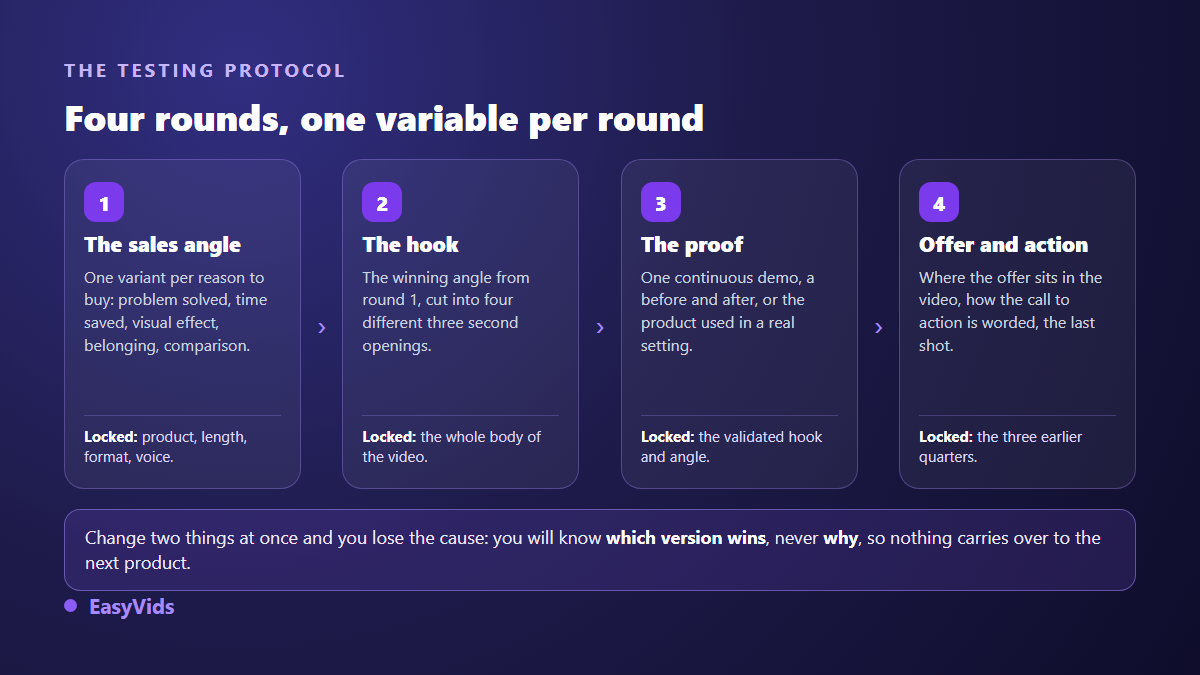
The cheapest method locks a base, then varies one layer. Same product, same length, same vertical format, same voice. Only the selling angle moves, meaning the reason someone would buy. Once the winning angle is known, a second round varies nothing but the first three seconds.
- Round 1, the selling angle: one variant per promise, everything else identical.
- Round 2, the hook: the winning angle, cut into four different openings.
- Round 3, the proof: continuous demonstration, before and after, or real use.
- Round 4, the offer: where it lands in the video and how the call to action is worded.
- In every round, one variable moves while the rest stay locked.
The selling angles worth putting head to head
An angle is not a product feature, it is a reason to buy. The same object rarely sells the same way to two audiences. Running five angles against each other on a tiny budget costs less than betting on one, and the answer carries over to the rest of your catalogue.
- The problem solved: show the daily annoyance before you show the product.
- The time saved: the same task, before and after, timed on screen.
- The visual effect: the product does something surprising within seconds.
- Identity: the object as a marker of a lifestyle or a group.
- The comparison: your product against whatever the viewer already uses.
The first thirty seconds
A test video does not need to be beautiful, it needs to be readable. Four beats are enough, and their length matters more than their content. The first three seconds carry the hook alone, with no logo and no intro. The next ten set up the problem. The demonstration then takes the longest segment, and the offer plus a single call to action close the video, stated once.
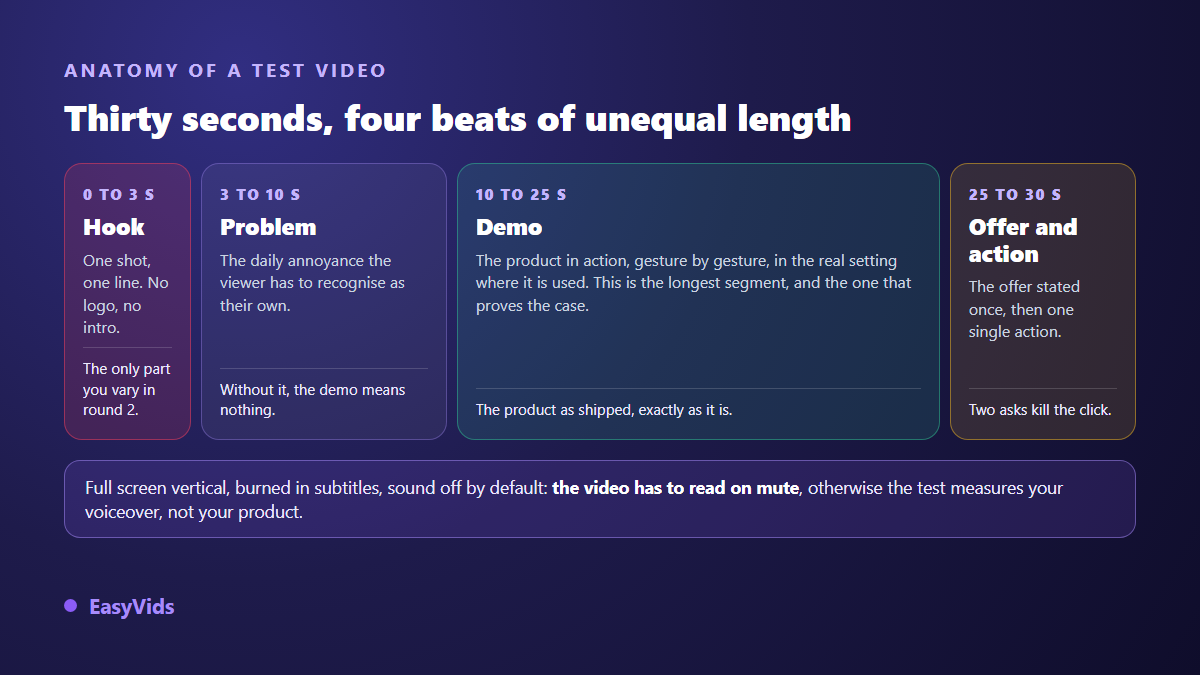
Aspect ratio is decided before the first shot, never at export: a test runs full screen vertical, because that is where attention is won. Burn in captions, since a large share of viewers watch with the sound off. The opening deserves separate work, because it declines almost for free, and a bank of ready made hooks saves a whole round, as these fifty one hooks sorted by niche show.
Producing eight variants without a studio
The real cost of a test is not the media spend, it is producing the variants. Filming eight different openings takes a day. Generating them takes minutes. The starting point stays a plain product photo, yours or the supplier's: it works as a visual reference, so the model animates a scene around the real object instead of inventing something similar. Cleaning that photo first changes the result a lot, and our method for turning a phone snapshot into a storefront visual explains how.
Inside the EasyVids studio, on demand generation accepts several reference images, up to five depending on the model, a vertical ratio, a short duration and several generations running at once, so one round is produced while the previous one is still rendering. Voice over and music sit in the same place, and the online editor then trims, adds captions and exports each variant. For the testimonial format, our guide to UGC videos for dropshipping covers staging a character who speaks to camera.
Reading the numbers: where the chain breaks
Three metrics are enough, read in order. Hook rate, the share of viewers still there after the first seconds, judges the opening. Click rate judges the promise. Add to cart rate judges the offer and the page. A sale is the result of those three wins in a row, which makes it a poor first metric: it arrives too late and too rarely to separate eight variants.
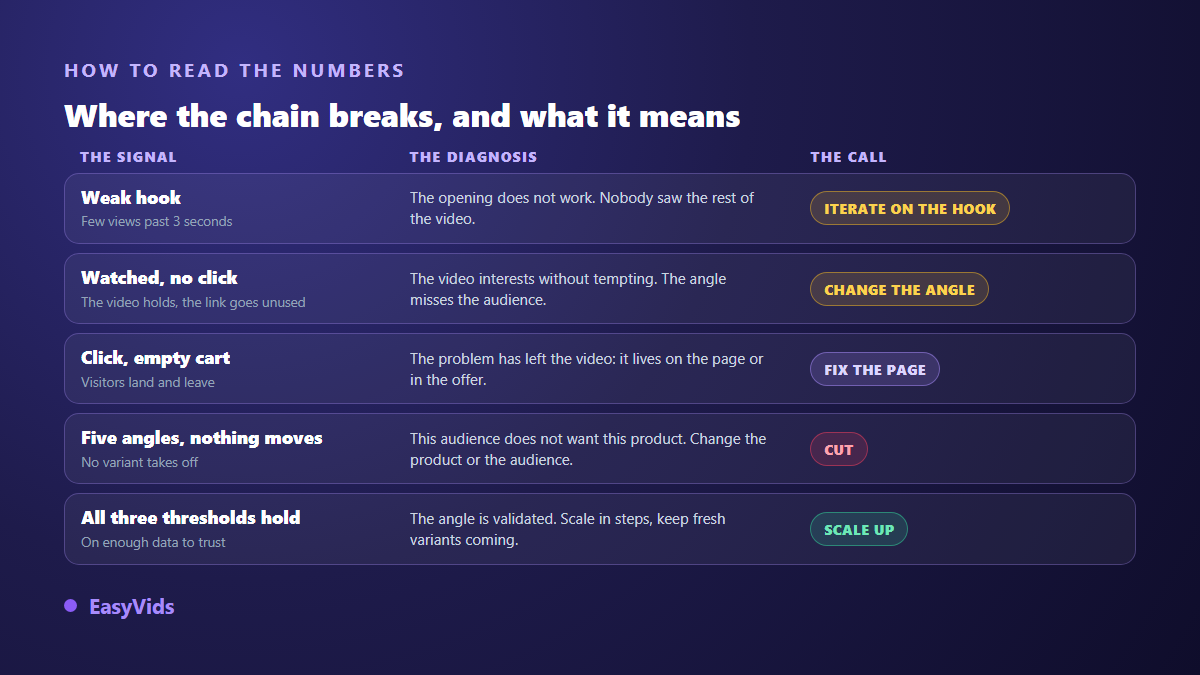
Read the grid from top to bottom. Weak hook: the opening fails, and the rest of the video was never even seen. Strong hook but no clicks: the video holds attention without creating desire, so the angle has to change. Clicks but an empty cart: the problem left the video, it now lives on the product page or in the offer. Full cart but abandoned checkout: the video did its job, look at shipping, delays or payment methods.
How long to let it run
Cutting too early is the most common mistake. An ad set needs a minimum volume of events before delivery stabilises: according to the Meta Business Help Centre, the learning phase ends at around fifty optimisation events over seven days, and results read before that point stay unstable. Deciding on two days of data is a coin toss with extra confidence attached.
Two practical consequences. Pick an optimisation event frequent enough to be reached: during a test, add to cart fills far faster than purchase. And cap the number of variants in flight, because the same volume of data spread across twelve videos concludes nothing. Three to five per round remains the sensible compromise. On the tooling side, a free account already covers a first round, and the pricing page lists the current plans for what comes next.
Cut, iterate or scale
A test ends with a written decision, not an impression. Three outcomes only, and the criterion for each one is set before launch, never after seeing the numbers.
- Cut when no variant clears the first threshold across five angles: this audience does not want this product.
- Iterate when one variant wins on the hook but stalls further down: keep the winner, run the next variable.
- Scale when all three thresholds hold on enough data: raise budget in steps, with two fresh variants ready against fatigue.
- Either way, write down the winning angle: it transfers to neighbouring products in your catalogue.
What platforms expect from AI generated ads
AI produced ads are accepted, on two conditions. Accuracy first: the Meta advertising standards prohibit misleading claims and representations that do not match the product actually sold. Disclosure second: the TikTok community guidelines require realistic AI generated or edited content to be labelled, and the platform provides a dedicated toggle at upload. In practice, show the product that will actually ship, and never invent a testimonial: an openly staged scene is a format, while a fake customer describing an experience they never had is a claim.
Frequently asked questions
How many variants does a winning product test need?
Three to five per round, rarely more. Beyond that the data spreads thin and no variant reaches the threshold that would let you conclude. Three rounds of four beat one round of twelve.
Do I need the product in hand to shoot the test video?
No for the test, yes before scaling. A sharp supplier photo is enough for the first variants. Selling at volume something you have never held exposes you to gaps between the video and the delivery, and therefore to disputes and refunds.
How long should a product test video be?
Fifteen to thirty seconds. Long enough to set up a problem and show a demonstration, short enough to be watched through. Longer cuts belong later, once the angle is validated and the audience is already warm.
Can I test several products in one video?
No. One video, one product, one angle. A video showing three items measures your storefront rather than a product, and you will never know which one carried the result.
What if two variants perform the same?
Keep the one that costs less effort to decline, and treat the tested variable as having no measurable effect. That is useful information: move to the next variable instead of splitting hairs between equivalent versions.
A winning product is proven, not guessed, and the test video is the instrument of that proof. Set your thresholds before launch, move one variable at a time, let delivery stabilise, then decide without regret. The rest is cadence: the faster you produce variants, the more products you test each month. Creating an account opens generation, voice over and the editor in one place, and the EasyVids studio covers the whole chain, from the product photo to a vertical file ready to run.