You have a product, a testing budget and a decision to make this week: pay someone to film a testimonial at home, or generate an AI UGC clip where a synthetic presenter delivers the same script. The comparison keeps coming back in every team buying social ads, because both approaches ship what looks like the same thing: a person talking to their phone about something they tried.
The answer depends less on the technology than on what you need to learn in the next thirty days. A creative test and a brand campaign do not call for the same face. This article compares both routes on what can actually be measured: iteration speed, number of variants, perceived credibility, legal exposure and the cost of a fix. If the mechanics of a talking character are still unclear, our guide to AI avatars and UGC videos covers the build before you get to the trade off.
The short answer
Neither approach converts better in general, and anyone claiming otherwise without a published protocol deserves scepticism. Ad performance is decided by the angle, the hook and the fit between product and audience, not by the production method. In practice, AI presenters win the exploration phase, because they produce ten versions while a shoot is still being scheduled. Human creators keep the edge on trust, when the message rests on lived experience, on handling an object, or on an audience the creator already owns. The teams getting the best results do not pick a side once and for all: they search with AI, then hand the winning angle to a person.
Two production chains for the same ad
A UGC creator is a real person paid to film something that looks like an ordinary post: vertical framing, everyday light, phone held at arm's length. You ship a product and a brief, they deliver footage, and a usage licence lets you run it as an ad. An AI presenter follows a very different path: a character is built from a reference image, and a video model renders each shot where they speak your words.
The difference that matters is logistical rather than aesthetic. One chain depends on a person's availability and on a parcel arriving. The other runs on a written instruction and a few photos.
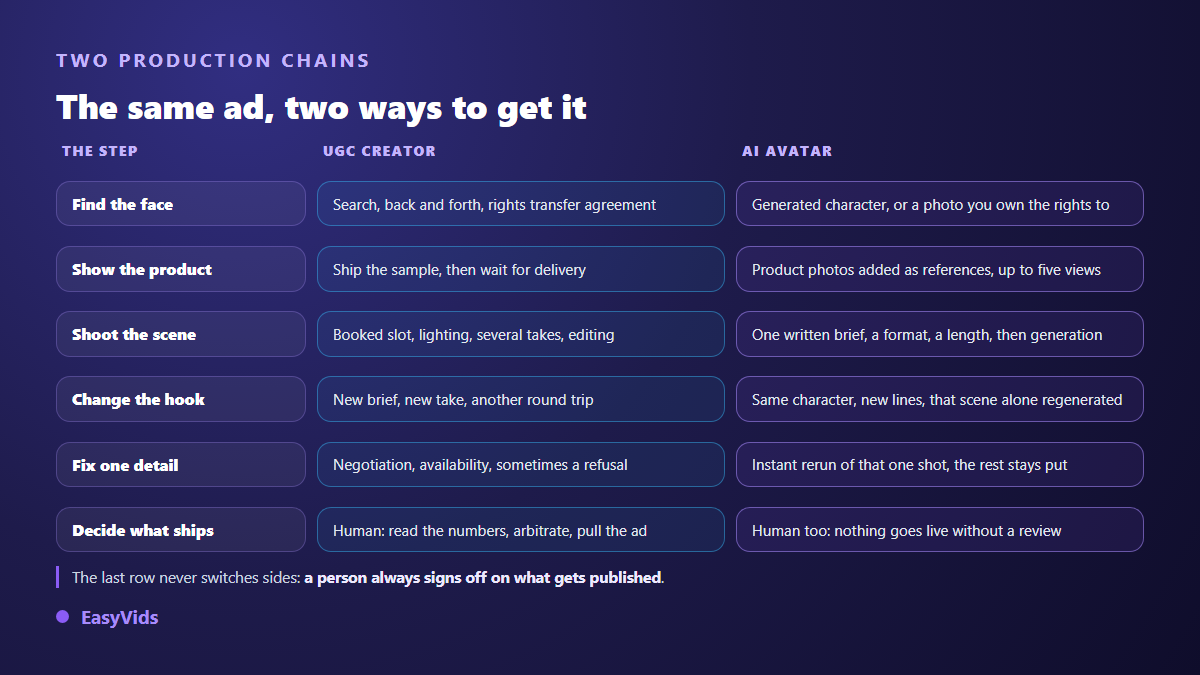
Look at the fix row. With a creator, changing three words after delivery triggers another round trip and sometimes a renegotiation. With a generated character, only the affected shot is rerun and the rest of the edit survives. On a catalogue that changes weekly, that gap shows up immediately, which is the exact ground covered by our method for producing product videos without hiring creators.
What can honestly be said about conversion
Start with what is missing. To our knowledge there is no independent public study comparing avatar creatives and filmed creatives at equal budget across a large number of accounts. The percentages circulating online almost always come from vendors selling one of the two options, measured on their own campaigns, with no protocol published. Treating them as proof would be dishonest.
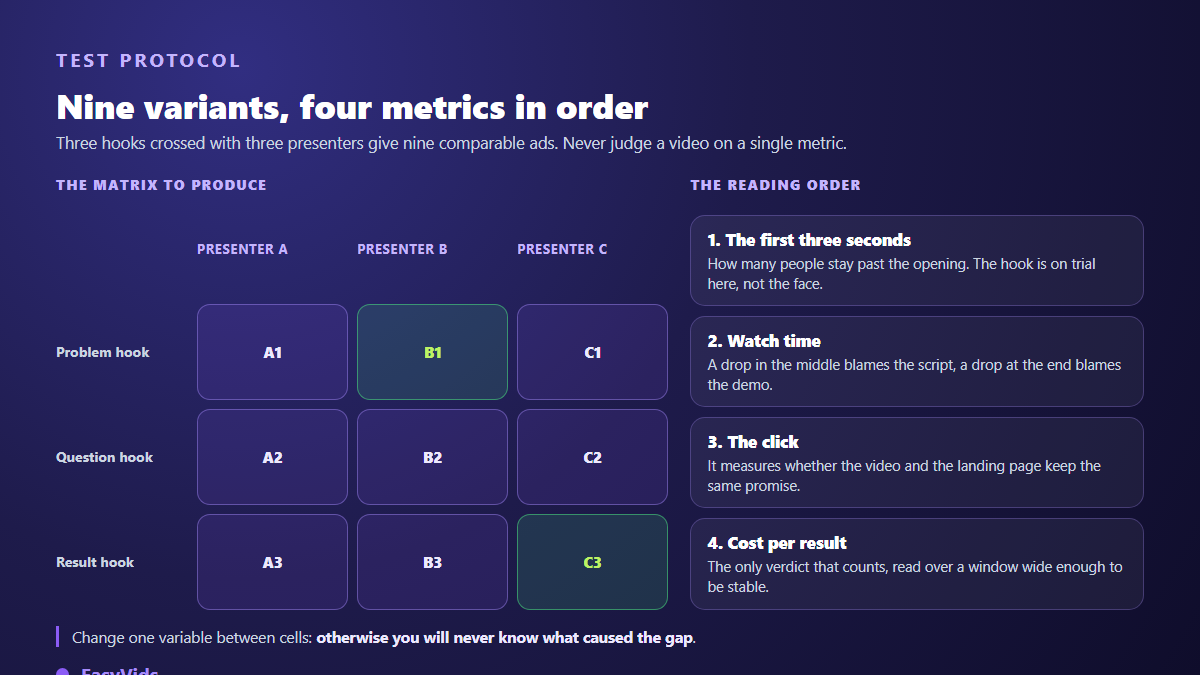
What you can measure is already inside your ad account. According to Meta's advertising documentation, a creative is read through early video plays, the ThruPlay metric, click through rate and cost per result. TikTok's ads manager exposes equivalents. Those four numbers, read in that order, separate two creatives far better than a gut feeling about how real a face looks.
One point defuses the whole debate: in the first three seconds, viewers judge a hook, a framing and a rhythm, not the nature of the presenter. A badly hooked human video loses to a well written generated one, and the reverse holds just as often. That is why the production method never belongs at the top of your testing list.
Where AI presenters take the lead
The real value of a generated character is not the saving on one video. It is the number of attempts you can afford before you find the angle that works. Campaigns are rarely won on the first try, and most teams stop early simply because they run out of creative to test.
- Volume: ten hooks on the same product ship in a day, with no shooting slot to book.
- Unit fixes: one edited sentence reruns one shot, not the whole video.
- Languages: the same character carries the same message in several languages by swapping the text.
- Unavailable stock: a pre order or a supplier held item can still be staged from photos.
- Consistency: the same face can return across a series of posts without depending on a calendar.
- Discretion: you can test a market without exposing your own face or committing someone else's.
That list describes a process advantage, not a persuasion advantage. The distinction matters: an avatar does not make you more convincing, it gives you more chances to land on what convinces.
Where human creators stay ahead
A video model builds a plausible person, it does not build an experience. As soon as your message rests on something genuinely lived, the creator regains the advantage, and not only for visual reasons: claimed authenticity has to be real, or the buyer is being misled.
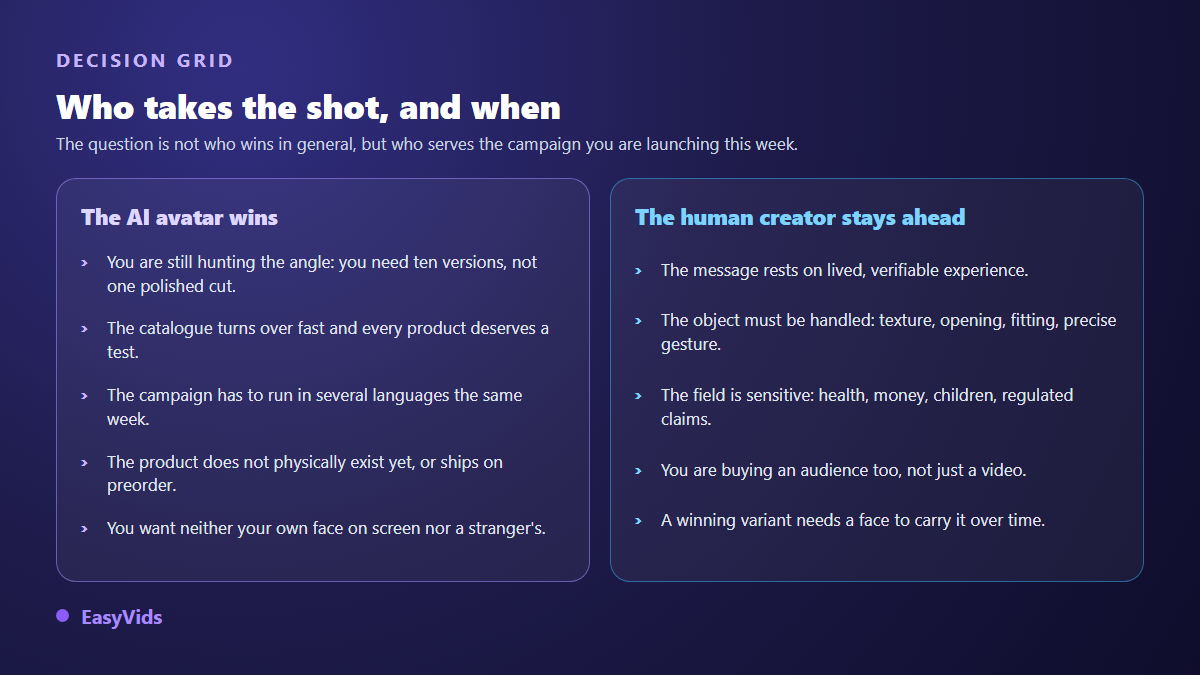
The second area is physical handling. Hands remain the weak point of generative models, especially opening packaging, showing texture or working a small object. A demonstration built on those shots is more convincing filmed. The third area is accountability: health, money, children, regulated claims. On those subjects the person speaking is putting something on the line, and a synthetic character puts nothing at all.
Finally, a creator often sells more than footage. They bring an audience and a niche legitimacy no generator replaces. If that legitimacy is what you are buying, the comparison collapses, because you are not buying the same product.
The test protocol that actually settles it
The right way to decide is not to read a comparison, this one included. It is to build a short matrix and let it run. Three hooks crossed with three presenters give nine comparable creatives, with only one variable moving at a time.
- Write three genuinely different hooks: the problem, the question, the result. Not three wordings of one idea.
- Produce the nine variants with the same body script and the same call to action, so the hook and the presenter stay isolated.
- Run them in a single campaign with equal budget per variant and a window long enough to clear the noise.
- Read the metrics in order: early retention, watch duration, clicks, then cost per result.
- Cut the bottom half, keep the two best, then run a second round changing only the body of the script.
- Hand the winning angle to a real person if the product allows it, and compare both versions of that same angle.
That last step is the one almost nobody runs, and it is the only one that answers the question for your own market. The avatar becomes a discovery tool, and the human creator steps in on an angle already proven, which makes their fee far easier to justify.
The hybrid model that wins in practice
Framed as a duel, the question has a boring answer: both, at different moments. Exploration goes to the generated presenter because it needs speed and volume. Consolidation goes to the human because it needs trust and durability. That split has a pleasant side effect on budget: you only commission a shoot on angles you already know hold up. We laid out the orders of magnitude between AI assisted and traditional production in our analysis of what a video really costs.
What platforms and regulators require, either way
This is not a footnote, it is the part that can cost you an ad account. According to YouTube's help centre, realistic content generated or altered by AI must be disclosed at upload in the video settings, and a label can be surfaced to viewers. Meta states that an AI information label is applied to content detected as generated, with a manual declaration expected otherwise. TikTok's advertising rules likewise require a label on realistic AI generated content. All three obligations date from 2024 and have tightened since.
Two texts complete the picture. The United States Federal Trade Commission adopted a rule in 2024 banning fake reviews and fake testimonials, including machine generated ones: a synthetic character presented as a happy customer falls squarely inside that ban. And under the application timeline of the European AI act, transparency duties on content imitating real people apply from August 2026. The working rule fits in one line: an avatar may play a role, it may not testify.
Consent applies to both camps. A creator signs a licence naming platforms, territories and duration. A real face used as a reference image needs exactly the same document, signed before the first generation. No tool checks that for you: an uploaded image is a visual reference, never a permission.
Producing the variants without a casting call
The production loop itself is short. In our one step generator you write the shot instruction, pick the model, the vertical format and the duration, then collect the clip. Models able to read references accept up to five images: the product photo, a second angle, the character portrait. Shot length stays short, around fifteen seconds at most on most models, which forces writing in scenes rather than monologues. Each type of generation runs independently, so several variants can be launched in parallel, and our tutorial on building an avatar from a photo covers how to prepare the reference image.
The rest of the chain lives in the same place: synthetic voice over for shots without a presenter, captions and editing in the online editor, and a generation history so you can find a variant that went live three weeks ago. Working on credits lets you pick a fast model for testing and a more polished one for the final cut, with the plans detailed on the pricing page.
Frequently asked questions
Does AI UGC convert worse than a real creator?
Not mechanically. On angle testing and products that are simple to show, observed gaps come mostly from how the hook is written. The advantage swings to a real person when the message needs lived experience, physical handling or a personal endorsement. The only valid answer for your market is your own test matrix.
Do I have to disclose that an ad was generated?
Yes, as soon as the content is realistic. According to YouTube's help centre the declaration happens at upload, and Meta and TikTok apply comparable labels to AI generated content. Disclosure costs nothing; skipping it can cost you the video or the account.
Can an AI character deliver a customer testimonial?
No. A synthetic character presented as a real customer is a fake testimonial, covered by the rule adopted in 2024 by the United States Federal Trade Commission and by unfair practice rules in many countries. An avatar can present a product, explain a benefit, play a scene announced as such. It cannot attest to an experience nobody had.
How many variants should I test before concluding?
Nine creatives from three hooks and three presenters is a reasonable first round. Below five, chance decides for you. Keep budgets equal per variant and give the campaign a window long enough for cost per result to stop moving daily.
Can I combine a real product with a generated presenter?
Yes, and it is often the best compromise. Real photos of your product act as references at generation time, keeping scale, material and label accurate, while the character carries the message. You get a video faithful to the object without waiting on a sample shipment.
Reframe the question before you choose: it is not avatar or creator, it is what you need to learn this week and how fast. Produce your nine variants, read your four metrics in order, keep the angle that survives, then decide who should carry it over time. To launch that first batch without casting or filming, creating an account opens the studio, and the EasyVids studio keeps generation, voice and editing in one place.