You know the stories already. What you do not have is a camera, a studio, or any wish to appear on screen. A faceless bible channel needs none of them: a chosen passage, a calm narration, images that carry the text, and music that stays out of the way. The production side will not hold you back for long. What decides everything is accuracy.
This kind of channel combines two problems that are rarely handled together. One is editorial: quoting without distorting, telling without judging, speaking to believers and to curious strangers at the same time. The other is industrial: publishing enough episodes to exist without producing the interchangeable series platforms now penalise. This guide covers both, alongside our guide to AI video generation. It describes a production method and nothing else: the substance of the message is yours.
The short answer
A faceless bible channel rests on four pieces. A passage taken from a translation you are allowed to use. A script that tells a story instead of preaching, cut into short scenes. A calm narration whose pace and silences you control. A visual register held from the first episode to the last. Assembly is automated from script to final file, and the whole path lives in the EasyVids studio. The difficulty therefore moves to two places, and they decide the fate of the channel: what you add to the text, and respect for viewers who do not all share the same tradition.
Choosing which stories to tell
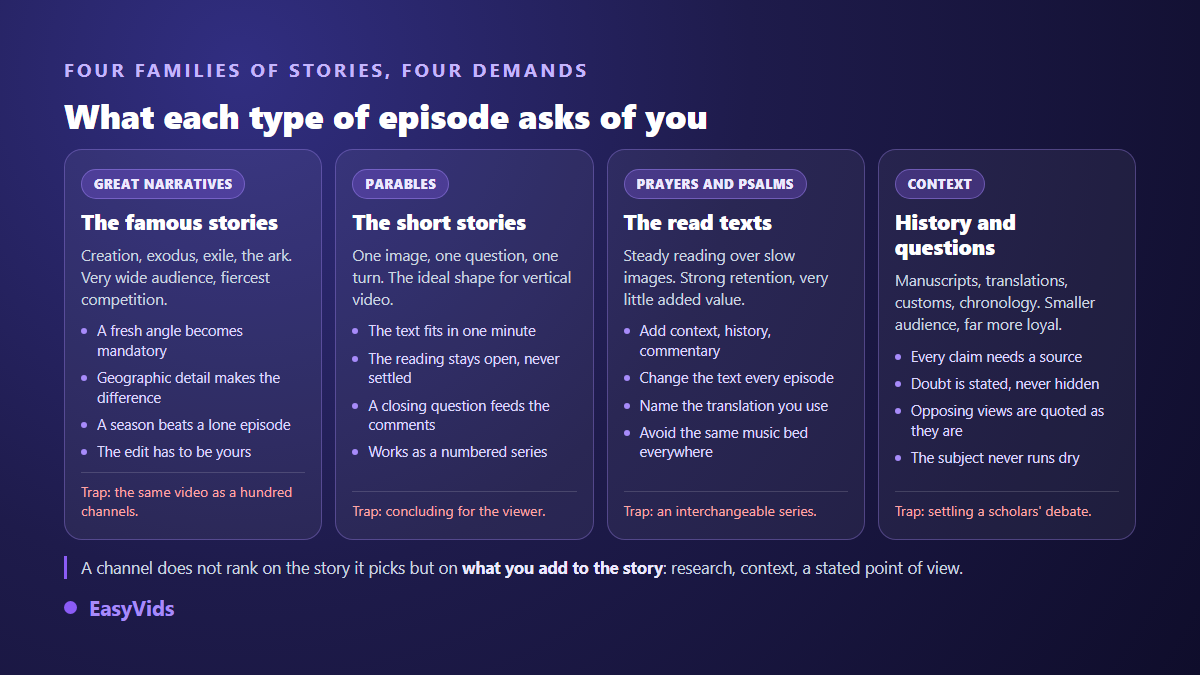
The catalogue looks infinite, and that is the trap. The famous narratives pull a very wide audience precisely because everyone searches for them, so competition is at its highest there. Short texts suit vertical video but wear out fast when strung together without logic. Read prayers hold attention for a long time while adding almost nothing of you. Every family has its upside and its cost.
A channel that lasts thinks in seasons rather than isolated uploads. Twelve episodes on one figure, a run of ten texts linked by a single question, a cycle that follows a chronology. Viewers come back for the next one, and you stop hunting for a subject every week. It is also what separates a channel from a feed with no memory, and what a platform recognises as a series rather than a repetition. When the cycle is aimed at younger viewers, it adds two constraints set out in our method for a channel made for children: a recurring character whose look never drifts, and an audience declaration that changes what the channel can switch on.
- One episode, one story, one question: the second idea becomes the next video.
- An angle you can defend: a place, a period, a material detail, an honest objection.
- A title that promises exactly what the video delivers, with no manufactured alarm.
- A length decided before writing, otherwise the script stretches and retention drops.
- A clear slot in the season, so the next episode chooses itself.
- A subject you would be willing to defend in the comments, because you will have to.
Faithfulness to the text: the quote comes before the effect
First thing to settle, and many skip it: not every translation is free to use. Modern versions are protected works, published by houses that set their own reproduction terms. Older translations, on the other hand, have entered the public domain in most countries, since protection runs for decades after publication or after the author's death. In the United States the rule is readable: a work published more than ninety five years ago is free, and a fresh batch enters the public domain every first of January. Check the copyright notice of your edition before reading a text aloud for eight minutes.
Then comes quoting discipline, the first thing your viewers will check. Put the reference on screen and in the description, name the translation you used, and always separate what the text says from what you understand of it. A narrator who slips an interpretation inside a quotation loses the most attentive viewers instantly, and those are the ones who comment and share. When a passage is disputed among specialists, say so. Acknowledged doubt makes a channel more credible than displayed certainty.
Writing an episode that tells instead of preaching
The most common flaw is not visual, it is tonal. A script written as an exhortation exhausts the viewer within a minute, because they hear that something is being asked of them. A script written as a story holds far longer: there is a situation, an obstacle, a decision, a consequence. The lesson, if you want one, arrives at the end and stays short. It then counts for far more than ten reminders scattered through the video. That narrative frame is not specific to sacred texts: our guide to a faceless true crime channel shows the same construction applied to criminal cases, with the same care over tone.
In the studio, that first draft is written from your idea. You describe the episode, pick a tone from the list, narrative, documentary or dramatic, set an approximate narration length, and the text comes back already split into scenes, editable line by line. Treat it as an author's draft, never as publishable copy: you check the facts, you cut the stock phrases, you put your own voice back in. Reckon on roughly one hundred and fifty words per minute of narration, which gives you a simple marker for writing straight to the right length.
- Open on a concrete situation, never on an announcement of the topic.
- One short sentence per idea, read aloud before you approve it.
- Conversational vocabulary rather than pulpit vocabulary, even when the source text is solemn.
- Difficult proper nouns spelled phonetically for the narration, then restored properly in the captions.
- No promise, no threat, no judgement on people who think otherwise.
- An open question at the end, inviting comment without demanding agreement.
- Your research visible somewhere: a source, a historical context, a detail nobody else supplied.
Narration: calm, never a sermon
The narration carries the whole episode, and that is where most channels give themselves away. The reflex is to pick the deepest, grandest voice, then leave it at that level for eight minutes. The result is the opposite of the intention: permanent solemnity cancels solemnity. A voice that stays low and steady leaves the text room to rise on its own. That is the logic of faceless channels in general, where the voice takes the place on screen presence usually holds, and our explanation of the faceless YouTube model covers what that shift changes for the writing and for the audience.
Two settings matter. The voice itself, previewed on your own text rather than on a demo line, because that is what your audience recognises before your logo and it should not change once the channel is running. Then the reading style, which one of the available engines accepts in plain language, for example to read slowly, without emphasis, pausing after every quotation. Breathing, punctuation and the mistakes that make narration sound artificial are covered in our guide to natural AI voice over.
- Write the silences into the script: a line break before the quotation beats any effect added in the edit.
- Slow down on quoted passages and return to normal pace for commentary; the ear understands the difference unannounced.
- One voice per channel, held across the whole series.
- Listen back to sentence endings, where synthesis shows most.
- Cloning a voice requires written consent from the person it belongs to, relatives and community leaders included.
Visual direction: showing without offending
Here is the question nobody can dodge on this theme: how far do you show? Traditions diverge, sometimes sharply, on depicting sacred figures. The same image reads as a fine illustration to some viewers and as an impropriety to others. There is no universal answer, but there is a method: choose a visual register, state it where useful, and hold it without exception.
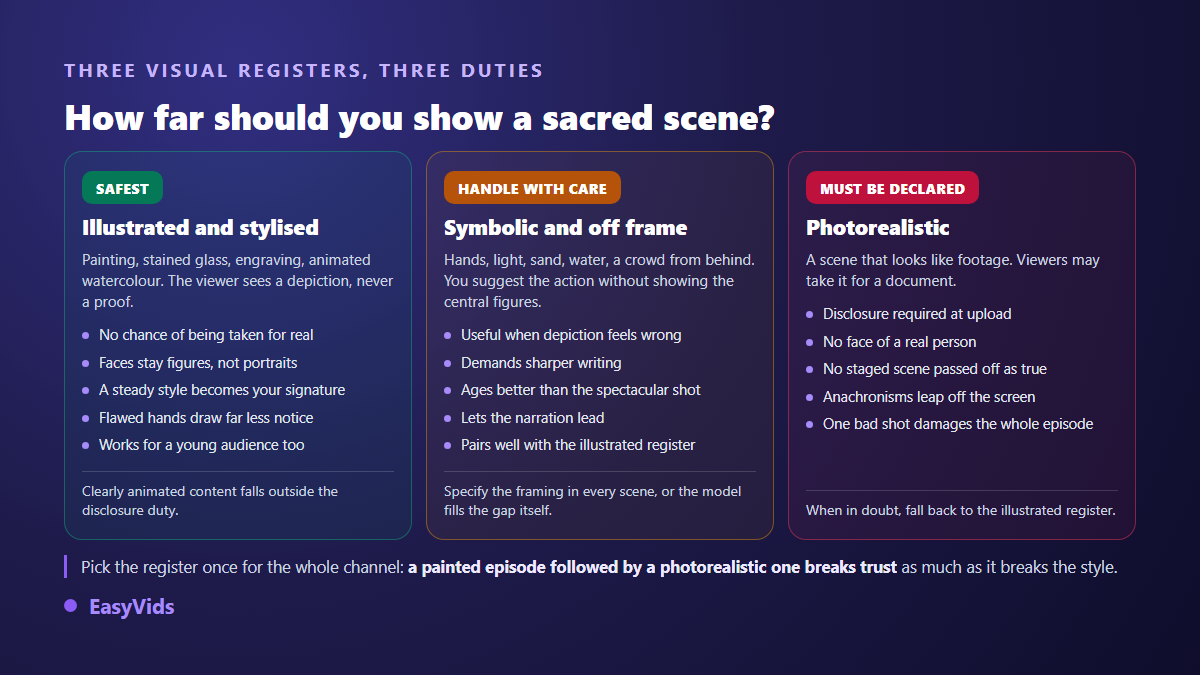
The illustrated register is the safest and, in practice, the most elegant. Painting, engraving, stained glass and animated watercolour tell the viewer they are seeing a representation, never a document. The symbolic register, showing hands, light, sand, a crowd from behind, lets you narrate without depicting the central figures: it demands more precise scene writing, because a model left free will fill the gap its own way. The photorealistic register remains possible, but it commits you further and it triggers the duties described below.
Consistency is built with images rather than adjectives. In the director workflow you attach up to three style images that set the visual tone of the whole project, and the workspace accepts your own visuals when you already have them. Each scene keeps its own text, shot and narration, and regenerates alone when it misses, so you fix one shot without rebuilding the episode. The aspect, landscape, portrait or square, is chosen at the start of the project and applies to images and videos alike. Captions call for the same consistency, same settings and same placement from one episode to the next, and our method for burning in subtitles that survive every platform shows where to put them so they stay readable in landscape and in vertical alike.
- One register for the whole channel: a painted episode followed by a photorealistic one breaks trust.
- Slow wide shots, held longer than on a news style video.
- No text baked into a generated image: letters distort, so add the words in the edit.
- Constant vigilance on anachronisms: clothing, tools, architecture, visible writing.
- No real person's face, living or dead, used to embody a figure from the story.
- Captions on everything, because a large share of your audience watches muted.
Music that supports without forcing the emotion
Music sets the atmosphere more reliably than the script, and it is also the line item that has sunk the most channels. A track lifted from a streaming service is not usable, even credited in the description, and an automated claim can redirect a video's revenue to a rights holder. Watch out for a common confusion: an old hymn may be free of rights while a recent recording of that same hymn is not. The composition and the recording follow two separate regimes.
Having the music produced for your channel removes the problem at the source. The music studio includes a praise and gospel brief, with a genre, a mood and a tempo to specify, plus a box to request a purely instrumental version, which is almost always the right call under narration. The job keeps running server side even if you close the page. Two or three tracks reserved for your channel are enough to build a sound signature viewers recognise from the first second.
Short form or long form
The two formats serve different goals. Vertical shorts get you discovered by people who were not looking for you: they need a story that fits in a minute, one strong image and a closing question. Long horizontal videos turn those strangers into regulars: they allow context, nuance and sources. A shorts only channel grows fast and retains badly; a long form only channel grows slowly and keeps its audience. Neighbouring faceless channels run the same double regime, and our guide to an AI motivation channel covers how to hold the short form pace without exhausting the subject. The cheapest method is to write the long episode first, then cut the vertical clips out of it, reusing the script, the narration and the music you already produced. Our step by step guide to a published YouTube video walks the same sequence end to end, thumbnail included.
Respecting sensitivities
A channel about belief touches what people hold most privately. You will be watched by believers from different traditions, by people of other religions, and by people with none. The rule fits in one sentence: speak about what you know, without belittling what you do not share. This is not only politeness. A channel that attacks builds an audience of confrontation, which comments a lot, tires quickly and attracts reports.
- No mockery of another denomination, another religion, or of unbelief.
- No promise of healing, wealth or protection: platforms treat those claims as risky content.
- No request for money dressed up as teaching.
- Internal debates presented honestly, with the opposing positions quoted as they stand.
- Sensitive current events handled at a distance, or not at all.
- Comments moderated from the first episode, before a quiet channel becomes a battlefield.
- A warning at the top of the video when a story contains violence, which happens often.
Monetisation: what the platform actually checks
The recurring question is whether an AI assisted channel can be monetised. It can. What gets refused is not the tool but the absence of contribution. Since the update to the inauthentic content policy, the platform requires videos that are not mass produced, generic or repetitive, and it names two examples that land directly on this subject: channels uploading narratives that differ only superficially, and slideshows carried by the same narration. The full criteria sit in YouTube's monetisation policies. A run of illustrated readings built on one template is therefore the most exposed format, and it is exactly the one convenience pushes you towards. We went through those criteria one by one, and what they imply for a channel assembled with AI, in our read of the monetisation rules for generated content.
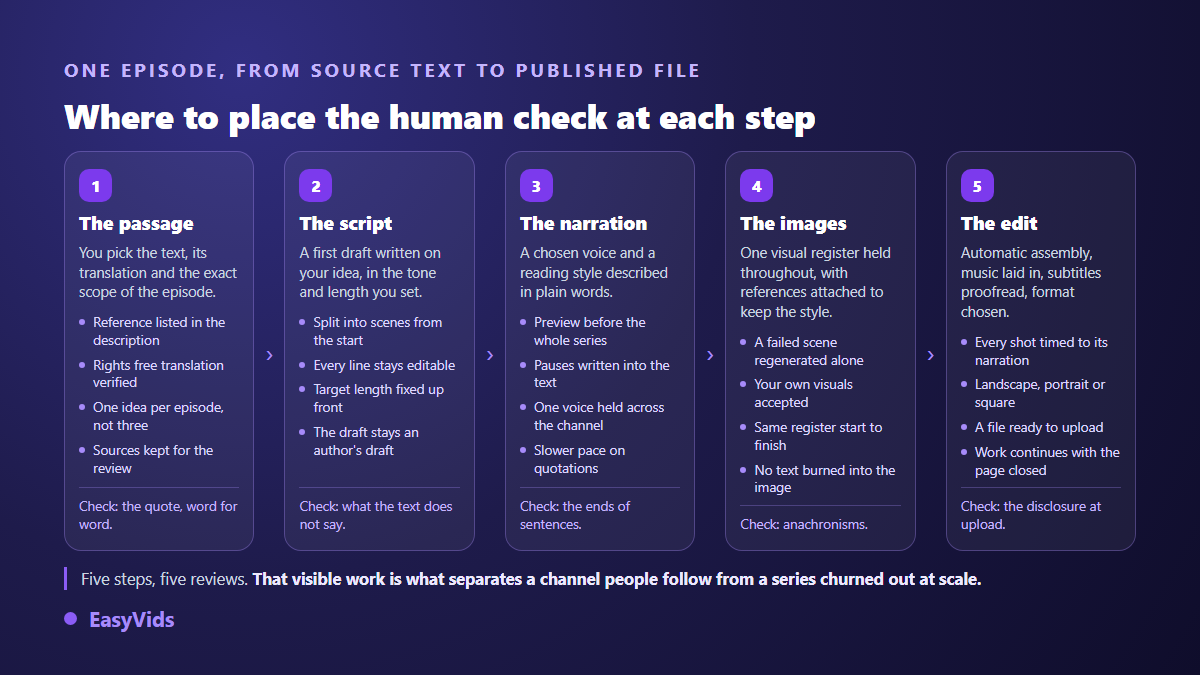
A second duty is separate from the first: realistic content generated or altered by AI must be disclosed at upload, and a label can be shown to viewers. The rule targets what could be mistaken for reality. A fully animated or clearly illustrated episode falls outside that disclosure; a photorealistic reconstruction does not. The case by case detail sits in the platform's altered and synthetic content help pages. Ticking the box costs nothing, forgetting it can cost the video or the account.
That leaves the profitability calculation, which everyone has to run on their own numbers. The orders of magnitude of AI assisted production against a conventional shoot are set out in our breakdown of what an AI video really costs, and the current details of our plans live on the pricing page. One principle holds over time: the channels in this space that last sell something other than advertising, a book, a reading plan, guidance, direct support from their community.
Frequently asked questions
Can a faceless bible channel made with AI be monetised?
Yes, provided every episode contributes something. The inauthentic content policy targets series produced at scale with no real variation between videos, and it explicitly names narratives that differ only superficially. Visible research, historical context, an evolving structure and narration written by you are enough to leave that category. The tool you used is not part of the assessment.
Which Bible translation can I read on camera?
One that has entered the public domain, or a modern translation whose publisher expressly permits that use within the limits it sets. Always check the copyright page of the edition you use, and name the version in the description. Rules vary by country, and protection does not depend on the medium you read it on.
Do I have to disclose an AI illustrated video?
It depends on the look, not on the tool. A clearly animated, painted or stylised episode falls outside the disclosure duty. A photorealistic scene that could be mistaken for footage must be flagged at upload. When in doubt, disclose: the label does not scare viewers away, and repeated omission puts the account at risk.
How do I keep the same visual style across episodes?
Work from references rather than from descriptions copied into every prompt. Attach style images to the project, keep the same register, palette and framing from one episode to the next, and regenerate the individual shots that drift. A repeated description gives you cousin images, never the same series.
Do I need to be a theologian to start one?
No, but you need to be honest about what you are. A narrator who tells a story and cites sources needs no title. A narrator who settles questions debated for centuries is exposed, whatever the diploma. State your position in the description, separate the text from your reading of it, and point to serious scholarship when a question goes beyond you.
A channel like this is not won on equipment. It is won on faithfulness to the text, on a voice that forces nothing, and on research the viewer senses without being told. Production will no longer hold you back: script, narration, music, shots and edit now live in one workflow, and the work continues server side while you prepare the next episode. Choose your first passage, write eight minutes of text, read it out loud, then create your account and give it a voice and images.