You have video ideas, a subject you know better than most people, maybe even a voice worth listening to. And the thought of stepping in front of a camera stops you cold. A faceless YouTube channel is not a fallback for shy people. It is a format in its own right, with its own strongest niches, its own production habits and its own rules.
What changed over the past few years is not the format, it is the manufacturing. Sourcing visuals, recording a clean narration, editing every episode: that was the wall that ended most channels somewhere around video five. This guide covers what actually matters, from picking a niche to monetisation, with no income promises attached.
The short answer
A faceless channel is one where the creator never appears on screen. The voice, the visuals and the edit carry everything. YouTube does not ban it, does not demote it, and monetisation stays fully open. The real condition fits in one sentence: every episode has to bring something of its own, an angle, a script, a point of view. What gets a channel rejected is never the missing face or the use of AI. It is repetitive, mass produced content with no added value.
Why the format holds up
Viewers do not show up to look at you. They show up for a story, an explanation, a mood. In most niches your face adds nothing to the content, and it adds a constraint: a set, lighting, several takes, and a lost day whenever your voice is off.
Without a camera, an episode becomes writing and editing again. It can be prepared ahead, produced in batches, and fixed without reshooting anything. That is what makes a steady schedule possible around a normal job, and what lets some creators run several channels at once. The full chain, from script to exported file, is broken down in our guide to AI video generators.
There is an honest trade off. Without a face, the bond with your audience builds more slowly. You compensate with a strong sonic and visual identity: the same voice, the same intro, the same thumbnail signature. Recognition moves from you to your format, which is far more durable anyway.
Picking a niche: six formats that work without a camera
Your niche decides almost everything: episode length, the kind of voice you need, how much research each video demands and how long one takes to finish. Six families work reliably without filming anyone, and they are not the same job at all.
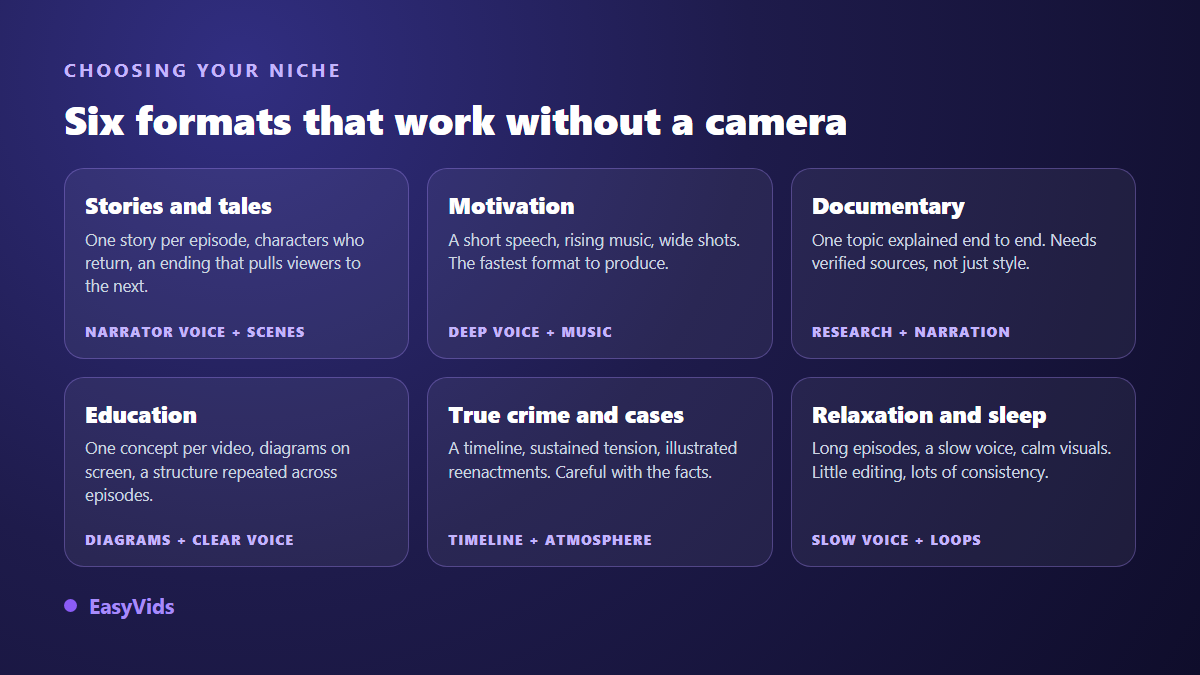
Stories and narrative fiction hold up best over time, because they create appetite for the next episode. Motivation is the fastest to produce and by far the most crowded. Documentary work demands real sourcing but keeps attention much longer. Educational videos age best in search, since a good one keeps being found years later. True crime and case files call for particular care with facts and with the people named. Relaxation and sleep content needs little editing but a lot of patience before anything moves. Each family then splits into sub niches with their own rules: inspirational and biblical storytelling, for instance, calls for a particular tone and reading pace, covered in our guide to running a Christian YouTube channel.
Before committing to a niche, run your idea through these four questions. They prevent most third month quits.
- Can you write a hundred episodes on this subject without getting bored? If not, the niche is too narrow.
- Are there already channels living off this format? A complete absence of competition is a bad sign, not an opening.
- What do you bring that others do not? An angle, a language, a standard of rigour. Without that answer the channel stays invisible.
- Does the subject support illustration? Some themes have no obvious imagery and quickly become painful to watch.
Produce a series, not one video at a time
A faceless channel is not won on video one, it is won on video one hundred. The difference comes down to organisation. Creators who last draw a clear line between what gets decided once for the whole channel and what gets redone every episode.
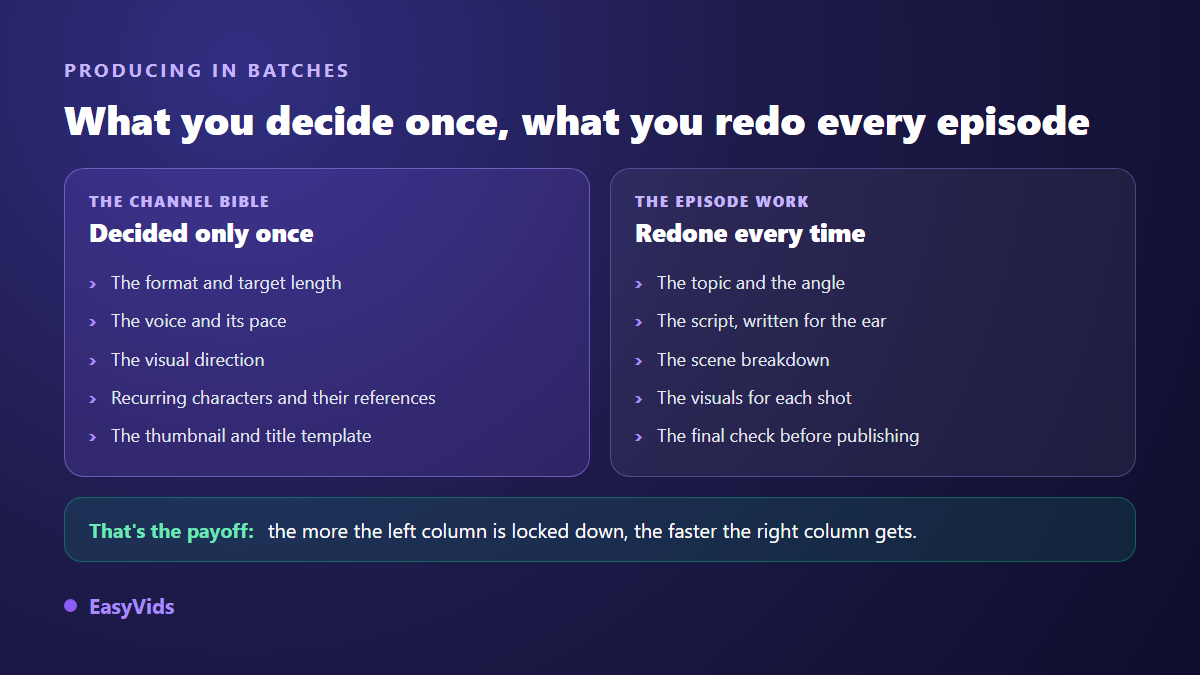
That first column is your channel bible, and it fits on a single page: the format, the target length, the voice, the visual direction, the recurring characters, the thumbnail template. Once those are locked, you stop relitigating them. Every episode becomes a matter of subject and writing, not a new project to invent.
The second habit is batching. Write four scripts in a row, then launch the four generations, then review all four. Your attention switches mode once instead of four times, and rendering runs while you do something else. It is the workflow described in our step by step YouTube video guide, applied to a whole series rather than a single upload.
Keeping the same characters from episode to episode
This is the technical point that separates a real series from a pile of unrelated uploads. As soon as your stories feature an illustrated narrator, a mascot or recurring characters, their appearance has to stay stable. A written description, however detailed, will not do it: the face drifts from one generation to the next, and viewers notice instantly.
The method that works is to lock visual references and reuse them in every scene, instead of redescribing the character in each prompt. That gives you believable continuity across an entire season. Locations follow the same rule: the same place returns under the same light and the same treatment.
Fix a palette and a rendering style for the whole channel too. Two episodes in different styles feel like two different channels, and break the series effect you are trying to build.
The voice is your only face
On a channel with no camera, the voice becomes the lead character. It carries emotion, pace and credibility. Average visuals with strong narration work fine. The reverse never does. Some niches rest almost entirely on it: in horror, the breath, the silences and the grain of the timbre build the tension, as our guide to an AI horror channel shows.
Pick one voice and keep it. A timbre that shifts between episodes undoes all your identity work. Take care with punctuation in your scripts, because synthesis engines read it the way an actor reads a score: a full stop creates a breath, a comma creates an emphasis. The settings that genuinely matter are gathered in our tips for natural sounding AI voice over.
Publishing rhythm, titles and thumbnails
Consistency beats volume. One video a week held for six months beats four videos in one week followed by two months of silence. Pick a rhythm you can sustain in a busy week, not in an ideal one. Build a buffer of a few finished episodes before you publish the first one.
With no face on screen, the click is decided entirely by the title and the thumbnail. A thumbnail readable on a phone holds three elements at most, with short, high contrast text. Keep a shared template across episodes: viewers should recognise your channel in a feed before they read its name. When you cut an episode into vertical clips for Shorts or Instagram, subtitles take over from the title, since sound starts muted there, and our subtitle settings for Reels keep them from hiding behind the caption.
Monetisation: what actually gets penalised
This is the question that worries people most, and it deserves a precise answer rather than a reassuring one. Joining the Partner Program first means reaching the current subscriber and watch time thresholds, which change from time to time and should be checked directly in the platform rules. None of them depend on whether you appear on camera. Advertising is not the only outlet for the writing a channel demands, either: the same stories can be republished as books, under disclosure obligations of their own, which our guide to publishing AI books on Amazon KDP sets out.
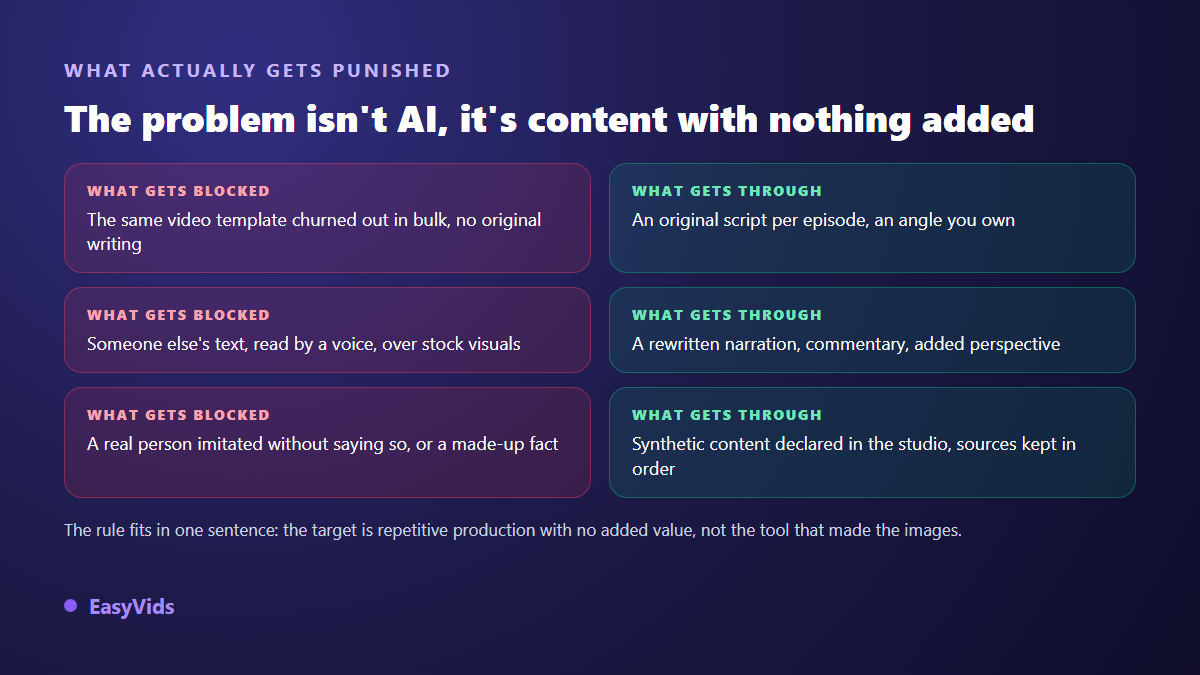
Then come the content rules, and this is where the rumours live. YouTube does not penalise the use of AI. Its policy targets mass produced, repetitive content with no original contribution: the same video template rolled out at scale, text lifted from elsewhere and simply read by a synthetic voice, an edit that adds nothing to its source. A faceless channel that writes its own scripts, chooses its own angles and works on its narration sits comfortably inside the rules.
Two obligations do deserve your attention. You must disclose in the video settings any realistic altered or generated content that could mislead viewers, particularly when it depicts real people or events. And you must be able to justify your rights to the music and imagery you use: one badly licensed track is enough to strip the revenue from an episode that works, sometimes months after it went up. Building your own audio branding closes that question, since the track is yours, and our guide to a personalised song written with AI shows how precise the brief can get, custom lyrics included.
Mistakes that stall a faceless channel
They almost always arrive in the same order, and none of them are technical.
- Switching niche after ten videos because the numbers are not climbing fast enough.
- Publishing episodes of wildly different lengths and styles, so the audience never knows what to expect.
- Handing the whole script to AI without ever reviewing it or adding a personal angle.
- Rushing the first sentence of every video, when it decides everything that follows.
- Treating the thumbnail as a closing formality after three hours of editing.
- Skipping music rights checks until dozens of episodes are already online.
Frequently asked questions
Can a faceless channel be monetised?
Yes. Neither anonymity nor the use of AI blocks monetisation. You need to reach the Partner Program thresholds, follow the content rules and bring real value to each episode. What gets refused is repetitive output with no contribution, however it was produced.
Do I have to use my own voice?
No. A synthetic voice works well, provided you keep the same one across episodes and take care with the script. Your own voice is an asset if you like it, but it ties the channel to your availability and your health, which makes batch production harder.
Which niche should a beginner choose?
The one you can write a hundred episodes about without tiring, and where you bring an angle nobody else occupies. Stories, explainers and educational content age best. Motivation starts faster but burns out faster too.
How often should I publish?
A rhythm you can hold beats an intense one. Weekly is more than enough to build an audience, as long as you never miss it. Build a buffer of three to five finished episodes before the first upload.
Can I run several channels at once?
Yes, and that is one of the strengths of the format, but not from the start. Wait until one channel runs on a stable bible and a smooth batch process. Launching two at the same time almost always means failing at both.
A faceless YouTube channel is built like a small studio, not like a diary: a format held steady, a recognisable voice, episodes similar enough to become a habit. The rest is consistency, and consistency comes from producing in batches. Details of our plans sit on the pricing page, and if you want to test a first series before giving it your weekends, creating an account opens the full studio, from script to final edit.