A photo shows up in your feed, something feels off, and you cannot name it. The light is beautiful, the smile is flawless, and still your eye keeps snagging. Knowing how to tell if an image is AI generated has become an everyday reflex: a property listing that looks too good, a dating profile with a single picture, a news photo shared thousands of times before anyone checked, a job ad illustrated with offices that never existed.
Most generated images still give themselves away, provided you look in the right places and in the right order. This guide covers the nine zones that talk the loudest, the method that goes with them, and above all the false clues that get perfectly real photographs accused. We generate images with AI every day, and our complete guide to AI image generators covers the other side of the story: what exactly produces these flaws during generation.
The short answer
To tell if an image is AI generated, check four zones in this order: hands and anything countable, text written inside the image, the attachment points of accessories, then the consistency of light and shadow. Move on to the file itself: capture metadata, provenance credentials, reverse image search. Then apply the decision rule that prevents false accusations. One clue proves nothing, since a real photo can easily show a blurry hand. Three anomalies across three unrelated zones leave almost no doubt.
Signs 1 to 3: read the human body
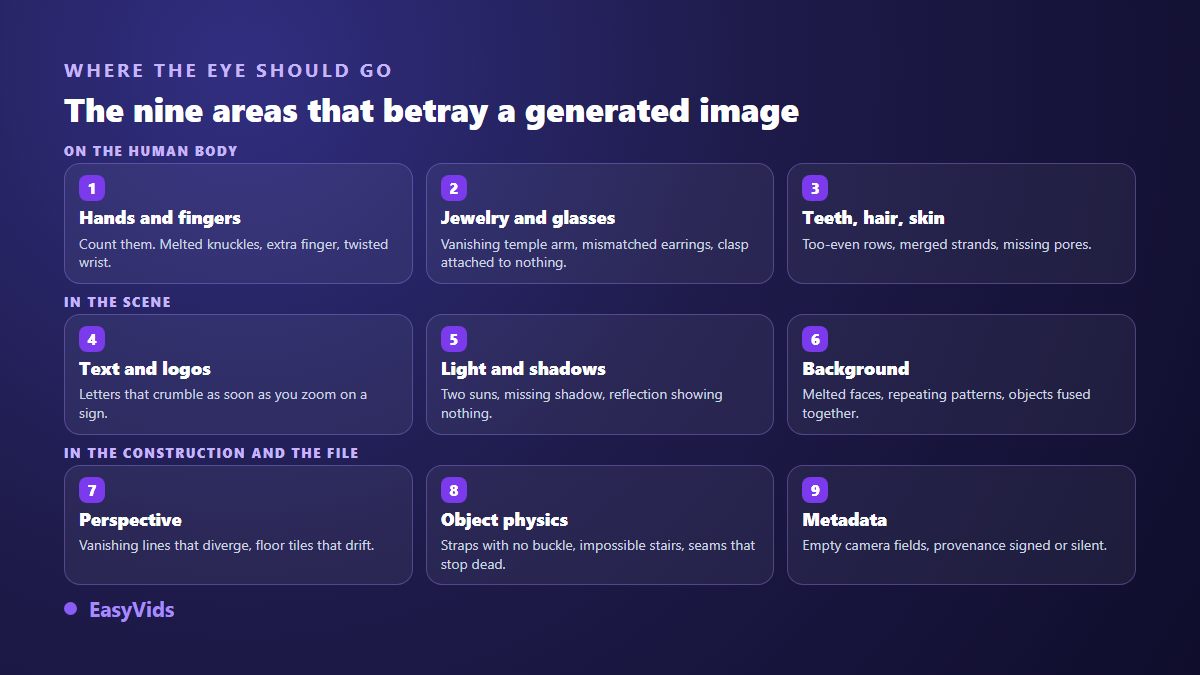
Hands remain the fastest check, but the modern version of the rule is not about counting a sixth finger. Look at knuckles, at relative finger length, at thumb placement, and above all at how the hand grips something. Recent models handle a resting hand shown in full. They still break on hands in interaction: a handshake, fingers wrapped around a cup, a hand half hidden behind an object. Extend the same logic to everything countable in the frame, from teeth and shirt buttons to stair railings and chair legs.
Jewellery and glasses come next, because a model renders appearance and never mechanism. Flaws cluster wherever two things meet: a glasses arm that enters the temple without passing behind the ear, a watch strap that changes width under the wrist, an earring with no fastening or no matching twin, a necklace that vanishes behind a collar and never comes out. Skin and hair form the third body signal, and the weakest one: uniform pores, mechanical background blur, strands that merge halfway. Beauty retouching produces the same look, so treat it as a warning rather than proof.
Signs 4 to 6: read the scene
Text is the loudest signal of all. A model does not know the alphabet, it draws shapes that resemble letters. Large headlines often survive, small type collapses. Hunt for background text: street plates, shelf labels, book spines, computer screens, garment prints. A word that is almost right, with a doubled letter or a hybrid character, is a strong tell, and familiar logos redrawn from memory show the same distortion. The decisive test is contrast: if small lettering dissolves while that area is as sharp as everything else, focus is not the explanation.
Light is the hardest lie to hold across a whole frame. Every cast shadow should describe the same source, with the same direction and the same hardness. A missing shadow under a foot, a shadow falling left while the backlight comes from the right, a face lit by an invisible window: cameras do not do that. Reflections deserve the same attention, in shop windows, glasses, puddles, mirrors and car bodies, because models often place a plausible reflection that contains none of the scene it should contain. Backgrounds finish the job: melted faces in a crowd, an arm crossing through another person, a tile pattern that repeats too exactly and then blurs, two chairs sharing one leg.
Signs 7 to 9: geometry, physics and the file
A camera obeys strict geometry, a generative model obeys statistics. Follow one straight line end to end, a table edge, a skirting board, a building corner, a rail. It should stay straight and converge with the others toward a shared vanishing point. Architecture is fertile ground: steps that change height, windows misaligned between floors, a door too small for the person beside it. Rotating the image a quarter turn helps a great deal, because your eye stops recognising the scene and starts seeing shapes. Object physics closes the visual pass: a glass held without pressure, clothing that ignores the body underneath, steam rising from a visibly cold plate, a cushion that does not deform under someone's weight.
The ninth sign lives outside the pixels. A file straight out of a camera or a phone carries capture fields: make, model, focal length, sensitivity, date. A generated image carries none. That absence proves nothing on its own, because social platforms strip those fields on upload and a screenshot removes them too. The useful signal runs the other way, since present and mutually consistent capture data argues for a real photograph. Voluntary marking has also taken hold since 2024. The C2PA standard, maintained by the Coalition for Content Provenance and Authenticity, attaches a signed manifest describing an asset's origin and edits, surfaced by tools as Content Credentials. Google DeepMind embeds an invisible watermark called SynthID in images produced by its own models and opened a verification portal in 2025. Meta has been applying AI information labels on Facebook and Instagram since 2024 when it detects such signals, TikTok announced automatic labelling of Content Credentials in May 2024, and the European AI Act requires machine readable marking of synthetic content under its Article 50, with transparency obligations applying since August 2026.
The three pass method
Staring at an image at random is tiring and settles nothing. Three passes are enough, and together they take under three minutes.
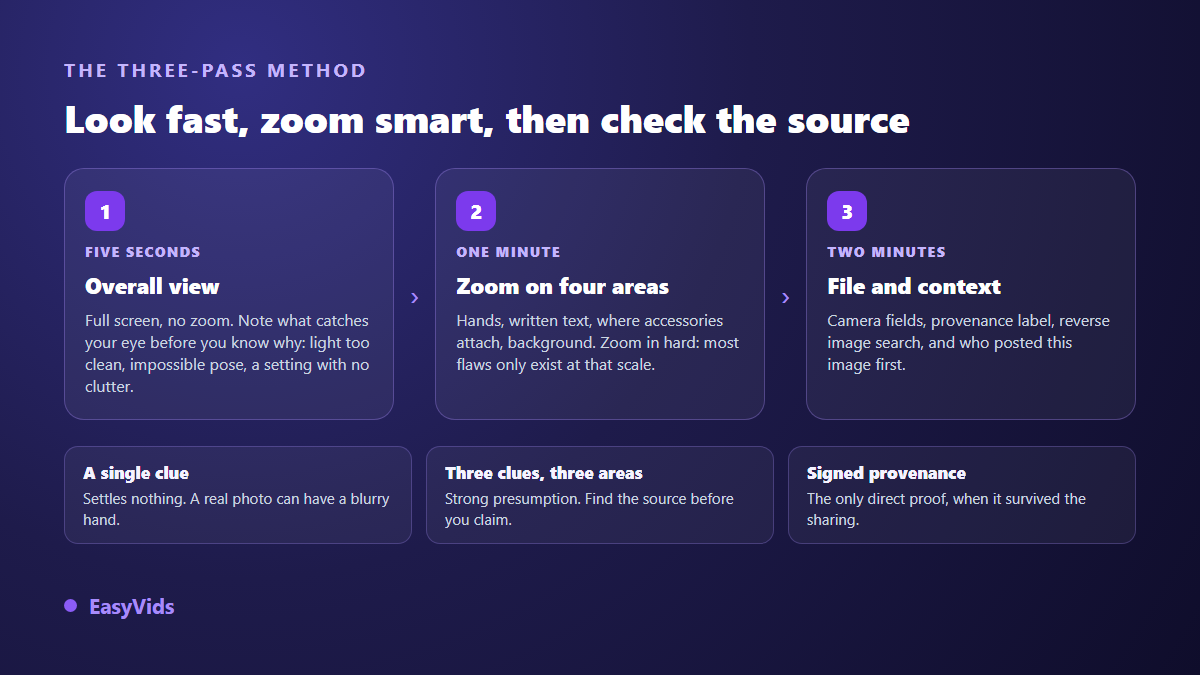
- Pass 1, five seconds. Full screen, no zoom. Note what snags your eye before you know why: light that is too clean, an impossible pose, a scene without any mess.
- Pass 2, one minute. Magnify hard, and only on four zones: hands, written text, accessory attachment points, and the background behind the subject.
- Pass 3, two minutes. Leave the image: capture metadata, provenance credentials, reverse image search, and the history of the account publishing it.
- Verdict. One clue is arguable. Three clues across three different zones settle it. Signed provenance stays the only direct proof.
What proves nothing
The common mistake is not missing a generated image, it is accusing a genuine photograph. Popular checklists mix solid clues with impressions, and a well lit portrait ends up under suspicion for no reason.
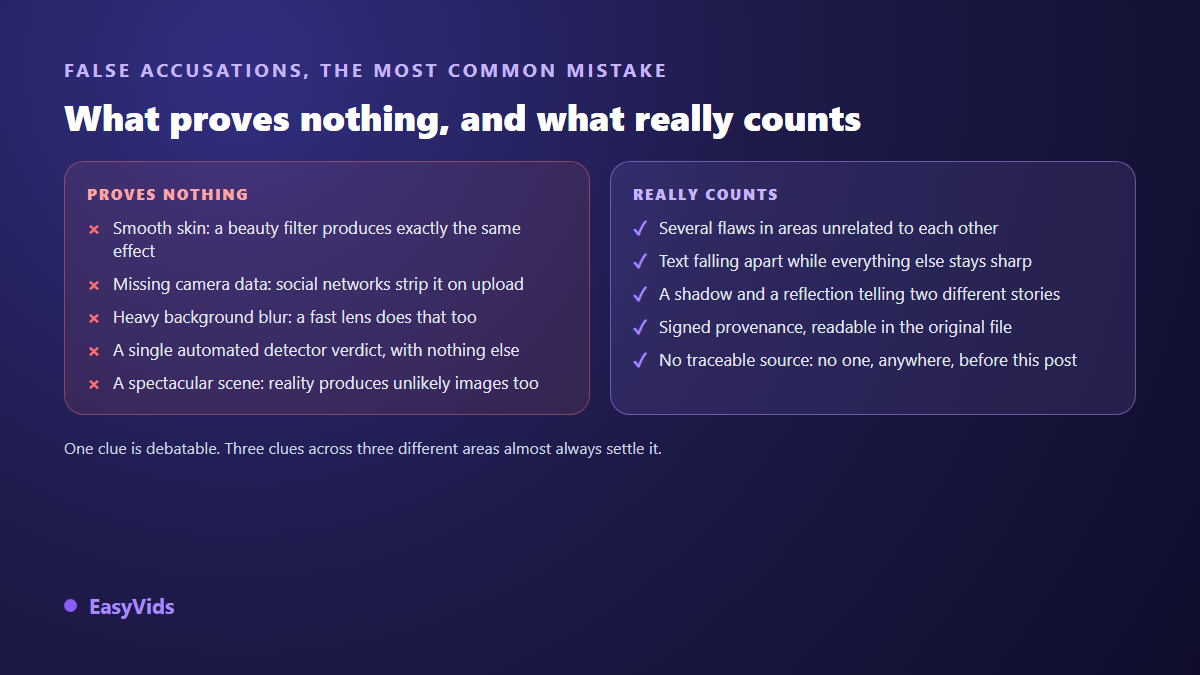
- Smooth skin: beauty retouching and filters produce exactly the same finish.
- Missing capture metadata: platforms strip it on upload, and screenshots erase it too.
- A heavily blurred background: fast lenses have done that for decades.
- A spectacular or improbable scene: reality produces those every day.
- A single automated detector verdict with nothing else to support it.
- Perfect lighting: that is also what studio photographers are paid for.
What automated detectors are worth
Several services promise a one click verdict with a confidence score. They rely on statistical cues and fail in both directions: a heavily retouched or compressed photo gets flagged as generated, while a recent, carefully made image slips through. Reliability drops further once an image has been cropped, recompressed or screenshotted, which describes almost everything circulating online. Use them as one opinion among several, never as a conclusion, and do not quote their percentage as an established fact.
Flip the checklist when you are the one generating
This list pays off in the other direction too. Before publishing a generated image, run the four critical zones again: hands, text, attachments, shadows. Most fixes happen in the description. Naming a precise pose, avoiding complex gestures, asking for a visible resting hand, and adding titles later in an editor instead of asking the model to write, all of that removes the majority of flaws before generation. A title added afterwards also works better inside a layout that has already proved itself, and six fill in thumbnail layouts say where the subject goes, where the words go and how many to keep. Our library of ready made image prompts gives wording you can copy for exactly those constraints.
Two production habits handle the rest. Frame around the problem rather than fighting it, since a shot cropped above the hands never asks the model to draw fingers. And work with reference images whenever the same face has to come back from one picture to the next. Inside the EasyVids studio, a single image regenerates on its own without relaunching the project, the prompt stays editable between attempts, and reference aware models accept up to five supporting visuals, which is what lets you fix one detail instead of starting over.
Frequently asked questions
Is there a reliable AI image detector?
No tool gives a certain answer on an arbitrary image. Statistical detectors fail in both directions, especially after cropping or recompression. The only direct check is signed provenance, when the original file still carries it, through the C2PA standard and its Content Credentials. For everything else, your own eye plus a reverse image search beats any score.
Does missing metadata prove an image is AI generated?
No. Social networks and messaging apps strip those fields on upload, and screenshots remove them as well, so an image without metadata is entirely ordinary. The reasoning only works the other way round: present and mutually consistent capture fields count in favour of a real photograph.
Do I have to disclose that an image was made with AI?
On major platforms, yes, as soon as the image depicts a realistic scene that could mislead. Meta and TikTok have required that disclosure and applied their own labels since 2024. The European AI Act requires machine readable marking of synthetic content under Article 50, with transparency obligations applying since August 2026. A clearly stylised illustration raises far fewer issues than a realistic fake document.
Will AI images soon be impossible to spot?
Visual defects are shrinking fast, so part of this list will age. Structural clues hold up better: consistent light across a whole scene, the geometry of a building, the physics of a gesture involving two people. More importantly, verification is shifting toward provenance and context, which do not depend on render quality. Get used to looking for the source, not only for the flaw.
Spotting an AI generated image is not a talent, it is a routine: four zones, three passes, and a decision rule that forbids concluding from a single clue. The same eye makes you better when you produce your own visuals, because you know exactly where they are likely to betray themselves. To practise on your own generations and watch those flaws appear and disappear as you correct them, create your account and run a first series of images.