You want to post video regularly, with your own face on screen. What you do not have is the time to film every week, or the patience to shoot fourteen takes because a cloud moved. Wanting to create an AI twin of yourself answers exactly that: a character built from one photo of you, delivering whatever script you hand it, as many times as needed, with no tripod and no lighting setup.
The topic deserves attention on two fronts at once. The technical one, because whether a twin genuinely looks like you comes down to three or four decisions made very early and almost impossible to fix later. And the legal one, because a face carries rights, including yours. If the whole category is new to you, our guide to AI avatars and to camera video sets the wider scene. This article is about the specific case where the duplicated face is your own.
The short answer
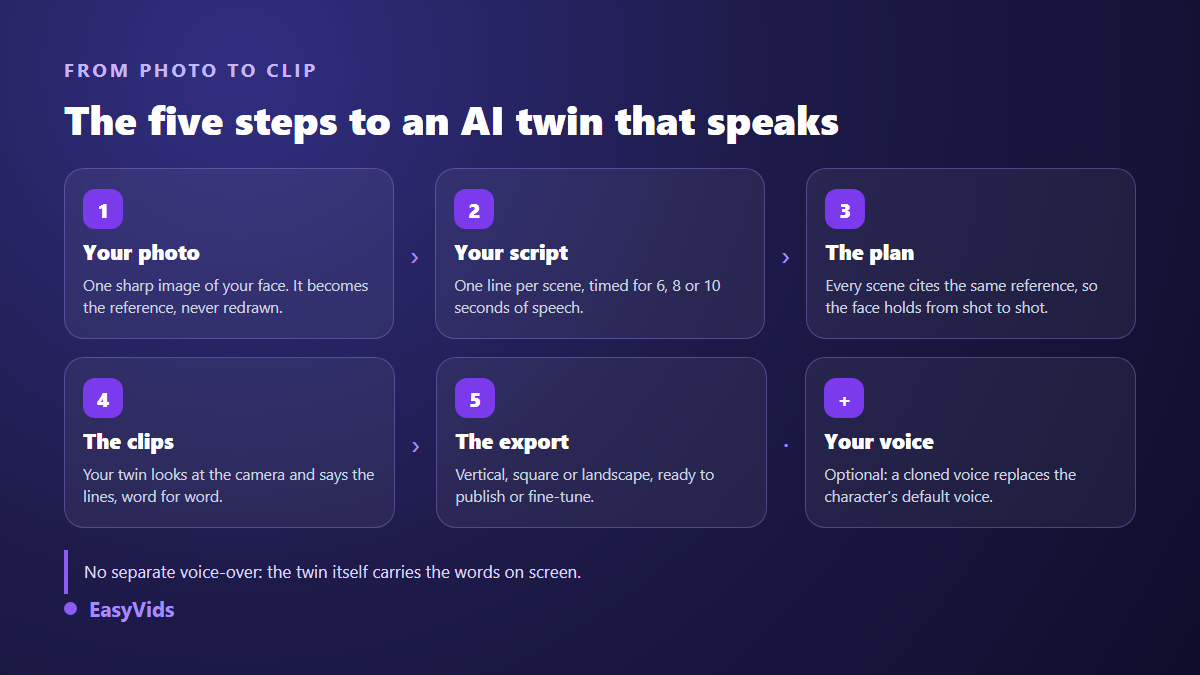
Creating an AI twin takes three things: a sharp photo of your face, a script cut into short lines, and a studio that treats that photo as a fixed reference rather than loose inspiration. On EasyVids, the Character page works that way. You upload a photo, paste your text, pick a scene length of 6, 8 or 10 seconds, and every clip shows your twin delivering that segment word for word. There is no separate voice over: the twin carries the speech on screen.
A twin is not a stock presenter
Plenty of tools offer off the shelf presenters: actors filmed once in a studio, then reused by thousands of customers. It is convenient, and it is exactly what viewers end up noticing. Your audience meets the same face in three different ads in one week, and any sense of closeness collapses.
A twin works the other way round. The face belongs only to you, it carries your personal brand, and it stays available when you are travelling, losing your voice, or simply not in the mood to sit in front of a lens. It is built from a reference photo rather than a shoot, and the full tutorial for building an avatar from a photo covers that step image by image.
What the studio actually does with your photo
The decisive point, and the one sales pages tend to skip, is the status given to your photo. Two treatments exist. In the first, the tool uses it as inspiration and redraws a similar face for every shot: the likeness drifts, the nose narrows, the apparent age wanders, and six scenes in it is no longer you. In the second, the photo is kept as a reference cited by every scene, and the face stays identical from the first clip to the last.
On the Character page, the photo you upload becomes a stable reference reused in every scene where your twin appears, never regenerated. That leads to a practical consequence many people discover too late: swapping the photo mid project means swapping twins. Pick yours once, keep it, and treat it as a brand asset in the same way as your logo.
Working without a photo is also possible. The studio then defines a believable creator itself, suited to the subject of your script, and holds them steady across scenes. That is a sensible way to test a format or a hook before committing your own face to it.
The source photo is your only real lever
No setting rescues a bad photo. It is the raw material, it decides everything downstream, and it needs no special gear: a recent phone and a window are enough.
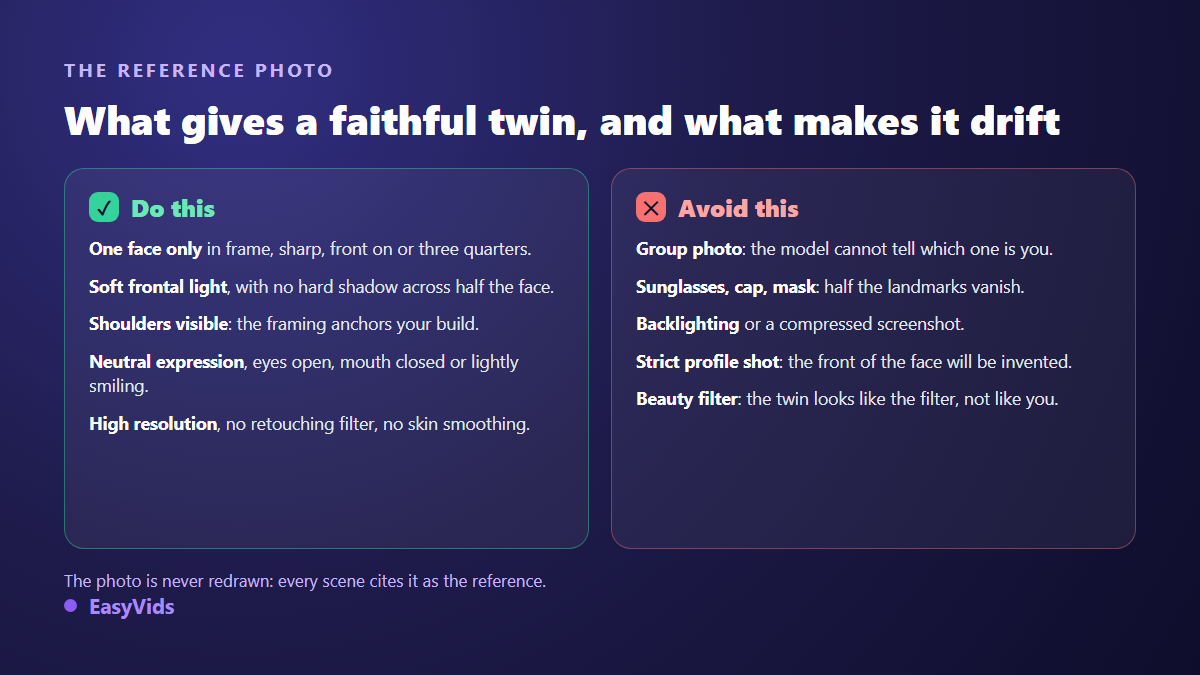
- One face in frame: in a group shot, nothing says which person to duplicate.
- Front on or three quarter view, never a strict profile, or half the face gets invented.
- Soft frontal light, with no hard shadow slicing the face in two.
- Shoulders visible: the framing carries your build and avoids an implausible body.
- No beauty filter and no skin smoothing, otherwise the twin resembles the filter.
- Real resolution, not a recompressed screenshot or a frame pulled from blurry footage.
One habit matters more than it sounds: keep the original file with its date. If anyone ever asks where that face came from, or if someone reuses your twin without permission, that timestamped photo is the first piece of evidence you will reach for.
Writing for a twin that speaks to camera
Text written to be read with the eyes sounds wrong in a character's mouth. Write the way you speak: short sentences, one idea per line, words you actually pronounce. The studio splits the script into scenes, but you decide where the breaths land, and that decision shows on screen.
The technical constraint is strict, and it is a healthy one. Each line has to fit a clip of 6, 8 or 10 seconds of speech, no more, because that is how long a talking shot holds attention. The splitting tool applies the rule and flags lines that run well past the length you picked. An overlong sentence does not produce a longer clip, it produces one that cuts mid word. If your source text already exists, a blog post or a product page, the splitting job is identical, and our method for turning an article into a video shows how to bring it down to lines of that length without losing the thread.
Two staging modes are available. In action, your twin speaks while doing something: walking down a street, cooking, holding an object up. With cutaways, shots of them talking alternate with shots of whatever they are describing, their voice carrying off screen. The first feels more embodied, the second sustains a longer format without tiring the eye. If you are presenting a product, adding its photo lets your twin hold the real item instead of miming it. At the other end of the spectrum, a single clip of a few seconds already is a complete vertical video, and our guide to producing YouTube Shorts with AI shows how to turn that into a publishing rhythm you can hold.
Your voice, or a borrowed one
A complete twin is a face plus a voice. By default the character speaks on screen with the voice produced by the video model, which suits most short formats. You can also add a voice over chosen from the catalogue of natural voices, in several languages: it then appears in the voice list like any other and carries over from project to project.
Cloning your own voice raises no issue of principle. Cloning someone else's raises many, and the rules are laid out in our article on the legality of voice cloning. They come down to one sentence: without written permission from the person, you do not duplicate their voice, not even for an internal test.
Consent: what you agree to when you build a twin
Using your own likeness is a right, not a formality. By uploading your face you hand a service data that identifies you uniquely. The European General Data Protection Regulation places biometric data used to identify a person among the special categories of its Article 9, where processing requires explicit consent and a use limited to what was announced.
Before building your twin, answer three questions and write the answers down: where the files live, for how long, and how they get deleted. These are the questions you would ask for a modelling contract, because that is what this is. If anything is unclear about retention, the studio's frequently asked questions and the contact page are the right places to start.
The third habit is contractual. If you work for clients, state in the quote that the video is produced with a digital double. A brand that finds out afterwards feels misled, while the same fact shared upfront reads as an advantage: instant availability, unlimited corrections, no shoot day to reschedule.
Someone else's face: the rule that does not bend
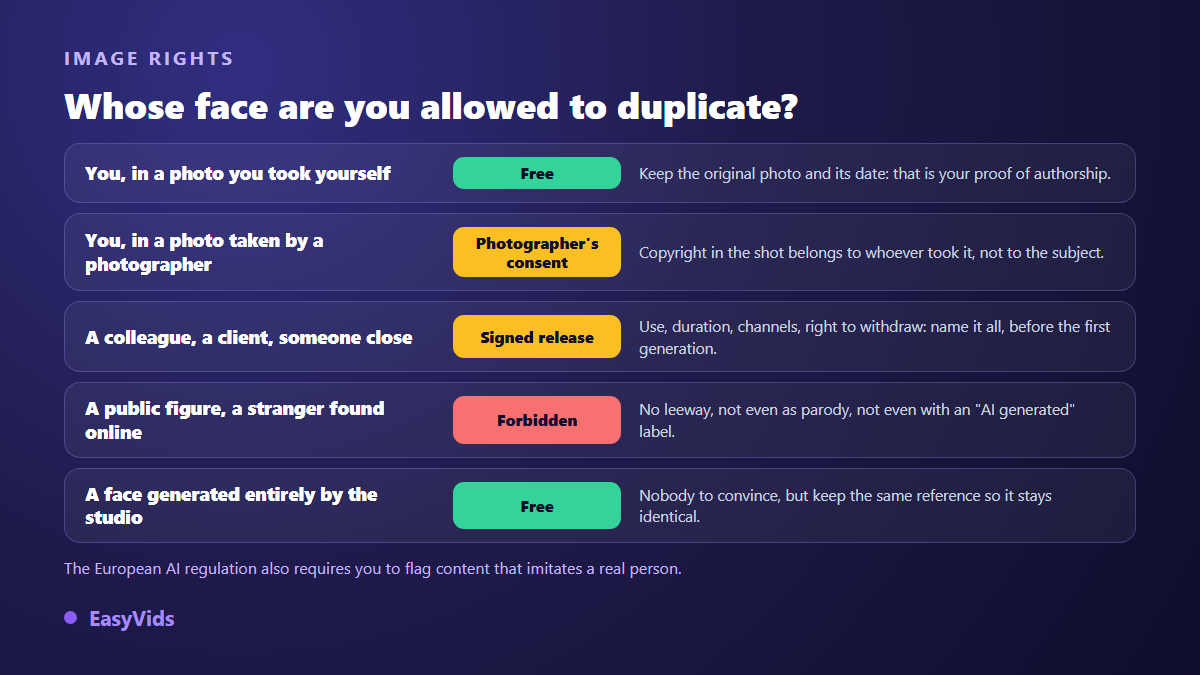
As long as the face is yours, the question stays between you and the service. The moment it belongs to somebody else, the law steps in, and it is stricter than most people expect. In France, Article 9 of the Civil Code protects everyone's right over their own image, and Article 226-8 of the Penal Code punishes publishing a montage made with a person's words or image without their consent, unless it is obviously a montage or is expressly labelled as one. The law of 21 May 2024 on securing and regulating the digital space extended that text to content produced by an algorithm.
In practice a signed written agreement settles it. Name the person, the intended use, the channels, the duration and the territories, and include a withdrawal procedure. Do it before the first generation, not after the first video that performs. And never use a public figure's face: fame has never amounted to permission, and an « AI generated » caption covers nothing.
The photographer case is the most common trap. The picture belongs to whoever took it, even when you are the one in it. A studio portrait commissioned for your website does not automatically let you derive an animated character from it. Check the rights assignment attached to the job, or start again from a photo you took yourself.
Disclosing a video made with your twin
Labelling synthetic content is no longer a courtesy. The European Union's artificial intelligence regulation, whose Article 50 transparency obligations have applied since 2 August 2026, requires content that realistically imitates a person or an event to be presented as machine generated or manipulated.
Platforms moved first. The YouTube help centre has asked creators since 2024 to tick, at upload time, the box stating that a video contains realistic synthetic or altered content. TikTok's community guidelines require the same disclosure, and the platform relies on the C2PA provenance standard from the Coalition for Content Provenance and Authenticity, which attaches origin metadata to the file. Meta announced in 2024 that it was extending its labelling of AI generated content across Facebook and Instagram.
The good news is that an honest disclosure costs almost nothing in reach when it sits in the description or in the opening seconds. What audiences punish is finding out late, never the tool itself.
Keeping the same twin for months
A twin only pays off if it lasts. Three habits are enough. Keep the reference photo in a dedicated folder and replace it only on purpose. Reuse the same visual setting and the same aspect ratio from one video to the next. And write down the settings that worked, because memory is unreliable three weeks later. A face that has grown familiar over months then opens up a format that lands well in December, the year in review, and our guide to the annual retrospective video lays out its structure.
Consistency goes beyond the face: sets, clothes and light all have to be recognisable from one episode to the next. We collected that method in our guide to keeping the same character across scenes, and it applies word for word to your own twin.
On the practical side, the Character page keeps your plans on your account: you can close the tab while a plan is being prepared and pick it up later. A credit estimate appears before you launch, and if you stop a generation midway, only the work already done is charged. The pricing page covers the plans themselves.
When filming yourself is still the better call
A twin does not replace everything, and pretending otherwise hurts the format. A handful of situations still call for a real camera.
- Official statements, where the speaker's authenticity is part of the message.
- Demonstrations where your hands genuinely handle a fragile or intricate object.
- Testimonials presented as spontaneous: having a double perform one is plainly deceptive.
- Regulated sectors such as health or finance, where a synthetic content notice complicates approval.
- Emotionally charged content, where one missed micro expression undoes the whole effect.
Frequently asked questions
How many photos do I need to create an AI twin of myself?
One is enough, provided it is sharp and well lit. Adding variants does not rescue a poor first image, while a good front facing shot gives a stable result on the first attempt and stays usable for months.
Can my twin speak a language I do not?
Yes. The character delivers the text you write, in the language of that text: an English script gives an English video. The timbre stays that of the model, unless you add a voice over from the catalogue, which covers several languages, in which case that voice carries the video.
Am I allowed to use my twin in advertising?
Yes, your likeness is yours and nothing forbids commercial use. Two caveats: the source photo must be free of copyright claims, so ideally one you took, and the ad has to respect the synthetic content disclosure rules of the platform running it.
What if someone builds a twin of me without permission?
You have recourse. Likeness rights and, in France, Article 226-8 of the Penal Code cover the publication of a non consented montage, and the major platforms offer a reporting form for image misuse. Keep screenshots, addresses and dates: evidence carries more weight than outrage.
Can I create an AI twin without showing my real face?
Yes. With no photo supplied, the studio defines a believable creator and holds them identical across your videos. You get a recurring, recognisable spokesperson without exposing your own features, which is what anonymous channels usually pick. Going one step further, building a fully animated video without editing software drops the live action look altogether.
Creating an AI twin of yourself comes down to two things: a photo chosen with care, and a clear line on what you authorise, for yourself and for anyone else who appears. The rest is repetition, which is exactly where the format buys back your week. To build yours, creating an account opens the Character page and the rest of the EasyVids studio, no bank card required.