Your first video worked, so you decided to make a follow up. That is when everything starts to slip: your main character's face is no longer quite the same, the lighting changed, the intro disappeared somewhere along the way, and viewers recognise nothing. Using an AI video series generator is not the same job as making one video. The hard part is not producing an episode. It is producing the twelfth one exactly like the first, three months later, without burning your evenings.
A series that survives rests on three pillars, and losing one is enough to bring it down: a reference document that fixes the world once and for all, a story arc that runs through episodes instead of stacking them, and a production routine light enough to repeat without thinking. This guide covers all three in build order. If AI generation itself is still new to you, start with our guide to the AI video studio and come back.
The short answer
Building a series with AI means freezing a show bible before episode one, then refusing to improvise. That bible names the world, every recurring character with a reference image, the sets that come back, the visual and audio rules, and the shape of an episode. Every new episode reuses those same references and the same settings, and that is what creates continuity, far more than raw model quality. The story then runs on two levels: a season question asked in episode one, and a complete arc inside each episode. The rest is publishing discipline. All of it is built inside the EasyVids studio, with no camera, no crew and nothing to install.
A series is not a pile of videos
The difference happens in the viewer's head. Facing a pile of videos, they decide every single time whether to watch. Facing a series, they come back because they are waiting for something specific: an answer, a character, the next step of a story. You are not producing more videos, you are producing anticipation.
In practice a series imposes four commitments a standalone video ignores. A stable format, so people know what they are getting before they click. Recognisable characters, or the promise collapses. Progression, or episode six feels like episode two. And an appointment, or your audience scatters between drops. All four are decided before a single line of script exists, which is exactly the step most creators skip.
The show bible decides everything
The bible is the only document you write for yourself and never for the audience. It runs a few pages and answers, in advance, the questions you will keep asking every episode: what does this character look like, what colour is this place, what is the tone, how long is an episode. Without it you make those calls again each time, and you make them differently. A series is rarely killed by one bad scene. It is killed by dozens of small incompatible decisions.
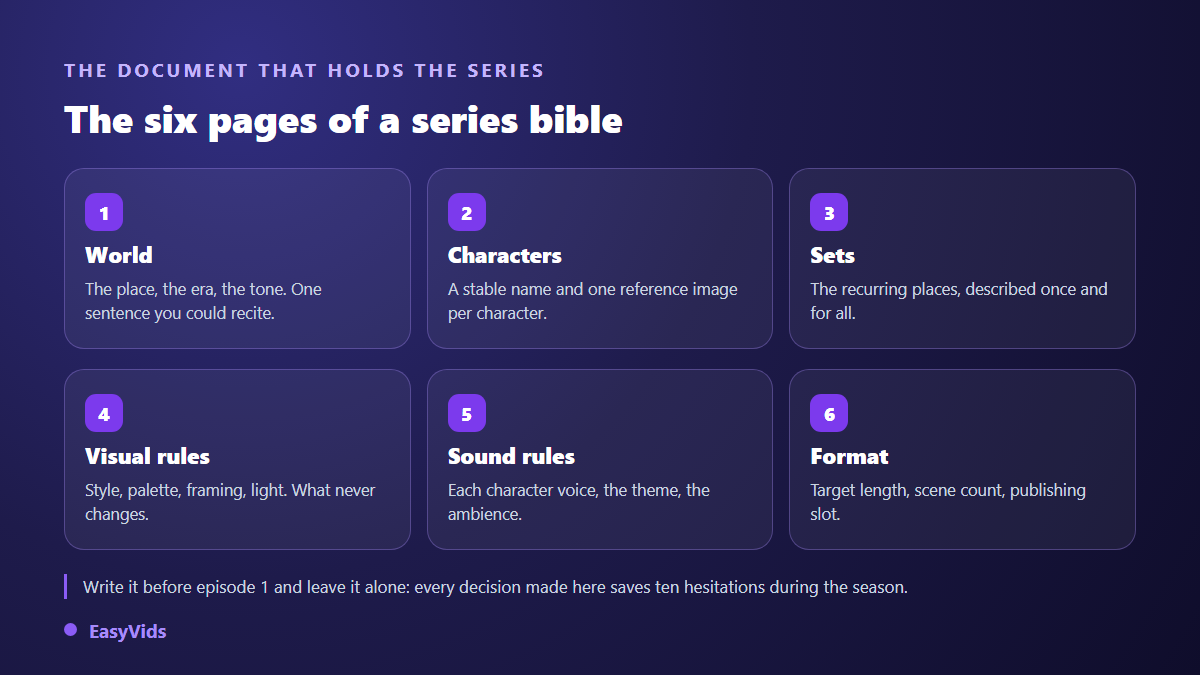
Part of that work is handled for you. When you hand a script to our director stage, it builds a bible before planning any scene: it names the world, the recurring characters and the sets, then gives each one a stable identifier that every relevant scene will cite. That mechanism, not a description pasted into each prompt, is what keeps a character from drifting across a long script. Your job is to decide what goes into the bible, then leave it alone for the rest of the season.
- The world in one sentence: place, period, tone. If you cannot recite it from memory, it is too complicated.
- One lead and at most two supporting characters for a first season, each with a reference image, an apparent age, a hairstyle and an outfit that do not move.
- Two or three recurring sets, described once: their return is what makes the whole thing feel like a series.
- Visual rules: style, palette, framing, dominant light, vertical or horizontal.
- Audio rules: one voice per character, music or no music, a short intro sting.
- Format: target length, number of scenes, publishing day and frequency.
- A list of what the series will never do. One clear ban is worth ten instructions.
Recurring characters hold through images, not words
This is where most generated series fall apart. Writers paste a description into every prompt and hope the machine finds the same person again. It returns a convincing cousin, never the same individual, and the gap becomes obvious by episode three, once viewers have memorised a face.
What actually works is a reference image sent back to the model for every scene the character appears in, with an explicit instruction to keep the same face, hair and outfit. Our character workflow runs that way: the photo you provide is never redrawn, it is used as the reference exactly as supplied, and the same file goes out with every shot. For a series the consequence is blunt: keep your reference images in one dedicated folder and always start from the same files, episode after episode. That same photo can also become the starting point when a character has to address the viewer directly, which is what our method for making a photo talk walks through.
Two series habits sit on top of that. First, give each character a signature of two or three elements repeated identically in every episode, a jacket in a specific colour and tied back hair for instance. Second, do not evolve appearance mid season. A change of outfit is an expensive narrative event: save it for the moment it means something, otherwise it reads as a production error. If the recurring character is you, the logic is identical: our guide to building a digital double shows how to lock a reference image of your own face and reuse it from one episode to the next.
The story arc: two lines moving at once
A boring series is rarely badly made. It is flat, and it is missing one of the two arcs. The season arc is the question raised in episode one and settled in the finale. The episode arc is the complete path travelled inside a single episode, with its own payoff. The first makes people come back, the second makes them stay. With only the first you frustrate. With only the second your episodes can be watched in any order, and dropped just as easily.
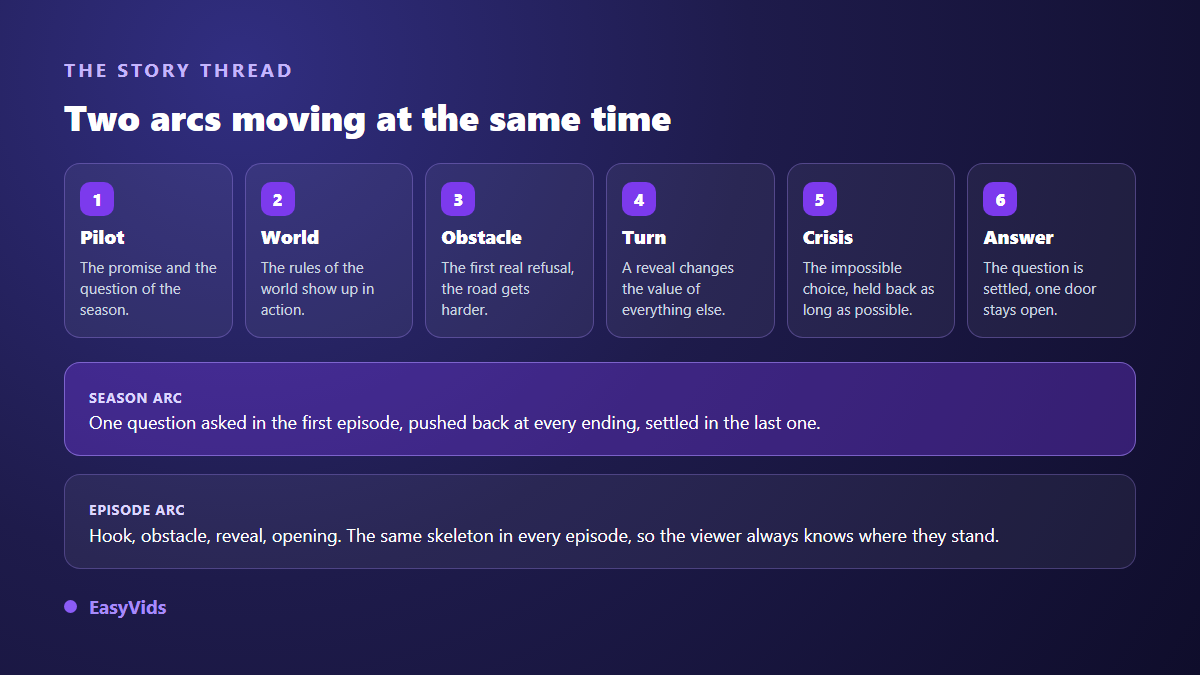
So write the season question before anything else. Will she find her brother. Will the workshop survive the winter. One question, one sentence, answerable with yes or no. Then spread across the episodes whatever moves it forward: a reveal, an obstacle, a turn, a crisis, an answer. The episode count follows from that distribution, never the other way round.
Inside each episode, keep the same skeleton: hook, obstacle, reveal, opening. That regularity does not flatten the story, it frees your attention for the content. And end every episode on an open question rather than a tidy conclusion. It is the only reliable reason anyone clicks the next one. That skeleton is not reserved for fiction: a one off montage built from memories follows the same curve, as our method for a retirement farewell video sets out.
Hooking viewers in episode one
A pilot does not summarise the series, it demonstrates it. Viewers decide within seconds, and they decide on what they see rather than what you promise. So episode one has to contain, in action rather than explanation, everything that will make the rest worth watching. Write the pilot last, once the season is planned: only then do you know what to show and what to withhold.
- Open on a scene already in motion, never on an introduction. Context can be explained later, in one line.
- Show the lead making a choice: the choice is what attaches viewers, not the description.
- Raise the season question before the end, audibly, without announcing it.
- Show at least one recurring set, so it already feels familiar in episode two.
- Close on a door left open: a suspended line, an unexplained object, an arrival.
- State the appointment in the final seconds, naming the publishing day.
Holding visual consistency between episodes
Consistency is a settings problem as much as a writing one. How an episode looks depends on the chosen world, the format, the model, shot length and any extra instructions you add on top. Change a single one of those between episodes and it shows on screen, even when viewers could not name what moved. When an episode lands visibly below the previous one, the cause is almost always somewhere in that list, and our review of what makes an AI video fail helps you isolate it before regenerating anything.
The strongest safeguard is saved presets: you store a full project configuration under a name, soundtrack, dialogue, world, models, format and scene splitting, then reapply it to the next episode in one click. You can also define your series world from your own pictures by uploading one to three examples of the look you want, and the analysed style becomes the world of the project. For a series that is the safest route, because you re-run decisions instead of remaking them.
Audio consistency, the part nobody prepares
Ears catch a break before eyes do. An episode where the voice changes timbre, or where levels jump between scenes, reads as amateur work that no amount of image quality repairs. Decide the sound of your series at the same time as its look, not while editing episode three. An original theme is ordered like anything else, from an occasion, a style and a set of words to sing, and our guide to a personalised song written with AI shows how precise that brief can get.
Three elements are enough. One voice per character, picked once and kept: a voice taken from the catalogue and reused unchanged on every episode guarantees the same timbre across episodes. One short musical motif reused on the intro and the last shot, which becomes the signature of the show. And one simple ambience rule, for example no music under dialogue. We covered voice work in our guide to natural AI voice over, and everything there counts double on a series, where each flaw repeats.
Production rhythm: batches, never single episodes
The real risk is not quality, it is abandonment. Most series stop between episode three and episode six, exactly when enthusiasm drops and the workload does not. The fix is industrial rather than artistic: you do not make an episode, you make a batch.
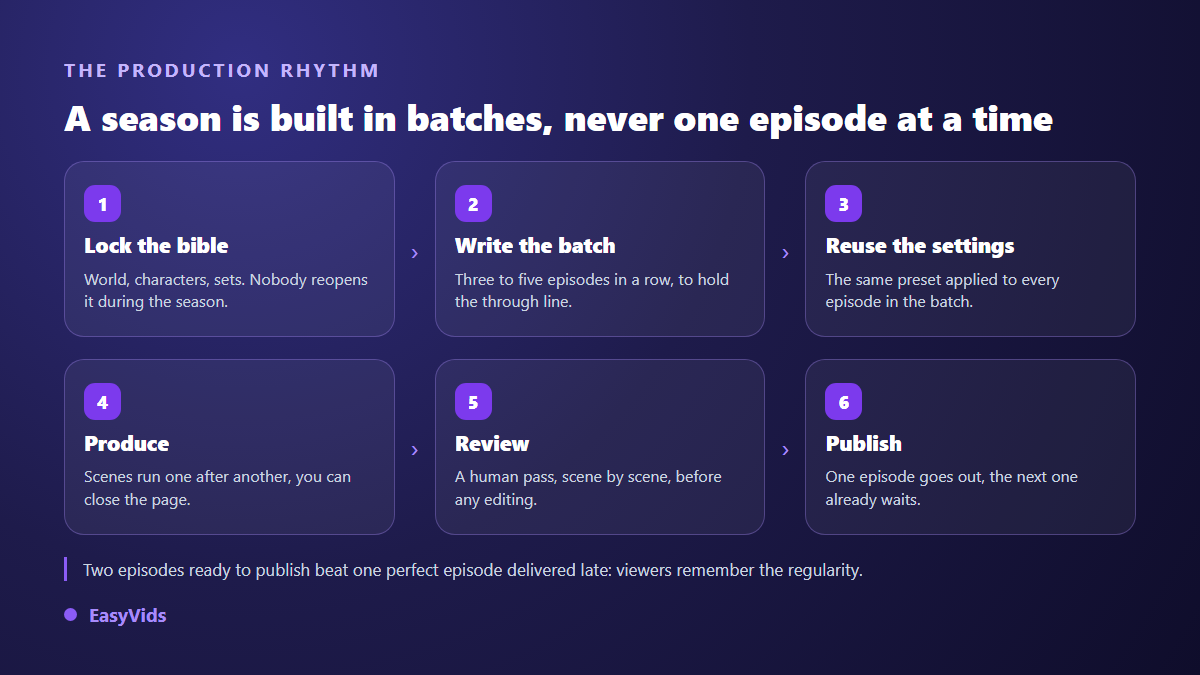
Write three to five episodes back to back in one sitting, so the through line stays strong while the whole season sits in your head. Produce them with the same preset. Our automatic workshop mode runs server side: once a batch is launched you can close the page and shut the computer down, the work continues and the page reconnects on its own when you return. Then review scene by scene, since a failed scene regenerates on its own without redoing the episode.
Always keep two finished episodes in reserve. That is your only insurance against the week when nothing works. And budget per scene rather than per episode, because the scene is the real unit of production. Our plans are listed on the pricing page, and we compared assisted production against a conventional shoot in our breakdown of what a video really costs.
Publishing a series: numbering, playlists, thumbnails
A badly filed series behaves like a pile of unrelated clips. Number episodes at the front of the title, never at the end, and keep the exact same formula every time. Then group them in an ordered playlist: YouTube's official playlist documentation covers creation, ordering and sharing, and it is what lets a newcomer start at episode one instead of the latest upload.
Treat thumbnails as part of the bible: same template, same position for the number, same colour family, only the visual changes. Finally, match format to surface. A vertical episode published as a Short has to fit the platform limit, currently up to three minutes according to YouTube's own help pages; beyond that it becomes a long form video with different distribution. Our step by step guide to publishing on YouTube walks through the upload itself.
Frequently asked questions
How many episodes should a first season have?
Six to eight is plenty, and already a serious commitment. A short season finishes, which leaves you free to adjust the format before the next one. A twenty episode season announced too early is nearly always abandoned halfway, and an unfinished series is worth less than a short complete one.
How do I keep the same character across a whole series?
Start from the same reference image in every scene and every episode, never from a copied description. Add a stable signature, hair and outfit, repeated identically, and avoid abrupt lighting or framing shifts between neighbouring scenes. Likeness is requested and monitored, it is never guaranteed on its own.
Do I need to write the whole season before producing episode one?
Not the whole season, but at least the season question, the intended ending and a one line summary of each episode. That is enough to hold the through line without trapping you. Then write full text in batches of three to five episodes, which keeps the tone consistent while leaving room to react to your audience.
Can I mix short and long episodes?
Better not to, inside one season. Length is part of the promise, and a viewer used to a short episode feels trapped by one three times longer. If you want both, run two separate series with two appointments and two clear promises.
Do I have to disclose that a series is AI generated?
Yes, as soon as realistic content could be mistaken for a real recording. Major platforms ask for a declaration at upload and may surface a label to viewers. Clearly stylised fiction raises fewer questions, but declaring remains the healthy reflex. Our answers about using the platform are collected in the FAQ.
A series rarely survives on one brilliant episode. It survives on a bible written before the first shot, a question that carries the season, and a production routine you can repeat on a Tuesday evening without thinking. Start small: six episodes, two characters, two sets, one weekly appointment. Write the bible today, produce the first batch this week, keep two episodes in reserve and stop changing your settings. Creating an account opens the studio so you can build your pilot before episode two is even written.