You ask an AI to write a book on your topic. Twelve chapters arrive in a few minutes. You read them back, and something feels off: the text is clean, structured, error free, and it could carry anybody's name. That is the usual experience when people try to write a book with AI, and it almost never comes down to the model.
It comes down to how the request was made. A book ordered in one go is a book written with no memory, no angle and no length constraint, so the machine returns the average of everything it has read on the subject. That average is precisely what readers call generic. The method below does the opposite. It turns writing into a short loop, repeated once per chapter, with specific material to hand over on every pass. For everything around the writing itself, from picking a topic to the first sale, our guide to building an ebook with AI walks through the full sequence.
Write a book with AI: the short answer
Never ask for the whole book in one message. Have the angle written first, then the outline, then the chapters one at a time. On every chapter, hand back three things: the title and key idea set in the outline, a summary of the previous chapter, and a continuity sheet fixing names, places and the promises already made to the reader. Finish with two separate reviews, one on the language, one on consistency across the whole book. That discipline, not the choice of model, is what separates a personal manuscript from average text.
Why a book ordered in one shot comes out generic
A language model produces the most probable continuation of your request. If the request fits on one line, the most probable continuation is the most ordinary book in the field: same chapters, same examples, same opening formulas. Nothing is wrong, everything has been read before. There is no mystery here, only mechanics: the vaguer the instruction, the harder the answer pulls toward the centre.
A memory problem sits on top of that. When a whole book is generated in one stretch, the last chapters get written while the first ones have already slipped far back in context. The result shows three tells: the introduction gets restated in chapter four, a first name changes along the way, and the promise made at the start is never kept. Splitting the writing is not about comfort, it is about keeping a thread.
The writing loop: six stages, one pass per chapter
Writing a book with AI looks less like an order than a production line. Six stages follow one another, and three of them repeat as many times as there are chapters. It is the logic of any serial production, the same one building a complete system from idea to publication applies to a video channel. Each one produces material the next one consumes, so skipping a stage starves the one after it.
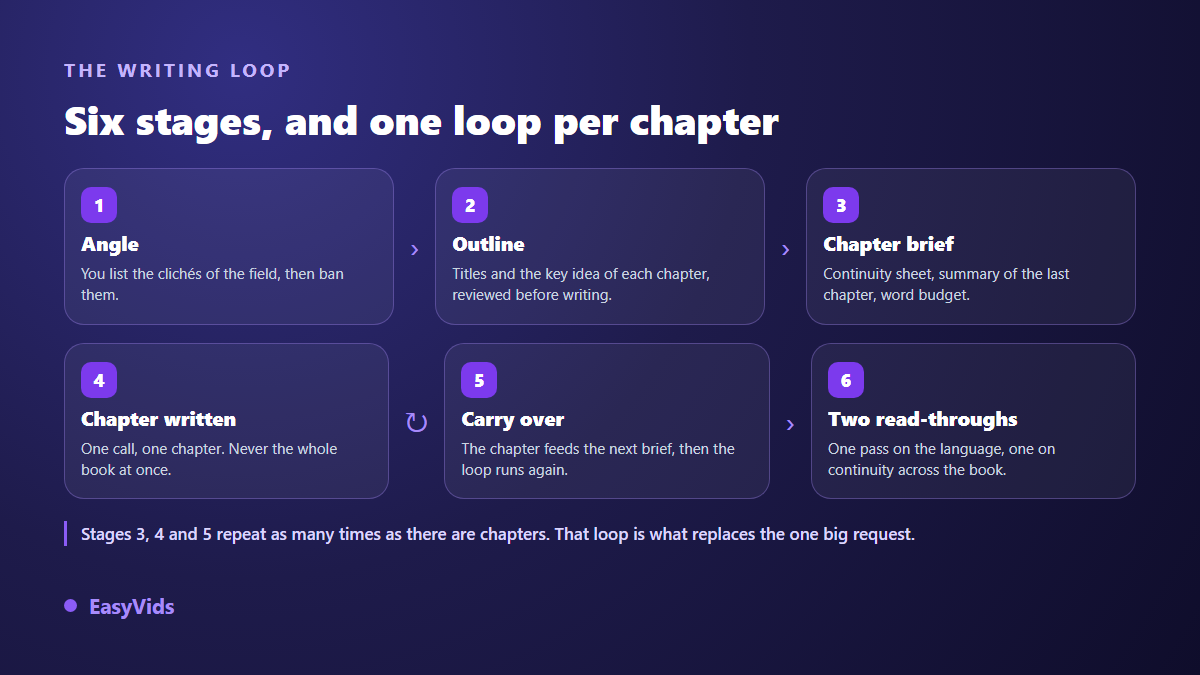
The practical gain is control between passes. A weak chapter gets rewritten on its own, without touching the other eleven. A title changed in the outline carries into every chapter still to come. A single bulk request gives you none of those handles: all you can do is run it again and hope.
Stage 1: settle the angle before the first line
The angle is not the topic. The topic is time management. The angle is the claim that cuts against what the reader expects, for instance that productivity systems fail because they manage the calendar instead of managing decisions. A book without an angle is a compilation of what already exists. A book with one has a reason to exist, and that reason shows in the table of contents.
The most reliable way to get an angle is to list what to avoid first. Ask the model for the clichés most books in the field repeat, turn that list into bans, then demand a claim that appears nowhere in it. Those bans travel with every chapter afterwards, as a standing constraint. If you would rather start from ready made wording, our prompt templates for writing a book give the shape of that opening request.
Stage 2: the outline is the only piece you can fix for free
The outline is the one moment where a correction costs almost nothing. Swapping two chapters before writing takes a second. Doing it afterwards means rewriting every transition in the book. So read the outline as a reader, not as an author. Does each title promise a clear benefit? Do two chapters say the same thing under different names? Does the progression hold up if you read only the titles, in order?
A useful outline is more than a list of titles. For each chapter, note the key idea, the one thing a reader should keep even after forgetting the rest, then two or three points that must be covered. That level of detail is what stops the drafting from drifting into generalities: the model fills a frame instead of inventing the frame as it writes.
Stage 3: the chapter brief, the piece everyone forgets
This is where the method actually pays. Every chapter must be requested on its own, and every request must carry enough to continue the book rather than start a new one. A chapter written without that context is technically fine and narratively orphaned: it repeats what was already said, or announces what was already covered.
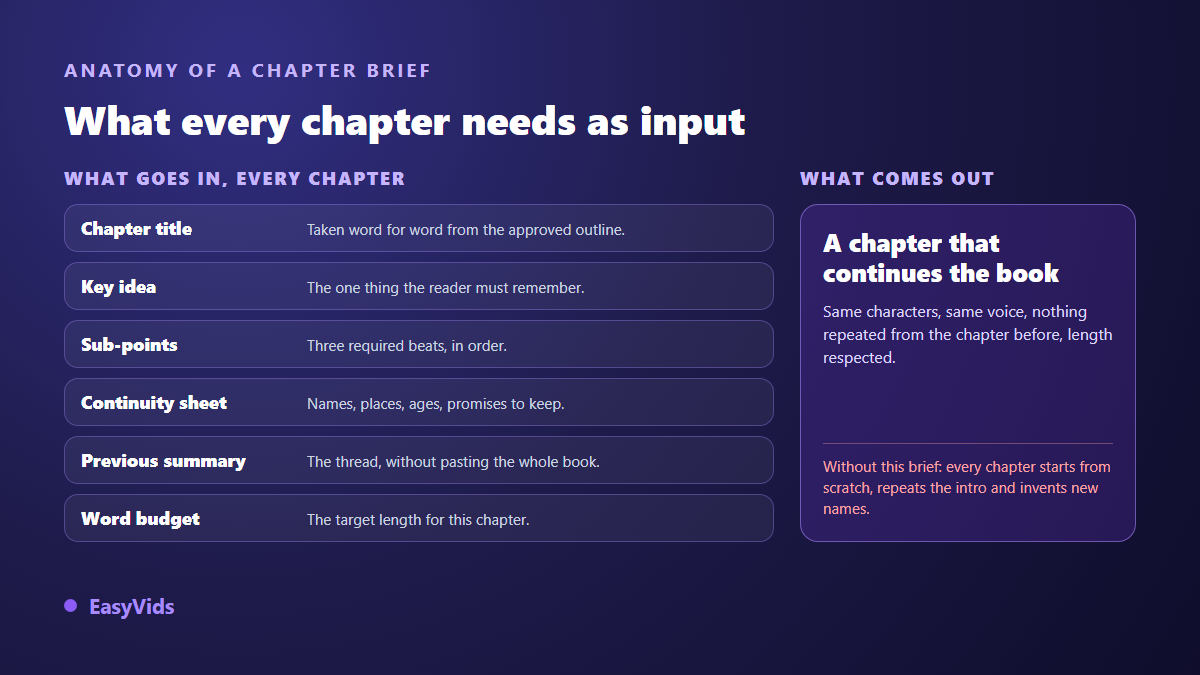
The continuity sheet deserves a special mention. It is a short paragraph, kept up to date as chapters land, listing the people named, their age, their city, the timeline you have set and the promises already made. It never runs beyond a few lines, and on its own it prevents half the inconsistencies of a long book. Here is what a complete brief carries.
- The exact chapter title, copied word for word from the approved outline.
- The key idea in one sentence, plus the points that must be covered, in order.
- A summary of the previous chapter: a few lines are enough, that is the thread.
- The continuity sheet: names, ages, places, timeline, promises still open.
- The word budget for this chapter, so lengths do not vary threefold.
- The bans that came out of the angle, so discarded clichés do not return in chapter eight.
Set the length before writing, never after
Length decided after the fact is paid for in rewriting. Fix it in the outline: a total volume, then a split per chapter. Across our own productions, the default split allows one chapter per 1,200 words ordered, which gives even chapters and a balanced table of contents. How that volume turns into a page count then depends on the format you choose, and our note on ebook page counts covers that conversion.
A per chapter budget also works as a guardrail. Without it, chapter one swells because the topic inspires the model, and chapter ten shrinks to a few paragraphs because it feels everything has been said. Readers experience that slope as a book running out of breath, and they close the file well before the conclusion.
Stage 4: hold one voice from first chapter to last
A voice is a set of choices you keep: direct or formal address, lists or no lists, opening on a story or on a definition, a closing box at the end of each chapter or none. Those choices are not guessed. They are declared once, then restated on every pass of the loop. A book that alternates between a warm mentor and a cold consultant reads like an anthology written by six people.
The simplest approach is to name the voice before writing: intimate practical guide, understated method manual, inspiring narrative, straight talking playbook with no storytelling. The instruction fits in three lines and governs the whole book, down to the tone of the conclusions. More settings of the same kind, all aimed at breaking the mould effect, are gathered in our techniques for making a generated book genuinely unique.
Stage 5: two reviews that see different things
Reviewing an AI written book in a single pass is not enough, for a simple reason. A long text is not read in one block, it is read in slices, and a slice knows nothing about the others. A language slip shows inside the slice. A name drifting shows only when two distant chapters are compared.
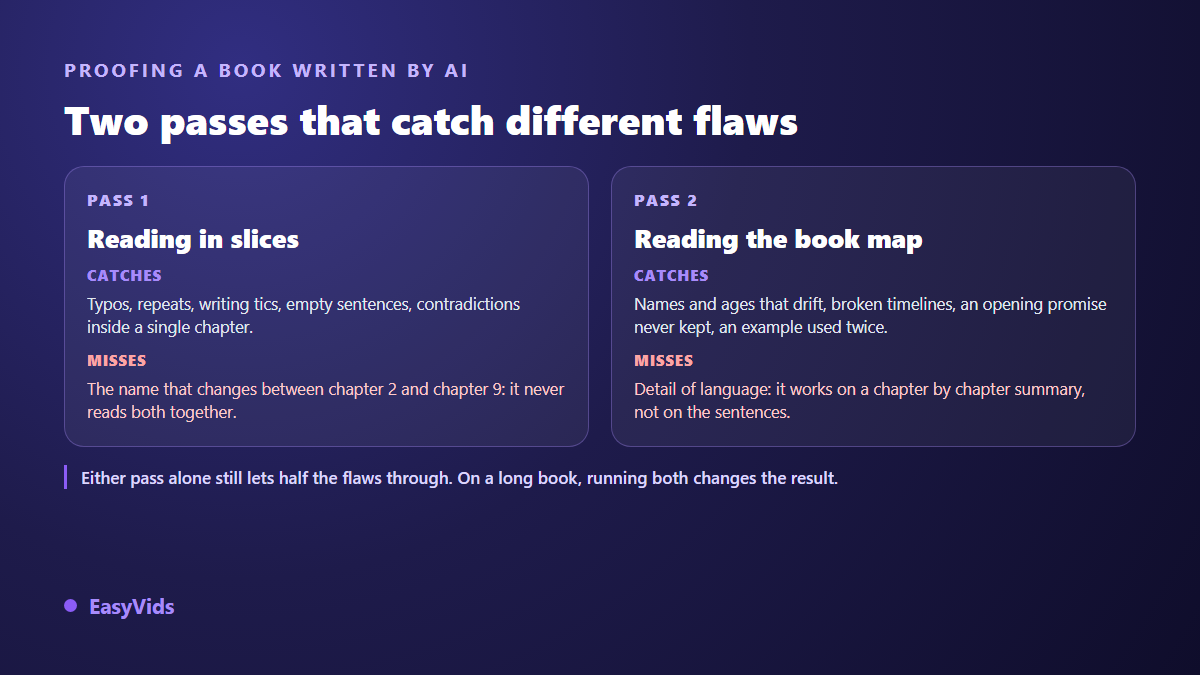
The second pass therefore works on a map of the book: for each chapter, its title and its key facts in a few lines. That compressed form makes the whole thing visible at once and surfaces what only distance reveals: an age that changes, an impossible date, an example served twice, an introduction promise never honoured. Then apply the fixes chapter by chapter, without letting the model rewrite what was already fine.
The tells of a chapter written without method
Some flaws repeat from one generated text to the next until they read as a signature. Hunting them takes two minutes per chapter and changes how the whole book lands, far more than a full rewrite would.
- Antithesis on repeat: "it is not X, it is Y", three times on the same page.
- Three adjective cascades where two would have done and one would have landed.
- The mechanical "here is" placed at the top of every list.
- Chapters that all open the same way: a question, a statistic, a promise.
- Statistics with no source, unverifiable and often invented: cut them, or name their origin in the sentence.
- A closing paragraph that summarises the chapter instead of opening onto the next.
What you bring that the machine cannot
A book produced entirely without personal material stays a competent book nobody recommends. What readers keep are the details a machine cannot know: the exact message a client sent, a number measured in your own business, a sentence overheard in a session, the mistake that cost you six months. Three or four per chapter are enough to change the nature of the text.
The practical move is to prepare, before writing, a reserve of anecdotes and verified facts, then drop two or three into each chapter brief. The model handles structure and rhythm, you supply the proof. That division of labour produces the best books by a wide margin.
Running the loop without driving it by hand
The whole method runs manually, in any chat window, at the cost of copy and paste work that gets heavy across twelve chapters. It can also be automated: the ebook writing workshop inside the EasyVids studio chains the angle, the outline submitted for your approval, chapters written one by one with memory of the previous one, both review passes, the illustrations and the layout. You keep control where it matters, on the outline and on the corrections. Plan details sit on the pricing page.
One point worth knowing before publishing. According to the Kindle Direct Publishing help centre, Amazon asks at upload whether the text, the images or the translation were AI generated, and that declaration is not shown on the public book page. It does not block publication, it documents production. Our article on Kindle Direct Publishing rules covers the line between AI generated and AI assisted, which decides what you tick.
Frequently asked questions
Can a single prompt write a whole book?
Technically yes, and the result is recognisable straight away. One message produces text that reaches the length but loses the thread: repetition, wildly uneven chapters, small inconsistencies. A chain of requests takes longer to set up and returns a usable manuscript instead of a draft to redo.
How many words should each chapter get?
Aim for regularity rather than an ideal figure. Across our productions, counting one chapter per 1,200 words of total volume gives a comfortable rhythm: room to develop one strong idea, short enough to read in one sitting. A very practical guide takes shorter chapters, a narrative takes longer ones.
How do I keep the same characters across chapters?
By recording them in a continuity sheet you resend with every chapter, with each person's name, age, place and role. Redescribing characters from memory in each request does not work: details drift, and the drift stays invisible until you read two chapters side by side.
Do I have to rewrite everything by hand afterwards?
No, and it is counterproductive: a full rewrite breaks the rhythm without fixing the real faults. Concentrate on three things, injecting your own examples, hunting the writing tics, and consistency across the whole book. The rest of the text only needs a careful read.
How long does a book take with this method?
Half a day is realistic for a short book, including preparing the angle, reviewing the outline and adding your own material. Generation itself takes a small share of that. Most of the time goes into decisions only you can make, which is exactly what makes the book publishable.
Keep the principle rather than the checklist: a book written with AI is worth exactly what you feed it on each pass of the loop. Decide the angle, approve the outline, carry the previous chapter into the next, review twice with two different eyes. To start a first book on a chain that is already assembled, create your account and begin with the topic. The rest follows.