Three notes, a name sung once, and a brand sits in someone's head for the rest of the day. That is the entire job of a jingle. Getting one used to be the hard part: a studio to book, a composer to brief, a singer to bring in, an engineer for the mix, and weeks of back and forth before the first playback. An AI jingle maker removes that queue and leaves you with the part that actually decides the result, the writing.
A shop opening a second location, a podcaster who wants a recognisable intro, an online brand preparing a seasonal campaign: all of them need the same thing, a sonic signature of five to thirty seconds that can be cut into several lengths. How these composition engines work in general is covered in our guide to AI music generators. This article stays on the shortest format, and by far the most demanding one.
The short answer
Start from the length your channel imposes, never from the music. Write one sung line carrying the brand name and a single promise. Pick a style that matches your customers, then run the composition: a full track lands in one to four minutes. Keep the chorus only, trim it to length, and check it on a phone speaker before anything goes live. Allow half an hour for a first usable jingle, proofreading included.
A jingle is not a short song
The word covers three different objects, and confusing them wastes time from the brief onward. The sung jingle carries the brand name inside a melody of a few seconds. The sonic logo, or mnemonic, is two or three notes with no words at all: the signature that closes a spot or an app. The music bed is an instrumental layer under a speaking voice, and it is never meant to be memorised.
They are judged by different standards. A sung jingle is judged on whether a listener can hum it after two plays. A sonic logo is judged on instant recognition out of context. A music bed is judged on discretion: if it draws attention, it failed. So the first decision is naming exactly what you are making. Everything downstream follows from it.
Anatomy of the six seconds that matter
An effective jingle does not improvise its structure. It stacks four bricks in an order that barely changes, and the position of the brand name is not negotiable: it lands early, then returns at the end.
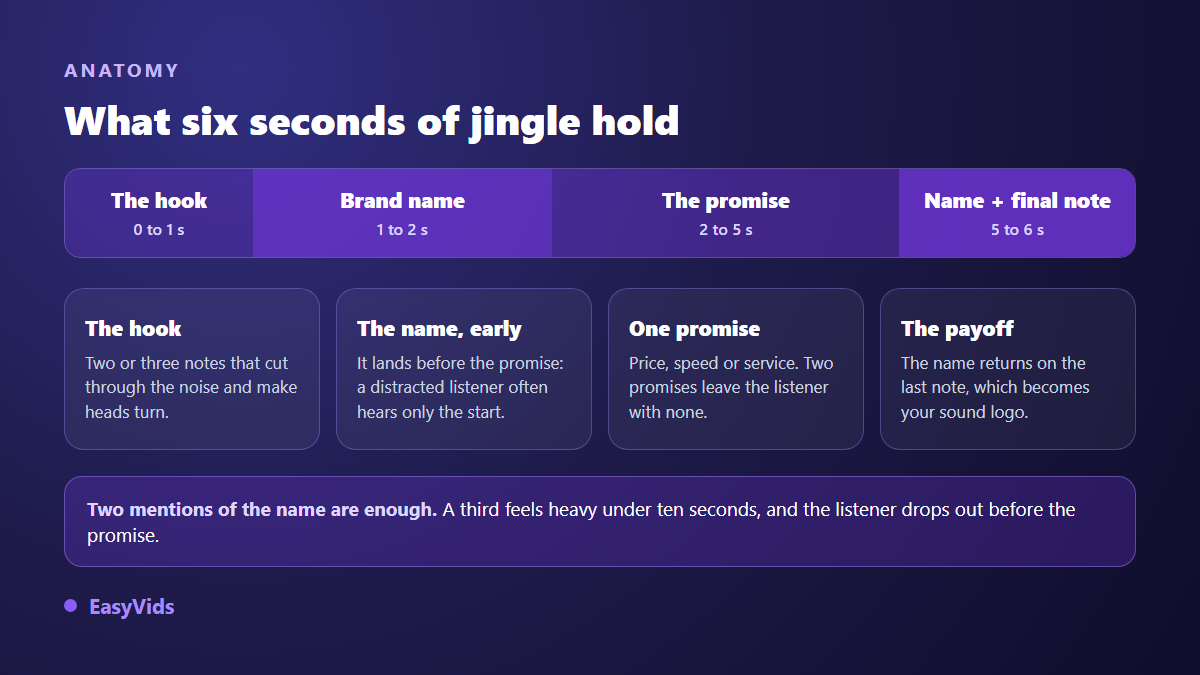
The classic mistake is saving the name for the punchline. A distracted listener often hears only the opening. Put the name in the first two seconds, unfold the promise, then land the name again on the closing note. Two occurrences are enough, and the second one doubles as your signature.
Length is the constraint that decides everything
A jingle is never composed in the abstract, it is composed for a slot. The channel sets the length, the length sets the word count, and the word count sets the melody. According to the Google Ads help centre, a bumper ad on YouTube cannot exceed six seconds and cannot be skipped. It is the tightest format on the market, and a useful discipline even if you never buy one.
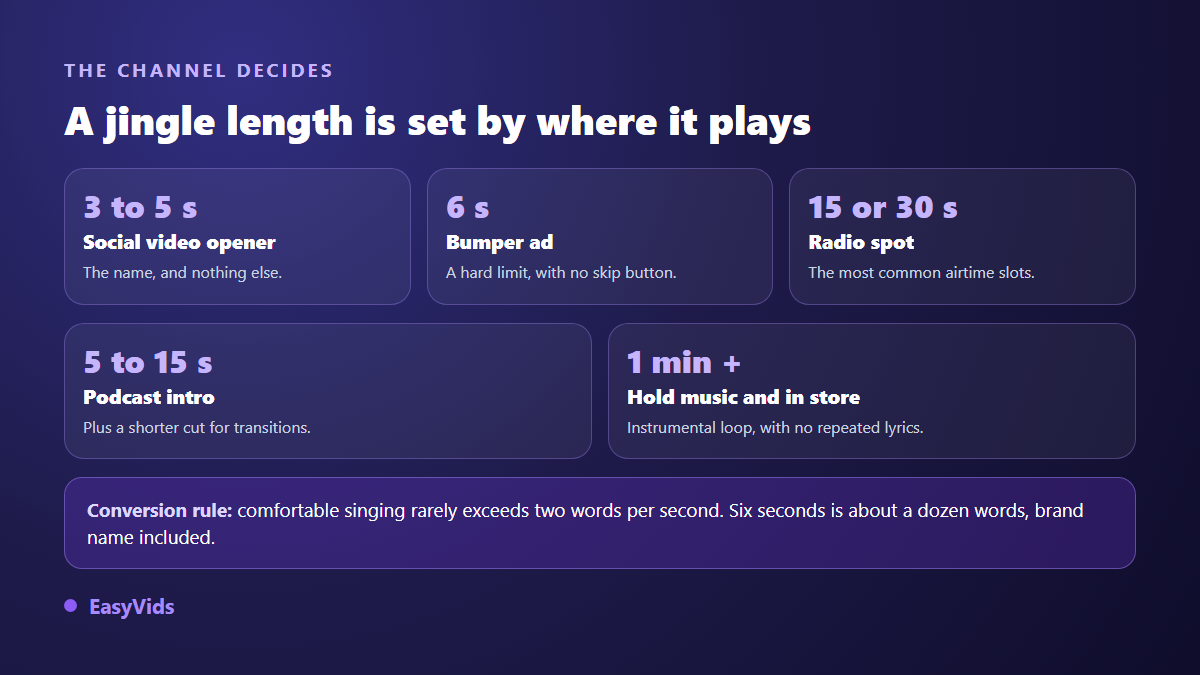
- Social video opener: three to five seconds, the name and nothing else.
- Bumper ad: six seconds maximum, with no skip button.
- Radio spot: media buying slots are usually counted in fifteen and thirty seconds, jingle included.
- Podcast intro: five to fifteen seconds, plus a shortened cut for transitions.
- Phone hold or in store ambience: an instrumental loop of a minute or more, with no repeated lyrics.
One conversion rule saves a lot of disappointment: comfortable singing rarely exceeds two words per second. Six seconds therefore means a dozen words at most, brand name included. Writing fifteen and hoping they fit means asking the engine to rush the delivery, which is audible straight away.
The five step method
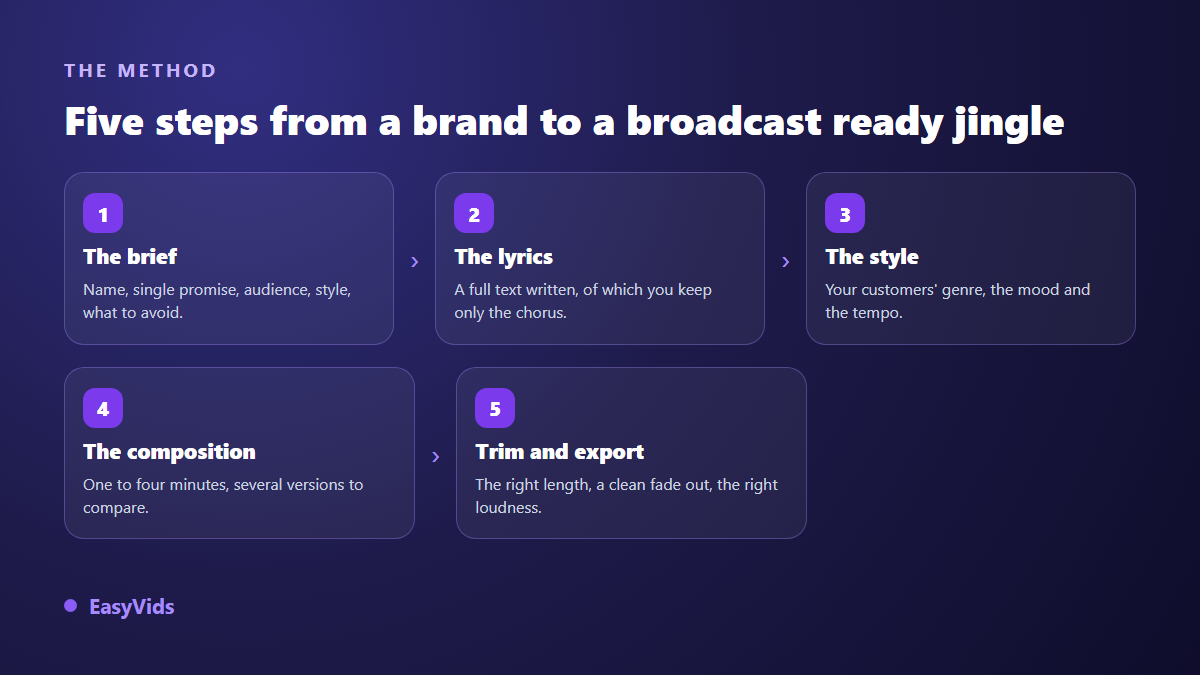
The five moves below always run in the same order, and each one shapes the next. Allow an hour the first time, ten minutes once the habits are in place.
Step 1: a five line brief
The studio guesses neither your positioning nor your audience. It sets to music what you hand it, and nothing else. Five lines are enough, provided they are precise: the brand name spelled the way it is pronounced, one single promise, the audience in one concrete sentence, a named musical genre rather than the word modern, and what must be avoided.
In the Music Studio each of these has its own field. You pick the occasion in one click from a set of ready situations, and the Custom option opens a free field where you describe your case, the built in example being a shop anniversary. One useful detail: the field meant for a first name takes a brand name just as well, and the instruction our lyricist works with places that name in the chorus and in at least one verse.
Step 2: short lyrics, pulled out of a long text
The writing engine produces full lyrics: two verses, a repeated chorus, a bridge, roughly one and a half to three minutes of singing. Perfect for a song, far too long for a jingle. So the technique is to have the whole text written, then keep the chorus alone, cut down to two lines if needed. The memorable formula is almost always in there, because that is precisely what a chorus is for.
Nothing forces you through that route. You can write your four lines yourself and paste them in: the studio sings them untouched, and a bracketed label such as [Chorus] tells the engine there is a single block. Lyrics already written stay filed at the bottom of the page and reload in one click, so testing a variant costs no second writing pass. The same mechanics serve personal commissions, as shown in our method for a birthday song with the name in the chorus.
An example beats a rule. For a bakery chain called Nova, the chorus Nova, warm from six delivers the name, the offer and the opening time in four words. Nova, your everyday quality partner since always says nothing verifiable, sticks to nobody, and fits no six second slot. The difference is not the lyricist's talent, it is the precision of the brief.
Step 3: pick the style for your customers
Style is not personal taste, it is a signal of belonging. A family audience, a nightlife audience and a professional audience do not hear the same thing in the same track. Watch what your customers actually play, in the shop, in the car, on their platforms, and ask for that rather than for your own playlist.
The studio offers a set of genres in one click, from afrobeat to gospel, pop to acoustic, along with rap, reggae, zouk and jazz, and the field stays open for something more specific. Two settings finish the picture: the mood, from joyful to solemn, and the tempo. For a jingle the tempo decides itself quickly, fast for a promotion, medium for a service, slow for a premium position. All of it sits in one place, inside the EasyVids creation studio.
Step 4: compose, listen, run it again
Composing usually takes one to four minutes. You can close the tab: production continues on the server and you find it again when you return. Every track stays in the page history, replayable and downloadable, which lets you compare several takes cold instead of deciding in the excitement of the moment. For that comparison, the nine criteria that separate a publishable track from a good demo give you a steadier listening grid than the impression left by a first play.
Plan for several attempts, that is the method rather than an accident. A jingle is chosen by elimination: run three versions of the same chorus in three styles, play them back to back, and keep the one that returns to you the next day unprompted. Cost is counted in credits and depends on the engine, the detail sits on the pricing page, and a failed generation is not charged.
Step 5: trim, mix, export at the right level
The file arrives as a downloadable audio track, usually longer than your slot. A trim is left to do, and it takes minutes: import the file, keep the useful part, add a half second fade at the end to avoid the hard cut. Online video editing is more than enough for that, and lets you drop the jingle under a product video in the same session.
Loudness deserves real attention, because the target changes with the destination. Recommendation R 128 from the European Broadcasting Union sets the reference level of broadcast programmes at -23 LUFS, while the artist documentation published by Spotify states that playback is normalised around -14 LUFS. A jingle mixed too hot will simply be turned down on delivery, losing the contrast that made it punchy. Always check the final version on a phone speaker, since that is where most of your audience will hear it.
Podcasts need three pieces, not one
A podcast does not need a jingle, it needs three variations on one theme. The opening intro sets the world and leaves room for the episode title. Transitions, two or three seconds, mark the shift between parts without breaking the listening rhythm. The outro brings the theme back and leaves silence for the subscribe line. Compose all three from the same brief and the same style, otherwise listeners never connect them. An instrumental bed of about thirty seconds, composed from the same brief, then covers read ads and sponsored segments. The voice speaking over it is prepared separately, with its own rules of pace and tone, gathered in our guide to advertising voice over.
Rights, sound marks and disclosure
Three questions appear the moment a jingle goes into paid distribution. Ownership comes first, and it depends on the terms of the service that produced the track, which differ from one provider to the next. Read them before the campaign, not after: our article on AI music and copyright sets out what can be protected and what cannot.
Registration comes second. A jingle can become a sound mark: according to the European Union Intellectual Property Office, this type of mark has been filed as a plain audio file since 1 October 2017, graphic representation no longer being required. Disclosure comes third: the European Union regulation on artificial intelligence, in its article 50, has required since 2 August 2026 that providers of systems producing synthetic audio mark those outputs in a machine readable format. If the jingle goes onto a video platform, our guide to AI music on YouTube explains how automatic claim systems behave.
Mistakes that sink a jingle
- A brand name said once, buried in the middle, where nobody expects it.
- Two promises instead of one: the listener keeps neither.
- A text too long, sung too fast to fit the slot.
- A style picked for the owner's taste rather than the customer's.
- A jingle that changes every campaign, when repetition is the only mechanism that builds a sonic identity.
- A file approved on headphones and never heard on a phone or in real shop noise.
Frequently asked questions
How long should a brand jingle be?
As long as your channel allows, never an ideal length in the abstract. Three to five seconds for a video opener, six for a bumper ad, fifteen or thirty for radio, five to fifteen for a podcast intro. Produce the long version first, then cut the short ones out of it so they stay recognisably related.
Can an AI generated jingle be used in paid advertising?
It depends on the terms of the service that produced it, and that is the first document to read before buying media. Check that commercial use is covered, that the export carries no audible watermark, and keep the creation date and the brief you used. Those records matter if an automatic claim ever lands on the track.
Lyrics or instrumental?
Lyrics whenever the brand name has to be memorised, instrumental whenever a voice will speak over it. Many brands run both: a sung jingle for campaigns, and an instrumental bed of around thirty seconds for read ads, phone hold and in store ambience.
How many versions before choosing?
Three is enough, provided you change one thing at a time: the style, then the tempo, then the voice. Play them back to back the next day rather than the same evening, and keep the one that comes back to you without effort. A jingle that does not survive one night will not survive a campaign.
A brand jingle needs no orchestra and no production budget. It needs an accepted constraint: one length, one name, one promise, and the patience to repeat the same melody campaign after campaign. The rest is proofreading. To compose yours and walk away with the file, create your account and open the Music Studio, where the Custom option is waiting for your brief.