Your videos keep coming, your editing keeps improving, and still nothing tells the ear that they come from you. Intro music for YouTube fixes that in a few seconds: viewers recognise your channel before they read the title, sometimes without even looking at the screen. It is the one piece of your identity that works while the phone stays in a pocket.
Finding music is not the hard part. The hard part is owning a motif: short enough to survive a thirtieth listen, distinct enough to hum. AI makes that reachable without a studio or a composer, provided you know what to ask for. If these tools are new to you, our guide to AI music generators covers the ground rules; this article is only about the channel theme.
The short answer
Describe a style in one sentence, tick the instrumental option, run three compositions from the same brief, keep the one you still remember the next morning, then trim it to five seconds in a video editor. Half an hour the first time, minutes after that. The EasyVids creation studio holds both halves of the job: the composing on its music page, the trimming and mixing in the editor.
A theme is not a short song
A song tells its own story. A theme exists only to announce something else: you. The same person will hear it dozens of times, often on headphones, often while doing something else. That repetition changes every rule. What charms on the first listen becomes tiring by the twentieth, which is exactly what happens to overloaded intros.
So a theme rests on a motif: three to five notes, one recognisable instrument, a stable sonic colour. Think of what you can still hum from a show you watched as a child. It is never a whole piece, it is a handful of notes. That is the target, not a rich production.
The anatomy of the five seconds that matter
A working theme breaks into four moments, each with a job. The signal opens, the motif settles, the resolution closes, the silence lets your voice in. When an intro feels off without anyone being able to say why, one of those moments is usually missing.
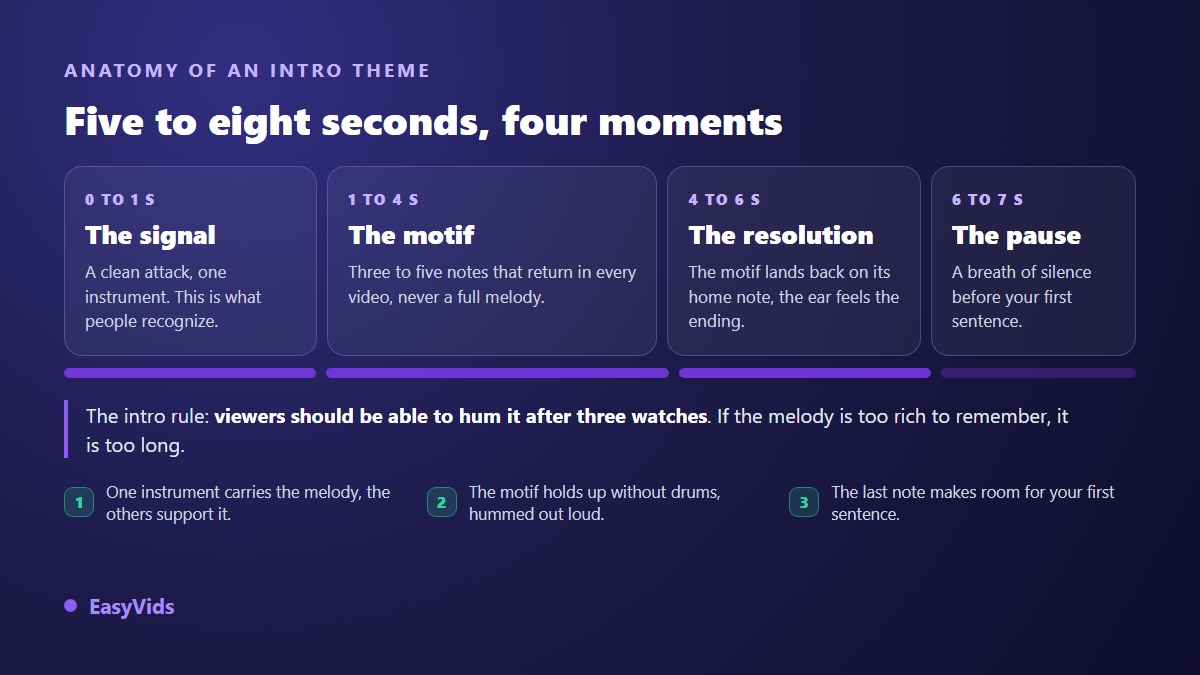
That final silence is exactly what gets skipped. An intro that stops on the very word you start speaking feels rushed. Leave half a second of air, or fade the music down under your first words. You hear the difference on the first playback, and it costs nothing.
How long, depending on the format
An intro is never free: it delays the content. The audience retention report in YouTube Studio draws the curve of those first seconds for every video, and it is the only honest judge of your theme. Check yours after three uploads: if the curve dips exactly where the intro sits, it is too long, too loud, or in the wrong place.
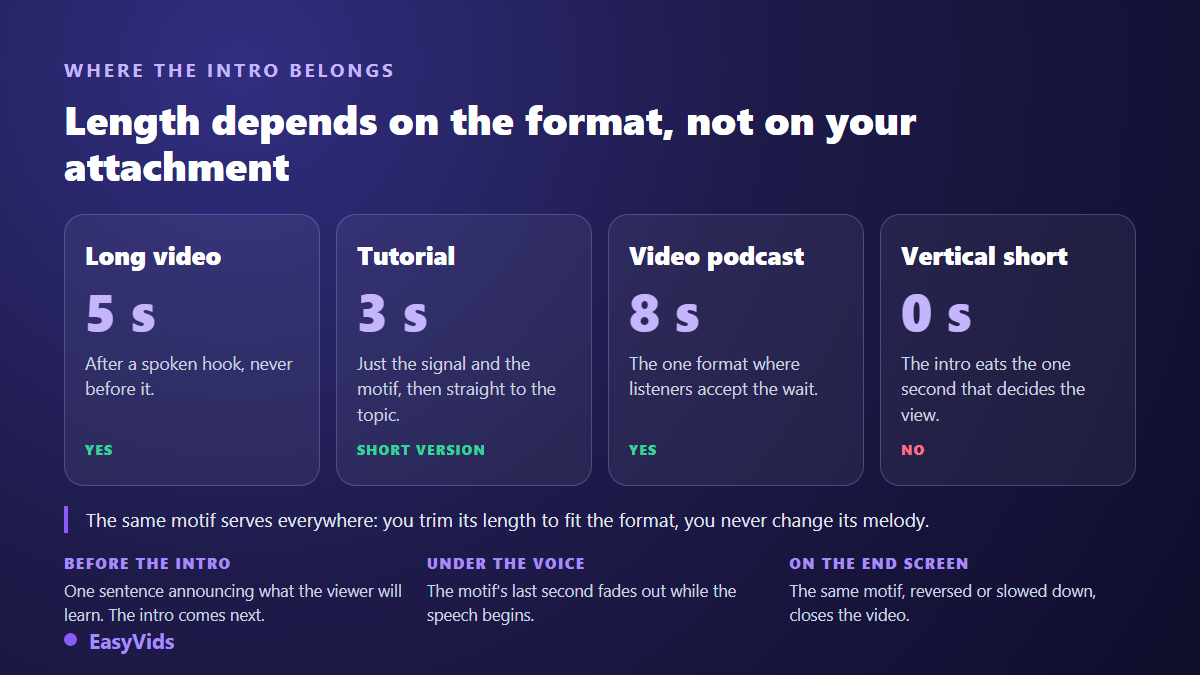
One rule holds in most cases: a spoken hook first, the theme after it, never the other way round. Viewers need to know why they are staying before they agree to wait. On short vertical formats, drop the theme entirely: the first second decides the view, and you cannot hand it to a logo.
The brief that produces a motif, not a pad
The EasyVids music page starts from an occasion, a style and a mood, not from musician vocabulary. Pick the custom occasion, write "channel theme", and use the message field to say what your channel talks about and to whom. That context shapes the character of the piece far more reliably than a pile of adjectives.
- One genre, never three. Afrobeat, pop, jazz, orchestral, electronic, acoustic.
- The lead instrument that carries the motif: piano, guitar, synth, brass, percussion.
- The mood: warm, tense, joyful, solemn. It must match your subject, not your listening habits.
- The tempo: slow, medium or fast. A tempo close to your speaking rate flows nicely into the narration.
- The use, spelled out: a short opening theme that ends cleanly.
Tick the instrumental box. A sung vocal in a theme competes with your own voice, and the viewer no longer knows who to listen to. Singing only earns its place when music is the subject of the channel itself. It keeps its place elsewhere, in a track meant to be listened to for itself: a Christmas song written for one particular person is the clearest example, custom lyrics and all.
Step by step in the music studio
The path is always the same: brief, style, lyrics, generation. For a theme, the lyrics step simply disappears. Leave the field empty, tick instrumental, and start the composition.
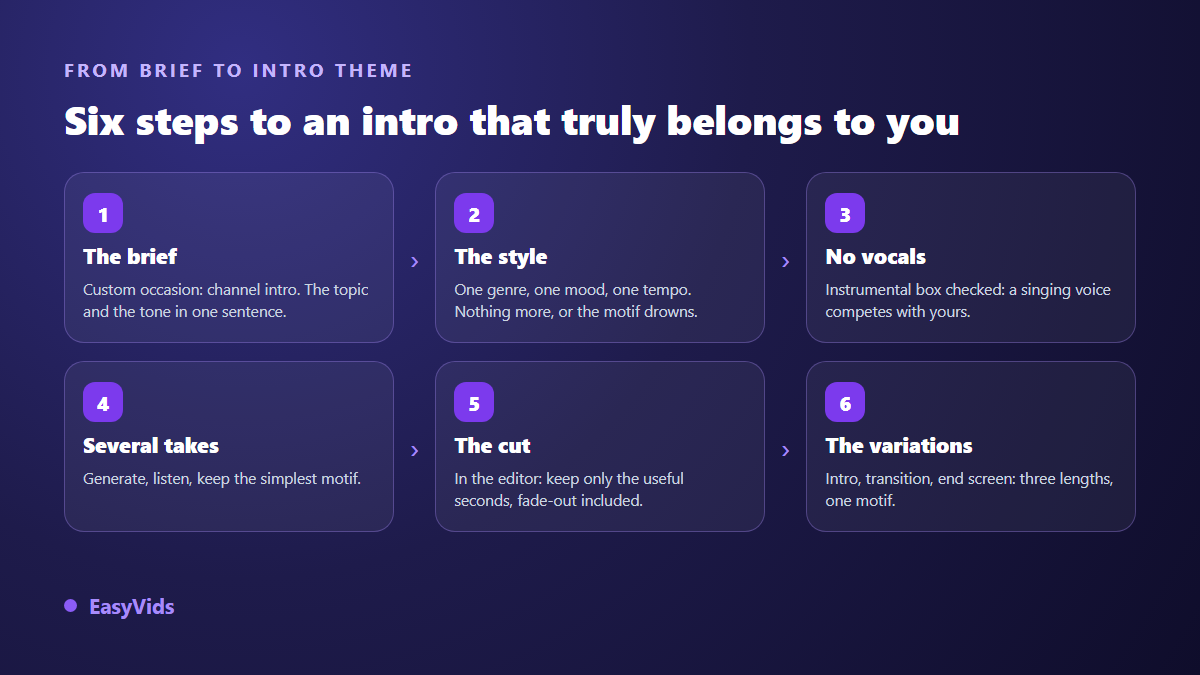
Generation runs on the server. You can close the tab: the composition continues and the track waits for you in the page history when you come back. Every attempt arrives as an audio file you can play and download, which lets you compare two directions instead of falling for the first one.
Run at least three attempts on the same brief before changing anything. Music engines vary a lot from one take to the next, and a perfectly good brief can produce a dull result followed by an excellent one. How credits work is explained on the pricing page.
Trimming is half the work
A generated track always runs longer than a theme. The work is to find the few seconds that carry the motif and drop the rest without regret. That is editing, not composing. In a video editor that runs in the browser, you drop the audio on the timeline, trim both ends, and cut exactly where the motif resolves.
Two details separate a clean intro from a homemade one. A very short fade out, a few tenths of a second, avoids the hard click of a blunt cut. And the start point belongs on a strong beat: cut mid bar, a motif sounds truncated even to an ear that could not explain why.
Loudness: the setting that gives amateurs away
An intro that blasts is the most common flaw on new channels. The gap between an exploding theme and a normal speaking voice forces the viewer to reach for the volume, and nobody agrees to do that twice. Set the theme barely above your voice over, never at double, and hold the same restraint over the background music that runs under the rest of the video.
YouTube evens out the differences at playback anyway: loud videos are turned down, and the player shows the correction it applied in its technical stats panel, the one you open with a right click on the video. Pushing the level in the mix does not make you louder to the viewer. It only flattens your dynamics, and the intro ends up sounding lifeless.
Turn one motif into three pieces
A theme is not a file, it is a family. From the same motif, cut three pieces: the full opening, a very short version for chapter transitions, and a slower or softer version for the end screen. That gives a consistency three different tracks will never produce.
The logic goes beyond sound. Your theme, your thumbnail and the way you open a video tell the same audience the same story. If you are shaping the visual side at the same time, our guide to YouTube thumbnails covers the other half: what people see before they click, while your motif is already playing in their memory.
Rights, Content ID and monetisation
Two questions get mixed up here. First, are you allowed to use the music you generate commercially? That depends on the terms of the service you used, and we break it down in our piece on AI music and copyright. Second, what happens if a claim lands on one of your videos?
According to the YouTube help centre, a Content ID claim does not remove the video: it lets the claiming rights holder block it, track its statistics or collect its advertising revenue. An original theme, composed for you and reused across your catalogue, cuts that risk far below what a snippet of well known music carries. The cases specific to generated music are covered in our article on AI music and YouTube monetisation.
The mistakes that make people skip your intro
Intros that get fast forwarded almost always share the same flaws. They are easy to fix, and the best time to fix them is before fifty videos carry them.
- A fifteen second intro in front of a five minute video.
- A different track on every upload: nothing gets memorised, so nothing identifies you.
- A theme louder than the voice that follows it.
- A blunt cut with no fade, producing an audible click on headphones.
- A melody too busy to remember, which defeats the whole purpose.
- A theme placed before the hook, delaying the reason to stay.
Frequently asked questions
How long should YouTube intro music be?
Five seconds for a long video, three for a tutorial, up to eight for a video podcast where the listener settles in. Past that, retention drops with nothing in return. On a short vertical format, no intro at all is the better call.
Should the theme be instrumental or sung?
Instrumental in nearly every case. A sung vocal occupies the same space as your narration and blurs the opening. Singing only makes sense when music is what the channel is about.
Can I keep the same theme for years?
Yes, and that is the point. A motif only becomes recognisable through repetition. Refresh the visuals if you like, keep the melody. A full redesign erases the habit you spent months building.
How do I get a short intro when the generated track is longer?
By cutting it in the editor. Generators do not compose five second fragments: they deliver a track, and you extract the useful passage. Drop the audio on the timeline, keep the segment carrying the motif, add a fade out and export.
Can AI generated music be claimed by someone else on YouTube?
A claim remains possible, by mistake or because a third party registered a very close track. Keep the original file and the trace of its creation: those are what let you dispute it. A short original motif attracts far fewer claims than a slice of popular music.
A theme is judged over time, not on the first listen. Compose three candidates today, publish with the one still in your head tomorrow morning, and let it live a full season before questioning it. To build yours, trim it at the right point and cut its variations, create your account and open the music page of the studio.