You want to test five hooks on the same product this week. A creator quotes you for one video, delivery takes days, and four of your angles never get filmed at all. AI UGC ads solve exactly that bottleneck: creator-style videos, shot as if on a phone, with no casting, no shoot and nobody's calendar to wait for.
The format is not new, the tooling is. A generator can now make a stable character say your exact words, filmed in a living room rather than a studio. What matters is knowing what it does well, what it still gets wrong, and how to run variants without losing the ability to read your results. If the whole idea is new to you, our guide to AI avatars and UGC videos covers the talking character itself; this page is about the advertising case.
The short answer
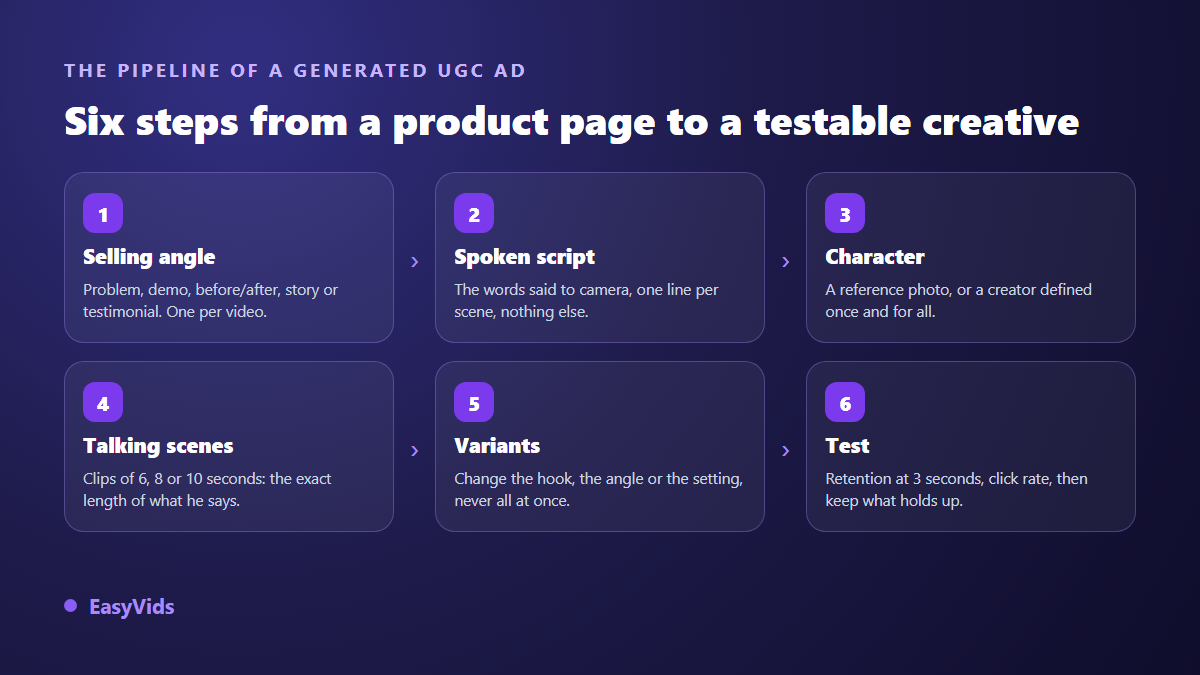
To create an AI UGC ad: pick one selling angle, write about thirty seconds of spoken copy, upload a photo of the character and photos of the product, split the text into lines of six to ten seconds of speech, generate, then produce variants that change one element at a time. The EasyVids studio runs those steps in one place, script writing included, and outputs straight to the vertical format social platforms expect.
Why the format outperforms a polished brand film
A UGC ad is not trying to look good. It is trying to look like what the viewer already watches: someone talking, phone in hand, in an ordinary room. The edit stays dry, the lighting is imperfect, the first sentence lands before any logo. That missing polish is what makes the message read as an opinion rather than an advert.
The buyer's logic is short. Creatives wear out: served too long to the same audience, the same video ends up costing more than it returns. So you need volume, and above all variety. Hiring a creator for every variant makes that pace impossible. Generating variants makes it sustainable, provided you keep a strict frame, otherwise you produce plenty of videos that teach you nothing.
What generation handles well, and what it still misses
Be precise about the limits, because they dictate the shape of your videos. What already works: a character speaking to camera in short shots, a product held in hand from a real photo, changing locations from scene to scene, and the same ad delivered in several languages.
- Shots are short. Video models deliver a few seconds per clip, commonly four to fifteen. A longer ad comes from chaining scenes, not from asking for one long take.
- Hands and small objects still distort, especially during fast handling. Favour slow gestures and a clearly visible object.
- Text written inside the image rarely comes out clean. Add your on screen wording at the editing stage, not in the prompt.
- Lip sync drifts on long sentences. One idea per scene, one breath per scene.
- The set shifts between clips unless you lock it. Describe the location once and keep the same description.
None of this stops you from shipping a creative that stands next to a filmed one. It only imposes discipline: short sentences, one idea per shot, on screen text added in the edit.
The character: one face, held to the end
There are two routes. Either you supply a photo of a real person, which becomes the reference for every scene and is never redrawn, or you let the tool define a credible creator itself and reuse it as a stable reference across the whole production. On the EasyVids character page both cases are explicit, and the character speaks the script on screen rather than receiving a voice over pasted on top.
One legal point has no workaround: a real person's face requires their consent, ideally written, and that consent has to cover advertising use. A face pulled from a stock library or a social profile is not free scenery. On the technical side, our walkthrough for building an avatar from a photo covers the framing and image quality that keep the likeness stable.
The script: words meant to be spoken
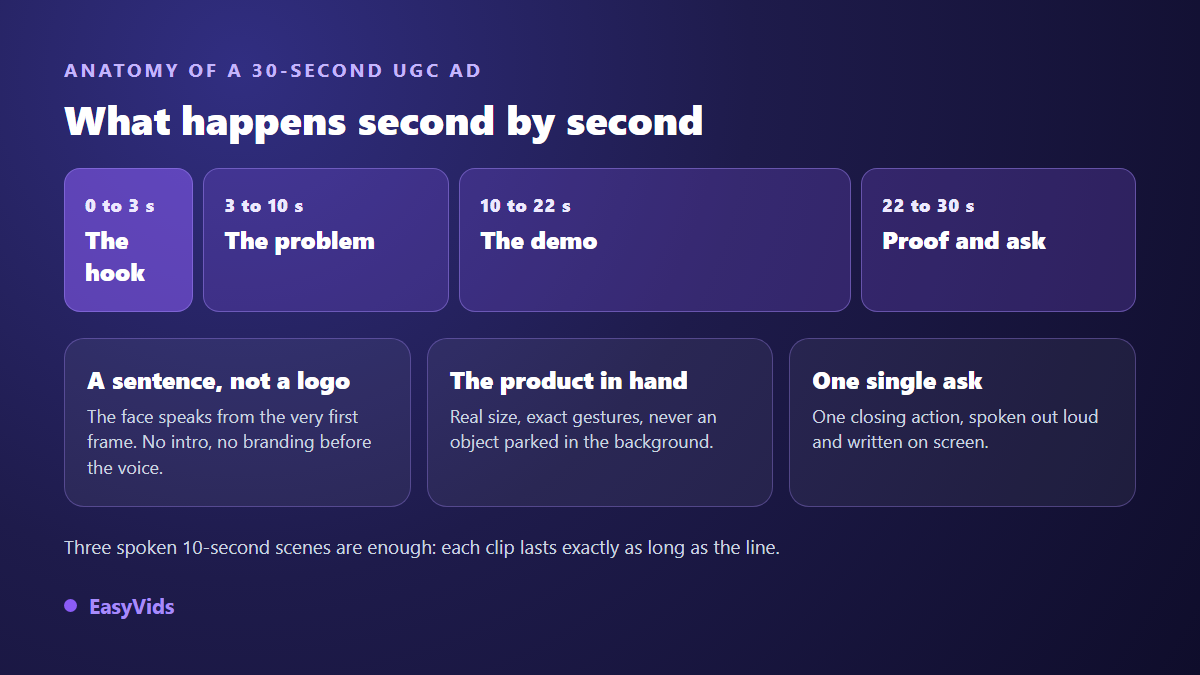
A UGC script contains speech and nothing else. No stage directions, no quotation marks, no shot notes. The benchmark we work with: around 110 characters of speech fit into six seconds, roughly twenty words. A thirty second ad is therefore three to five lines, no more.
The structure repeats from campaign to campaign: a hook that stops the scroll in the first three seconds, a problem the buyer recognises, a concrete demonstration, a proof, then one single ask. If those first three seconds cost you hours, our collection of scroll stopping hooks works as a test bench. In the studio, a dedicated writer produces that script from the product name, a short description and the angle you impose.
Five selling angles worth testing against each other
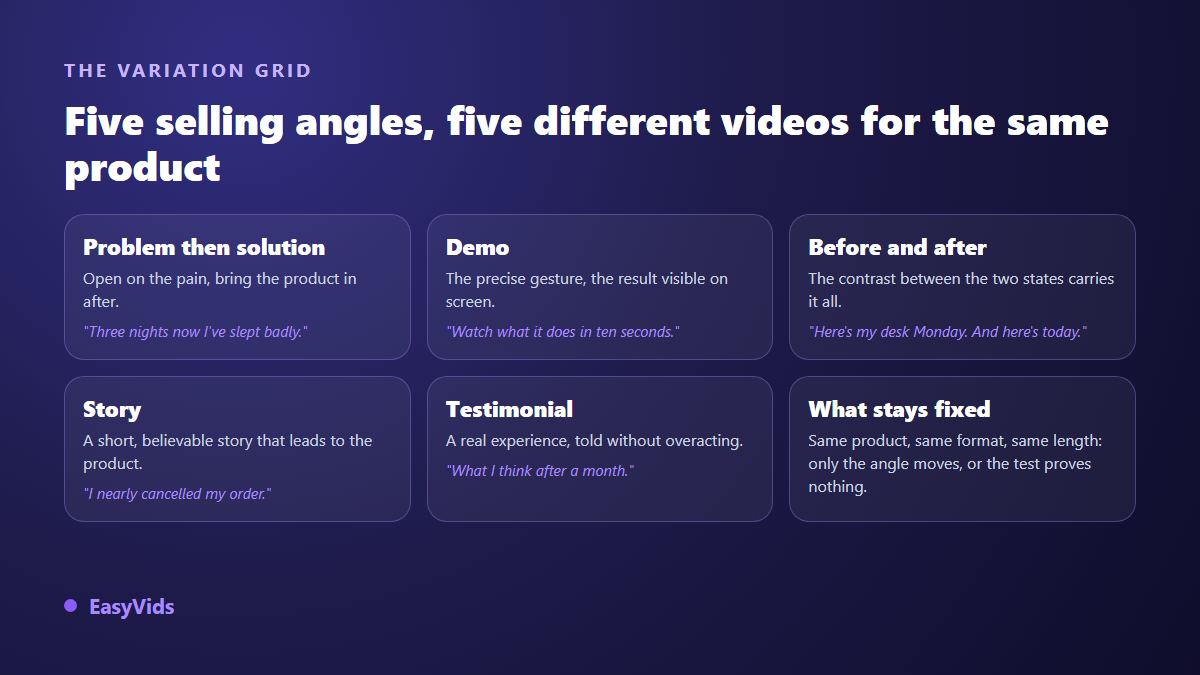
The angle is the heaviest decision, ahead of the face or the location. The same product told through two angles produces two ads that attract different people. Five families cover almost every case, and they are offered as such when you write an ad script in the studio.
- Problem then solution: the video opens on the friction, the product arrives as the way out.
- Demonstration: the product in use, precise gestures, a visible result.
- Before and after: the contrast between the two situations carries the message.
- Story: a short, believable narrative that leads to the product.
- Testimonial: a reported experience, told plainly and never oversold.
The product on screen: start from a real photo
The most common trap is letting the model invent the product. The result looks fine and is unusable: the delivered item does not match the video, and the returns follow. Always start from your own photos, the listing shot plus two or three extra views, the back, the detail, the product in use. The character then holds the real object at its real scale, with the gestures that match it.
The same reflex applies to products you have not received yet, a common case when you test a supplier catalogue. The full method for that case sits in our guide to product presentation videos without a creator, including the question of rights on supplier photos.
Cutting into scenes of six, eight or ten seconds
One script line equals one scene. The clip length has to match the spoken line, otherwise the mouth keeps moving after the words stop, or the sentence ends off screen. That is why the character page accepts only three scene lengths, six, eight or ten seconds, and flags lines that clearly overrun.
Two staging modes cover most needs. The first keeps the character on camera while acting: walking, cooking, showing. The second alternates talking shots with cutaways where the same voice continues off screen. The first feels closer to native creator content, the second helps when the product needs close inspection.
Running variants without ruining the test
A generated ad costs decision time, not shooting time, so the temptation is to change everything between versions: new angle, new face, new location, new hook. You then get performance gaps that nothing explains. Change one variable at a time and keep everything else identical, format and duration included.
A simple matrix does the job: five angles down the side, three hooks across the top, and you pick the cells you genuinely want to separate. Name every file after its combination, or three days later you will not know which one produced the best click through rate. On the closing scene, the final ask deserves the same treatment as the hook, and our call to action formulas give you enough material for that column.
What platforms and the law expect from a generated ad
Two obligations apply directly. The first is disclosure. TikTok's community guidelines require realistic AI generated or edited content to be labelled, and the platform added automatic reading of Content Credentials, the technical marker defined by the C2PA standard, in 2024. On Meta's side, an AI information label is applied to posts identified as generated, and the group's advertising rules require disclosure of photorealistic AI content for ads about political and social issues.
The second obligation is about substance. An invented testimonial is not a creative angle: in the United States, the Federal Trade Commission rule on fake reviews and testimonials, in force since autumn 2024, prohibits publishing the opinion of a customer who does not exist. In Europe, the AI Act sets out in article 50 that AI generated or manipulated content must be disclosed, with that transparency layer expected to apply from August 2026. The practical reading is simple: a synthetic presenter describing a product honestly stays inside the rules, a fake customer recounting a fabricated experience does not.
Frequently asked questions
Can an AI generated UGC ad be rejected by an ad platform?
Yes, like any creative. The usual grounds have nothing to do with AI: impossible result claims, health claims, fake testimonials, third party trademarks or faces used without rights. A restrained video showing the real product and promising only what it does clears review on the same terms as a filmed one.
Do I need the product in hand to make the video?
No, but you need its real photos and an accurate description. Without a photo the model invents an object that will not match delivery, which turns a good creative into a stream of disputes. Two or three views of the same product are enough for believable handling.
How many variants should a first test include?
Start small: three to five variants separated by a single difference, the selling angle for instance. You will quickly see which one holds attention. Producing dozens before you have a first signal spreads your delivery budget across creatives that never gather enough impressions to be judged.
Can the same virtual creator run across a whole season of ads?
Yes, and it is worth doing. A recurring face becomes a landmark for your audience, exactly like a spokesperson. The technical condition is to keep the same reference photo from one production to the next rather than describing the character again in words, since a description alone lets the face drift.
Can one ad exist in several languages?
Yes. The character speaks the language of your script, so translating the script is enough to produce a foreign version with the same face and the same setting. Check how brand names and units are pronounced, since that is where a translated version gives itself away first.
A good generated UGC ad is not recognised by its video model but by three decisions taken before anything is generated: one angle, one face held throughout, one ask at the end. The rest is mechanics, and it fits in an afternoon. To build your first batch of variants, create your account and run an ad script on your best selling product.