You open a blank document, you know what the video is about, and nothing comes out. Or the opposite happens: you write three pages in one go, you read them out loud, and you hear straight away that it sounds like homework. Neither problem is about the idea. Both are about the video script, the piece of text that decides the pace, the attention and how many people reach the end.
A script is not an article read aloud. It is a score. It rests on four pillars: a hook that stops the scroll, a promise that gives a reason to stay, a body that keeps moving, and an exit that asks for one action. This guide covers each of them, with structures you can fill in as they are, length benchmarks for any runtime, and a working method for writing with AI without losing your own voice.
What a good video script looks like, in short
A good video script has four blocks. A hook of two or three seconds that names a problem or announces a result. A promise that states what the viewer walks away with. A body split into segments of five to fifteen seconds, one idea per segment. A single call to action at the end. All of it written for the ear: short sentences, active voice, spoken vocabulary. Count roughly 150 words per minute of video, and always read it out loud before you shoot or generate. If the text leaves you out of breath, it will do the same to your viewer.
What a video script actually contains
Many creators confuse the script with the voice over text. The spoken words are only half of it. A complete script also says what is on screen, when it appears, and what happens between two shots. That is why scripts are almost always laid out in two columns or paired blocks: what is heard on one side, what is seen on the other.
That double reading changes everything in production. A sentence can be excellent on paper and impossible to illustrate. A shot can be beautiful and have nothing to say. Writing both together exposes those mismatches before you lose hours filming or generating.
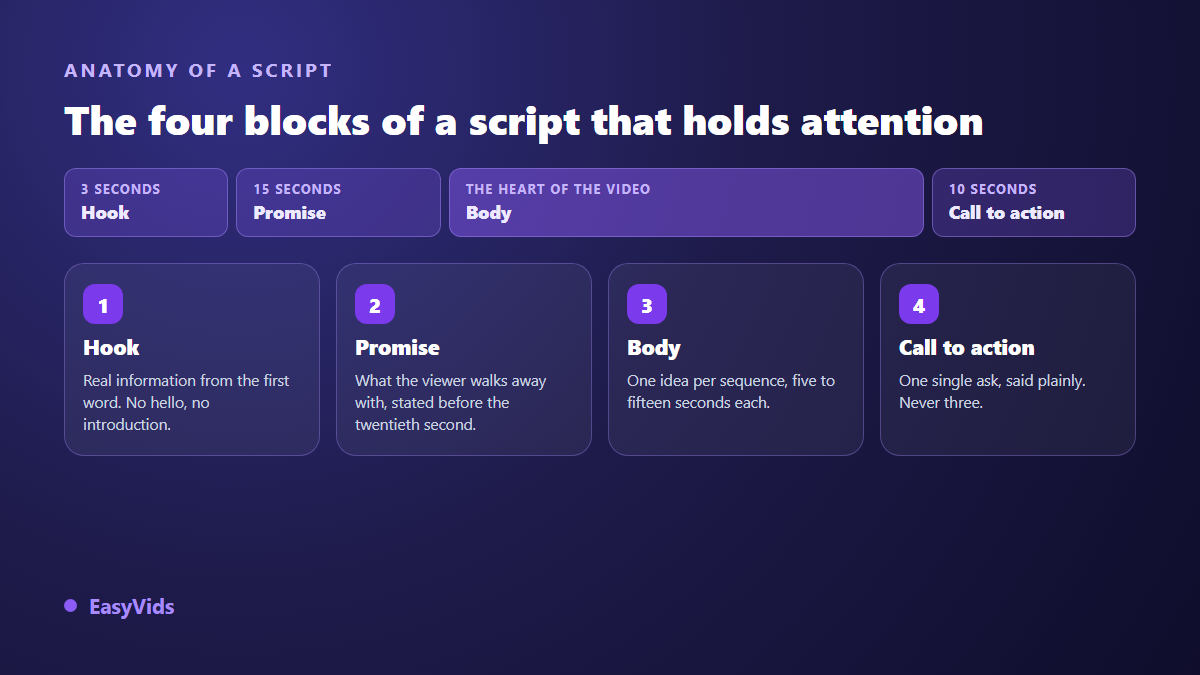
Those blocks do not share the runtime evenly. In a three minute video, the hook and the promise take barely twenty seconds. Yet almost all of your remaining audience is decided there. The rest of the script exists to deliver what was announced, then to turn it into images, a chain covered in our guide to AI video production.
The first three seconds decide the rest
Viewers decide to stay or leave before your first sentence ends. That does not mean shouting or overpromising. It means the first sentence must carry information, not politeness. Cut the greetings, the introductions and the thank you notes at the top: they cost three seconds and give nothing back.
Effective hooks almost always run on one of five mechanisms. Pick one, write three versions, keep the one that fits in under fifteen words.
- The named problem: open on the exact difficulty your viewer has, in their own words.
- The announced result: show the destination first, explain the road afterwards.
- The contradiction: push back on a belief that is taken for granted in your field.
- The closed question: ask something whose obvious answer is yes.
- The countdown: state how many steps, mistakes or shortcuts are coming.
One detail gets forgotten constantly: the hook is written last. Draft the body, find out what you really have to say, then go back to the top and announce it. Hooks written first almost always promise something the video never delivers, and that gap is paid for in drop offs.
Write for the ear, not for the eye
A reader can go back. A listener cannot. That single difference governs every choice in a video script. A badly built sentence gets reread on the page; spoken aloud, it is simply lost. Constructions that work well in an article become obstacles the moment a voice has to say them.
A handful of habits move a text over to the ear. One idea per sentence. Subject before verb. No clause nested inside another. Numbers written the way they are said. Acronyms spelled out on first use. And punctuation treated as breathing, because that is exactly how an actor reads it, and how speech engines interpret it: a full stop calls for a longer pause than a comma.
The test is simple and merciless. Read your script out loud, standing, at normal speed. Every place where you stumble, run out of air, or have to restart a sentence is a place to rewrite. The same test applies to scripts handed to a synthetic voice, as covered in our advice on natural sounding AI voice over.
How many words for how long
The question comes back on every project: how many words should I write? The useful benchmark is not a character count, it is a speaking rate. A steady voice delivers around 150 words per minute, a little less on technical material, a little more on a punchy short. Everything else follows from there.
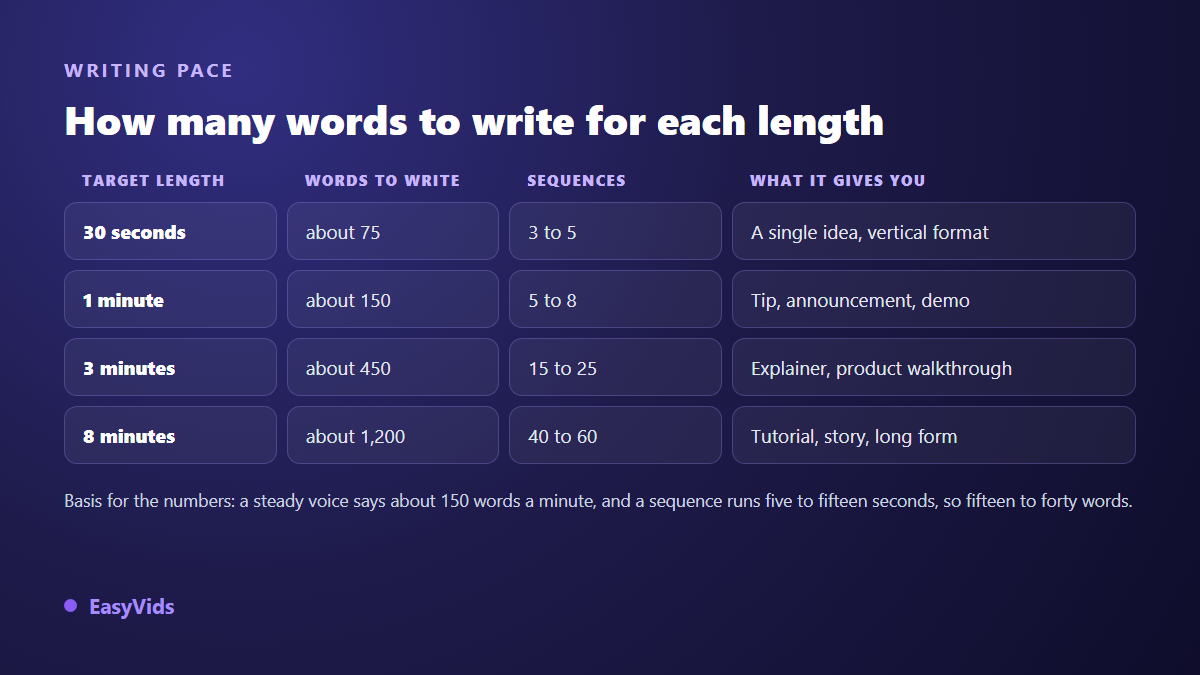
What matters most is the ratio between segments and text: a segment runs five to fifteen seconds of voice, or fifteen to forty words. If one of yours runs well past that range, split it in two instead of speeding up the read. Pace is won in the cut, never in the delivery speed. If those segments are then produced by a video model, each one needs an image description as careful as its text, and our method for writing a video prompt sets out what belongs in it, from framing to camera movement.
Writing to a duration rather than to a word count also avoids the most common trap: a six minute script for a video that was supposed to run three. Set the target runtime before the first line and treat it as a constraint, not a suggestion. An overlong script is never fixed in the edit, it is cut, and the best passages are usually the first to go.
Short form and long form are two different crafts
The same subject is not written the same way for a forty second vertical video and for a ten minute upload. It is not a question of length, it is a question of structure. Short form is not long form trimmed down, and most disappointing verticals are exactly that.
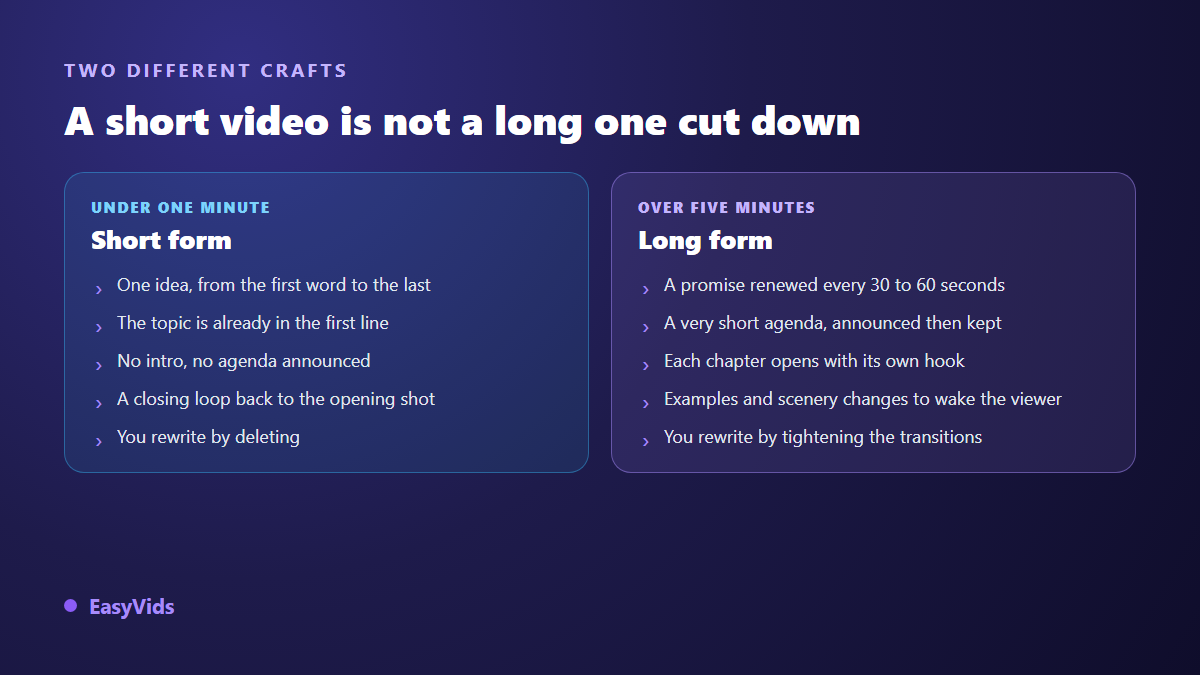
In short form, everything rests on one idea. No introduction, no announced outline, no detour. The first sentence is already the subject, the last is already the answer, and a closing loop often returns to the opening image to trigger a second view. A short script is improved by deletion: every word you can remove without losing meaning is a word gained. It is exactly how product demo videos are written, where the demonstration has to convince before the first sentence ends, as our script patterns for dropshipping UGC videos show.
In long form the problem flips. You have to give a fresh reason to stay every thirty to sixty seconds: a new promise, a change of setting, an open question, a concrete example. An outline stated up front helps, as long as it stays very short. And every chapter benefits from opening on its own small hook, as if the viewer had just arrived, because quite often they have. Long form is also decided before the first second, since on YouTube the thumbnail is what earns the open: the sheet of exact thumbnail dimensions keeps it from arriving cropped or blurred at the moment it matters most.
Three script structures that work
You do not need to invent a structure for every video. Three templates cover the vast majority of cases. Pick the one that matches your intent, then fill in the slots.
- Problem, consequence, solution: name the difficulty, show what it costs if nothing changes, deliver the method. Best for how to videos and sales pieces.
- Before, during, after: the starting state, the transformation step by step, the final result. Best for demos, recipes and projects taken end to end.
- The announced list: a numbered promise in the hook, then one segment per item, each with its own example. Best for educational formats and short form series.
A fourth structure is worth knowing as soon as you tell a story: the loop. You open on the ending, go back to the beginning, and close exactly where you started. It takes more work than the others, but it holds attention remarkably well, because the curiosity opened in the first seconds only resolves in the last.
Finding ideas and keeping a publishing rhythm
The best script in the world is worthless if it shows up once a quarter. Consistency does more for a channel than one perfect video. But you still need something to write about, and that is exactly where most creators stall.
Ideas are not searched for at writing time, they are collected continuously. Three sources will keep you going for months. The real questions your audience asks, in comments, private messages and the searches that lead people to you. The objections you hear whenever you talk about your subject. And your own content that performed, which a different angle lets you revisit without repeating yourself.
On the practical side, one rule holds up: write in batches, publish one at a time. Block a session and produce four or five scripts back to back, you stay in the same writing momentum and the results are more consistent. Always keep two videos in reserve, which is what saves the week when nothing goes to plan. Our step by step YouTube video guide shows how these steps chain together in practice.
Writing with AI without losing your voice
A language model writes fast and clean. That is exactly the risk: clean often means smooth, and smooth means forgettable. AI is still an excellent scripting assistant, on three conditions, all of which come down to what you give it up front.
Give it an intent, not a topic. A video about sleep produces generic text. Convincing an exhausted parent that they can recover an hour of sleep without changing their schedule produces an angle. Then give it your material: your examples, your observations, your anecdotes, everything a model cannot invent for you. Finally give it your voice, by showing it two or three of your existing texts and asking it to match their rhythm and register.
And keep the last pass for yourself. Always rewrite the first and last sentences, they carry your signature. Swap generic examples for your own. Cut the hollow phrases models love to drop in. A script written four handed, where AI supplies the skeleton and you supply the substance, moves faster than writing alone and sounds far truer than a text generated in one block. Plan details are on the pricing page, and a free trial lets you test the whole chain on your own subject.
The mistakes that make viewers leave
Failing scripts look remarkably alike. These are the flaws that come up most often, and every one of them is fixed in a single careful reread.
- An introduction that presents the video instead of starting the video.
- A promise delivered only at the end, when it should be visible from the start.
- Sentences over twenty words long, impossible to say in one breath.
- Written vocabulary where spoken vocabulary would land much better.
- Three different calls to action, which amounts to having none.
- No visual notes alongside the text, which dumps all the work on production.
Frequently asked questions
How long should a script be for a one minute video?
Around 150 words for a steady voice, slightly less if you let the visuals breathe. The better method is to time your own read out loud: your personal rate beats any average.
Should I write word for word or just notes?
Word for word whenever the video has to be precise, short, or voiced by a speech engine. Notes are enough for a long form piece where your spontaneity is part of the appeal, provided you still write the hook and the closing lines, the two moments where improvising costs the most.
How do I write a video script if I am not a writer?
Speak first, write second. Record yourself explaining the subject to a real person, transcribe it, then clean it up. You end up with a natural tone, which is far harder to reach from a blank page.
Can AI write a complete video script?
Yes for the structure, the segmentation and a first usable draft. No for what makes it yours: your examples, your point of view, your way of putting things. The right use is to have the model build the skeleton and to keep the final rewrite.
Do I need a different script for each platform?
Yes, at least for the hook and the runtime. The core argument travels well from one platform to another, but the opening seconds and the aspect ratio have to be rethought every time. More practical answers are gathered on our frequently asked questions page.
A video script is not a writing exercise, it is a flight plan. Set the target runtime, pick a structure, write the hook last, read it out loud, cut everything that does not move forward. The difference shows on your very next video. And if you want to go straight from text to scenes, voices and edit, creating an account opens the full studio, no bank card required.