A quote video takes minutes to make and two seconds to judge. That is what makes the format both irresistible and brutal: thousands of accounts post the same lines, over the same backgrounds, in the same typeface, and only a handful clear a thousand views. The gap almost never comes from the line itself.
It comes from how the text enters the frame, how large it sits, and the exact moment the strong word lands. This format has no actor, no set and no plot to rescue a weak composition: the text is the film. This guide walks the whole chain, from picking the line to publishing a series, with the legibility thresholds we enforce on our own shots. If your raw material is longer than a single sentence, our guide to turning text into video covers the general case.
The short answer
A quote video that works rests on four decisions taken before the first frame. A short line, checked and attributed. A cut into three to five shots, never the whole sentence dumped at once. Type sized for a phone screen, with one dominant word per shot. A sound treatment chosen in advance, silence included. The rest is consistency: this format is judged on a series, not on a single upload.
Why most quote videos flatline
The default reflex is to drop the whole sentence onto a photo, add a slow zoom, and publish. The result is an animated postcard. The viewer reads everything in one second, understands nothing else is coming, and swipes. The video runs twelve seconds; attention lasted two.
The format lives on one mechanism: progressive reveal. Viewers stay because a piece of the sentence is still missing. Each shot hands over that piece and promises another. It is the logic of a headline cut in half, applied to a fifteen word line. Once you understand that, everything else is execution.
Picking the line: the raw material decides everything
Not every quote survives this treatment. A forty word sentence cannot be cut, it can only be endured. An abstract sentence gives you nothing to show. The filters below apply before you open any tool.
- Under twenty words. Beyond that, the progressive reveal turns into reading, and nobody reads a video.
- A pivot word. There must be one term you can isolate at huge size: a verb, an opposite, a number.
- A contrast or a reversal. Lines that land say one thing, then its opposite. That is what creates the gap between two shots.
- Concrete language. A word that carries an image beats a word that carries a concept, both on screen and in the ear.
- A traceable source. A line with no verifiable author exposes you, and gets caught fast in the comments.
Motivation is the most crowded niche, so the most demanding. Posting a line that has been seen a thousand times requires an angle: a theme held across the whole channel, a recognisable visual direction, a constant tone. That is the logic set out in our method for running a motivation channel with AI, applied here to ten second formats.
Check the attribution before you publish
Plenty of circulating quotes are misattributed, and video amplifies the error: the line and the name appear at full size, with no room for nuance. The phrase "be the change you wish to see in the world", universally credited to Gandhi, appears nowhere in his writings; the New York Times documented that back in 2011. Publishing that kind of line attracts correctors, and the correction becomes the most liked comment under your video.
There is a legal side too, often ignored because the line is short. Copyright does not expire with fame: under the Berne Convention the minimum term is fifty years after the author's death, and the European Union and the United Kingdom apply seventy. Short quotation exceptions exist in most jurisdictions, and they share one requirement everywhere: name the author and the source. French law states it explicitly in article L122-5 of the Intellectual Property Code. Keep the credit on screen, in every video.
Typography does the work, because the text is the image
Stop treating words as a caption laid over a background. Treat them as the graphic material itself: sharply contrasted sizes, different weights, deliberate line breaks, one word alone in the frame while the rest waits its turn. What is said gets shown, instead of merely subtitled. That is animated typography, covered in our motion design guide.
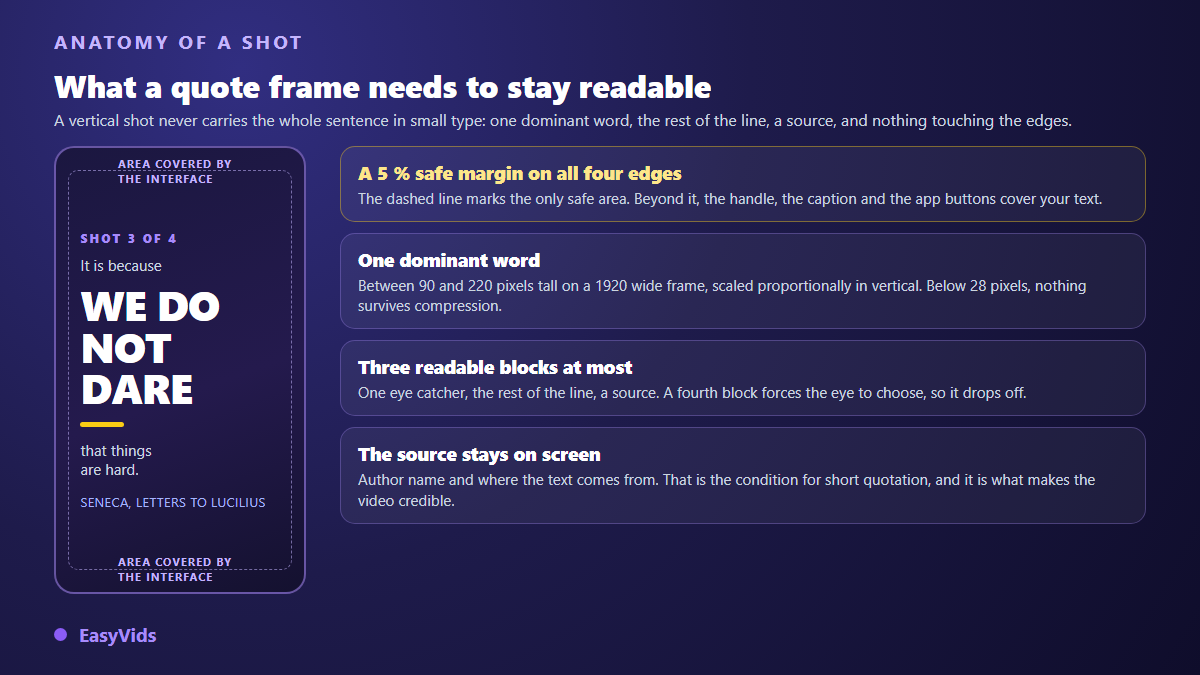
One sizing rule decides everything, and beginners miss it most often. A video is watched full screen or on a phone, never at reading distance like a web page. On a frame 1920 pixels wide, a dominant word sits between 90 and 220 pixels tall, a title between 64 and 140, secondary text between 32 and 56. Under 28 pixels nothing survives platform compression. Those are the thresholds we enforce on our own shots, and they transfer to any tool.
Two guardrails complete the picture. Keep anything meant to be read at least 5 per cent away from every edge, otherwise the handle, the caption and the interface buttons will cover your line. And never show more than three legible blocks at the same instant: past that, the eye has to choose, so it reads badly.
Cut the quote into three to five shots
Cutting is what separates a quote video from a still image. Each shot carries the fragment the voice is speaking at that moment, and only that fragment. A timing reference helps you calibrate: in French, roughly 110 characters of spoken text run 6 seconds, and English sits in the same range. A shot longer than eight seconds stops being motion design, because its animation finished long ago and the frame just sits there. That ceiling applies to the shot, not to the film: holding several minutes is a question of how shots follow one another, which our guide to longer AI videos breaks down.
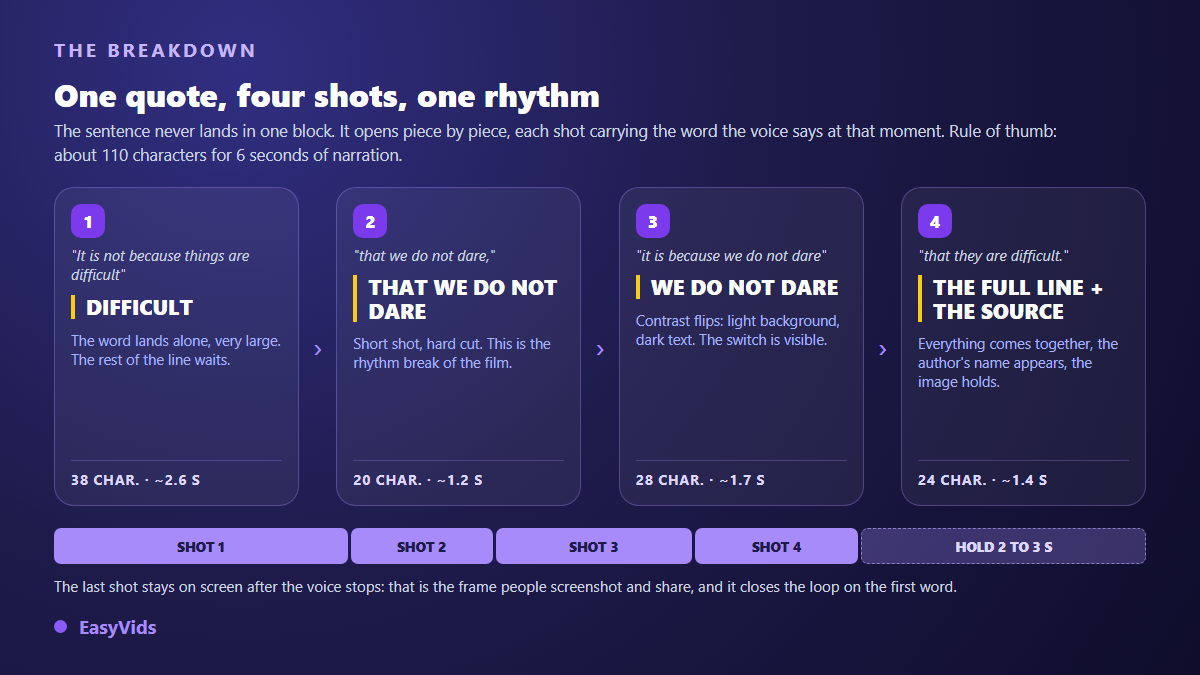
The final shot deserves separate treatment. Let it hold two to three seconds after the voice ends, with the complete sentence and the source. That is the frame viewers screenshot, share or reread, and the one that closes the loop when the video restarts. The same cutting logic scales to longer texts, as our method for turning a finished script into an edited video explains.
Vertical format and the zones the interface covers
Vertical 9:16 is the natural frame for this content, at 1080 by 1920 pixels. Two precautions are worth stating. Compose directly in vertical rather than cropping a horizontal frame: cropping always removes what mattered. And only produce square or landscape versions if you publish elsewhere, with a composition rebuilt for that frame. Our rundown of sizes and ratios per platform gives the exact values.
Voice over, music or silence
Sound is not a layer added at the end: it decides how long your shots run. A silent video is read at the viewer's pace, a narrated one imposes yours. So the choice happens before writing, not after.
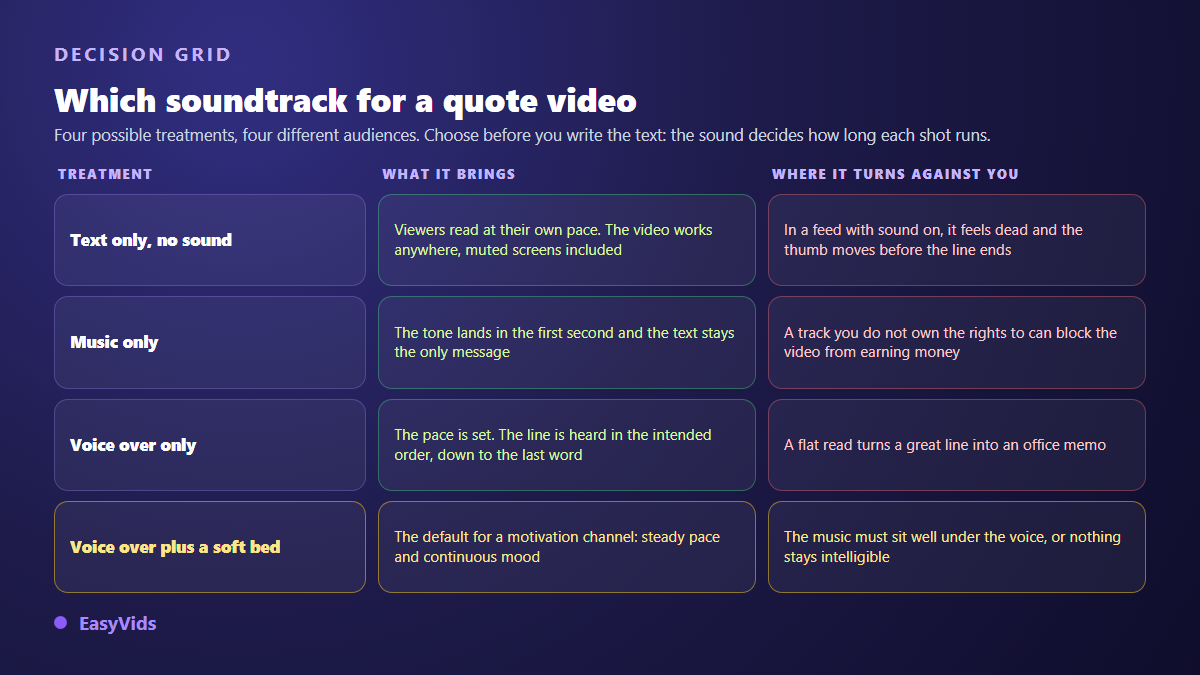
For a motivation channel, the most reliable combination stays a measured voice over a discreet pad, kept well under the voice. Delivery matters as much as wording: synthesis engines read punctuation the way an actor reads a score, and a direction on how to perform the line changes the result entirely. Our guide to text into video with voice over covers those settings. Finally, check that your music is cleared for the platform you target: a protected track can block monetisation on a video that is otherwise working.
Render by code rather than with a video model
A generative video model is the wrong tool for this format. Those models produce convincing moving images, but they write badly: warped letters, invented words, unstable spelling. And here, the text is everything. The approach that gives clean results has another name, rendering by code: each shot is a page described in code, photographed frame by frame, then assembled. The type stays perfectly drawn, the colours are exactly the ones you supplied, and nothing is reused from a template shared with other accounts.
That is the principle behind the motion design engine we are building inside the EasyVids studio. An art direction is written for your project, a shared set of rules gives the film its unity, and animation timing is expressed as a fraction of each shot's duration: changing the voice or fixing a word therefore does not mean rewriting the animations, they realign on their own. Every shot is then reviewed automatically to check that no text is hidden, clipped or too faint to read. One point of honesty: this piece is still being finished and is not open to every account yet. The rest of the chain, writing, visuals, voice over, music and editing, is available from sign up, and the plans are listed on the pricing page.
Publish as a series, the only mechanism that builds a channel
A single quote video proves nothing. The format is judged on a series: same visual direction, same voice, same length, regular publishing. Repetition is what teaches the platform who to show your videos to, and teaches viewers to recognise your account from one frame. Quote videos are only one entry point into content made without a camera, and our ideas for videos you can make without filming yourself give you formats to alternate with them so the rhythm holds without wearing thin.
The most efficient method is to gather twenty quotes in one document, one per line, then process them in a single working session. Each quote becomes a film of three to five shots, and line by line cutting lets you decide yourself where the sentence breaks. Then keep one variation per video, a background, an accent colour or a direction of entry, so the series stays recognisable without turning into a catalogue.
A word on monetisation, since the question always comes up. The YouTube help centre, in its monetisation policies revised in July 2025, requires original and authentic content and rules out mass produced, repetitive uploads. A channel stacking the same animated card with a different sentence falls under that rule. A channel bringing its own visual direction, a crafted narration and a deliberate editorial line does not. The difference is not the use of AI, it is what you add.
The mistakes that cap a quote channel
- The whole sentence shown at once. Nothing is left to wait for, so there is no reason to stay.
- Text glued to the edges. The app interface covers it, and you never see that from your editing tool.
- A style that changes every video. Your series stops being recognisable in a fast moving feed.
- No source on screen. It exposes you legally and makes the viewer doubt the line.
- The fifteen second shot. The animation ended twelve seconds ago and the frame is dead.
- Music louder than the voice. Nothing is understood, and the line is lost.
- Irregular publishing. Three videos in one day then nothing for two weeks builds no habit.
Frequently asked questions
Can I use any quote in a video?
No. A quote stays protected until its author enters the public domain, seventy years after death in the European Union and the United Kingdom. Short quotation exceptions allow reuse, but they require the author's name and the source, and an insertion into content that actually does something with the line. A sentence shown alone, with no context and no credit, falls outside that.
How long should a quote video run?
Between eight and twenty seconds depending on the length of the line, with a final frame held two to three seconds. A fifteen word quote read aloud runs about six seconds; the rest comes from the breathing between shots and the closing hold. Past thirty seconds you need more than one sentence to keep anyone.
Do I need a voice over, or is music enough?
Both work, but not for the same audience. Music alone lets viewers read at their own pace and suits very short lines. A voice over imposes the rhythm and holds better on longer lines or lines built on a reversal. For a regular channel, a measured voice with a discreet pad gives the steadiest result.
How do I stop my videos from all looking the same?
Lock what must stay stable and vary the rest. The typeface, the format and the voice are your signature, they do not move. The background, the accent colour, the direction the text enters from and the composition change every video. A recognisable series is not an identical series.
Are quote videos monetisable?
Yes, if they contribute something. YouTube's monetisation policies revised in July 2025 rule out mass produced, repetitive content, not the use of AI. On very short formats the logic differs anyway: they mostly build an audience you monetise elsewhere, through long form video, a newsletter or a product.
This format needs no equipment, no drawing talent and no production budget. It needs a line worth showing, an honest cut and a series held over several weeks. Start with ten quotes written in a document, one per line, and build the first one today: creating an account opens writing, voice over and editing in one place.