You have a story in your head. Not a ten second clip, not an ad: an actual piece of fiction, with a character, a problem and an ending that leaves something behind. An AI short film puts that within reach without a crew, a camera or a shooting day. It is not built like a social video, though. The film is won somewhere else: in the writing, in the shot breakdown, and in the discipline that keeps one visual identity alive until the last frame.
The hard part is no longer technical. Generating one beautiful shot is easy now. Chaining forty shots that look like they belong to the same film, with the same face, the same light and the same rhythm, is the real work. This guide follows the actual order of production: story, shot breakdown, visual consistency, recurring characters, sound, then edit.
The short answer
An AI short film is made in six moves: you write a short story, you cut it into segments where each one becomes a scene, a production plan is drawn up (world, characters, sets, narrative arc), each scene is generated as an image then animated, voice and sound are laid in, and the edit fits every shot to its line. The third move decides everything. Without a reference document that locks your characters and your style, you end up with a series of pretty shots that tell nothing together. The wider chain is explained in our guide to the AI video generator.
A short film is not a long clip
A social video lives on hooks and pace. A short film lives on tension: the viewer has to want to know what happens next, for several minutes, with no reassuring promise. That changes three things. Your first line sells nothing, it sets a situation. Your middle never explains, it complicates. Your ending does not summarise, it closes.
It also changes the tooling. A clip is generated in one block. A film is built in pieces, with a place to find every shot, fix it, regenerate it alone and reassemble the whole without starting over. That is exactly how an AI creation studio is organised: one project, numbered scenes, and each scene editable without touching its neighbours.
Writing a story that fits into a few minutes
Write for the ear, not the eye. What you produce here is not a technical screenplay with slug lines and camera notes. It is the narration that will be spoken, sentence after sentence, while the images run. Every sentence becomes a shot. The constraint feels brutal and turns out to be your best rhythm tool, because it forbids paragraphs that drift.
So you need the conversion between text and duration. On our French productions, roughly a hundred and ten characters of voice over run for six seconds, and that is the default target when the studio cuts a script into scenes, adjustable to six, eight or ten seconds. Do the maths backwards before writing: a three minute film fits into about thirty short scenes. You then know how many sentences you are allowed, and you stop dreaming of a twenty minute film you will never finish.
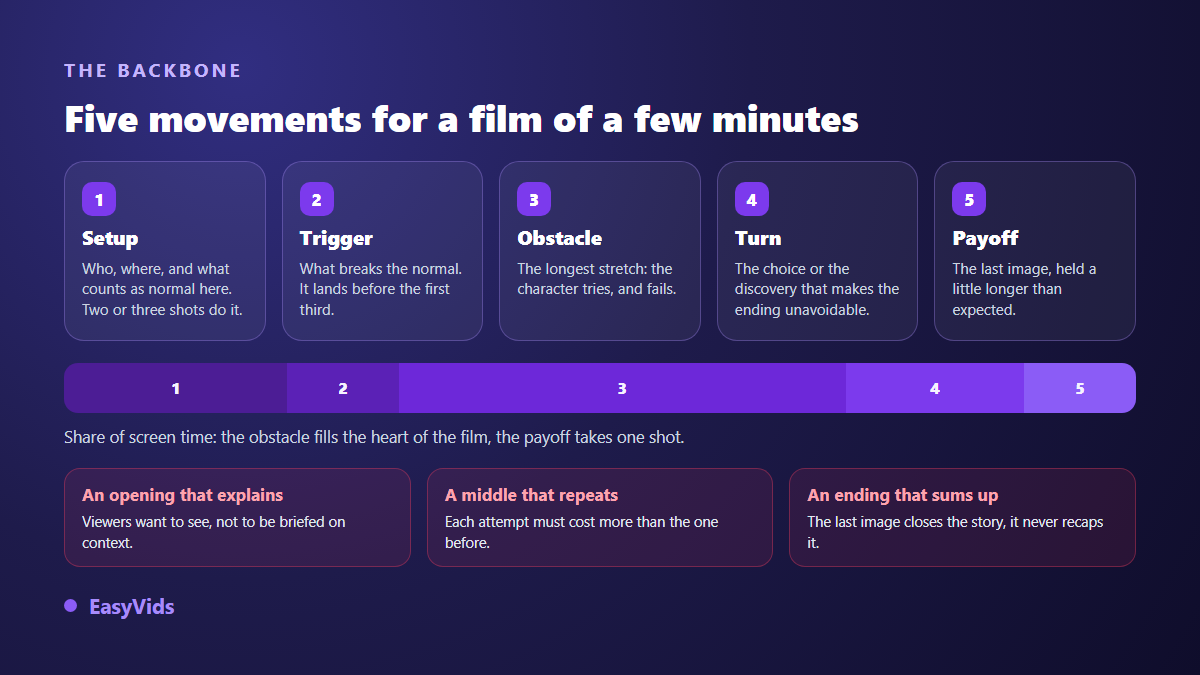
- Situation: who, where, and what counts as normal here. Two or three shots are enough.
- Trigger: the thing that breaks the normal. It must land before the first third is over.
- Obstacle: the longest stretch, where your character tries and fails.
- Turn: the decision or discovery that makes the ending inevitable.
- Last beat: the final image, held one second longer than feels comfortable.
Shot breakdown: one line, one scene
The studio applies a rule you can read at a glance: one line of your script is one segment, and every segment becomes one scene. You therefore see your film as a list before you see a single image, which is the best moment to spot weakness. A scene that adds nothing is cut here, for free, before anything is produced. Turning written text into a run of narrated shots is not specific to fiction, and our method for turning a text into a narrated video shows the simplest version of it, with no characters or sets to hold from one shot to the next.
The text of each segment then travels untouched into production: the voice over of a scene is the exact copy of its segment, never a paraphrase. That detail prevents the classic drift where the finished film says something other than the script you approved. Aspect ratio is chosen when the project starts, wide, vertical or square, and it applies to every image and every video in the film. If you hesitate on that choice, our guide to video formats platform by platform sets out the ratio and the length each one expects.
- One idea per scene. When a shot carries two facts, the second one is not heard.
- No sentence beyond the target length: cut at the comma rather than rushing the voice.
- Vary the shot sizes: wide, medium, close, or the film flattens out within a minute.
- Plan shots with no speech at all. Silence is a storytelling tool, not a hole to fill.
- Number your scenes while writing: that number is what you will use to fix things later.
One look, from the first frame to the last
This is where most projects fall apart. Each shot is generated separately, so without a shared reference the light shifts, the colours slide and the set no longer has the same architecture when you return to it. Traditional production has a name for the fix, the bible, and it exists in an automated chain too. Before a single scene is produced, the studio writes that reference: period, style, palette, characters with their portraits, sets, and the phases of the story.
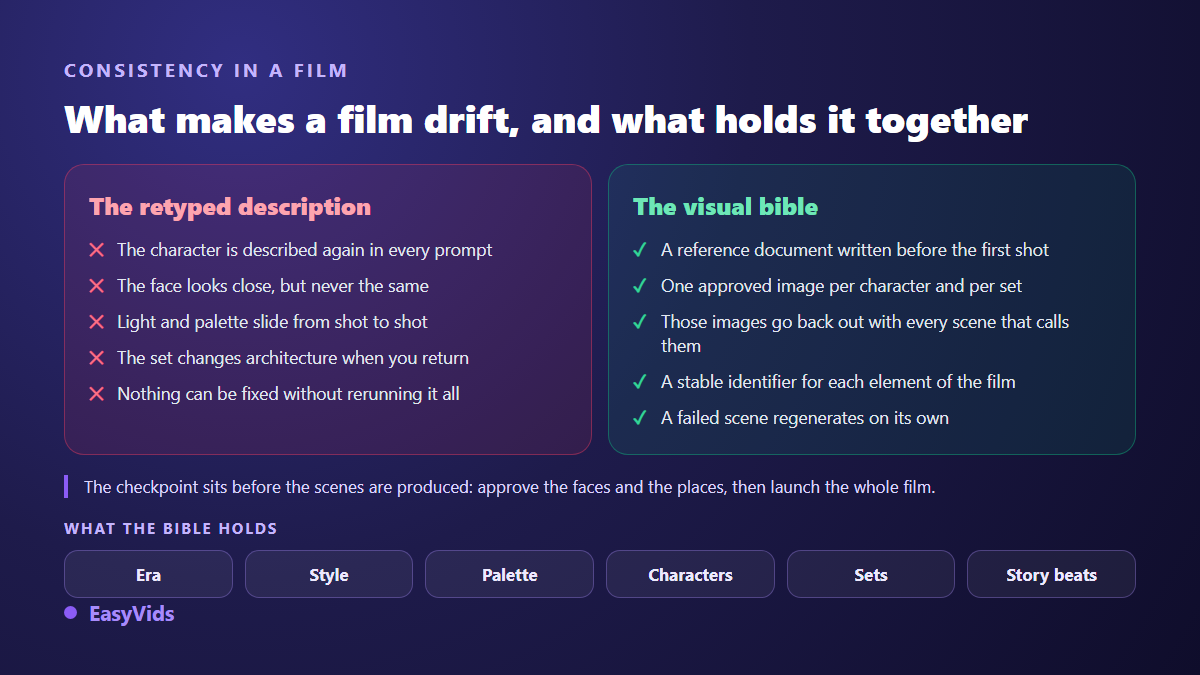
That document is not decoration. The characters and sets it describes are built as images first, and those images are what travel back into every scene that calls for them. A checkpoint sits exactly there: you approve the faces and the places before the whole film is launched. Take that time. Fixing a character at that moment costs one image; fixing it afterwards costs the film.
Recurring characters, the real test
Repeating a description in every prompt never gives you the same person, only a convincing cousin. What holds a character is their reference image, sent back to the generator on every shot where they appear, along with an explicit instruction to keep the face, the hair and the outfit. The studio gives each character a stable identifier, and every scene declares the identifiers it needs. Consistency becomes a property of the plan rather than a hope.
One practical limit is worth knowing: a scene cannot lean on an unlimited number of references. When a shot gathers too many people, the answer is to build a group image that merges two or three references into one, then quote it as a single reference. Your three character scenes become as stable as your solo shots, which matters in fiction where people talk to each other.
Sound: voice, dialogue and silence
Sound decides believability more surely than picture, and it is set at project level. Two dialogue treatments exist and they do not tell the same story. The first has characters speak on screen, their line carried by the shot itself. The second keeps everyone silent and hands the story to a narrator. The first suits dialogue driven fiction, the second suits a tale or an interior monologue. Choose before generating, because the choice shows in every shot. Writing narration that does not sound synthetic is covered in our natural AI voice over guide.
Ambience is handled separately from music, on purpose. The studio lays a voice over and a discreet sound design by default, with no background score imposed: rain on a window, a door, a distant street. Music comes later, once the edit exists, because a score laid too early hides pacing faults instead of exposing them. An original track can then be composed on the mood you choose and placed under the finished film. A film carried by music rather than by speech follows different editing rules, which we gathered in our guide to photo slideshows set to music.
The edit, where the film actually happens
A generated shot almost never lasts exactly as long as its line. The edit resolves that gap shot by shot, and several behaviours are offered per scene. The most useful one in fiction fits the shot to the voice: if the video is shorter it is slowed until it covers the line, if it is longer it is cut at the end of the sentence. Other modes let the video play in full, or loop it while the voice continues.
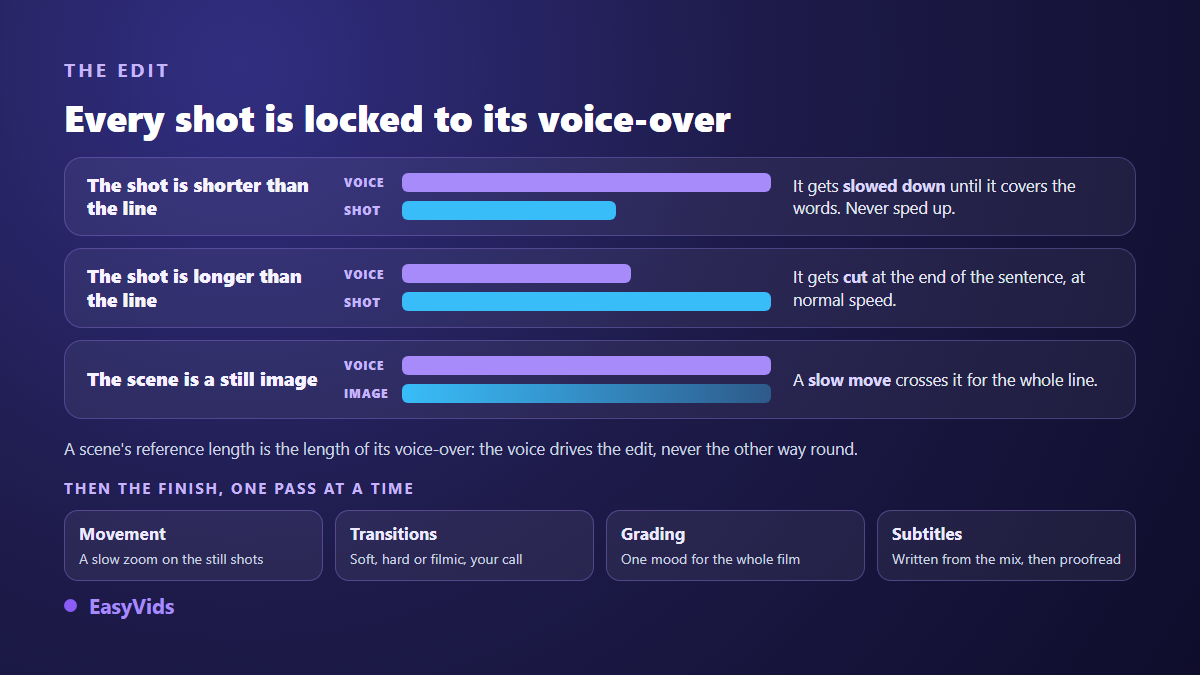
- Slow motion on still frames: a gentle zoom or pan avoids the slideshow effect.
- Transitions chosen by style: a soft dissolve for a tale, a hard cut for a tense story.
- One grade across the whole film: warm gold, dark cinema, black and white, film grain.
- Captions written from the soundtrack then proofread: part of your audience watches muted.
- A scene order you can revise to the end: moving a shot costs less than regenerating it.
- One final export, only once the ending convinces you.
Length, format and disclosure before you publish
Length is not only an artistic question. The Academy defines a short film as one running forty minutes or less including credits, which is a ceiling rather than a goal. For a first work, aim far shorter: a three to five minute film gets watched to the end, and a film watched to the end beats an ambitious one abandoned halfway. Many authors cut their teeth on a piece of a few dozen seconds built for a precise purpose, an animated invitation sent to friends and family for instance, or a keepsake film built from family photos: the breakdown follows the same rules, with far less risk of giving up midway. Format matters too. On YouTube, any square or vertical video of three minutes or less is classified as a Short, so keep a wide frame if you want your film treated as a work rather than as feed content. Decide that before generating, because the aspect ratio is set on the first shot. Nothing stops you from cutting a short vertical version to announce the film, though: one strong line held on screen over a shot from the story is enough, and our method for quote videos gives the readability rules for that kind of shot.
Then comes disclosure. YouTube asks creators to flag realistic content generated or altered by artificial intelligence at upload time, while clearly unrealistic material such as stylised animation does not need the label. A cartoon tale raises no issue; fiction shot to look like live footage must be declared. Tick the box: skipping it can cost you the video.
What to accept before you start
- Shots stay short. A two minute continuous take is not obtained, it is composed.
- Likeness is requested, never guaranteed: human review remains part of the job.
- Text baked into a generated image distorts quickly: write your title cards in the edit.
- Fast action and hands handling small objects remain the most fragile shots.
- Safety filters reject some subjects, especially anything resembling a public figure.
- The first cut of a film is never the right one: plan correction passes into your schedule.
Cost, finally, is reasoned per scene rather than per film, since every element produced is billed individually. A short film is therefore priced from the number of scenes you wrote, which makes the breakdown a budget decision as much as an artistic one. Plans are listed on the pricing page, and an estimate for your project appears before launch, to confirm or cancel.
Frequently asked questions
How long does an AI short film take to make?
Budget a working day spread out for a first film of a few minutes, most of it going to writing and review. Generation itself runs on the server: you can close the page and come back to check progress. Your schedule is set by the correction rounds, not by the machine.
How long should a first AI short film be?
Around three minutes, which is roughly thirty short scenes. Long enough to establish a character and a turn, short enough to actually finish. Stretch it on the next film, once your breakdown method is settled.
How do I keep the same character throughout?
Work from a stable reference image reused on every shot where the character appears, instead of copying a description into each prompt. Approve the portraits before launching the whole film, and avoid abrupt lighting changes between neighbouring scenes: the wider the gap, the more visible the drift.
Do I need to know how to write a screenplay?
No, but you need to know how to tell a story. The studio can develop a story from a one sentence idea and cut it into scenes for you. What stays human is judgement: deciding whether a scene serves the film, whether the ending lands, whether a line rings false. No tool will do that for you, and that is exactly what will set your film apart.
An AI short film is not won at generation time, it is won in writing and review. Write your story in sentences you have said out loud, cut it into short scenes, lock your characters before producing anything, let silence exist, and export only once the ending convinces you. The EasyVids studio brings writing, generation, sound and editing into one place, and creating an account lets you launch your first scene today.