You have a video ready, and one plain question stops you: how long is it allowed to be? TikTok video length is one of the few settings the platform has changed almost every year, and half the answers floating around describe an app version that no longer exists. One creator still believes the ceiling is three minutes. Another posts a ten minute tutorial and cannot work out why nobody reaches the end.
Both mistakes come from the same confusion. There is a technical ceiling, set by TikTok, and an effective length, set by your audience. They have almost nothing in common. This page gives the current limits depending on how you publish, the length to aim for depending on your goal, and the structure that keeps a viewer past the first three seconds. For dimensions, aspect ratio and resolution, our platform by platform video format sheet takes over: this one only deals with time.
The short answer
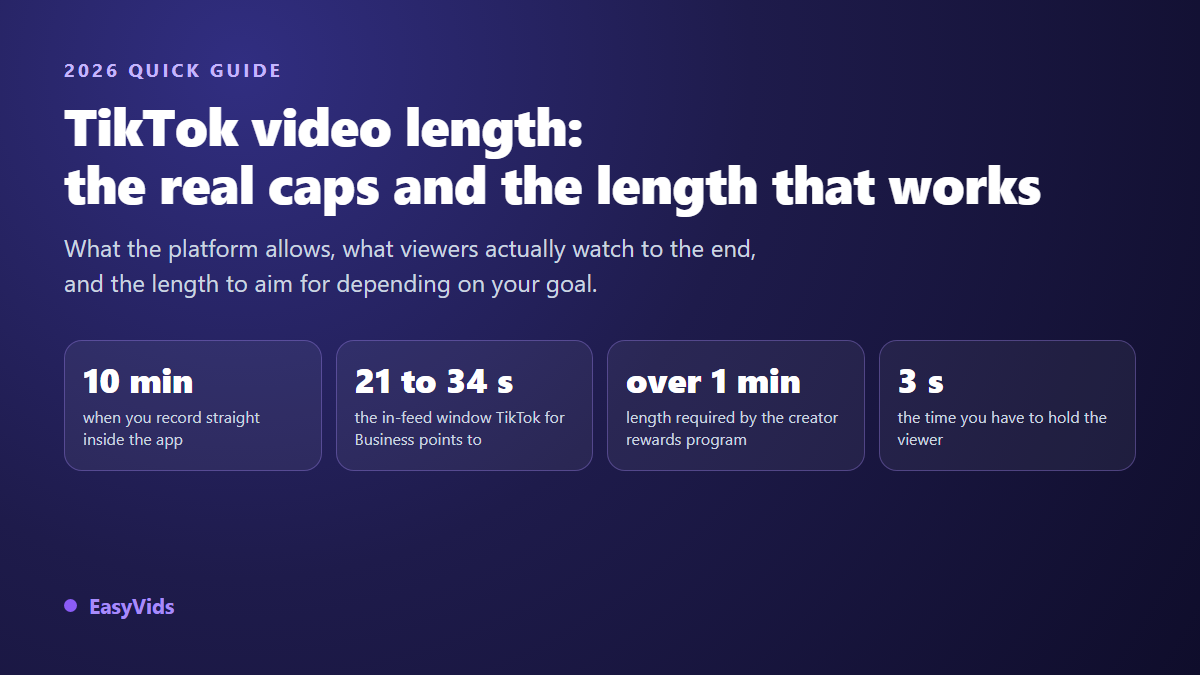
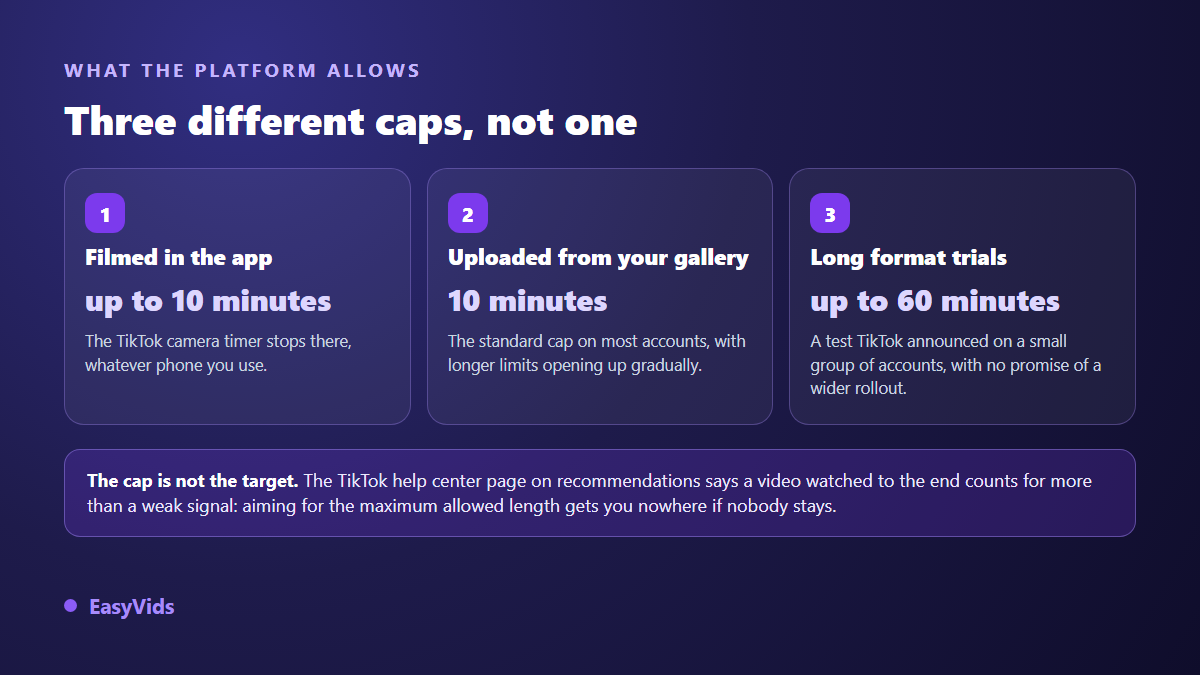
A video recorded inside the TikTok camera can run up to 10 minutes. A video uploaded from your gallery sits under the same ceiling for the vast majority of accounts, with longer durations opened in waves. TikTok has also confirmed testing uploads of up to 60 minutes with a small group of users, while noting that an experiment does not always become a permanent feature. In terms of results, the useful window is far shorter: 7 to 15 seconds to earn views, 21 to 34 seconds to convince, and over one minute only if monetisation is part of your plan.
Three ceilings people keep mixing up
The first ceiling belongs to the built in camera. When you hit record inside the app, the counter stops at 10 minutes on any phone. The second one applies to uploads: you edit elsewhere, then send the file from your gallery. That is the route long durations travel through, and the one TikTok changes most often. The third is pure experimentation: very long formats reach a handful of accounts first, often professional ones, before being widened or dropped.
The history explains why articles contradict each other. TikTok launched with 15 second clips, then allowed 60 seconds, then 3 minutes in 2021, then 10 minutes. Tests of 30 minutes and later 60 minutes followed. The most reliable move is to check what your own app accepts: open the upload screen, pick a long file, and read the error message if it gets refused. That check takes ten seconds and beats any table copied from elsewhere.
How short is too short
TikTok accepts very brief clips, down to a few seconds. The problem is not technical, it is arithmetic. A two second video leaves no room for an idea: viewers watch it go by without understanding it, do not comment and do not share. Those signals decide how far it travels. Below five seconds you are playing on the loop alone, meaning the automatic replay that inflates total watch time. That effect is real and widely underused: an 8 second video watched three times in a row beats a 30 second video abandoned at the tenth second.
The length that actually performs
In its creative best practice material, TikTok for Business highlights a window of 21 to 34 seconds for in feed videos. Below 20 seconds a demonstration stays shallow. Past 35 seconds the drop off curve gets steep on content that never gave a real reason to stay. Treat the range as a starting point, not a law, and apply it above all to videos that ask the viewer to do something.
The real judge sits elsewhere: in the first three seconds. TikTok builds its feed so viewers can leave at any moment, so the question is never how long you may run, but how much time you have earned. A vague opening kills an 8 second video as surely as an 8 minute one. If that opening is where you get stuck, our 51 scroll stopping hooks sorted by niche give you lines ready to adapt.
Pick your length from the goal
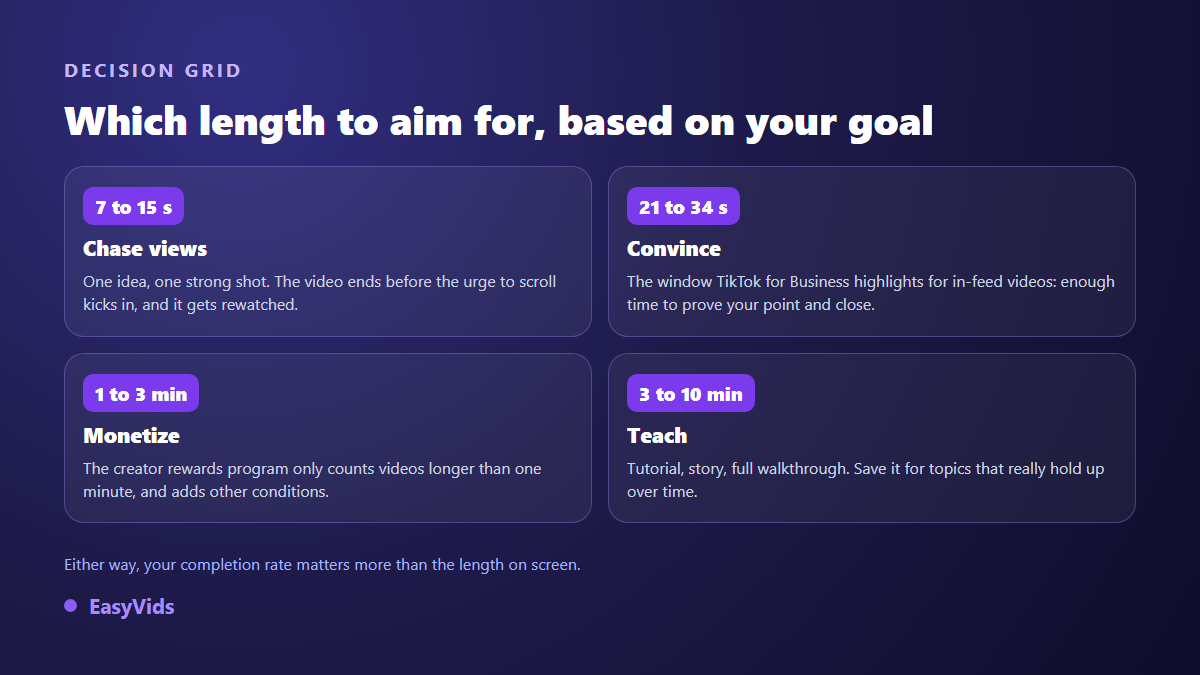
One question settles it: what must this video achieve? The length follows almost mechanically.
- Views and followers: 7 to 15 seconds. One idea, one strong shot, one punchline. It ends before fatigue and replays itself.
- Convincing and selling: 21 to 34 seconds. Enough room to state a problem, show a solution and close.
- Creator Rewards Program: over one minute, a strict requirement, but only on subjects that genuinely fill that time.
- Teaching and storytelling: 3 to 10 minutes. Reserved for high value formats where viewers came looking for something specific.
- Testing an idea: 10 seconds. A hook on its own tells you whether the subject lands, before you invest in a full production.
Brand accounts fall into the same trap over and over: publishing a two minute video because the product has many arguments. Cut it into three forty second videos instead. You get three different entries into the feed, three hooks, and three chances to reach audiences that barely overlap.
Completion rate beats raw duration
The TikTok help centre page on how content is recommended is explicit: the system looks at videos you watched, finished, liked or skipped, and a strong signal, such as finishing a longer video from beginning to end, carries more weight than a weak one. The platform does not reward the duration you display, it rewards the share of it you manage to get watched.
The maths is easy to run yourself. A 60 second video abandoned at second 15 leaves a ratio of 25 per cent. A 20 second video watched until second 16 leaves 80 per cent. The second one sends a far better signal while holding three times less content. Your account analytics show this: open the data for a published video and compare average watch time with total length. That single number should drive your next format decisions.
Anatomy of a 30 second video
Length is not decided, it is built. Thirty seconds is not a stopwatch to fill, it is a structure to respect. The split below is the one we apply to short videos produced in our studio, and it transfers to any subject.
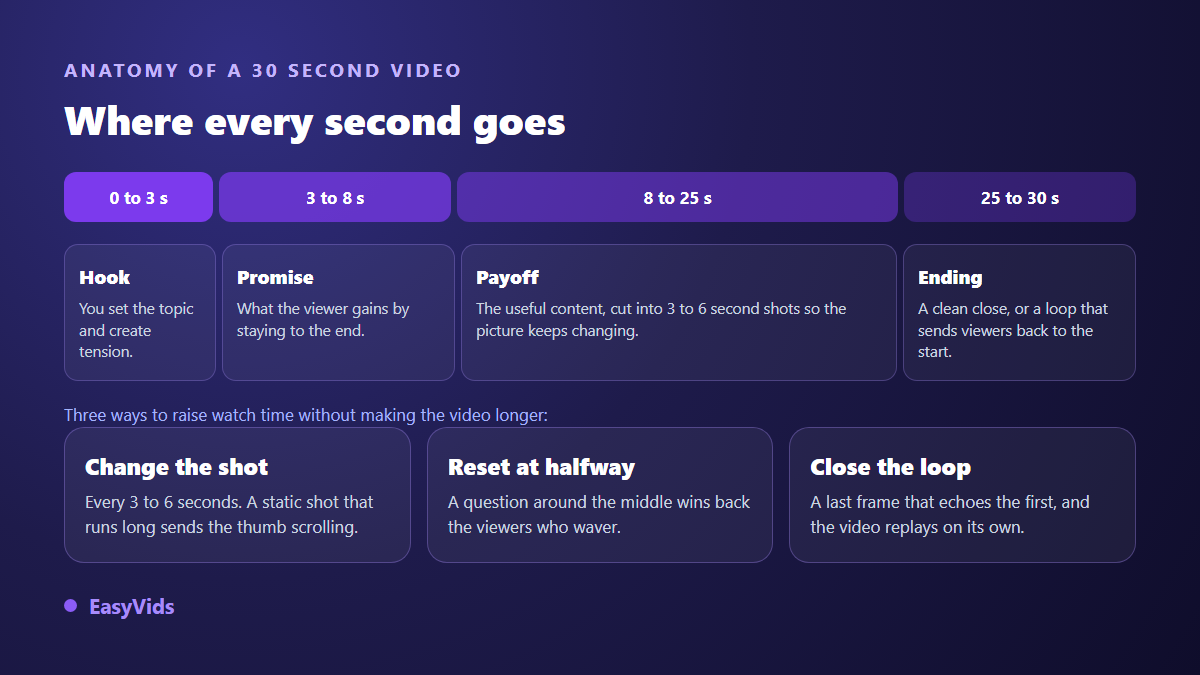
The most neglected stretch runs from second 8 to second 25. That is where the image has to keep changing, otherwise attention drops even when the words stay interesting. Change shot every 3 to 6 seconds. On a video written before it is shot, that cutting is prepared in the text itself, as our method for turning a written idea into a TikTok video explains.
Monetisation: why the one minute bar matters
According to the Creator Rewards Program pages published by TikTok in its help centre and Creator Academy, only videos longer than one minute can earn rewards under that programme. The platform adds further conditions: original, high quality content, a minimum number of views on the For You feed, and the exclusion of Duets, Stitches and photo posts. Access to the programme itself depends on follower and recent view thresholds that vary by country and get revised. Check the official page before building a strategy on top of it.
That one minute bar has a well known side effect: it pushes creators to stretch videos that worked fine at thirty seconds. Analytics show the damage immediately, with average watch time collapsing. If you target the programme, change format rather than pad: move to storytelling, detailed tutorials, deep dives. A dense minute gets watched. A minute of introductions and thank yous does not.
Making a video longer without losing the viewer
Going from thirty seconds to two minutes is not about talking longer. It is about adding reasons to stay, spread across the timeline. Here are the mistakes that sink watch time, in the order we meet them most often.
- An intro that announces the content instead of starting it: enter the subject in the first second.
- A static shot that lasts twenty seconds: even a slow push in or a reframe revives attention.
- No mid video reset: a question asked halfway buys back the undecided.
- On screen text nobody can read on a small display: large, contrasted, short, and clear of the interface buttons.
- No captions, when a large share of the audience watches with the sound off.
- An ending that lingers: cut the closing pleasantries, they only cost you completion rate.
Captions deserve a special mention on longer formats, where the odds of a noisy or muted viewing environment go up. Our guide to automatic captions covers generating, fixing and burning them in cleanly.
Producing calibrated videos with AI
Generating a video at the right ratio and the right length removes both cropping and rushed trimming. In the EasyVids studio, short generation is configured before launch: you pick the 9:16 ratio, the duration in seconds among those the model accepts, then the resolution. Current video models output shots of a few seconds, typically between 4 and 15 depending on the model. A thirty second video is therefore never a single clip: it is a sequence of shots assembled together, which happens to be exactly what TikTok pacing demands.
For longer formats the principle scales up. The Director splits your text into scenes, every scene gets its visual and its voice, and each shot follows the length of its narration unless you force a manual duration. The chosen ratio stays locked from the first scene to the export, so a vertical production never comes out in landscape. The wider chain is described in our AI video generator guide, and the tools all live in the EasyVids studio.
Then comes fine editing. The online editor splits a shot in two, trims the opening, adds animated text and generates captions before exporting to MP4. That is where the last seconds are won: deleting a dead beat at the start often moves completion rate more than an hour of visual polish.
Reusing one video across TikTok, Reels and Shorts
The three platforms share the vertical format, but not the durations. A 34 second video travels everywhere untouched, which makes it the most economical length when you publish on all three. Past one minute the rules diverge and the edit has to be rethought rather than trimmed. Our production routine for short form is detailed in our guide to AI generated YouTube Shorts, and it transfers almost unchanged to TikTok.
Frequently asked questions
What is the maximum length of a TikTok video?
Ten minutes when recorded inside the app, and the same ceiling for uploads on the vast majority of accounts. TikTok has confirmed testing uploads of up to 60 minutes with a limited group, with no commitment to a general rollout. The safest check is to try a long upload from your own account.
What is the best TikTok video length?
Between 21 and 34 seconds for a video meant to convince, the window TikTok for Business highlights in its creative best practices. For entertainment content chasing views, drop to 7 to 15 seconds. Either way, watch the average watch time in your analytics rather than the length itself.
Do videos have to exceed one minute to earn money?
For the Creator Rewards Program, yes: TikTok states that only videos longer than one minute are eligible, alongside other quality and view conditions. Other revenue streams, such as brand deals or selling your own products, carry no minimum length at all.
Why does TikTok cut my video when I post it?
Two usual causes. Either the file exceeds the ceiling your account allows, so the app trims or refuses it. Or the built in editor applied an automatic cut during import. Check the source file duration before uploading, and avoid running an already edited video back through the TikTok timeline.
Are short videos penalised by TikTok?
No, no duration is penalised as such. A very short video is simply harder to make work, because it leaves little room for anything memorable. It compensates through automatic replay: if viewers watch it twice or three times, cumulative watch time becomes excellent.
The right way to approach TikTok video length is to start from the goal, not from the ceiling. Write for the length you target, cut often, and let your analytics settle the argument between two formats instead of your instinct. To produce calibrated vertical videos scene by scene, with nothing to install, creating an account opens the full studio.