You export a vertical video, upload it, and YouTube files it in the regular feed instead of the Shorts feed. Or the opposite: you cut at 58 seconds out of caution, when the platform has allowed far more for a while now. YouTube Shorts length has a short, official, dated answer. The trouble is that half the pages still online quote a ceiling that was retired more than a year ago.
The question deserves better than a number with no context, because the technical limit says nothing about the duration that works. A Short can run three minutes and lose its audience by second twelve. This page gives both answers: the limit the platform actually enforces, and the length to aim for depending on what you are telling. If you also need dimensions and ratios for other networks, our reference sheet on video formats platform by platform gathers them in one place.
The exact limit, in one line
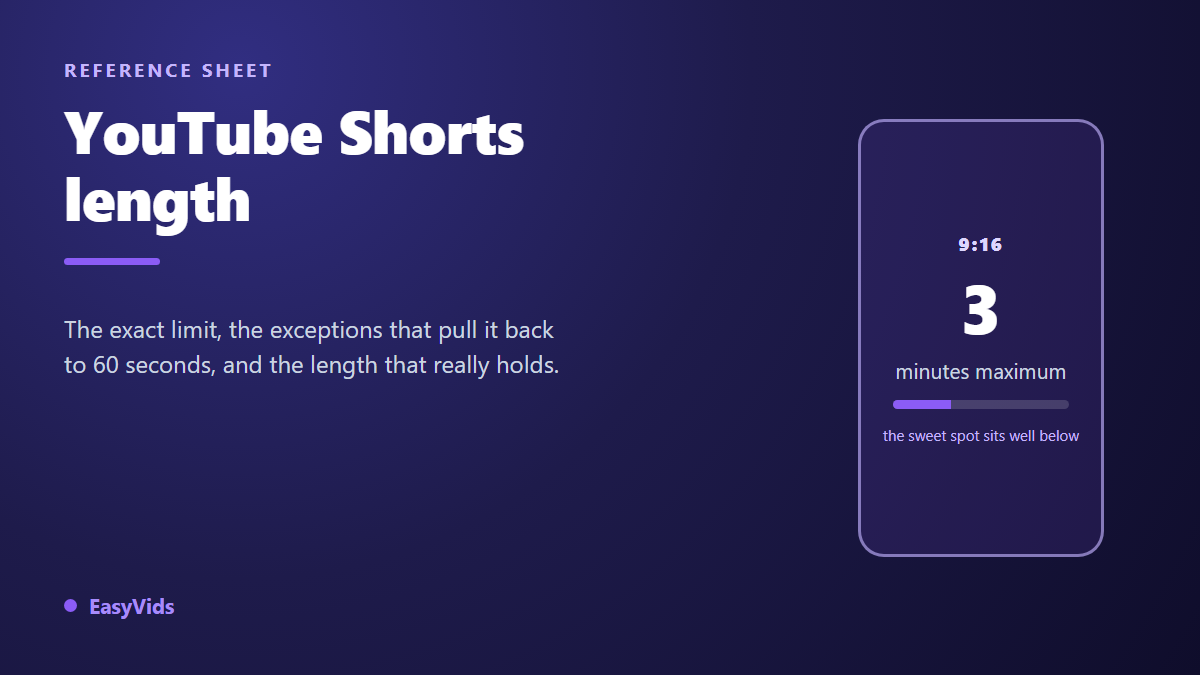
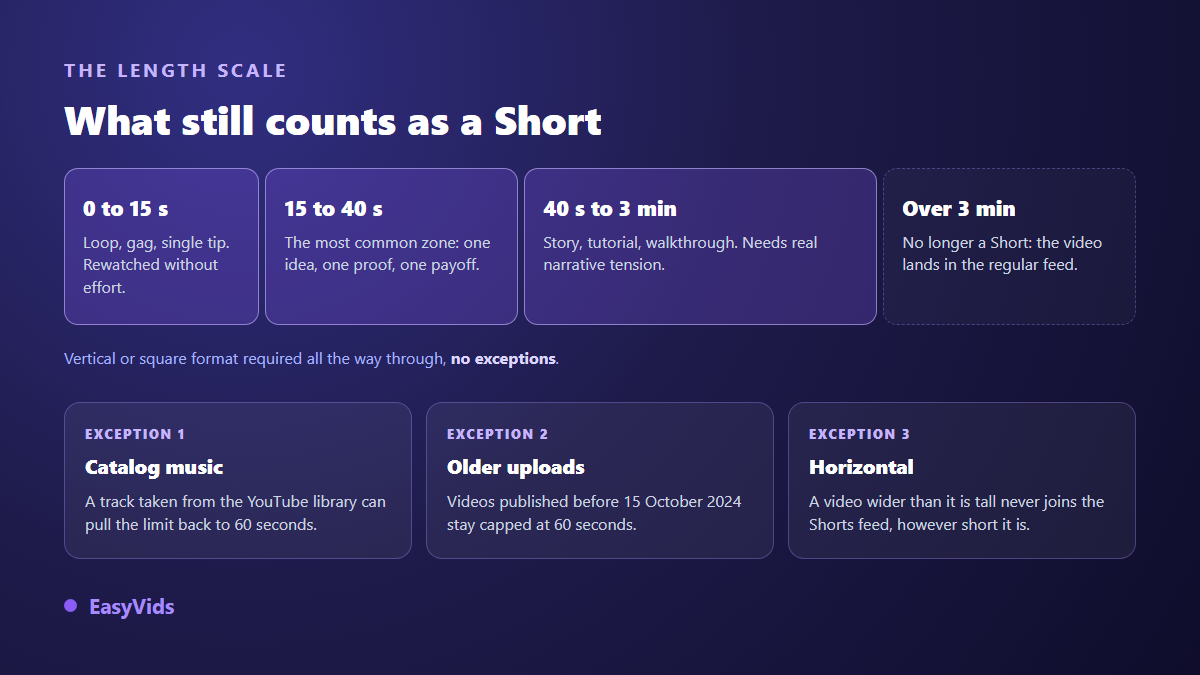
A YouTube Short runs 3 minutes at most. According to YouTube's help centre, a video joins the Shorts feed if it is vertical or square and does not exceed that duration. The ceiling used to be 60 seconds: YouTube raised it to 3 minutes on 15 October 2024, and its documentation states that videos uploaded before that switch keep the old limit. One second past 3 minutes and your file becomes a regular video, with a completely different distribution.
What YouTube checks before filing a video as a Short
Two criteria, not one. Duration first, image shape second. A twenty second clip shot in landscape will never become a Short, however good it looks: the vertical feed only accepts images taller than they are wide, or square. That single confusion explains most cases where a short video ends up in the wrong feed.
Titles, descriptions and hashtags no longer play a part. The Shorts hashtag, long recommended, is not needed for identification any more. The platform relies on what it measures in the file itself, which is good news: nothing to tick, as long as the video respects both criteria from start to finish.
Three situations that bring you back to 60 seconds
The 3 minute limit is the general case, not a guarantee. Three configurations shorten it, and they usually surprise people at upload time rather than during editing.
- Music from the YouTube catalogue. The platform's help centre notes that a Short using a track from its music library can stay capped at 60 seconds. If your project runs longer, bring your own soundtrack.
- Older uploads. Videos published before 15 October 2024 keep the old 60 second ceiling. Re-posting a longer archive hoping it will slide into Shorts does not work.
- Third party tools. Some scheduling apps still apply the previous rule and reject files over one minute. The block comes from the tool, not from YouTube, and disappears if you upload directly.
Three minutes available does not mean three minutes useful
The move to 3 minutes was welcomed as a release. It is mostly a trap for anyone who confuses permission with recommendation. The Shorts feed is consumed with a thumb: every extra second is one more chance for the viewer to swipe away. Stretching a video without reason simply multiplies the exits.
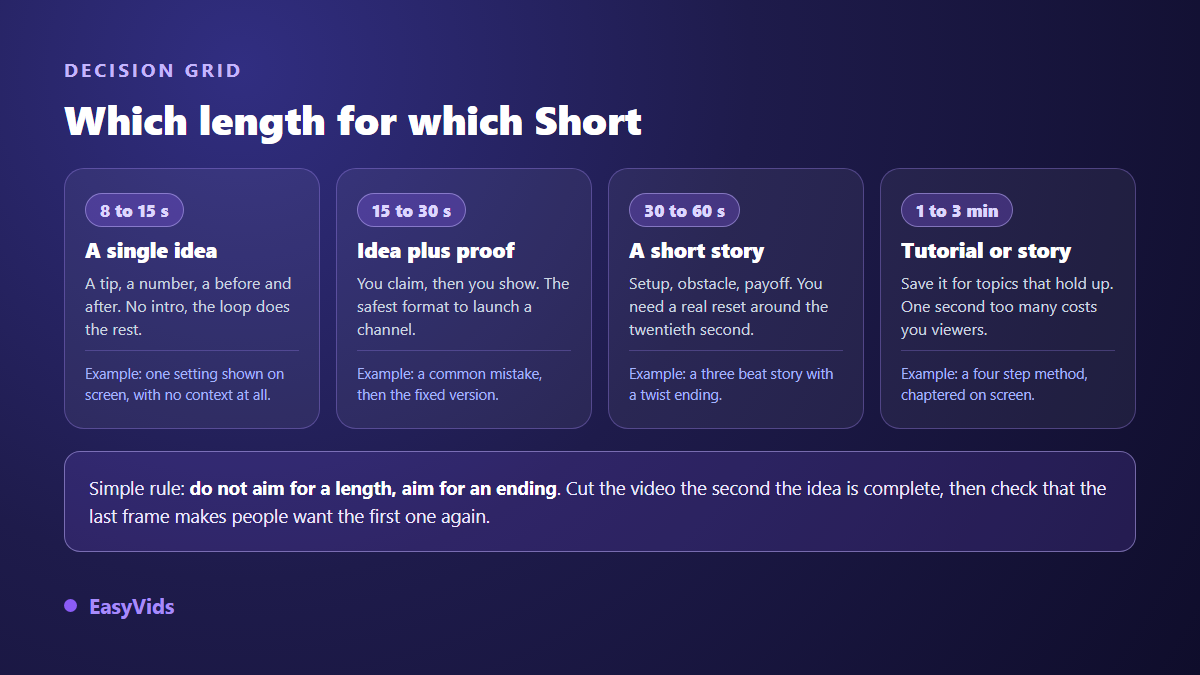
YouTube publishes no ideal duration, and wisely so: the right length depends on the subject, the pace and the audience. What the platform does document is that Shorts are recommended based on what viewers watch, replay and enjoy. Length is never judged in absolute terms, only by what it produces. Fifteen seconds watched three times beats two minutes abandoned a third of the way in.
Decide the length before writing, not after editing
The classic mistake is to shoot or generate first, then trim until it fits. You can hear the result: the pace stutters, the ending lands without a punchline, and the video feels like an excerpt rather than a finished object. Flip the order. Set the target duration, write for it, and let the edit simply assemble. That is the logic behind our method for publishing YouTube Shorts in series, which starts from the calibre rather than the material.
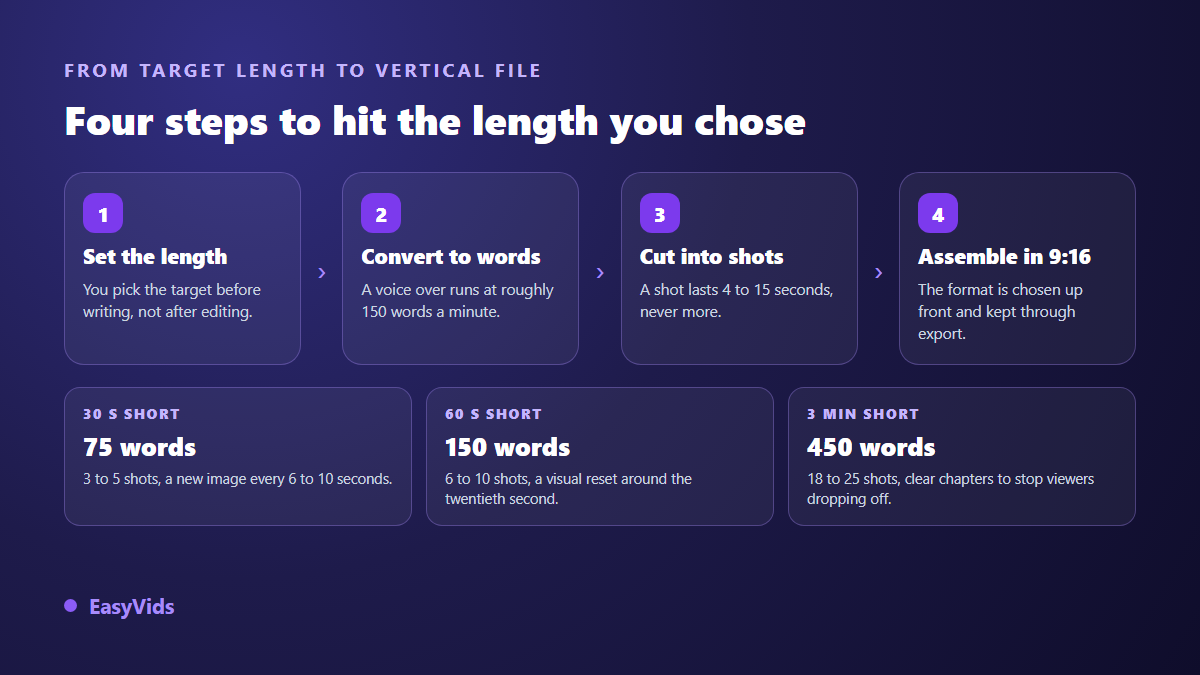
The conversion is easy enough to do in your head. A voice over runs at roughly 150 words per minute, about 2.5 words per second. A 30 second Short therefore fits in 75 words, a 60 second Short in 150 words, a 3 minute Short in 450 words. Write that word count and no more: it is the only reliable way to know, before generating anything, whether your idea fits the format or calls for a long form video.
Building a full Short when a model only renders a few seconds
Here is the part few articles cover. Current video models output short clips: depending on the one you pick, a render lasts 4, 6, 8, 10 or 15 seconds, rarely more. A 45 second Short never comes out of a single call. It comes from chaining several shots, each synced to its fragment of voice over, which is exactly the subject of our guide to going beyond a few second clips.
In our studio that split is automatic: the text is divided into scenes, each scene gets its visual, and assembly locks every shot to the real length of its voice. The rule we apply on vertical productions fits in one line: change the image every 4 to 15 seconds, never let a still shot linger. Pricing details sit on the pricing page, and a free trial is enough to measure how many shots your Short really needs.
Vertical is decided at the start, never at export
A video designed in 16:9 and cropped to 9:16 always loses something: a head cut off, text out of frame, a subject pushed off centre. Pick the format before the first generation and hold it to the export. In our studio, 9:16 is selected when you launch production and carried by every model through to the final file, 1080 pixels wide by 1920 high. Remember too that a large share of the audience watches with the sound off: a 40 second Short with no on screen text loses them in the first second. Our online editor ships a ready made vertical canvas and a captions panel that transcribes the voice automatically.
Measuring the length that works on your channel
No universal duration will replace your own numbers, provided you read the right ones. YouTube changed how Shorts views are counted in March 2025: a view is now recorded as soon as playback starts, while the older, stricter measure became engaged views in YouTube Studio. Judging a duration on the raw view counter no longer means much. Look at engaged views, average view duration and the share of viewers who reach the end.
The protocol takes patience rather than talent.
- Take one subject and produce three versions: around 15 seconds, around 30 seconds, around 60 seconds.
- Publish them days apart, at the same time of day, with the same opening frame.
- Give each one a full week before comparing anything.
- Compare the share of viewers who reach the end, not the raw view count.
- Repeat on three different subjects before drawing a conclusion: one video proves nothing.
What length changes for monetisation
Length opens no special door on the revenue side: Shorts ad revenue sharing works at channel level, not per video. To join the YouTube Partner Programme through the Shorts route, the conditions published by YouTube ask for 1,000 subscribers and 10 million valid public Shorts views over 90 days, as an alternative to the watch hours route. Stretching your videos to hit the threshold faster is a poor bet: views are what count, and they come from retention, not from the clock.
Frequently asked questions
What is the maximum length of a YouTube Short?
Three minutes. That limit has applied since 15 October 2024, when YouTube raised the previous 60 second ceiling. Past three minutes, the video is no longer treated as a Short and moves to the regular feed.
Is a 3 minute Short penalised against a 30 second one?
Not as a rule. YouTube announces no penalty tied to length. In practice a longer video has to hold attention longer to earn the same signal, which is simply harder. A short duration is a convenience, not an obligation.
Why is my vertical video not showing up as a Short?
Three causes cover almost every case: the video runs past 3 minutes, its frame is wider than it is tall despite appearances, or it was uploaded before October 2024 and still carries the old limit. Check the exact dimensions of the exported file, not the preview shown by your editor.
Should every Short have the same length?
No, and a channel that varies learns faster. Keep one constant instead: the promise has to land in the first three seconds, whatever the total duration. That is the regularity that builds an audience, not a uniform runtime.
Can a published Short be made longer?
No. The duration of an uploaded video cannot be changed: the YouTube Studio editor lets you trim a passage, never add material. A longer version means a new upload, which resets the performance history.
The limit is settled, and it fits in one number. The real work starts after: decide the length before writing, turn it into a word count, then into a number of shots, and cut on the second the idea is complete. To apply that without spending your evenings on it, creating an account opens the full studio, from vertical script to 9:16 export. The EasyVids studio brings writing, voice over, visuals and editing together in one place.