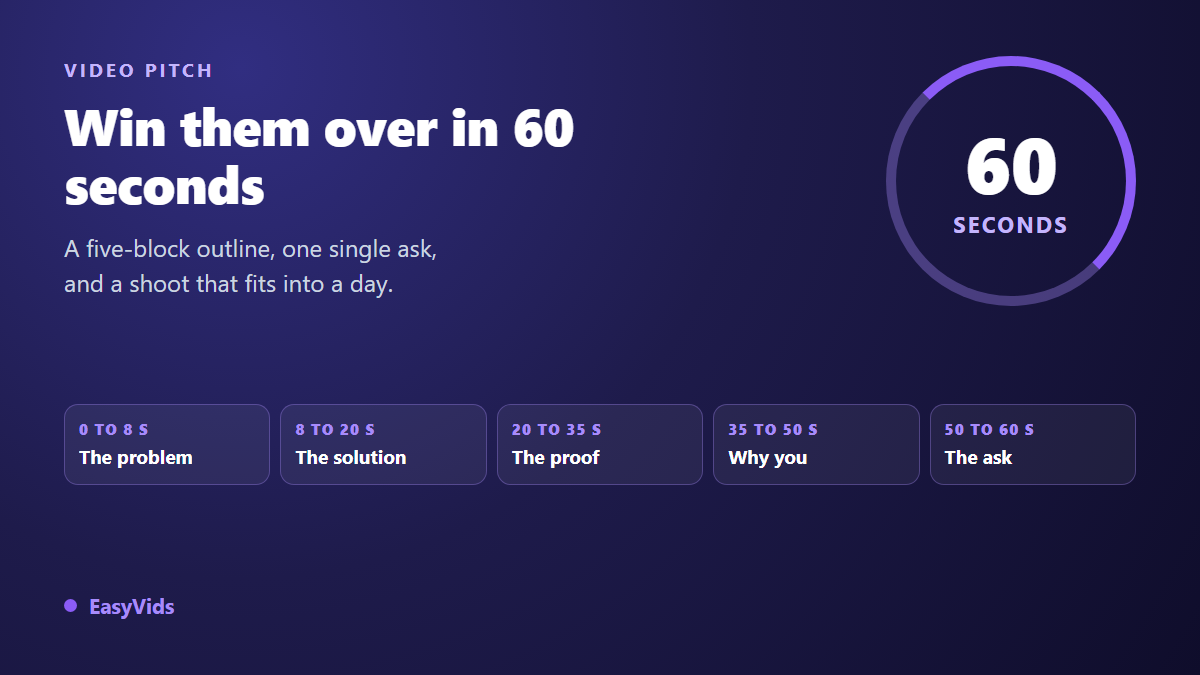
You have sixty seconds to explain what you do. An investor opens your message between two meetings, a prospect taps play on a phone, a competition jury works through a stack of applications. A pitch video is not meant to say everything. It is meant to earn the next step: the call, the demo, the meeting. That single difference in purpose decides everything else.
The gear is almost never the problem. The order of the information is, along with the length of your sentences and the number of things you ask for at the end. A phone recording with sharp writing beats a polished film that opens on the year your company was founded. This guide gives the structure second by second, the mistakes that come back most often, and a way to build the file without a crew, extending our complete guide to AI video generators to one very specific format.
The short answer
A pitch video that lands runs on five blocks with no decorative transitions: the problem in eight seconds, what you do in twelve, proof in fifteen, your difference in fifteen, and one single ask over the last ten. Budget roughly 150 words of voice over for the whole minute, one idea per sentence, one visual per idea. Anything that does not serve that progression leaves the edit, starting with the animated logo.
Why one minute instead of three
Length is not a matter of taste here, it follows from how the video gets watched. Your pitch is almost always played in stolen time: an inbox being cleared, a feed scrolled standing up, a pile of applications being sorted. Nobody sits down for you. One minute is what a stranger grants before deciding whether to keep going.
The constraint helps. It forces you to pick one strong idea, where a three minute video lets you line up five that nobody remembers. The underlying rule is the same as in any well built video script: viewers keep one thing, and that thing is chosen while writing, never in the edit.
If your subject genuinely needs more room, ship two files. A one minute pitch that opens the door, and a longer demo you send to whoever asks. Merging them loses the first audience without satisfying the second.
The five block structure that fits in a minute
This structure is not borrowed from a rhetoric textbook. It follows how a non captive viewer processes information: first what this is about, then whether it is credible, finally what you want from them. The order matters more than what fills each block.
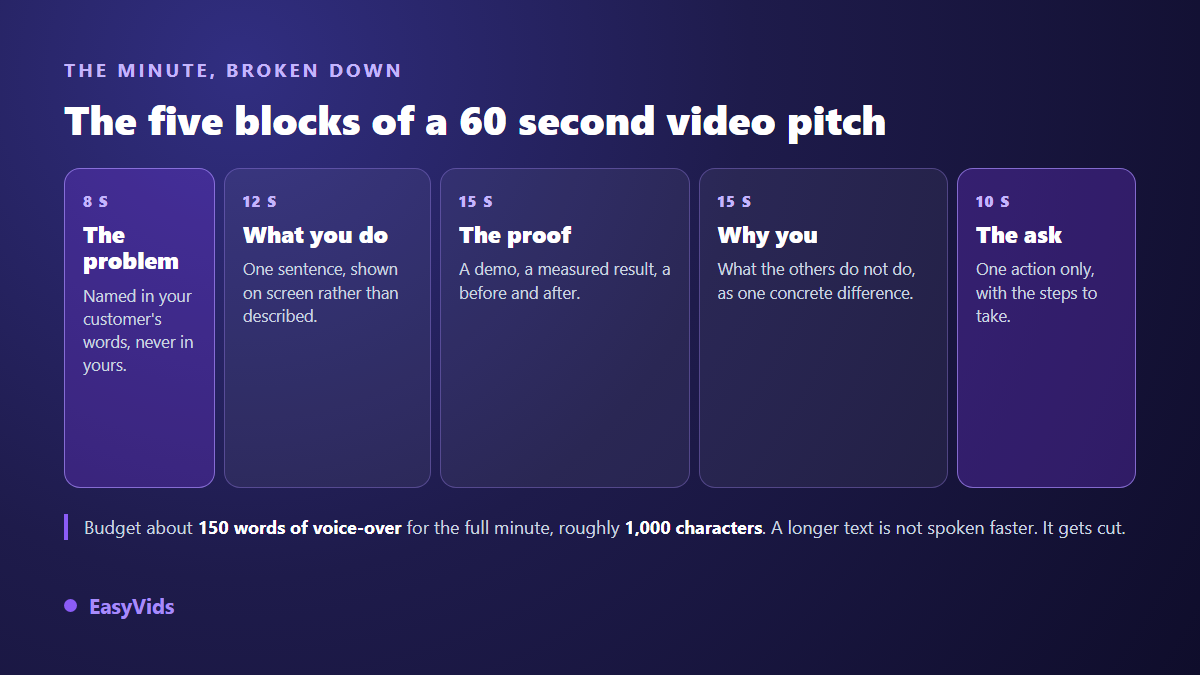
- 0 to 8 seconds, the problem. A concrete situation your viewer recognises, said in their words. « Your drivers spend the morning hunting for addresses » beats « logistics optimisation is a major challenge ».
- 8 to 20 seconds, what you do. One sentence, never two. The benefit before the product name, and shown on screen rather than described.
- 20 to 35 seconds, the proof. A demo, a measured result, a before and after. This is the block people skip out of modesty, and the one that decides the outcome.
- 35 to 50 seconds, why you. One single difference, framed as a deliberate choice: what you do differently, and what the usual way costs.
- 50 to 60 seconds, the ask. One action, with the exact next step: reply to this message, book a slot, try the demo.
The timings are not sacred, the proportions are. If your problem takes twenty seconds, you started too far upstream. If your proof fits in five, you probably do not have proof yet, which is useful to learn before recording anything.
The first ten seconds decide the rest
A pitch is lost at the start, not at the end. Those opening seconds answer one silent question: does this concern me? Until the answer is obvious, the viewer is not listening, they are looking for a reason to leave. That is why the opening never describes your company. It describes the situation of the person watching.
There is a simple test. Read your first sentence to someone in your target audience and watch their face. A nod means you found the right problem. A puzzled look means you opened on your solution before stating the question it answers.
Write for the ear, not for a slide
Most weak pitches are excellent written summaries read out loud. Those are two different crafts. A sentence written for the eye tolerates clauses, asides and acronyms. The same sentence spoken aloud turns into mush the ear gives up on after ten words.
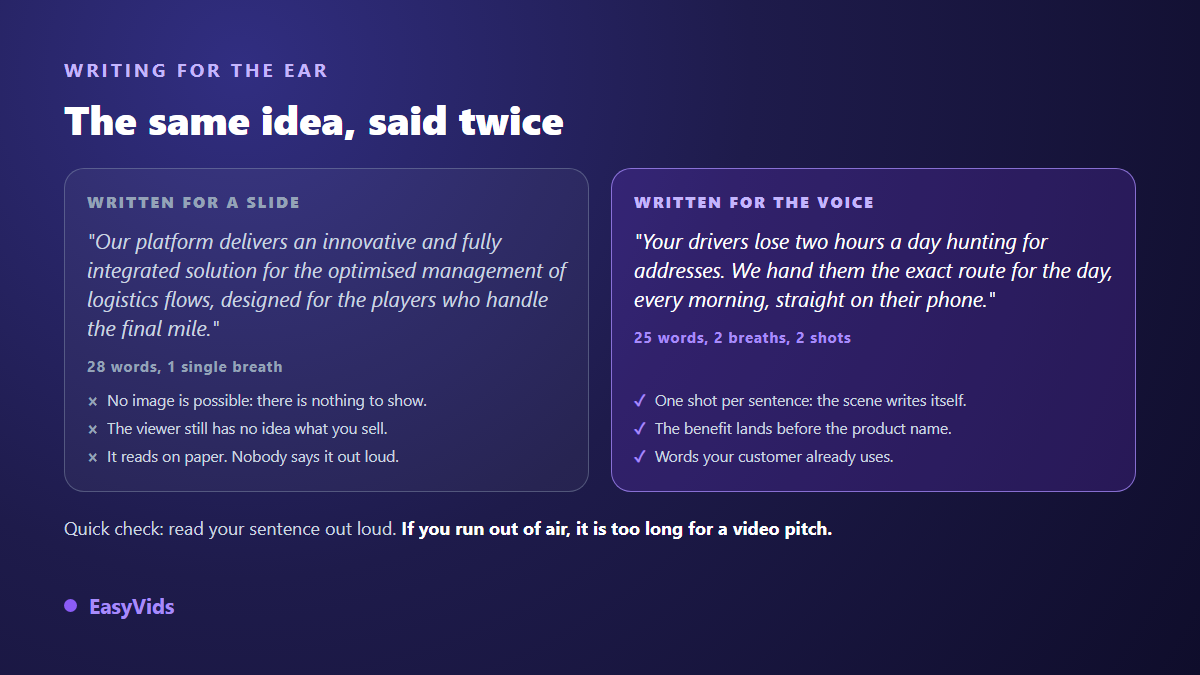
Three moves fix it. Write the text, read it aloud with a timer, then cut everything that left you short of breath. Replace every piece of jargon with the word your customer actually uses. Finally check that one sentence carries one idea, which makes the shot list write itself.
The length benchmark is stable: one minute of voice over is roughly 150 words, or about 1 000 characters. If your draft runs 260 words, you do not have a one minute pitch, you have a two minute pitch you are about to rush. Cut the text, never the delivery.
Where the pitch gets watched, and what that changes
The same content is not edited the same way depending on where it lands. A file attached to a deck or played on a laptop stays comfortable in landscape. A pitch posted in a feed read on a phone earns its place by filling the vertical screen. Sizes, ratios and useful durations per platform are covered in our guide to video formats, and the choice is made before writing, not after.
Two practical consequences. The first frame works as a cover: it must be understandable frozen, with no sound and no context. And a share of your audience plays the video muted, out of habit or courtesy. A pitch without captions loses them before your second sentence.
Show instead of describing, then decide whether you appear
A pitch video has exactly one advantage over a written paragraph: it shows. Every time you describe something visible, you waste that advantage. The product on screen, the interface responding, the customer gesture, the result next to the situation it replaced: each of those shots is worth three adjectives.
Should you appear yourself? When the person is part of the offer, yes: consultants, trainers and craftspeople also sell a presence. When the product does the work, a face adds nothing and adds a shooting constraint. Voice over on demo shots is enough, and it can be redone in minutes the day your argument changes. The trade offs of presenting to camera, with or without a shoot, are covered in our guide to AI avatars and UGC style videos.
One caution if you hand the presentation to a realistic synthetic presenter: disclosure is expected at upload. According to the YouTube help centre, realistic content generated or modified by artificial intelligence must be flagged in the video settings when you publish. The rule targets material that could pass for a real recording, not obviously stylised animation.
From structure to file: building the pitch without a shoot
Once the text is locked, production becomes mechanical. The script is cut into scenes of five to eight seconds, each scene gets its visual, the voice over is generated, then every shot is trimmed to the real duration of its audio. That is the path described in our article on turning a finished script into an edited video, applied to a short format.
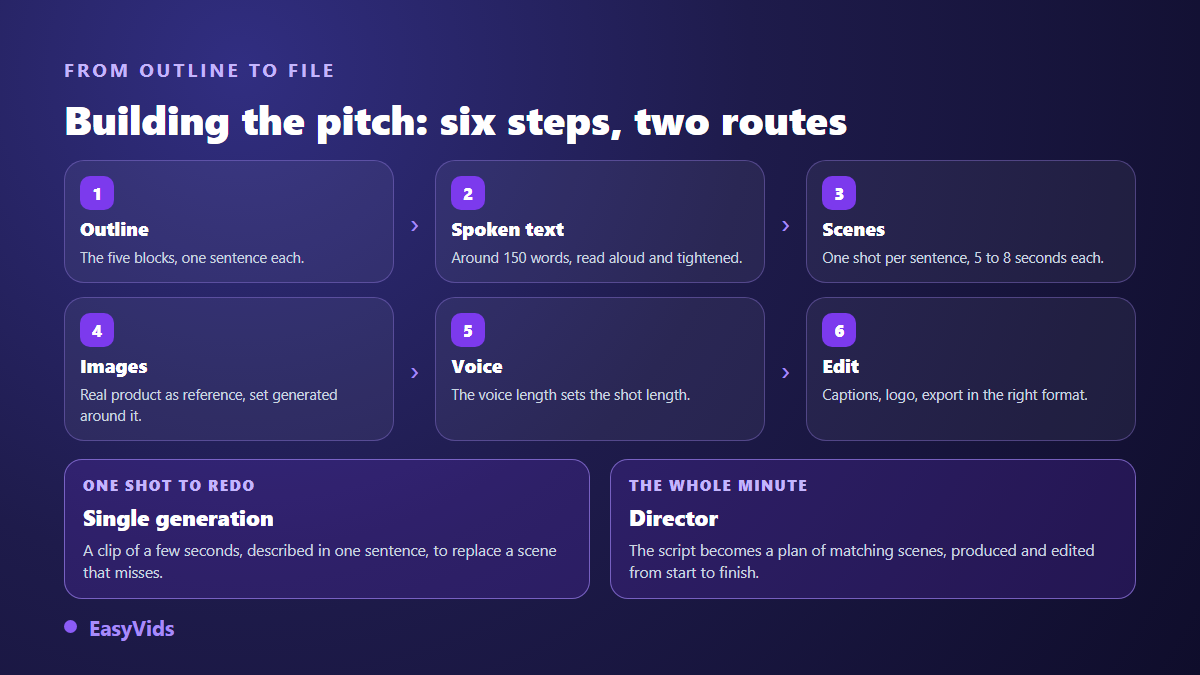
Inside EasyVids there are two routes. Single clip generation turns one sentence into a few seconds of video, which is what you want when one shot misses. The Director reads your whole script and turns it into a plan of consistent scenes: same characters, same sets, same aspect ratio from start to finish, with 16:9, 9:16 or 1:1 chosen upfront and an adjustable target duration per scene. If you sell a physical product, its real photos join the project as references, never redrawn, so the scenes match what the customer will receive. Plans are listed on our pricing page.
Plan a correction pass. In our own generations the same shots tend to fail: a face that drifts between scenes, on screen text that cannot be read, a camera move too fast for a two second shot. Regenerating one scene costs far less than relaunching everything, and a one minute pitch rarely holds more than ten scenes.
Voice, captions and silence
Voice carries half the perceived quality. A commercial pitch wants a confident but calm delivery, no advertising emphasis, with breaths where you would have breathed. The settings that separate a flat read from a persuasive one are covered in our piece on commercial voice over. Punctuation matters as much as wording: a full stop where you would have paused beats a comma.
Captions are not a comfort feature on this format. They allow muted playback, help viewers who do not share your language, and hold the eye on the screen. The EasyVids editor transcribes the audio of a video into a subtitle file, which you correct line by line before burning it in.
Music is more debatable. A bed supports an emotional pitch and gets in the way of a technical one where every word counts. When in doubt, keep the silence: it puts attention back on the voice, and no pitch was ever criticised for being too clear.
End with one ask, and only one
The ending is where most pitches sink. After fifty seconds of demonstration, the author asks viewers to book a call, subscribe to a newsletter and share the video. Three asks equal none: the viewer opts out of all of them. State one action, use a verb, and give the exact next step. Our collection of call to action formulas offers wording that earns a gesture without begging.
Mistakes that make viewers leave
- Opening on company history. Nobody knows you yet, so nobody cares when you were founded.
- Starting with a full screen animated logo. You spend your most expensive seconds on information the viewer already has.
- Stacking final asks. Book a call, subscribe and share means the viewer does none of the three.
- Using internal vocabulary. Your trade words reassure your team and lose everyone else.
- Describing a product nobody ever sees. A minute of abstract stock shots proves nothing.
- Reading text written for the eye. Asides and acronyms do not survive being spoken aloud.
- Publishing without captions. Part of your audience watches muted and leaves before sentence two.
One more mistake deserves its own line because it hides so well: shooting a perfect pitch and never updating it. Arguments age, offers change, features disappear. A pitch built from an editable script is refreshed in one pass, which is not true of a shooting day.
Frequently asked questions
How long should a pitch video be?
Between 45 and 90 seconds depending on how complex the offer is. Below 45 seconds the proof is missing and the pitch reads as an ad. Above 90 you leave the pitch register for the presentation register, and lose half the audience before your ask. One minute stays the safest benchmark for a first contact.
Do I need to show my face in a pitch video?
Only when you are part of what you sell, as in consulting, training or craft work. When the product does the work, voice over on demo shots convinces just as well, corrects faster and depends on nobody's availability for a shoot.
Can I make a pitch video without filming anything?
Yes, as long as you have something to show. Real product photos, interface captures or documents act as references, and the scenes are generated around them. Voice over, editing and captions come after. The only case where filming still wins is a gesture or a place that cannot be reconstructed faithfully.
Which aspect ratio should I use for a pitch sent by message?
Landscape suits a file attached to a deck or played on a laptop. Vertical is the right call for a social feed read on a phone. Square is an acceptable compromise everywhere and excellent nowhere. Decide before writing, because framing depends on it.
How long does it take to produce a pitch video?
Writing takes most of the time: allow half a day to find the right problem, the right proof and the right ask. Production is a matter of tens of minutes once the text is locked, since scene breakdown, visuals, voice and edit run in sequence on their own. Later versions cost even less, because only the text changes.
Take your current pitch and run one test: mute it, watch the first ten seconds, and ask whether a stranger can tell who you are talking to. If the answer is no, the five block structure gives you everything you need to rewrite it tonight. Once the text holds, the video follows fast: create your EasyVids account and turn your script into a pitch that is edited, captioned and exported in the format you need.