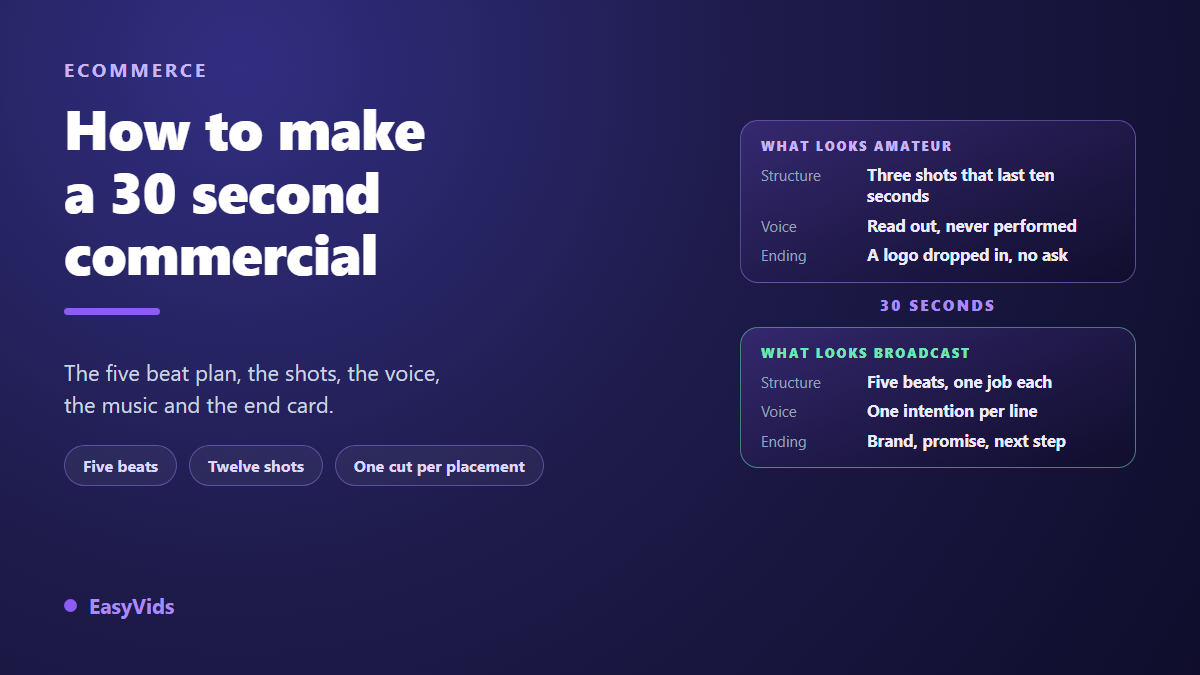
A 30 second commercial is the most demanding format there is. You get half a minute to set up a problem, show a product, give a reason to believe and ask for an action. Every second wasted at the start is a second stolen from the end, where your brand name lives. That is why most home made ads look like slideshows: they fill their 30 seconds instead of dividing them.
The good news is that broadcast quality does not come from the camera or from the budget. It comes from a structure, a cutting rhythm and the way sound is handled. All three can be learned in one read and reproduced with AI generation tools, with no set, no crew and no shoot. Here is the full method, from the five beat plan to the end card, plus the mistakes that give an amateur away in three seconds.
The short answer: what makes a 30 second spot credible
A commercial that holds up is built in five beats (hook, tension, proof, payoff, brand), cut into ten to fourteen shots of two to three seconds, carried by a voice that plays a different intention in every line, and closed by four seconds of branding with one single ask. The export format follows the placement, never the reverse. If you are starting from nothing, our walkthrough on building a video ad from idea to exported file covers the production chain; this article covers the craft that makes the result watchable.
The five beat plan, the backbone of the spot
Thirty seconds are not filled, they are divided. Five beats, five different jobs, a target length for each. The pattern comes from broadcast advertising and still works in a social feed, because it follows the order in which a viewer accepts information: first a reason to stay, then a reason to listen, finally a reason to act.
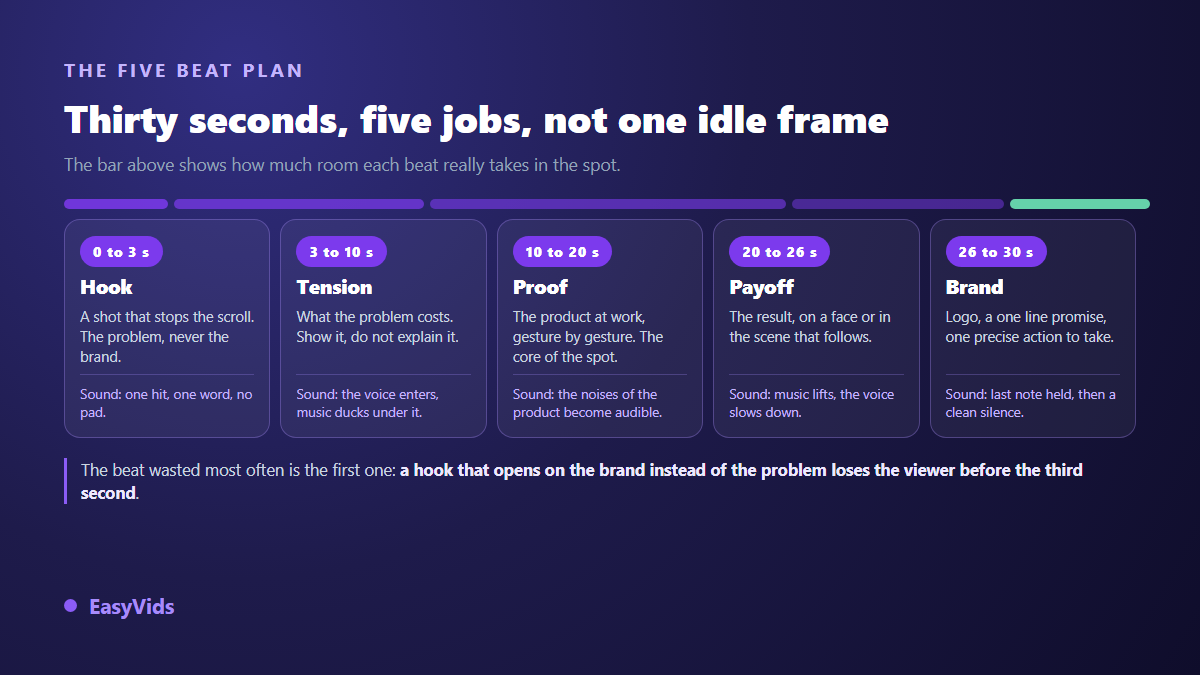
The worst treated beat is the first one. Plenty of spots open on a logo, an establishing shot of a building or a welcome line. Those three seconds say nothing and cost a tenth of the total. Open on the problem instead: a hand fighting with packaging, a screen showing an error, a room in a mess. The viewer recognises the situation before realising this is an ad, which is exactly the effect you want.
The last beat allows no improvisation: four seconds, a logo, a promise line, one single ask. Two asks in the same ending cancel each other out.
Writing 30 seconds: count in seconds, not in lines
An ad script is measured by ear. On our own generations, a steady voice over runs at roughly 150 words per minute, which leaves 65 to 75 words for 30 seconds, pauses included. Write 90 and the voice speeds up until the spot sounds like a station announcement. Ready made ad templates are a good starting point, and our set of advertising scripts for TikTok and Facebook covers that side of the work; here we assume the copy exists and we turn it into pictures.
One proofreading habit beats every writing tip: read the script out loud with a stopwatch. If you go past 28 seconds, cut words, never pauses. Pauses are precisely what separates a brand voice from an automated message.
Choosing shots: four values, one job each
A shot is not a picture, it is a framing decision. Four values are enough to cover 30 seconds, and each does a job the others cannot. The wide shot places, the close shot makes you feel, the detail shot proves, the product shot fixes the object in memory.
The usual mistake is stacking wide shots because they show everything. They show nothing: at phone size a wide shot turns to mush. Allow one or two wides at most, placed early to set the scene, and give the rest to tighter values. Proof always happens in detail: the weave of a fabric, the click of a clasp, the movement of a hand.
Rhythm: twelve shots rather than four
The clearest difference between a professional spot and a home made one is the number of cuts. A 30 second broadcast commercial commonly holds ten to fourteen shots. An amateur one holds three or four, each stretched over seven or eight seconds, because shot length was decided by the footage available and not by the story.
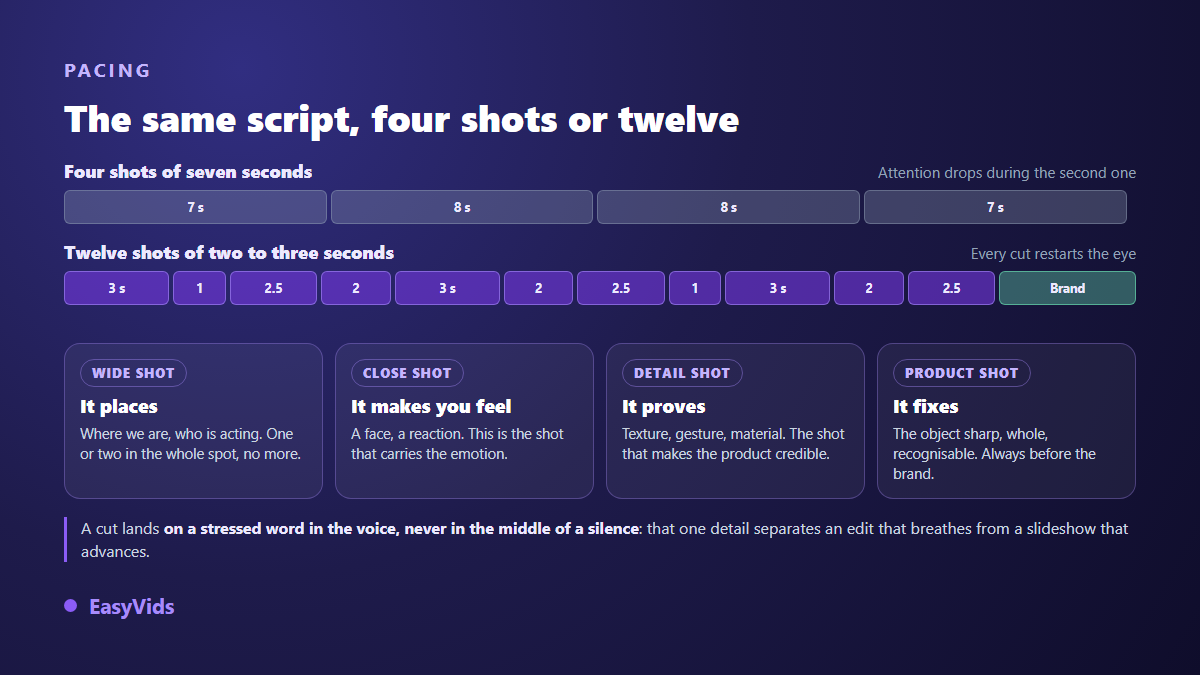
The working rule fits in a line: no shot runs past four seconds except the last one. A shot that stops adding information after two seconds should end at two seconds. On our production chain the automatic split settles around six seconds for narrative video; for an ad you deliberately go below that and accept generating more shots, each shorter.
Frame rate matters too. A commercial made for television runs at 25 or 30 frames per second, a film look at 24. If your generated shots and your filmed shots do not share a cadence, the eye notices without being able to name it; our breakdown of choosing between 24, 30 and 60 frames per second explains what to pick and why never to mix them in one edit.
Voice: one intention per line
An ad voice does not narrate, it sells. The difference is intention: every line carries a precise emotion, and that emotion changes from line to line. The opening line lands with surprise or irritation, the proof line with calm authority, the last one with clear warmth. A voice that keeps one colour for 30 seconds sounds like an airport announcement, however good the audio quality.
You steer it in the copy, not with a slider. A comma is a breath, a full stop is a halt, an ellipsis is a wait. With a synthetic voice, punctuation is your direction: it decides the real length of every shot. We devoted a full article to the tone that sells in fifteen seconds on an advertising voice over, and it picks up exactly where this section stops.
Music: it carries the spot, it never covers it
Ad music has three moments: it sets the scene, it ducks under the voice, it rises again at the end. That movement is called ducking, and a professional editor does it without thinking. Without it the voice fights the instruments and the viewer turns the sound down instead of listening. Pick a track whose structure matches the five beats, with a turn around the tenth second and a clean resolution at the end. Many brands go further and sign their ending with three recognisable notes, a job we cover in our method for creating a brand jingle.
Loudness deserves a minute of thought. Recommendation R 128 from the European Broadcasting Union sets the broadcast reference level at -23 LUFS, and online platforms apply their own normalisation on playback. The practical consequence: crushing your mix will not make the spot louder, only more tiring. Keep some dynamic range and your final beat will hit harder.
Logo and end card: the last four seconds
The end of a spot is a page, not a shot. It holds four elements at most: the logo, a promise line, the action to take, and any legal notice your sector requires. Beyond that nobody reads. Hold that page for at least three seconds: enough to read one short line, plus the time to decide. The ask must be precise and single. A phrase like available in our store asks for nothing, while order before Sunday or try it free asks for something. In paid media, the wording on screen should match the platform button, otherwise you create hesitation at the exact moment you request the click.
On mandatory disclaimers, the rule depends on the country of broadcast and deserves a check. European directive 2005/29/EC on unfair commercial practices forbids any misleading claim in a commercial communication, and national consumer law repeats that ban. In practice, a promised result, an announced discount or an offer deadline must be accurate and provable. Food, credit, health and gambling carry their own extra obligations almost everywhere.
The placement decides the format
A spot does not have one format, it has four. The same story is re exported in 16:9 for television and YouTube, in 4:5 for the Facebook and Instagram feed, in 9:16 for Reels, Shorts and TikTok. These are not simple crops: shot composition changes, and so does length.
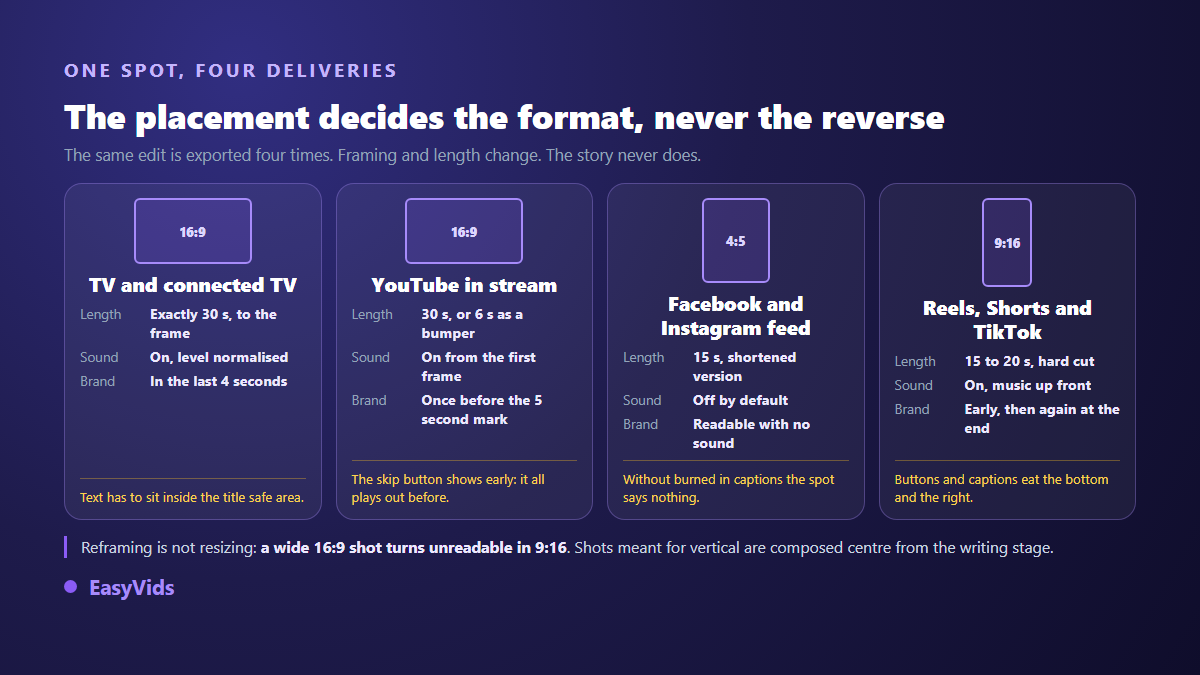
Two constraints are worth knowing before you write. According to the Google Ads help centre, a bumper video ad is capped at six seconds and cannot be skipped, while a skippable in stream ad shows the skip button after five seconds of playback, so your brand has to exist once very early. According to the Meta advertising specifications guide, feed videos play with the sound off by default, which makes burned in captions mandatory rather than optional. The anatomy of a creative built for both constraints sits in our breakdown of a Facebook ad that converts.
The mistakes that look amateur
These flaws are spotted within three seconds, often before the first line has been heard. None of them is about image quality.
- Opening on the logo. Nobody stays for a brand they do not know yet. Open on the problem, bring the brand at the end.
- Seven second shots. Go down to two or three seconds and generate more shots instead of stretching the ones you have.
- Music level with the voice. Duck the music under the voice and lift it between lines.
- On screen text set too small. An ad is watched on a phone: three to six words per card, large and contrasted.
- A fade to black between every shot. Fades slow things down. The hard cut is the default transition in advertising.
- Two asks in the ending. One action only, written with an imperative verb.
- One export for every platform. A 16:9 file dropped into a vertical feed leaves two black bars that scream amateur.
- No captions at all. Part of your audience will never turn the sound on, and they will not come back to do it.
One last habit pays off: watch the spot with no sound, then listen to it with your eyes closed. If it works both ways, it will work anywhere.
Making the spot with no set and no crew
The whole chain fits in one tool. You start from the copy, split it into shots with a framing value for each, generate the images or clips, add the voice over, the music and the captions, then export in the formats you target. That is exactly what the AI video creation studio at EasyVids does, with the option to redo a single shot without rebuilding the spot. What really changes against a classic production is not only the delay, it is the number of attempts: when a shot takes minutes, you can test five versions and keep the best one, which no shooting day allows. A free trial is enough for a first complete spot, and the pricing page has the current details if you move to producing in volume.
Frequently asked questions
How many shots should a 30 second commercial have?
Count on ten to fourteen. Below eight the spot drags. Above sixteen it turns unreadable, unless saturation is the effect you want. Average shot length lands around two and a half seconds, with a longer final shot for the brand.
Do I have to remake the spot for every platform?
You do not remake it, you re export it. Story, voice and music stay the same. What changes is the framing of each shot, the position of on screen text, total length and whether captions are burned in. Plan those variants while writing, compose your shots centred, and the re export takes minutes.
Is a synthetic voice good enough for a commercial?
Yes, provided you direct it. Current voices hold 30 seconds of credible read without trouble. What gives a badly used voice away is not its timbre, it is flat punctuation and the lack of changing intention. Write the copy like a score, test two or three voices on the same take, and keep the one with the right age and energy.
Can I use a well known song in my ad?
Not without clearance. Commercial music used in advertising needs the rights holders agreement and a synchronisation licence, and platform content identification systems block or pull flagged videos. Generated music you are allowed to use commercially, or a royalty free track, avoids the issue and fits your edit better.
Should I go with 15 or 30 seconds?
Thirty seconds when you have something to demonstrate, fifteen when the product reads in one shot. Build the 30 second version first: the short one is a tighter edit of it that keeps hook, proof and brand while dropping tension. Never work the other way round, a short spot stretched to 30 seconds is obvious.
A good commercial is not a hardware question, it is an editing question. Five beats, a dozen shots, a voice that acts, music that leaves room for it, and four closing seconds that ask for one thing. Write your 30 seconds tonight, split them into shots with framing values, then start your first production and watch the spot exist before tomorrow.