You sell a product, your targeting is fine, and your Story ads do nothing. Instagram Story ads forgive very little. They take the whole screen, they arrive uninvited, and the gesture that kills them is the same one people use to skip their friends' stories. One thumb tap on the right edge and your ad is gone.
Targeting is rarely the culprit. The problem lives in the video file: a landscape edit cropped in a hurry, a headline sitting right under the call to action button, a hook that only lands on the fourth second. Below you get the exact specs, the useful length, the area you must leave empty and five ad structures you can rebuild today. If commercial video is new to you, our product video guide covers the ground this article assumes.
The short answer
An Instagram Story ad is built in 9:16 full screen, at 1080 x 1920 pixels, delivered as MP4 or MOV. The main message belongs in the middle third of the frame: according to Meta's design recommendations for Stories, keep roughly 14 percent of the height clear at the top and at the bottom, about 250 pixels on each side, because those bands are covered by the account name, the progress bar and the call to action button. Aim for around ten seconds, one idea, and text that reads with the sound off. Then build three variants instead of one polished version.
Why the Story placement behaves unlike anything else
A Story ad slots in between two stories from accounts your customer already follows. Nobody searched for it, nobody clicked it. It appears full screen with no thumbnail, no title, no description. Three practical consequences follow. The opening shot has to make sense on its own. The frame has to be composed vertically from the start, never cropped afterwards. And the sound must never carry information the viewer needs.
The second point is harsher. In a feed, viewers spend effort to leave: they scroll. In Stories, the effort is reversed, they spend it to stay. The default gesture, the one they have repeated for two minutes, is a tap on the right edge. Your ad is not competing with other advertisers, it is competing with a motor habit.
Dimensions, resolution and file format
Meta's ads guide asks for a 9:16 ratio on the Stories placement, with a recommended resolution of 1080 x 1920 pixels, delivered as MP4 or MOV. Those are the only numbers worth memorising. Everything else, maximum file weight and accepted durations, shifts with platform updates: do not copy it from a blog post, ours included, check the official guide before an important campaign.
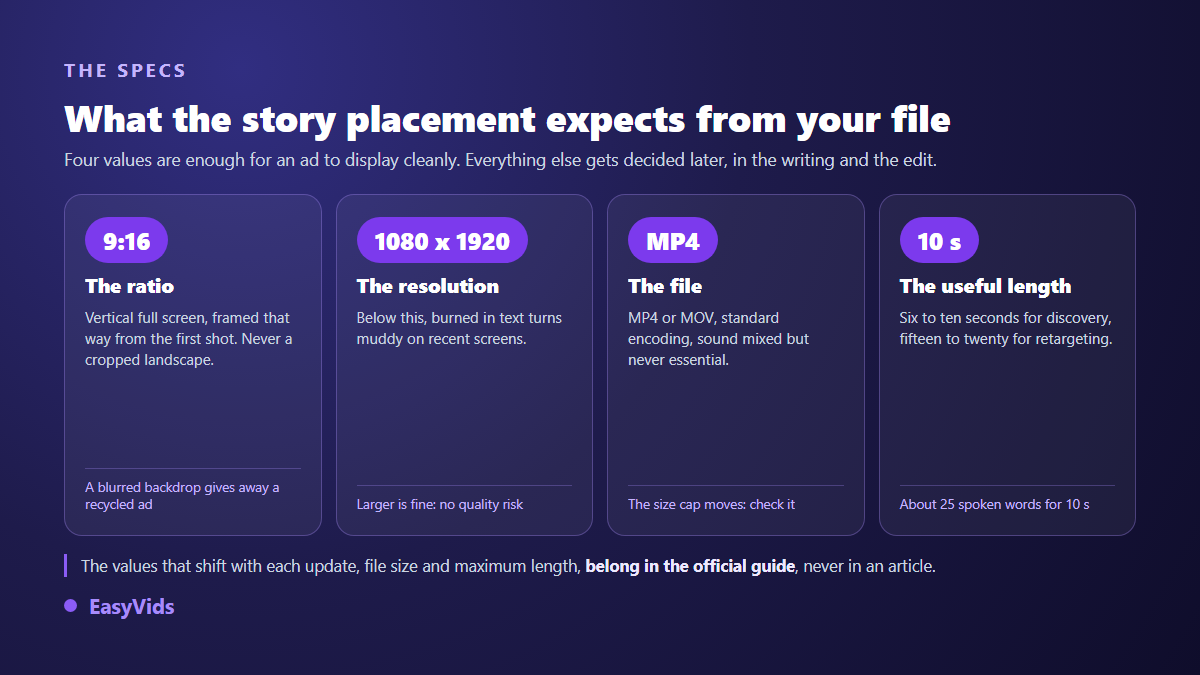
- 9:16 ratio, full screen. A 16:9 clip dropped on a blurred background reads as recycled within half a second.
- 1080 x 1920 resolution: below that, burned in text turns mushy on recent screens.
- MP4 or MOV file, standard encoding, audio mixed but never load bearing.
- Short, large text: one sentence per shot, never a paragraph.
- Captions burned into the image, not a separate file the placement will ignore.
Cropping is the most expensive mistake, because it stays invisible during production and becomes obvious on delivery. A video composed in landscape then pushed to vertical loses its edges, so often the product itself or the hand holding it. Decide the format before the first shot: our breakdown of sizes and ratios per platform lists the values for other placements if you reuse the campaign elsewhere.
The safe zone, the mistake everyone makes once
At the top of the screen, Instagram draws the progress bar, the profile picture, the account name and the sponsored label. At the bottom, the call to action button and the reply field. None of it moves, and all of it sits on top of your image. Meta's design recommendations for Stories put a number on the margin: roughly 14 percent of the height, about 250 pixels, kept clear at the top and at the bottom.
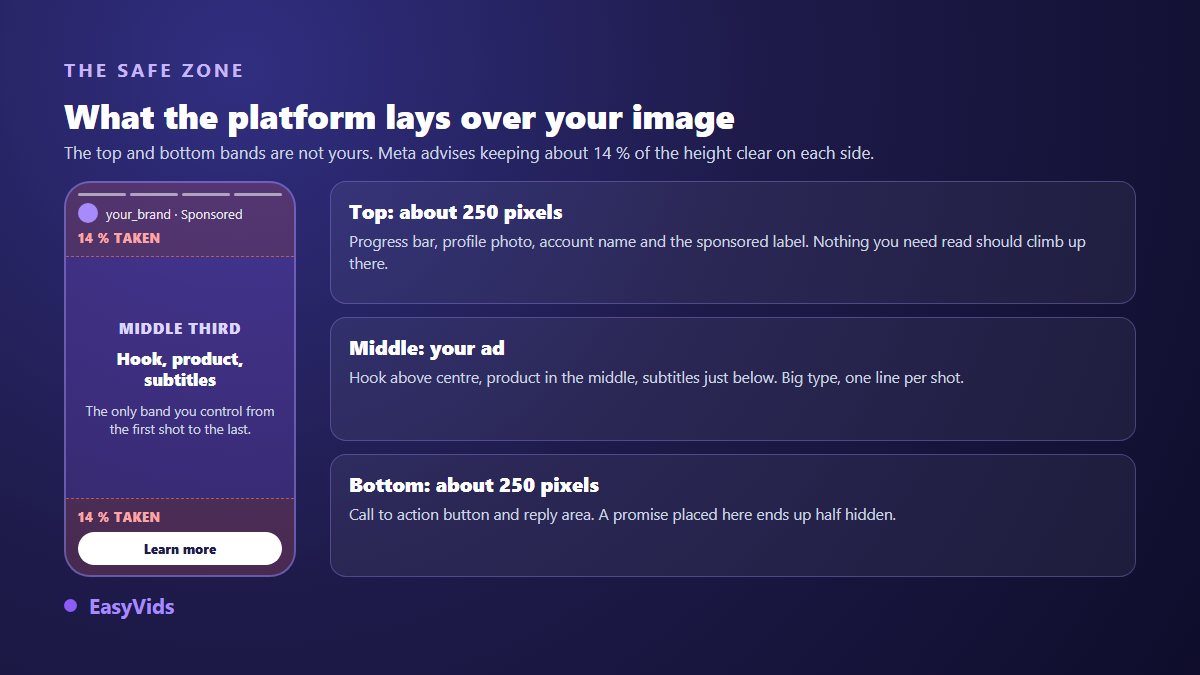
In practice that means one simple thing. Your written hook sits above the middle, your product owns the centre, and nothing readable drops into the bottom fifth. Plenty of ads park their promise right at the bottom out of landscape habit, and that promise ends up half hidden behind the button. Always check the file on a phone before publishing, never on a desktop screen: the proportions there will lie to you.
How long a Story ad should run
Instagram removed the automatic splitting of stories longer than fifteen seconds in 2022: a segment now holds in one piece up to sixty seconds. The maximum accepted on the advertising side depends on the placement and changes with the versions of the creation tool, so check it in Ads Manager rather than in an article.
The real question is not the allowed maximum, it is the point where your audience drops. A prospecting ad, aimed at someone who does not know you, plays out in the first six to ten seconds. A retargeting ad, aimed at someone who already saw the product, can run to fifteen or twenty seconds because the interest already exists. Past that, you only keep attention if the video tells something: a full demonstration, a testimonial, a story of use.
That length is decided before writing, not in the edit. Voice over reads at roughly 150 words per minute, so ten seconds is barely twenty five words, a sentence and a half. Writing straight to the target length avoids trimming later by speeding up the read, which is always audible.
The first three seconds decide the rest
The opening frame must contain the subject, not an introduction. No animated logo, no fade from black, no establishing shot: the product, a face, or the promised result, immediately. A large written hook on top helps, as long as it fits in four or five words. Our library of hooks that stop the scroll transposes directly to the vertical format.
One test separates a good opening from a bad one, and it takes ten seconds. Mute the sound, pause on the first second, and ask someone what this ad sells. If they hesitate, your first second is decorative, which means wasted.
Five Story ad structures that hold up
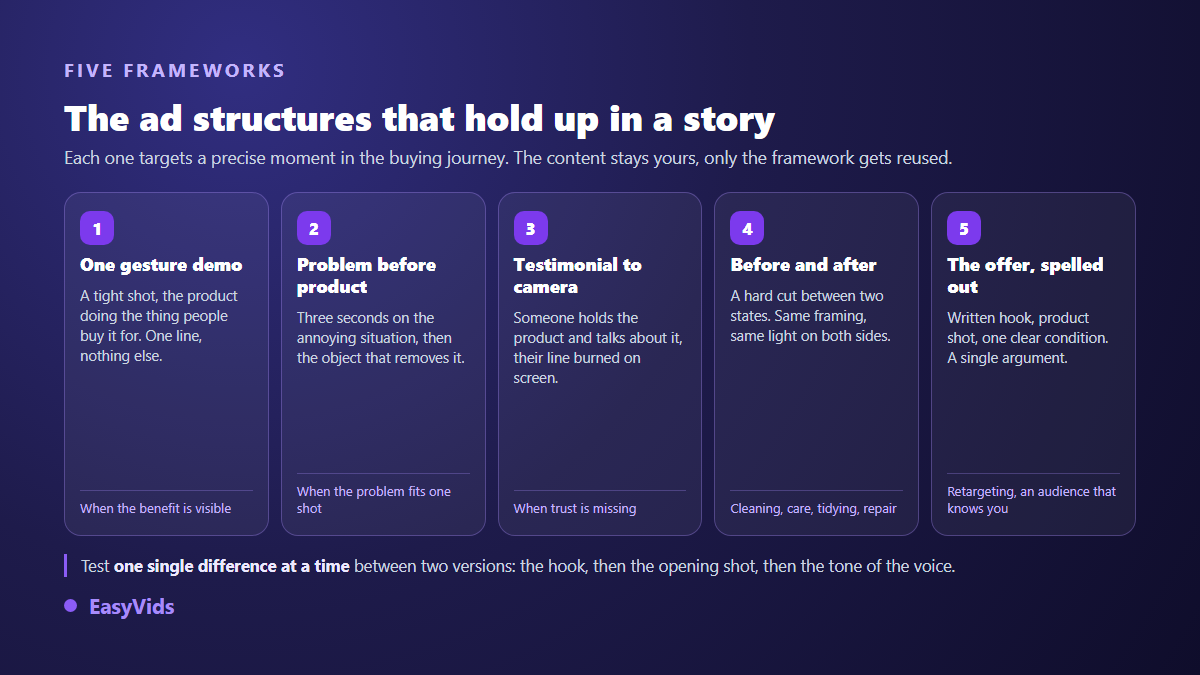
Ads that work in Stories boil down to a small number of shapes. Here are five, with what they show and where they belong in the buying journey. They are not shot for shot templates, they are frames: the content stays yours.
1. The one gesture demonstration
A single tight shot where the product does exactly what people buy it for. A cover slipping on, a powder dissolving, a lamp switching on. Nothing else on screen but one short sentence. It is the strongest structure when the benefit is visible, and the weakest when it is not: a service or a piece of software does not fit here.
2. Problem before product
Three seconds on the irritating situation, then the product that removes it. This shape assumes the problem is recognisable in one frame: tangled cables, a suitcase that will not close, a meal going cold. If it needs text to be explained, it will not survive in Stories.
3. The talking head testimonial
Someone talks about the product while holding it, framed at shoulder height, with their sentence burned on screen. This is the creator content register, the one that looks least like advertising, which is exactly why it survives a feed of personal stories. The full production method sits in our guide to creator style product videos.
4. Before and after
A hard cut between two states, no transition, no effect. Unbeatable for anything visible: cleaning, tidying, skincare, repair, decoration. The only rule is to keep the same framing and the same light on both sides, otherwise viewers suspect the edit rather than trust the product.
5. The offer stated plainly
A written hook, a product shot, one clear condition. This structure does not seduce, it filters: it speaks to an audience that already knows you and wants a reason to act now. Keep the text short and resist stacking three arguments, a Story only has room for one.
Producing a Story ad without a shoot
None of these five structures needs a set. A decent product photo is enough to start: it animates into a vertical shot of a few seconds with a light camera move and shifting light, which is what our method for animating a photo walks through. In the EasyVids studio, video generation accepts the 9:16 ratio from the start and up to four reference images, so you work from your real photos rather than an invented product that will not match yours.
The rest of the chain happens in the same place: writing, voice over, music, then editing in the browser to place the title, the captions and the final cut. Generated clip length depends on the model, from a few seconds to about half a minute, which covers a Story comfortably. For a longer ad, assemble several shots on the timeline instead of hunting for one clip that does everything.
Sound off is not a hypothesis
A large share of Stories is watched in silence, on a commute or in a queue. Your ad has to work without sound and gain something when the sound is on. Concretely, every voice over sentence also appears on screen, large, in the middle third. The readability settings that work vertically are the same ones we detailed in our note on captions for vertical video.
Three variants beat one perfect version
A single ad teaches you nothing. Three ads differing by one element each teach you something reusable. Change the hook, keep everything else. Then change the opening shot, keep everything else. You find the version that holds by producing several quickly, which is exactly what a generation chain allows: the second variant costs minutes, not another shoot. Our plans are on the pricing page.
- Variant A: the written hook changes, the edit stays identical.
- Variant B: the opening shot changes, nothing else moves.
- Variant C: the voice over register changes, calm against upbeat.
- One difference per variant, otherwise you will never know what moved the needle.
- Let each one run long enough to leave randomness behind before you call it.
Frequently asked questions
What is the exact size of an Instagram Story ad?
The ratio is 9:16 and the resolution recommended by Meta's ads guide is 1080 x 1920 pixels. A smaller video gets stretched and burned in text loses its edge. A larger video causes no quality issue, only a heavier file.
Can I use the same video for Stories and Reels?
Yes for the footage, since both placements are vertical. No for the composition: Reels shows a caption, an account name and buttons down the right side, Stories shows a call to action button at the bottom. Keep the same edit and move the text according to the placement.
Does a Story ad need a voice over?
It is not required and it almost always helps, provided it stays short. A voice naming the benefit in one sentence gives a rhythm that text alone does not. It never replaces captions: assume a good half of your audience will not hear it.
Are AI generated ads allowed on Instagram?
Yes. Meta's advertising rules cover what an ad shows and promises, not the tool that made it. Since its transparency policy took effect in 2024, Meta does require disclosure for political or social issue ads altered with AI, and it labels images it detects as generated. For an ordinary product ad the caution is the old one: never show a result the product does not deliver.
How long does it take to produce a Story ad?
Around half an hour for a first complete ad starting from a product photo: a few minutes of generation, with most of the time going into review and text placement. Follow up variants take far less, since only the tested element changes.
Instagram Story ads are not won with budget, they are won on three decisions taken before the first shot: native vertical, the bands left clear at the top and bottom, and a first second that shows the subject. The rest is iteration, and that part is the fun one. To build your first variants from a single product photo, create an account and run the chain end to end.