You have an edit ready and one hesitation before you post: cut it, or let it run? Instagram Reels length is really two questions wearing the same coat. There is the limit the app accepts, and there is the moment people swipe away. The two numbers have almost nothing in common, and the second one decides your reach.
This guide gives you both, then a method for setting a target duration before you write the first line of the script. A 15 second Reel and a two minute Reel are not built the same way, and mixing them up always costs you in the same place: the second your viewer moves on. If you also need dimensions, aspect ratios and file weight, our platform by platform video format sheet covers the technical side.
The short answer
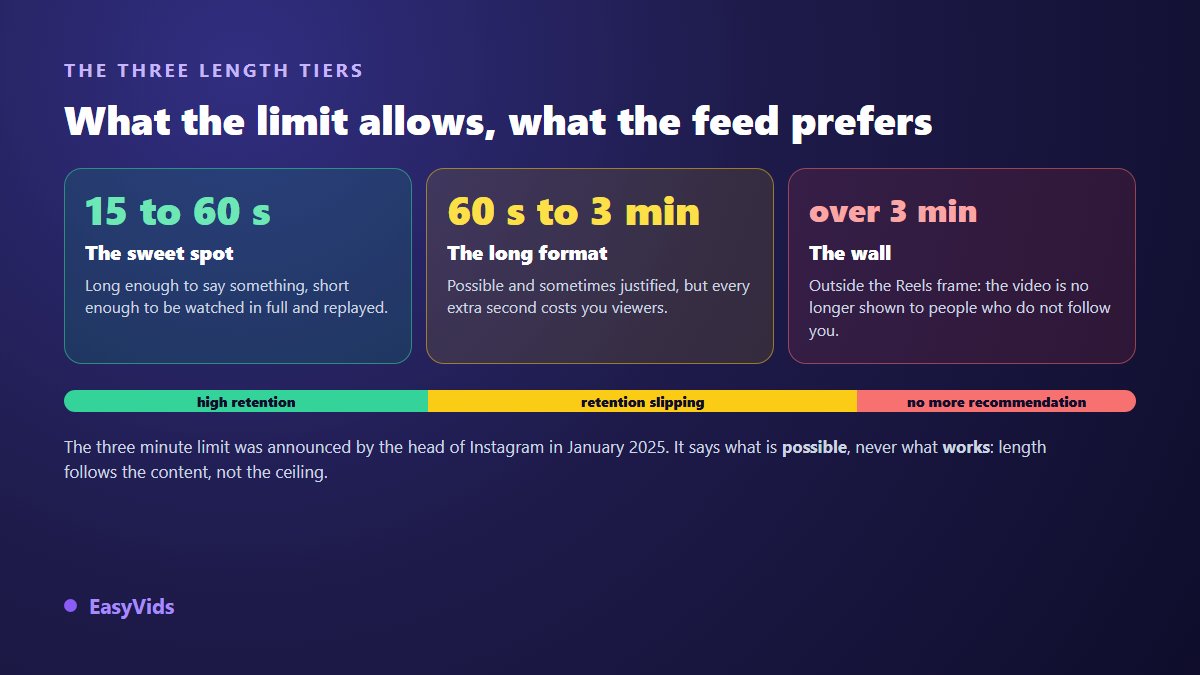
A Reel can run up to three minutes. That ceiling replaced the previous 90 second limit in January 2025, in an announcement from Adam Mosseri, the head of Instagram, who noted in the same message that Reels longer than three minutes are not eligible to be recommended. The duration that actually performs sits somewhere else: between 15 and 60 seconds for the vast majority of posts. Past that, every extra second has to earn its place.
The official limit, and how it got there
The number has moved a lot. When Reels launched in 2020, the cap was 15 seconds. It went to 30 and then 60 seconds in 2021, to 90 seconds in 2022, and to three minutes today. That progression says something useful: Instagram wants to keep creators who work in longer formats, without pushing everyone toward length.
Two details matter more than the ceiling itself. First, the limit applies to the published video, whether it was recorded in the app or imported from your camera roll. A file that runs over has to be trimmed, and trimming works better on a large screen than in a rush on a phone. Second, three minutes is not just a technical cut off. It is the recommendation boundary, the line that decides whether people who do not follow you ever see the video.
Three minutes is a ceiling, not a target
Confusing the limit with the target is the most common mistake. The limit describes what the platform accepts. The target depends on what your video says and how patient your audience is. In the ranking explainer Instagram published in 2023, watch time and the likelihood that a video is watched all the way through are listed among the signals that shape how a Reel is distributed. A short video that nearly everyone finishes sends a better signal than a long one abandoned in the first third.
The arithmetic is blunt. A 20 second Reel watched to the end shows one hundred per cent retention, and often more once replays are counted. The same subject stretched to 90 seconds and dropped at 25 seconds lands around 28 per cent. Same content, completely different signal.
The length that holds attention lives in your insights
There is no universal ideal duration, and nobody can hand you yours from a distance. Your audience gives it to you every week. A professional account shows views, total watch time and average watch time for each Reel. Since the metric harmonisation Instagram announced in 2024, views act as the shared reference across formats, which makes comparing your own videos far easier than it used to be.
The number you have to build yourself is the retention rate: divide average watch time by the length of the video. A 30 second Reel with 21 seconds of average watch time holds seventy per cent. Track that ratio across ten posts, sort it by duration band, and your target length appears without anyone needing to guess it for you.
- Average watch time against total length: the only figure that fairly compares two Reels of different durations.
- Replays: a short Reel with a clean loop plays again, and every replay inflates total watch time.
- Views against follower count: it tells you whether the video escaped your existing audience.
- Shares and saves, which often move reach more than a like on a useful video.
- The drop off across the first five seconds, when it is available: it separates a hook problem from a length problem.
Pick a duration from what the video says
Duration is not chosen in the abstract, it follows from intent. A visual punchline gains nothing from running a full minute. A testimonial suffocates below forty seconds. The reference points below are starting positions, to be corrected with your own numbers.
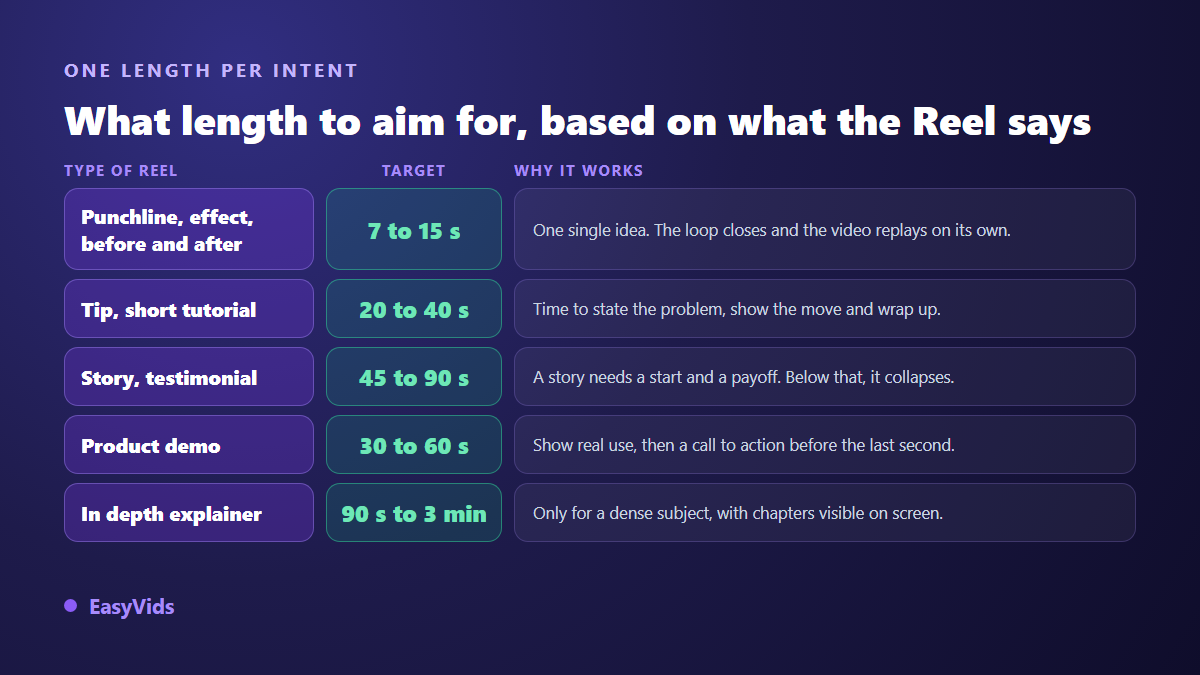
One principle runs through the whole grid: one idea per Reel. The moment you feel you need more time to say everything, you are holding two videos rather than one. Splitting into two posts almost always beats a stretched single video, and it hands you a second hook to test.
The first three seconds outweigh the two minutes that follow
Whatever length you choose, the viewer decides at the very start. A hook that states its promise on the first frame rescues a long video. A soft opening kills a 15 second one. If your curves collapse before the fifth second, length is not your problem, the opening is, and our hooks sorted by niche transfer directly to Reels.
Writing to length: the word count
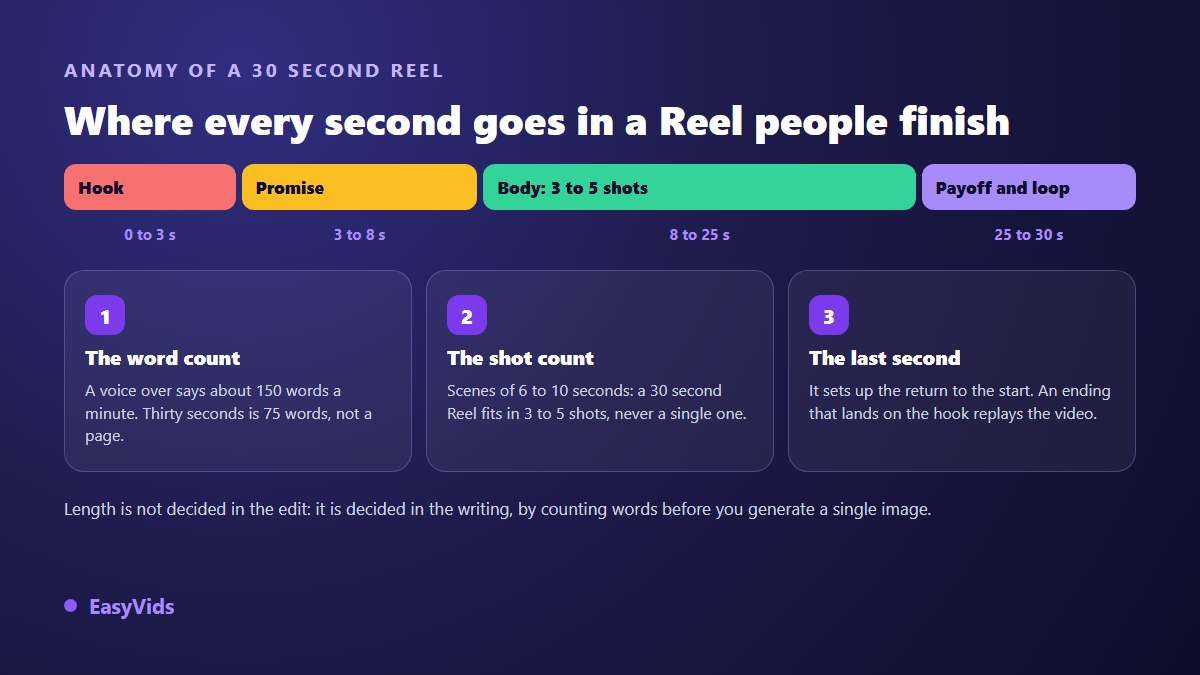
The duration of a narrated Reel is decided while writing, not while editing. A voice over reads roughly 150 words per minute, a natural pace that makes a reliable basis for calculation. The scale fits in four lines and saves you from discovering at the edit that you are twenty seconds of footage short.
- 15 seconds: about 37 words, one strong sentence and its punchline.
- 30 seconds: about 75 words, a hook, two points and a close.
- 60 seconds: about 150 words, the length of a complete short tutorial.
- 90 seconds: about 225 words, best kept for stories and detailed demos.
The second count is the number of shots. A static visual tires the eye quickly: past ten seconds or so on the same image, attention drifts. In the EasyVids director, automatic splitting offers scenes of six, eight or ten seconds, which works out to three or five shots for a 30 second Reel. That is not a style rule, it is what produces the rhythm.
Producing a Reel at the right length
One thing is worth knowing about video generators: the models output short clips, four to fifteen seconds depending on the engine. Nobody gets a 60 second Reel from a single prompt. A video at the right length is always an assembly of shots, which suits this format perfectly since that is exactly what its rhythm demands. The full method for getting past the isolated clip is in our guide to longer AI videos.
Vertical framing is chosen at the start, never at export. In the EasyVids studio, 9:16 is selected before generation and applies to the images and the video clips of every scene, which avoids the destructive crop that slices off heads and cuts text in half. The online editor then keeps the same vertical frame to trim a shot, adjust the breathing and export the final file at the exact duration you were aiming for.
Captions: what changes with length
The longer a Reel runs, the more captions decide its fate, because a large share of the audience watches with the sound off and readable text holds attention once the voice alone stops carrying it. The constraint shifts with duration. At 15 seconds, two or three words per screen are enough. At 90 seconds, you need a steady cadence and respected margins, otherwise the app interface sits on top of your sentences. Our caption settings for Reels cover the sizes and the safe areas.
Test two lengths instead of guessing
The best duration for your account is measured, not guessed. Take a subject that already worked, cut it two ways: a short version around twenty seconds, a longer one around forty five. Post them a week apart at the same time of day, and compare average watch time rather than likes. Three pairs are enough to show a clear trend.
Frequently asked questions
What is the maximum length of an Instagram Reel?
Three minutes. That ceiling was announced in January 2025 by Adam Mosseri, head of Instagram, replacing the previous 90 second limit. Rules like this change regularly, so check what the in app editor offers before building a long edit around the number.
What is the best length for a Reel?
Between 15 and 60 seconds in most cases, with a particularly comfortable zone around twenty to thirty seconds for useful content. The real answer sits in your insights: the duration band that keeps the highest average watch time across your last ten posts is yours.
Does Instagram penalise a Reel that runs too long?
It is not punished, but a Reel over three minutes is not eligible for recommendation, according to the January 2025 announcement. Below that limit no automatic penalty is documented: retention does the work, and it falls mechanically with length when the content does not justify it.
Can I change the length of a Reel after posting?
No. The app lets you edit the caption and the tags, not the video itself. Changing the edit means deleting the post and publishing again, which resets every counter. Settle the duration before you export.
Should TikTok and YouTube Shorts use the same length?
Limits differ from one platform to the next, so no. A well built vertical video travels, but the target duration is retuned each time and the hook is rewritten for the audience in front of it. Our method for producing Shorts in batches shows how to adapt one subject without starting over.
Reel duration is not a setting, it is a writing decision. Fix the target before the script, count your words, cut into shots of six to ten seconds, then let your insights correct the aim on the next posts. To produce your next vertical videos at the right length without opening an editing suite, create your account and launch a first calibrated Reel.