You framed it carefully, picked a colour that cuts through, wrote three words in huge type. The thumbnail still falls flat. Most of the time the problem is not the layout, it is the thumbnail facial expression: the face that was supposed to say something and says nothing. A neutral face takes up exactly the same space as an expressive one, and earns none of the clicks.
Viewers give you no examination time at all. They sweep across a grid of thumbnails and keep the one they understood without effort. An identifiable emotion is the fastest thing to understand, ahead of colour, ahead of text, ahead of the title. This article covers the seven emotions that work, the facial signature of each, and how to ask an image model for them. For everything else, sizes, text and composition, our complete guide to YouTube thumbnails takes over.
The short answer
Seven emotions read fast enough to survive in a thumbnail: surprise, shock, joy, fear, anger, disgust and seriousness. Six of them belong to the universal expressions described by the American psychologist Paul Ekman, recognised the same way across very different cultures. The seventh, seriousness, is not an emotion but a posture, and it works in niches where viewers come looking for authority. One rule matters above the rest: one emotion per thumbnail, its cause visible in the frame, and a final check at stamp size.
Why the face is read before colour and text
Paul Ekman and Wallace Friesen, working from the 1960s onward with populations that had almost nothing in common, established that a small set of facial expressions is recognised without any learning: joy, surprise, fear, anger, disgust and sadness. In 1978 they published the Facial Action Coding System, which breaks every expression down into observable muscle movements. That detail matters to you directly: an emotion is not a vague mood, it is a precise combination of brows, eyelids and mouth that you can describe, and therefore request.
The practical consequence is blunt. On a home feed or a results page, your thumbnail is judged alongside ten others, and the face is what the eye finds first. Anything that needs a second look arrives too late. We covered that decision mechanism in the psychology behind a good click through rate; here we go one level down, to the muscles.
The anatomy of an expression: brows, eyes, mouth
An expression lives in three zones, and they do not carry the same load. The brows set the intensity: raised, they open the face; lowered, they close it. The eyes carry the nature of the emotion, and they are what separates surprise from fear, since the mouth of both looks alike. The mouth only confirms what the other two have already said.
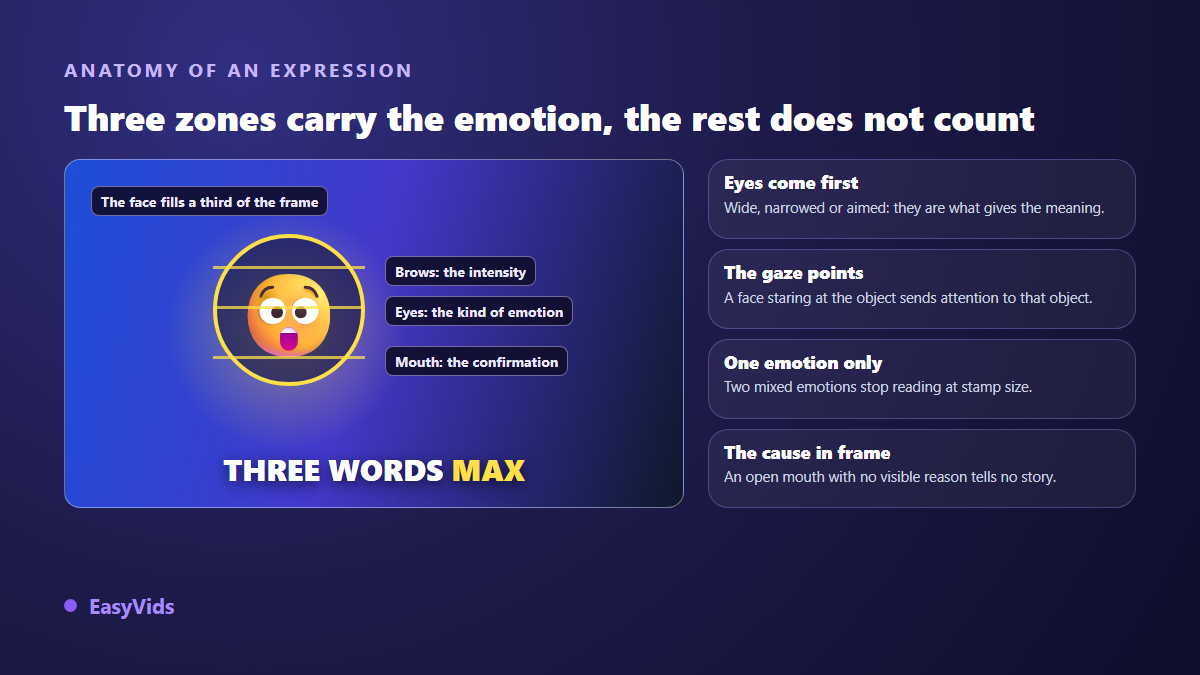
Hence a framing rule people skip: the face should fill around a third of the thumbnail, not less. Below that, the eyes collapse into two dark dots and the emotion disappears with them. Push the face to one side rather than centring it, and let the gaze point at the object the video is about. A face looking at something sends the viewer's attention to that something; a face looking at nothing directs nothing.
The seven emotions, one by one
Every emotion promises a different kind of video. Picking the wrong one is like advertising a horror film with a comedy poster: the click does not come, and when it does, it leaves after eight seconds.
1. Surprise, the safest choice
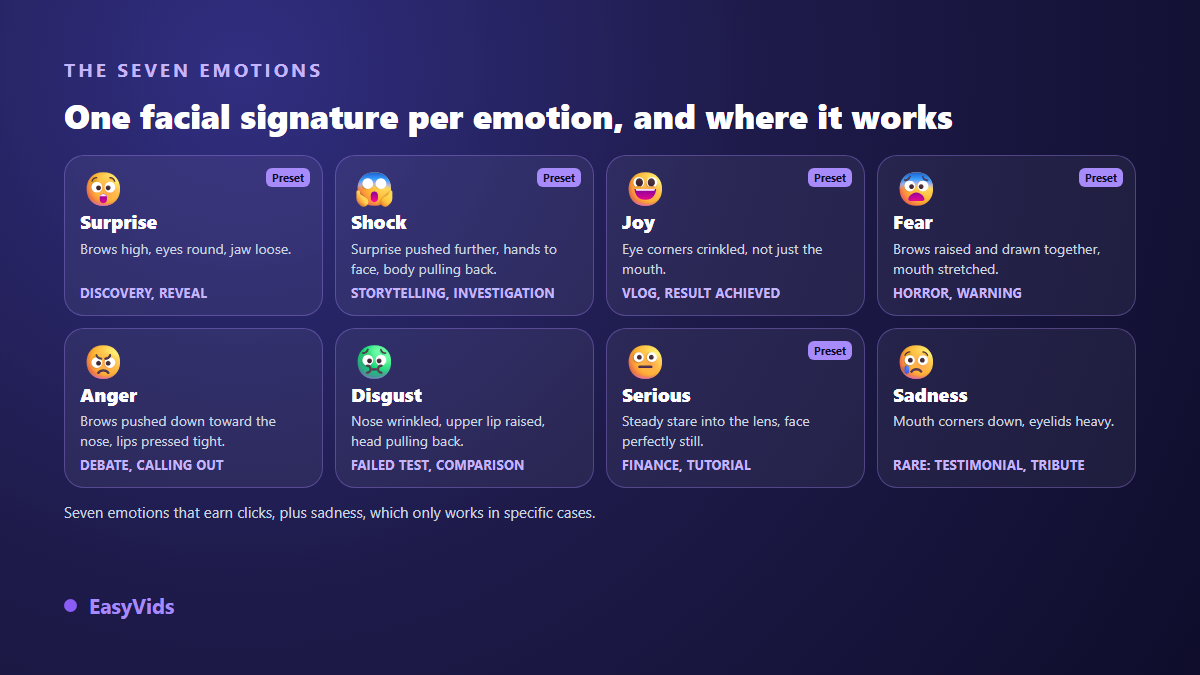
Signature: high arched brows, wide open eyes, slack jaw. Surprise is the most versatile emotion because it judges nothing. It simply announces that there is something to discover, which suits experiments, unexpected results and tests with an unknown outcome. It is also the default setting in our thumbnail tool, for a simple reason: it is the expression least likely to promise the wrong thing.
2. Shock, surprise pushed to its limit
Signature: surprise, plus the body. Hands to the face, head pulled back, shoulders up. Shock says that what was found goes beyond what was expected. It carries stories, investigations and reveals, and it is the dominant register of very large channels, as the MrBeast formula broken down shows. Its limit is sharp: used on every thumbnail, it stops meaning anything within a few videos.
3. Joy, but only if the eyes follow
Signature: raised mouth corners and crinkled eye corners. The neurologist Guillaume Duchenne de Boulogne showed in the nineteenth century that a genuine smile engages the muscle around the eye, the one you cannot fire on command; Paul Ekman later named that pattern the Duchenne smile. On a thumbnail, a smile that only moves the mouth reads as fake straight away. Joy suits vlogs, before and after, achievements and anything that ends well.
4. Fear, only where the niche promises it
Signature: brows raised then drawn together toward the centre, upper lids lifted, mouth stretched sideways. That is the detail separating it from surprise: in surprise the brows arch, in fear they arch and pinch. Fear carries horror, dark narration and genuine warnings. On a spreadsheet tutorial it does not attract clicks, it repels them.
5. Anger, when the video takes a side
Signature: brows pulled down and together, hard stare, lips pressed or mouth squared. Anger announces a stance, a disagreement, a call out. It performs well on reaction, debate and review content because it promises a clear position rather than a neutral summary. It also attracts an audience that comes for conflict, so use it deliberately.
6. Disgust, the verdict before the verdict
Signature: wrinkled nose, raised upper lip, head slightly back. Disgust is the least used and one of the most readable, because the nose wrinkle belongs to nothing else. It serves comparisons, failed tests and videos that take a product apart. Always pair it with the object being judged inside the frame, otherwise the expression floats and nobody knows what is being rejected.
7. Seriousness, the authority that reassures
Signature: steady gaze into the lens, still face, chin slightly tucked. This is not a universal emotion in Ekman's sense, it is a posture, and it earns its place because it is the only one that works when the promise is expertise. Finance, law, health, professional training: in those niches an exaggerated face destroys the credibility the video is trying to build. Seriousness is still not an empty face, and the tension in the gaze is what separates authority from boredom.
Matching the emotion to your niche
The useful shortcut is to start from the promise of the video, not from your own mood while making the thumbnail. Ask what the viewer will feel at the end. The expression has to announce that destination.
- Discovery, experiments, unexpected results: surprise.
- Stories, investigations, reveals, extreme challenges: shock.
- Vlogs, transformations, recipes, personal wins: joy.
- Horror, dark narration, real warnings: fear.
- Debate, reactions, criticism, call outs: anger.
- Comparisons, failed tests, disappointing products: disgust.
- Finance, training, health, technical subjects: seriousness.
That grid combines with the classic thumbnail layouts. If you want concrete staging already sorted by topic, our 51 thumbnail ideas by niche supply the setting and the object to pair with each emotion.
The expression has to keep the title's promise
A strong expression on a lukewarm video is the fastest way to lose an audience. The viewer clicks, works out within seconds that the promised emotion is nowhere in the video, and leaves. The signal sent to the platform is bad, and the next upload starts lower.
This is not only a performance question. YouTube's spam and deceptive practices policy, published in the platform's help centre, explicitly forbids thumbnails unrelated to the content of the video and provides for removal or a strike against the channel. A shocked face on an ordinary video fits that description exactly. Exaggerate the staging if you want, never the promise.
The expression mistakes that cancel everything else
The same flaws come back again and again on thumbnails that never take off. The diagram below isolates the four most common ones and their fixes, and the list adds two more. None of them requires new gear or a new graphic style.
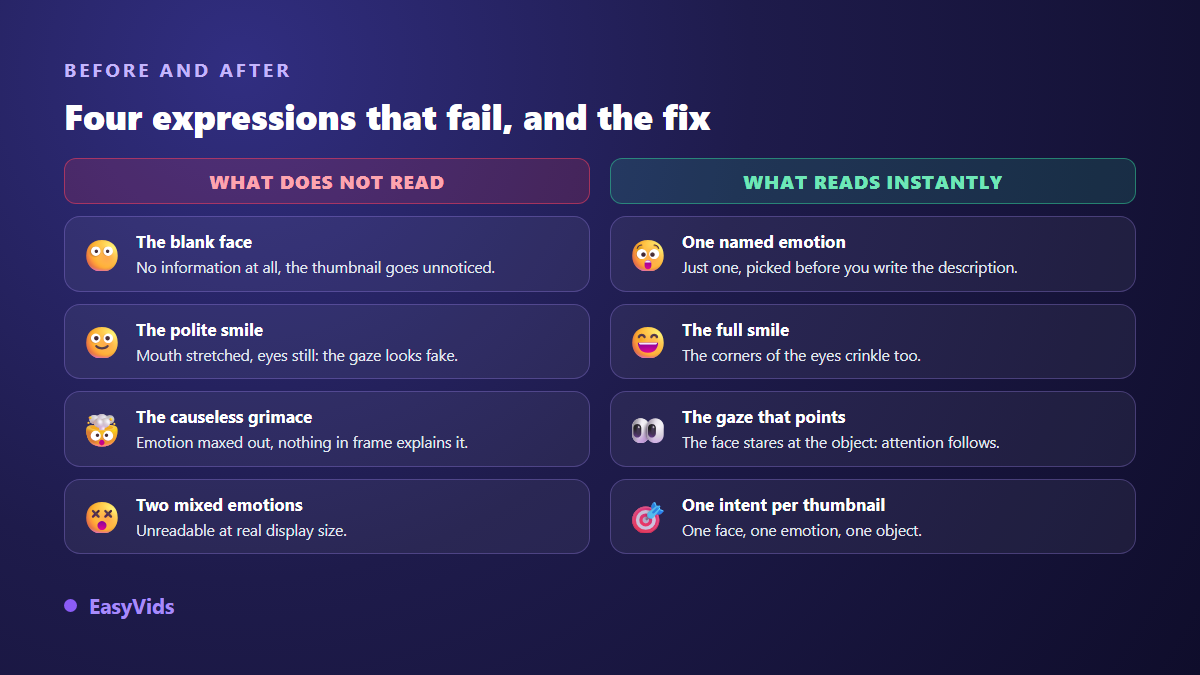
- The neutral face: it takes the space and announces nothing. Name an emotion before you generate.
- The fake smile: the mouth stretches, the eyes stay still, and viewers feel it.
- The causeless grimace: an emotion at maximum while nothing in the frame explains it.
- Two emotions mixed: unreadable at real display size, they only produce a confused face.
- A face that is too small: below a third of the frame, the eyes vanish and the emotion with them.
- The same expression channel wide: after five videos it stops meaning anything.
How to describe an expression to an image model
Image models handle abstract words badly. "Strong emotion" produces nothing stable, while a muscular description does: brows raised in an arch, eyes wide open, mouth slightly parted, gaze turned toward the object on the right. You describe what is visible, not what is felt. That habit of writing in observable terms comes straight from the way Ekman and Friesen coded expressions.
In the thumbnail tab of the EasyVids studio, part of that work is already done. You describe the subject in one sentence, pick a style among eight visual registers, and choose an emotion from a short list: Wow or Surprise, Shock, Joy, Fear, Serious. The tool turns that choice into a facial description before sending the request to the model. Anger and disgust, which are not in the list, are obtained by describing them in the subject field with the wording given above.
Two settings finish the job. The overlay text field places your three words directly in the image, and the format switches between 16:9 for a standard video and 9:16 for a short. Generate at least three versions before choosing: the expression is what varies most from one generation to the next, and the third one is often the keeper. How credits work and what each plan includes sit on the pricing page.
Carrying the emotion without showing your face
Plenty of channels have no face to put forward, and that is not a handicap. Three routes give a readable expression without filming yourself. A generated character reused from video to video eventually becomes the channel's signature. Hands in action carry credible emotion: a hand pulling back, hesitating, grabbing. An object shot very close and lit like a face pulls the eye the same way.
If you attach your own photo as a reference in the thumbnail tab, the tool keeps your features and applies the requested expression. The middle path is a recurring character, an approach covered in our guide to running a channel without showing your face. The rule stays the same either way: one emotion, one visible cause, one simple frame.
Test two expressions instead of trusting instinct
Your judgement on an expression is biased, because you already know what is in the video. Comparison is the only reliable measure. According to YouTube's help centre, YouTube Studio offers eligible channels a thumbnail test that serves up to three images on the same video and reports which one performed best. So prepare two genuinely different expressions, surprise and seriousness for instance, rather than two variants of the same face.
Before any test, run each version through the simplest check there is: shrink it to thumbnail size on a phone. If you can no longer name the emotion, no viewer will. Then confirm the file meets the platform's constraints, which our sheet on exact thumbnail dimensions lists line by line.
Frequently asked questions
Should the expression be exaggerated to get more clicks?
It should be readable, which is not the same thing. An exaggerated expression with no visible cause reads as a pose and pushes people away. A moderate but perfectly identifiable expression, with the object that justifies it inside the frame, performs better and ages far better across a whole channel.
Which emotion should a new channel start with?
Surprise. It carries no judgement, it fits almost any subject, and it is the least risky in terms of promise. After fifteen or so uploads your own analytics will tell you which emotion your audience responds to, and you can move away from it on purpose.
Can I put my own face on an AI generated thumbnail?
Yes. Attach a photo of yourself as a reference and the generator keeps your features while applying the requested expression. Our interface flags one provider limit we measured: when a reference image is attached, generation runs one image at a time. You simply relaunch a few times to compare expressions.
Does emotion matter as much on vertical formats?
Yes, and arguably more. On a short, the cover is seen in a narrow column and partly covered by interface text. Frame the face in the upper third, keep a single emotion, and generate directly in 9:16 rather than cropping a horizontal image.
Can a thumbnail without a face carry emotion?
Yes, through gesture and light. A hand hesitating above an object, a very tight shot on a detail, hard lighting that throws shadow: viewers project tension onto all of these. The face is the fastest shortcut, not the only route.
Facial expression is the one part of a thumbnail that is fully read before the viewer has decided anything. Choose the emotion before the colour, before the text, before the layout. One sentence of description, one named emotion, three versions generated and compared at stamp size are enough to change how a video performs. To build your covers with emotion presets and your own face as a reference, create your account and run your first batch.